Key differences
The main ChurnZero vs Totango difference is operating emphasis. ChurnZero increasingly presents one flow from customer signal to Play or Journey, communication, shared plan, and renewal forecast. Totango CSP is more explicitly composed around data modeling, health profiles, teams, SuccessBLOCs, SuccessPlays, objectives, campaigns, and Revenue Center.
Current product and packaging map
| Vendor | Product or package | Current role | What to confirm |
|---|---|---|---|
| ChurnZero | Professional and Enterprise | Core customer-success platform editions named in current public material | Base price, limits, Renewal Hub entitlement, services, and integrations |
| ChurnZero | Agentic Essentials | Separate annual Professional/Enterprise subscription with Marketplace, credits, Knowledge Sources, Customer Intelligence Profile, and MCP | Fee tier, credit allotment, overage, permitted agents, and controls |
| Totango | Totango CSP | Standalone enterprise Customer Success Platform with Enterprise and Premier on the current package page | Seats, account and email limits, teams, services, and add-ons |
| Totango | Catalyst | Standalone Customer Growth Platform, not a Totango CSP module | Migration path, shared data, connector behavior, and duplicated workflows |
| Totango | Unison | Standalone, platform-agnostic customer-intelligence engine with Standard AI models and Custom AI models | Scored accounts, integrations, model scope, history, alerts, and write-back |
ChurnZero does not publish a complete edition and price matrix. Composite ChurnScores require Enterprise. Engagement AI is an add-on, Agentic Essentials has its own annual fee and prepaid credits, and AI Email Play Steps are a separate add-on available across editions.
Totango’s current package page lists Enterprise and Premier and does not list Community, although legacy Community and Starter references remain elsewhere. Current user labels include Practitioner, Contributor, and Viewer; some APIs, imports, and feature labels still retain Spark or Zoe terminology.
Account data, product usage, and health
Customer health software is only as reliable as the customer model beneath it. Define the commercial account, product user, hierarchy level, contract, meaningful behavior, source of truth, and update cadence before comparing dashboards.
Account and hierarchy model
| Model question | ChurnZero | Totango CSP | Diligence test |
|---|---|---|---|
| Core entities | Account and Contact | Account and User or contact | Map the same real CRM records and product identities |
| Enterprise structure | Multi-level parent-child accounts | Custom Account Types across company, division, branch, or product levels | Load the deepest real hierarchy, not a flat demo account |
| Custom records | Custom tables for contracts, assets, tickets, invoices, and other records | Standard or custom collections; opportunity management is a premium capability | Prove keys, history, access, and reporting |
| User relationship | Contacts sit within account context | Users can associate with account structures and require stable binding IDs | Test shared contacts, movers, duplicates, and departed users |
| Roll-up behavior | Child usage stays at its source account; not every field or contact rolls up | Numeric usage and health can roll through configured hierarchies; other attributes need deliberate placement | Trace a child signal to every parent view |
| Ownership | Owners, roles, assignments, and segments | Assignment roles, teams, permissions, and employee hierarchy | Name a business and technical owner at every level |
Totango is more elastic for corporations, divisions, regions, and product accounts. Its documentation also warns that usage belongs at the ultimate child level and that hierarchy choices affect campaigns, users, health, contracts, and roll-ups. ChurnZero’s hierarchy is more constrained but may be easier to operate for a conventional SaaS account model.
Review ChurnZero’s parent-child account behavior and Totango’s account hierarchy guidance against the same source records.
How product-usage evidence enters each platform
| Evidence route | ChurnZero | Totango CSP | Interpretation |
|---|---|---|---|
| Direct capture | JavaScript events, URLs, attributes, and module time | JavaScript or HTTP Action-Module activity stream | Both need stable account and user identity |
| API | HTTP ingestion and REST extraction routes | HTTP and Data Hub APIs | Confirm rate limits, history, and write-back |
| CDP or behavioral tools | Documented routes include Segment, Pendo, and Mixpanel | Documented routes include Segment, Pendo, and Mixpanel | Map only governed events and identifiers |
| Warehouse and files | BigQuery, Snowflake, S3, and CSV routes | BigQuery, Snowflake, Databricks, SQL, and CSV routes | Define transformation and freshness owners |
| Aggregated usage | Attributes, imports, events, and custom data | Activity streams and explicit aggregate support | Keep numerator, denominator, and window visible |
| User-session link | Not confirmed No native Visit-level evidence chain found | Not confirmed No native Visit-level evidence chain found | Demonstrate the route from account signal to user evidence |
| Session replay | Not documented in sources reviewed August 15, 2026 | Not documented in sources reviewed August 15, 2026 | Do not infer absence beyond the dated public-doc review |
The reviewed documentation positions both products as CS platforms that operationalize selected usage signals, rather than as exploratory product-analytics systems. They can combine product usage with CRM, billing, support, relationship, and workflow context, but buyers should demonstrate segmentation, paths, feature analysis, raw-event access, and session evidence separately.
Health, risk, and opportunity
ChurnZero supports segment-specific ChurnScores with weighted factors and time windows, family scores for child-account context, and Enterprise composite scores. Totango supports account or multidimensional models, multiple profiles, profile precedence, weighted dimensions, and hierarchy calculations.
Neither score is objective truth. Source quality, lifecycle thresholds, weights, freshness, missing-data rules, hierarchy behavior, and review cadence determine whether a score helps. Use known accounts to test false positives and false negatives before allowing scores to trigger high-impact customer or revenue actions.
See how to build an explainable customer health score and how to investigate at-risk accounts with product usage.
Shared evidence, two lanes, one human checkpoint
Shared evidence
ChurnZero lane
Totango lane
Both end here
The two lanes name things differently and package programmes differently, but they consume the same evidence and stop at the same checkpoint. Compare the naming and the packaging, not the capability count.
Automation, renewals, and AI
The practical buying question is not whether a platform can create a task. It is whether a governed signal can trigger the right work, stop when conditions change, preserve an approval point, update the commercial view, and leave a readable evidence trail.
Workflow and customer collaboration
| Workflow | ChurnZero | Totango CSP |
|---|---|---|
| Lifecycle work | Journeys with phases, milestones, dependencies, tasks, and automation | SuccessBLOC programs with canvas, assets, SuccessPlays, campaigns, and reports |
| Automation | Triggered Plays with human and automated steps; eligible agents can run from Plays | Event-based or manual SuccessPlays create tasks, update data, request information, notify teams, or call webhooks |
| Daily workspace | Tasks, Command Center, account timelines, alerts, and ownership-based books | Tasks, My Portfolio, account timelines, segments, and team scope |
| Success plans | Shared goals, dates, collaborators, actions, comments, and customer alignment | Objectives, milestones, tasks, pacing, mutual plans, and customer-facing visibility |
| Customer space | Success Centers and shared plans | Customer portal for shared plans and tasks |
| Communication | Email, in-app messages, WalkThroughs, surveys, Success Centers, and reviewed AI Email steps | Campaign email, surveys, touchpoints, portal, and optional Sunshine Conversations integration; native In-App is sunset |
| Renewal workflow | Renewal and Forecast Hub for renewal, upsell, downsell, churn, probability, actuals, and reasons | Revenue Center for renewable accounts, renewal, upsell, downsell, churn, actuals, ARR, and NRR |
| Value evidence | Success Plans and Dynamic Slides can organize goals and progress | Objectives, milestones, success plans, and value-tracking views can organize outcomes |
ChurnZero offers the tighter documented connection among customer signal, Play or Journey, native digital engagement, shared plan, and renewal work. Totango fits teams that organize operations around BLOC scope, profiles, roles, reusable SuccessPlays, objectives, campaigns, and Revenue Center.
A completed playbook, improved health color, or sent campaign is not proof of customer value. Establish a baseline, agree on the customer’s outcome and time window, record the intervention, and distinguish correlation from a causal result.
AI scope and controls
| AI question | ChurnZero | Totango and Unison |
|---|---|---|
| Core assistance | Snapshot, Meeting, CS, and other assistants; automatic Snapshot refresh is Enterprise-only | Core account summaries and content generation; documented summaries use selected data rather than the full account record |
| Relationship intelligence | Engagement AI is an add-on analyzing supported communication inputs and is documented as English-only | Separate Unison analyzes engagement, sentiment, relationships, voice of customer, and key moments |
| Autonomous work | Agentic Essentials agents may recommend or execute; eligible agents can run inside Plays | Core CSP automation remains SuccessPlay-based; comparable autonomous CSP agents were not confirmed |
| Separate package | Agentic Essentials; AI Email Play Steps and Engagement AI have separate commercial boundaries | Unison Standard AI models or Custom AI models are sold separately from Totango CSP |
| Commercial meter | Agentic Essentials uses annual flat-fee tiers and prepaid credits | Quote-based; public packages expose model inclusions and customization but no credit meter |
| Context and controls | Knowledge Sources, Customer Intelligence Profile, live customer data, permissions, frequency, and account/contact scope | Totango permissions; Unison tiers, thresholds, weights, key moments, integrations, model inputs, and alerts |
| External assistants | ChurnZero Connect uses MCP for governed live data access from Claude and ChatGPT | No public MCP equivalent was confirmed in reviewed Totango documentation |
ChurnZero has the stronger documented case for AI as a workflow actor. Its separate Agentic Essentials subscription combines agents, credits, context layers, and MCP. AI Email Play Steps keep review enabled by default, although an administrator may disable that review; this control should not be generalized to every agent.
Totango separates core assistance from Unison’s predictive intelligence. Unison is platform-agnostic and can complement Totango CSP or another CSP, but its official documentation says it enhances health intelligence rather than replacing the team’s primary workspace.
Standardized renewal-risk scenario
Assume a fictional B2B SaaS company has 1,000 customer Companies across high-touch, pooled, and digital CS. One enterprise account renews in 120 days. Overall usage is falling, one department remains active, a critical feature depends on one champion, two admins stopped logging in, support sentiment worsened, the sponsor missed a meeting, and payment is healthy.
| Need | ChurnZero workflow | Totango workflow | Required validation |
|---|---|---|---|
| Consolidate context | Sync CRM, billing, support, meetings, communication, and events into account profiles and timeline | Load Account, User, collections, activity, CRM, support, billing, and meeting data | Identity, hierarchy, freshness, source ownership, and gaps |
| Assess health | Inspect component scores, weights, windows, family context, and score history | Inspect applicable profile, dimensions, precedence, missing-data rules, and hierarchy calculation | Known-account fit, false positives, and visible reasons |
| Find risk or opportunity | Review usage and contact trends, alerts, Signals, and contracted relationship or opportunity intelligence | Review usage, support, engagement, and optional Unison sentiment, key moments, and model output | Distinguish observed facts, configured logic, AI inference, and customer confirmation |
| Build recovery plan | Create a Success Plan and Journey for adoption, admin, sponsor, and support work | Create objectives and milestones inside an appropriate Risk or Renewal SuccessBLOC | Outcome, owner, due date, stop condition, and customer agreement |
| Assign actions | Use Play or Journey tasks for CSM, support, product, and executive owners; add eligible agent steps deliberately | Use SuccessPlay tasks, dynamic assignment, updates, notifications, and completion actions | Permissions, escalation, handoff, audit trail, and failure path |
| Personalize outreach | Use reviewed AI email, standard email, in-app message, or shared-plan update | Use campaign email, touchpoint, portal update, or optional Sunshine Conversations integration | Consent, channel, frequency, tone, review, and accessibility |
| Update forecast | Record Renewal Hub probability, upsell or downsell, actuals, and reasons | Record Revenue Center renewal, upsell, downsell, churn, actuals, and forecast | Commercial source, definition, edit rights, and CRM synchronization |
| Measure value | Compare agreed outcomes, usage distribution, support, stakeholders, and forecast before and after | Compare objectives, usage, health dimensions, engagement, and forecast before and after | Baseline, eligible denominator, behavior, window, customer evidence, and causal limits |
In Hymetry’s assessment, ChurnZero creates the shorter in-platform execution path. Totango provides the richer enterprise data and health framework, while Unison must be scoped and purchased deliberately for its specialized relationship and risk intelligence.
This table is a constructed evaluation workflow, not a vendor-prescribed implementation or proof of outcome. Use it as a scripted demonstration and score each platform on traceability, control, completeness, and the effort required to keep the process accurate.
Pricing, ratings, and implementation
Both products are quote-based. Compare complete written order forms and three-year operating cost, not a base subscription in isolation.
Commercial model
ChurnZero
Custom pricing
No complete public base-platform price or limit card was found. Composite ChurnScores require Enterprise; Agentic Essentials, Engagement AI, and AI Email Play Steps have separate boundaries.
Commercial model
Totango CSP
Custom pricing
Enterprise lists 10 Practitioner seats, 2,000 accounts, and five teams. Premier lists 20 Practitioners, three Viewers, 10,000 accounts, unlimited teams, and a development instance.
G2 snapshot
ChurnZero reviews
G2 snapshot
Totango reviews
G2 counts are volatile and the compared populations differ. Totango’s seller aggregate combines Totango and Catalyst, so this page uses the Totango product profile instead. Review themes are directional opinions, not controlled measurements; some reviews are incentivized.
Implementation and migration
| Workstream | ChurnZero focus | Totango focus | Proof before launch |
|---|---|---|---|
| Identity | Account and contact external IDs, CRM mapping, product events | Account, User, collection binding IDs, account types, product accounts | Duplicate, merge, mover, and missing-ID tests |
| Hierarchy | Parent-child levels, account ownership, family context | Hierarchy levels, working level, product level, layouts, calculations | Real enterprise family with revenue and usage roll-ups |
| Health | Segments, factors, weights, windows, composite and family logic | Lifecycle, dimensions, profiles, precedence, roll-up method | Historical validation and readable component reasons |
| Workflow | Segments, Plays, Journeys, plans, messages, agent scope, Hub | Teams, SuccessBLOCs, SuccessPlays, campaigns, objectives, Revenue Center | Trigger, stop, handoff, approval, exception, and audit tests |
| Data operations | CRM, support, billing, meetings, warehouse, API, usage freshness | Data Modeler, integrations, collections, activity, aggregates, warehouse jobs | Source inventory, reconciliation, alerts, export, and recovery |
| Ongoing ownership | Named CS Ops and data owners; monitor credits and agent behavior | Named platform and data owners; govern profiles, BLOCs, roles, and models | RACI, release process, change log, and quarterly review |
Migration is a data and operating-model project. Preserve external IDs, hierarchy, users, lifecycle, contracts, forecasts, activities, score inputs, tasks, consent, and source history. Rebuild scores and automations, then shadow-run old and new outputs before switching ownership.
Unison can coexist with Totango or another CSP, including ChurnZero, but connector scope, write-back, duplicated alerts, data rights, model boundaries, and price need explicit contract review. Running two full CSPs usually duplicates account records, health logic, workflows, forecasts, and responsibility.
Which should you choose?
Use these recommendations as a starting point, then demonstrate the real account model, health logic, workflow, permissions, commercial data, and owner.
| Scenario | Likely better starting point | Why |
|---|---|---|
| One layer for high-touch, pooled, and digital CS | ChurnZero | Profiles, Plays, Journeys, native digital engagement, shared plans, and renewal work form the tighter documented stack. |
| Corporations, divisions, regions, and product accounts | Totango CSP | Custom Account Types, deep hierarchy guidance, product accounts, layouts, and calculations are a stronger starting model. |
| Lifecycle-specific multidimensional health | Totango CSP | Profile precedence, weighted dimensions, multiple profiles, and hierarchy calculation provide more explicit modeling depth. |
| Agent execution and governed MCP access | ChurnZero with Agentic Essentials | Current documentation connects agents to Plays, context layers, credits, controls, Claude, and ChatGPT. |
| Specialized AI risk intelligence alongside a CSP | Totango Unison plus the chosen CSP | Unison is platform-agnostic and separately packaged for standard or historical custom risk models. |
| No reliable identity, contract data, or process owner | Neither yet | Fix the operating foundation before automating scores, outreach, or forecasts. |
| Need exploratory product analytics or Visit evidence | Neither alone | Use a product-intelligence layer and pass governed account signals into the selected CSP. |
Where Hymetry fits
Hymetry is not a Customer Success Platform. It is narrower account-centric product intelligence for B2B SaaS. It connects product behavior to the commercial Company, the Users inside it, grouped Pages and product areas, adoption breadth, user penetration, usage concentration, and inspectable Visits.
A team may supply approved account-level product evidence to either CSP through its chosen data infrastructure; no native Hymetry connector is claimed. Hymetry can also sit beside the CSP when a CSM needs to investigate what changed before acting on a risk or expansion signal.
| Hymetry can add | The CSP remains responsible for | Shared governance question |
|---|---|---|
| Company-level product adoption and trend | Customer 360, lifecycle, health orchestration, and portfolio work | Which account ID and time window are authoritative? |
| Users contributing to or dropping from an account signal | Stakeholder relationships, CSM ownership, communication, and tasks | Who is eligible, active, influential, or departed? |
| Grouped Pages, features, and product-area breadth | Success plans, playbooks, campaigns, renewals, and expansion management | Which behavior qualifies as meaningful adoption? |
| Visits and session evidence behind a selected signal | CRM, billing, support, sentiment, forecasts, and customer commitments | What evidence may be shared, retained, and acted upon? |
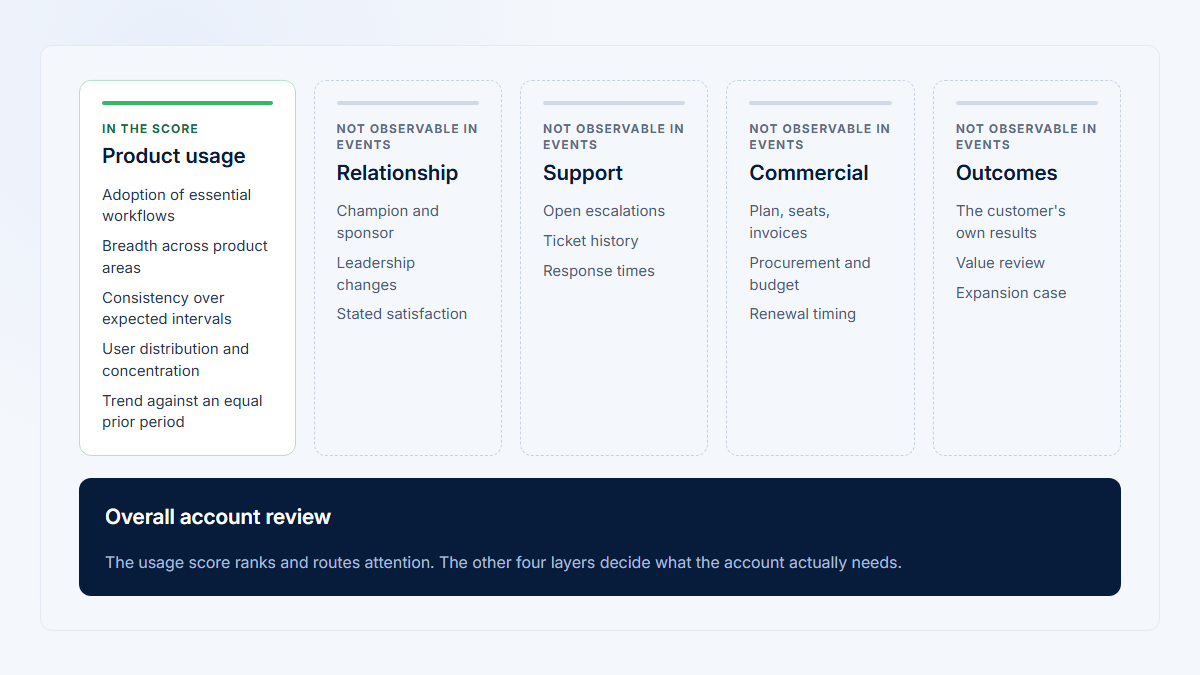
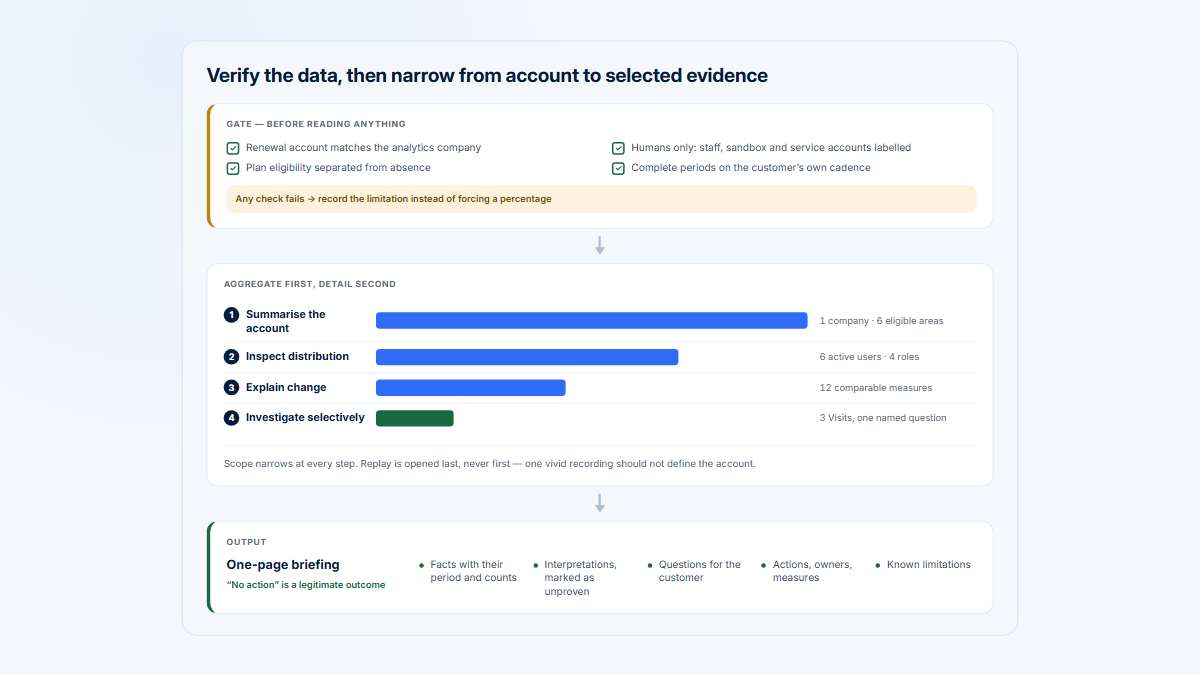
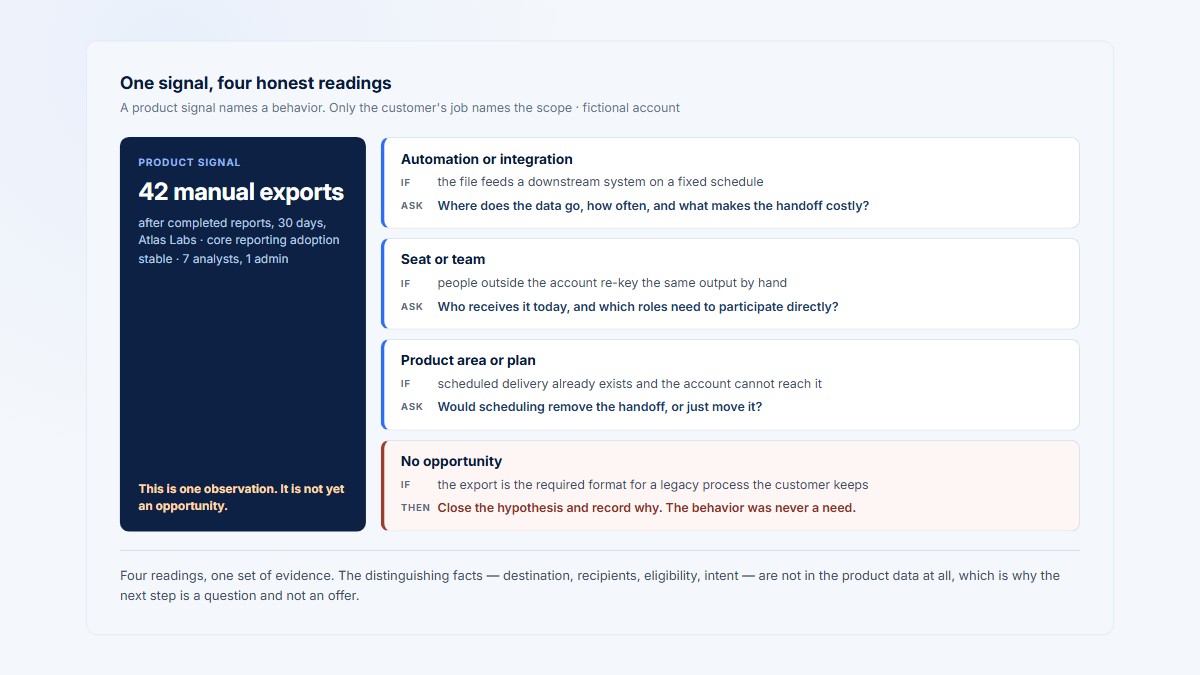
For example, a declining usage input can be decomposed into account breadth, participating Users, product areas, concentration around one champion, and the relevant Visits. That evidence supports investigation; it does not independently prove churn, value, or the correct customer action.
Explore Hymetry Companies, Users, Pages, and Visits, or see how to prepare product evidence before a renewal meeting.
FAQ
Is ChurnZero better than Totango?
ChurnZero is Hymetry's better default for integrated execution across communication, plans, renewals, and optional agent actions. Totango is better when custom Account Types, product accounts, multidimensional health, hierarchy roll-ups, and reusable SuccessBLOC programs matter more. Neither is universally better.
Which is better for enterprise Customer Success?
Totango is the stronger starting point for complex account types, product accounts, several hierarchy levels, and governed health profiles. ChurnZero can still fit a large enterprise when its customer model is conventional and the priority is a unified signal-to-action workflow.
Which has more flexible health scores?
Totango documents account and multidimensional models, multiple profiles, precedence, weighted dimensions, and hierarchy calculations. ChurnZero documents segment ChurnScores, family scores, and Enterprise composite scores. Maintainability, source quality, visible reasons, and historical validation matter more than configuration count.
Which has stronger automation and AI agents?
ChurnZero has the broader documented path across Plays, Journeys, communication, renewals, and optional agents. Totango is strong for SuccessPlay, task, data, webhook, and campaign automation inside SuccessBLOCs. Unison adds separate risk intelligence, not a comparable autonomous CSP execution layer.
What are Totango, Catalyst, and Unison?
They are three standalone products presented on Totango's current packages page: Totango is the enterprise Customer Success Platform, Catalyst is a Customer Growth Platform, and Unison is a platform-agnostic customer-intelligence engine with Standard AI models and Custom AI models.
Can either replace product analytics or session replay?
The reviewed documentation positions both as CS platforms that operationalize selected usage signals, not as exploratory product analytics. No native session-replay capability was found in public documentation reviewed August 15, 2026. Validate current roadmap and contract scope directly with each vendor.
How does ChurnZero pricing differ from Totango pricing?
Both are quote-based. Totango publishes more CSP limits for seats, accounts, teams, and its development instance. ChurnZero publishes less base-package detail and separates advanced AI into add-ons or Agentic Essentials with annual flat-fee tiers and prepaid credits. Compare complete order forms and internal operating cost.
Where does Hymetry fit?
Hymetry can add Company, User, Page, product-area, adoption-distribution, and Visit evidence behind an account signal. It does not replace CSP health orchestration, playbooks, CSM work, communication, success plans, renewals, forecasts, or AI agents.
Sources
Methodology, verification, and evidence limits
Product research was verified on August 15, 2026. Official product, help, package, release, API, integration, legal, and implementation sources were prioritized. G2 supplied the shared review-market snapshot captured August 14, 2026. No authenticated tenant, private demo, quote, customer interview, implementation, or controlled benchmark was used.
Claims are treated as documented functionality, vendor positioning, review themes, or Hymetry’s reasoned conclusion. “Not confirmed” marks a dated public-documentation gap. No undocumented price, minimum, implementation time, prediction accuracy, ROI, or customer outcome is inferred.
Publisher disclosure
Hymetry publishes this comparison and sells account-centric product intelligence for B2B SaaS. It may complement a CSP with product-usage and session evidence. Hymetry is not affiliated with ChurnZero or Totango, received no compensation from either vendor, and did not perform a sponsored product test.
Official ChurnZero product and workflow sources
- ChurnZero feature directory
- Customer Profiles
- Customer health scores
- Build ChurnScores
- Configure a Composite ChurnScore
- Parent-child account relationships
- JavaScript integration
- Digital customer success
- Success Plans
- Renewal and Forecast Hub
- ChurnZero integrations
These sources support the platform, profile, health, hierarchy, product-data, digital-engagement, plan, renewal, and integration descriptions.
Official ChurnZero AI and packaging sources
- Customer Success AI overview
- Agentic Essentials package and commercial model
- June 2026 agent-in-Play release notes
- AI Email Play Steps packaging and review control
- Engagement AI scope and add-on status
- Snapshot AI edition behavior
These sources establish separate AI commercial boundaries, agent execution, credits, context layers, MCP access, review controls, and documented edition or language limits.
Official Totango CSP product and workflow sources
- Totango current packages and product map
- Implement Totango
- Totango data objects
- Manage account hierarchy
- Products and Account Types
- Configure multidimensional health
- SuccessBLOC documentation
- Understand SuccessPlays
- Success plans and objectives
- Configure Revenue Center
- Totango In-App sunset notice
These sources support the CSP package, data-model, hierarchy, health, program, task, plan, revenue, and communication-boundary descriptions.
Official Totango AI, Unison, and license sources
- Totango core AI overview
- Totango account-summary scope
- Unison product overview
- About Unison
- Unison standard health scoring
- Unison key moments
- Totango user licenses
These sources establish the distinction between core Totango assistance and separately packaged, platform-agnostic Unison intelligence, including its public model labels and current license terminology.
Customer ratings and review themes
- ChurnZero seller rating on G2
- ChurnZero product reviews on G2
- ChurnZero review themes on G2
- Totango product rating and reviews on G2
- Totango review themes on G2
- Totango seller aggregate on G2
Ratings and approximate review volumes use the August 14, 2026 snapshot in the supplied research. Themes are directional, populations are not controlled, and totals change as reviews are added or moderated.
Hymetry product sources
The supplied canonical context and current product pages are the source of truth for Hymetry terminology, positioning, capabilities, and limitations.