Experience design and channel coverage
Appcues wins on channel breadth; Chameleon wins on web-surface specialization. Both use visual builders over a live application, reusable themes, targeting rules, and analytics. Both still depend on reliable installation, identity, events, selectors, quality assurance, and an owner who retires stale experiences.
Appcues documents a Chrome Builder for Flows, Pins, Banners, and click-to-track events, alongside Studio and the newer Appcues App. Chameleon combines its Chrome Extension with Dashboard configuration and a Sandbox. See the official Appcues Builder guide and Chameleon experience overview.
| Workflow | Appcues | Chameleon | Buyer implication |
|---|---|---|---|
| Tours and announcements | Modals, slideouts, tooltips, hotspots, Pins, Banners, Embeds, and multi-page Flows | Tours, modals, Tooltips, hotspots, Banners, Cards, and persistent Embeddables | Prototype the hardest responsive and multi-page case in both builders. |
| Checklists | Dedicated Checklists with event-, property-, and account-related completion options | Launchers configured as onboarding checklists | Compare completion logic, relaunch behavior, placement, and limits. |
| Resource center and help | Launchpads can hold links, support material, and relaunchable Flows | Launchers plus HelpBar search, navigation, resources, actions, and AI Answers | Chameleon has the clearer self-serve search advantage. |
| Surveys | NPS and Flow form components for ratings, choices, and open text on web and mobile | Contextual NPS, CSAT, open text, beta opt-ins, and multi-question Microsurveys | Test response branching, exports, caps, and mobile requirements. |
| Interactive demos | No first-party recording and editing workflow was verified | Record once and reuse on a site, help center, blog, inside a Tour, or in support | Chameleon is the stronger choice when demos are part of acquisition and education. |
| Styling and localization | Themes, defaults, custom CSS, XLIFF, and AI translation | Themes, templates, custom CSS, and AI-assisted localization | Review real brand constraints and the translation approval path. |
| Interface resilience | Debugger and selector-dependency checks | Debugger plus Ranger governance checks | Neither removes selector QA after interface changes. |
| Native mobile | Native iOS and Android plus React Native, Flutter, and Ionic SDKs | Responsive mobile web; native apps are not supported | Verify pattern parity, framework versions, deep links, and release ownership. |
Mobile and cross-channel boundary
Appcues can build native-mobile Flows, surveys, Embeds, and push experiences. Its Workflows coordinate email, push, and web Flows on one canvas with delays and branches. Chameleon can use OneSignal, Customer.io, Zapier, and other integrations for out-of-product messaging, but the lifecycle channel remains external.
Chameleon supports mobile web after an account-level control is enabled; its documentation says experiences are disabled below a 720-pixel browser width by default. Appcues has broader reach, but buyers should still verify that each required web pattern has the needed mobile equivalent. Compare the Appcues mobile overview with Chameleon compatibility guidance.
Targeting, feedback, and lifecycle orchestration
Both can target the right user only when the installation supplies the right identity and context. Role, plan, lifecycle stage, CRM fields, product events, and company attributes are useful inputs; missing or unstable user-to-company identity makes nominal rule depth irrelevant.
Appcues uses identify() for users and group() for account context. Chameleon combines User and Company records and properties. Company targeting answers who is eligible; it does not show whether adoption later spread through the company.
| Layer | Appcues | Chameleon | Implementation question |
|---|---|---|---|
| User and behavior | Properties, segments, events, experience history, and click-to-track events | Properties, tags, events, integration audiences, and experience history | Which properties are authoritative, and how quickly do they update? |
| Company context | Group identity and Group properties | Company records and Company properties combined with User rules | Can one user belong to multiple commercial accounts in your model? |
| Context and triggers | Domain, page, schedule, selector, page load, client event, or manual trigger | Environment, URL or regex, element, delay, schedule, recurrence, event, or custom code | Which rule is evaluated first, and what happens in an SPA? |
| Frequency and priority | Flow priority and a global limit that does not cover every experience type | Priorities, Tags, recurrence, and Rate Limits that do not cover every persistent pattern | Who owns collision prevention across all campaigns? |
| Feedback follow-up | Segments, survey answers, Goals, Workflows, and integrations | Experience-event filters can launch a Microsurvey after exit or abandonment | What decision will each response trigger? |
| External data | Integrations, APIs, webhooks, exports, and MCP | Integrations, JavaScript and REST APIs, webhooks, exports, and MCP | What is the delay between source data and targeting eligibility? |
Targeting readiness checklist
- Choose a stable user ID and customer-company ID before building segments.
- Define the eligible role, plan, lifecycle state, and exclusion rules.
- Send the behavioral event that should trigger the experience and the event that represents success.
- Test route changes, selector presence, delayed data, recurrence, and conflicting campaigns in a staging environment.
- Suppress users who already succeeded and document which system owns follow-up.
Appcues client-side events can trigger immediately, while synced server or CRM data may arrive later. Chameleon documents real-time event triggering but notes that segmentation availability can lag. Treat timing as a testable implementation property, not a label in a feature matrix.
Experiments and proof of adoption
Appcues publishes the clearer built-in holdout methodology. Its Flow control experiment randomizes newly eligible users, asks for baseline conversion and minimum detectable effect, calculates a minimum sample size and duration, and reports Goal lift at 95% confidence. Goal conversion must occur within seven days of assignment.
Appcues variation testing is different: teams clone experiences, use randomized audience segments, compare results manually, and may use an external significance calculator. Chameleon supports A/B and control groups through a persistent per-user Testing ID; its public guide describes assignment and Goal reporting but gives less detail about the significance method.
| Claim | Measured entity | Denominator | Qualifying evidence | Time window |
|---|---|---|---|---|
| 1. Exposure | User | Users eligible for the experience | Seen or viewed event | Campaign delivery window |
| 2. Interaction | User | Users exposed to the experience | Start, completion, exit, dismiss, snooze, or step event | Experience session or campaign window |
| 3. Near-term conversion | User or experiment assignment | Exposed users or assigned cohort | Configured Goal, page, click, event, or property change | Declared conversion window; seven days for Appcues control experiments |
| 4. Sustained use | User | Eligible users | Meaningful product behavior repeated at a defined cadence | Explicit follow-up period appropriate to the workflow |
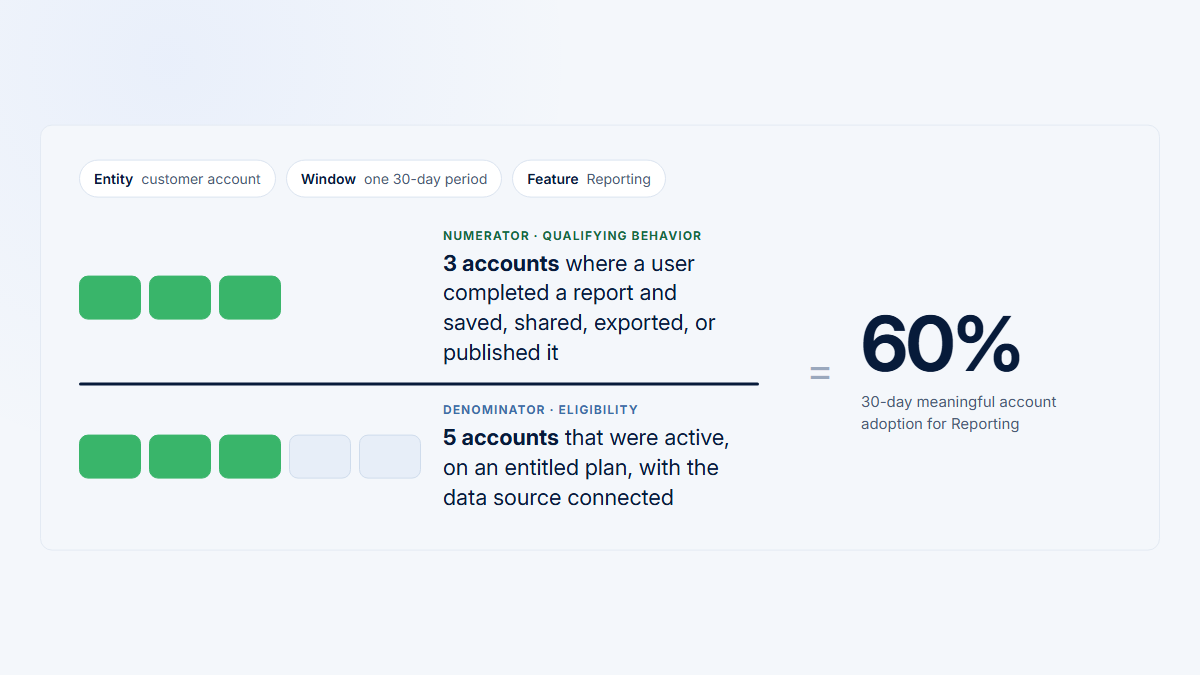
| 5. Company spread | Customer company | Eligible users inside that company | Penetration, breadth, repeat use, and usage concentration | Explicit account-analysis period |
Where in-app tools stop, and adoption evidence begins
1
Exposure
2
Interaction
3
Configured goal
4
Repeated behaviour
5
Company-wide spread
Appcues and Chameleon
Needs longitudinal analysis
Hymetry contributes
Hymetry does not
A completed guide and a first Goal are near-term engagement evidence. Proving adoption requires repeated use and distribution across the eligible users in the customer company — a different measurement, over a longer window.
Chameleon's Engagement Index is a normalized 0–100 ratio of positive and negative interactions with experiences. It can flag poor timing, placement, or content, but it is not proof that users adopted the underlying feature. A completed tour plus a first target action establishes interaction and near-term conversion, not sustained use or company spread.
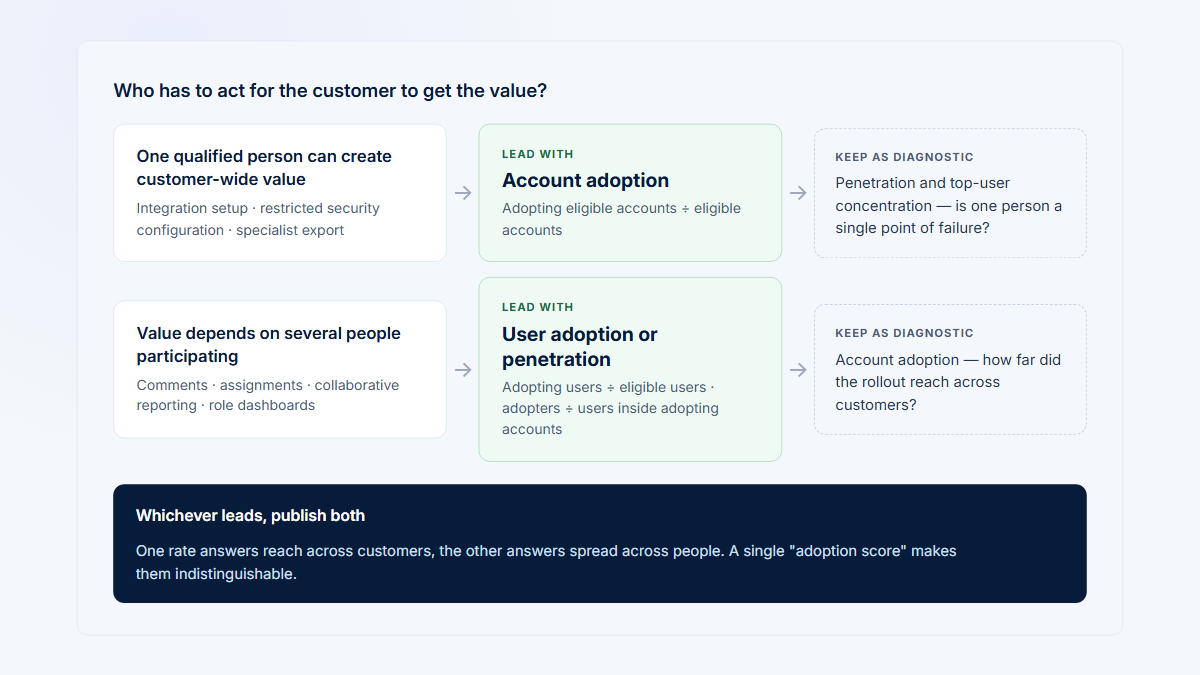
Use feature-adoption rate to define qualifying use, account versus user adoption to choose the commercial denominator, and product usage by company to examine distribution inside each customer.
Worked example: launch Reporting to 300 customer companies
Illustrative scenario: a B2B SaaS team introduces a complex Reporting area to 300 eligible customer companies. The number is an example denominator, not a benchmark or customer claim.
| Step | Appcues | Chameleon | Additional evidence |
|---|---|---|---|
| Define eligibility | Plan, role, lifecycle, event history, and Group properties | Plan, role, lifecycle, events, Company properties, and CRM/CDP fields | A company and user denominator frozen for the analysis window |
| Build guidance | Banner or Flow, walkthrough, Checklist, Launchpad, and feedback Flow | Embeddable or Banner, Tour, Launcher checklist, HelpBar content, and Microsurvey | A documented intervention owner and collision rules |
| Instrument success | Explicit or click-to-track events for setup started, Report created, and Report viewed | No-code page or click events, or custom events, attached as Goals | Meaningful event definitions that survive interface changes |
| Test impact | Variation test or built-in exposed-versus-control Flow experiment | A/B or control test on a supported pattern | Predeclared outcome, sample, window, and interference checks |
| Measure immediate result | Eligible, viewed, completed or dismissed, and first successful Report event | Seen, started, completed or exited, Goal conversion, and Engagement Index | Separate delivery, interaction, and first conversion |
| Measure adoption | Analyze repeated Reporting events after the campaign | Export or connect product and experience events for repeat-use analysis | Company penetration, breadth, concentration, and relevant Visit evidence |
AI, implementation, and governance
Both vendors use AI for authoring, analysis, and operational assistance, but neither publishes independent evidence that its AI consistently chooses the best audience, timing, intervention, or copy. Treat generated work as a draft, inspect its conditions, and preserve human publishing approval.
Appcues AI can draft an experience in the beta Appcues App and requires confirmation before publishing. Captain AI assists with analytics, troubleshooting, targeting, management, and mobile Flow creation. Chameleon Copilot builds and analyzes experiences; Ranger supports governance. Compass and Prism have preview, limited, or inconsistent availability across official pages, so verify the contracted state.
| Layer | Appcues | Chameleon | Evaluation rule |
|---|---|---|---|
| Authoring | Appcues AI drafts experiences; Captain can build mobile Flows | Copilot develops strategy, copy, targeting, configuration, and variants | Require preview, audience review, and explicit publishing approval. |
| Analysis and access | Captain analyzes account data; MCP exposes Appcues data to compatible clients | Copilot analyzes experiences; MCP exposes experience, User, Company, and survey data | Inspect the records and definitions behind an answer. |
| Specialized AI | Selector checks, recommendations, and AI localization | Ranger, HelpBar AI Answers, and AI+ Demo narration; Compass and Prism need verification | Separate generally available, beta, limited, and coming-soon capabilities. |
| Publishing controls | Admin, Publisher, and Editor roles; explicit AI-authoring confirmation | Review-before-publish, plan-based roles, and Ranger suggestions or selected Autopilot work | Test least privilege, approval, auditability, and rollback. |
| Delivery governance | Flow priorities and a global throttle covering Flows and legacy NPS, not every pattern | Tags, priorities, recurrence, and Rate Limits focused on selected experience types | Map every persistent, manual, and triggered pattern before assuming global protection. |
| Deployment footprint | Web identity/events plus optional mobile SDKs, push credentials, and authenticated email domain | Web snippet, identity/events, Company data, environments, and selector QA | Estimate ongoing maintenance, not only initial installation. |
What “no code” does not remove
- stable user and company identity, consent, and environment separation;
- meaningful events, Goals, properties, and eligible denominators;
- selector, route, accessibility, localization, and responsive testing;
- frequency, priority, review, publishing, and retirement ownership;
- integration monitoring, exports, data residency, and procurement review; and
- analysis that separates association, experiment lift, sustained behavior, and account spread.
Appcues documents US and EU hosting environments. Chameleon links to a Trust Center and exposes security, SAML, role, and procurement features by plan or add-on. Both provide APIs, webhooks, integrations, exports, and MCP access, but the exact commercial package should control the buying decision.
Pricing and customer ratings
Chameleon exposes the clearer public price signal; Appcues exposes plan limits but requires a quote. Compare the contracted billing definition, installations or environments, published/live experiences, seats, localization, events, surveys, AI use, services, overages, and renewal assumptions.
Appcues pricing
Appcues
Custom quote
- Start
- Up to 3,000 MAU; 10 published experiences; 12 months reporting history
- Grow
- Starts at 3,000 MAU; 25 published experiences; 24 months history
- Enterprise
- Custom MAU; 100 published experiences; 36 months history; priority support
- Packaging
- Current page says every experience type, feature, and integration is included; quote and order form remain definitive
Chameleon pricing
Chameleon
From $279/month
- Startup
- From $279/month; 2,000 MTU; 10 live experiences
- Pro
- From $750/month for 5,000 MTU; 20 live experiences
- Growth
- From $1,250/month for 5,000 MTU, billed annually; unlimited live experiences, Ranger, HelpBar, and Full AI+ Demos
- Enterprise
- Custom; broader roles, localization, Rate Limits, environments, and account switching
Detailed plan limits and packaging conflicts
Appcues prices by monthly active users, installations, and published experiences. Its pricing FAQ defines MAU by users who sign in during a month; subscription documentation uses a rolling 30-day active-user definition and includes anonymous identification. Live and scheduled experiences count as published. Confirm the contract's operational definition.
Chameleon defines MTU as uniquely identified profiles sent during the prior 30 days. Its current table lists Pro at 10 seats, 5 languages, 20 custom events, 2 Rate Limits, and 4 environments; Growth lists 15 seats, 10 languages, the same events and environment limits, and annual billing. Enterprise terms remain custom.
The Chameleon pricing table and current Pro-plan page include A/B testing on Pro, while an older experiment guide says Growth and Enterprise. Pricing lists Basic Demos on Pro, while other current documentation omits or limits that availability. HelpBar is best supported as Growth/Enterprise. Put each disputed item in the order form.
Published add-on signals include five extra Chameleon seats at $300/month on Pro or $3,000/year on Growth, SAML at $400/month on Pro or $4,000/year on Growth and Enterprise, and an additional Enterprise Account at $5,000/year. Prices can change; verify before purchase.
Appcues
358 reviews. Common praise concerns fast Flow creation, support, iteration, and visual flexibility; recurring criticism mentions cost growth, builder or navigation limits, integrations, and reporting gaps.
Chameleon
362 Chameleon reviews. Common praise concerns customization, launch speed, support, and web patterns; recurring criticism mentions analytics depth, tag or data management, and edge-case styling or setup effort.
Review caution: the Chameleon seller page also contains one separate Driveway review, so the seller total is one higher than the Chameleon product count. Ratings change continuously, themes are qualitative, and several visible recent reviews were seller-invited or incentivized. They are not controlled product tests.
Which should you choose?
The strongest fit follows the deployment surface and operating model, not the longest feature list.
| Scenario | Better starting point | Why | Watch-out |
|---|---|---|---|
| Web, native mobile, email, and push | Appcues | Broader documented delivery surface and cross-channel Workflows | Native-mobile experiences are separate from the documented web Flow node. |
| Browser SaaS with deep self-serve help | Chameleon | Launchers, HelpBar, AI Answers, and web-focused targeting | HelpBar packaging has conflicting official documentation. |
| Interactive product demos | Chameleon | Native recording, editing, embedding, and reuse | Confirm Basic versus Full AI+ Demo entitlements. |
| Formal Flow holdout experiment | Appcues | Published MDE, sample-size, duration, seven-day window, and 95% confidence workflow | Do not confuse the built-in control experiment with manual variation testing. |
| Web campaign governance and rate controls | Usually Chameleon | Ranger, Tags, priorities, recurrence, and Rate Limits | Controls do not cover every persistent or manually launched pattern. |
| Public entry price is required | Chameleon | Startup, Pro, and Growth provide visible starting prices | Total contract cost still changes with MTU, add-ons, and services. |
| Proof of repeat and company-wide adoption | Neither alone | Both establish engagement and configured-goal evidence | Add longitudinal product events, eligible users, and account distribution analysis. |
Migration or coexistence
A migration should preserve user and company IDs, event names, eligibility rules, translations, experiment assignment, and baseline metrics before rebuilding experiences. Use narrow segments or holdouts so equivalent tours do not run at the same time.
Coexistence can be deliberate: Chameleon may own web HelpBar and Demos while Appcues owns native mobile or lifecycle Workflows. It also increases SDK, collision, and attribution risk. Give one system responsibility for frequency governance and document the measurement source for every campaign.
- Choose Appcues when native mobile and coordinated web Flow, email, and push journeys outweigh web-only specialization.
- Choose Chameleon when a browser SaaS product needs flexible guidance, HelpBar, Interactive Demos, and deeper campaign governance.
- Evaluate both in your product when selectors, SPA behavior, localization, permissions, data latency, and visual fidelity could change the answer.
- Add product and account analytics when the business claim is sustained use or adoption across the customer company.
Where Hymetry fits
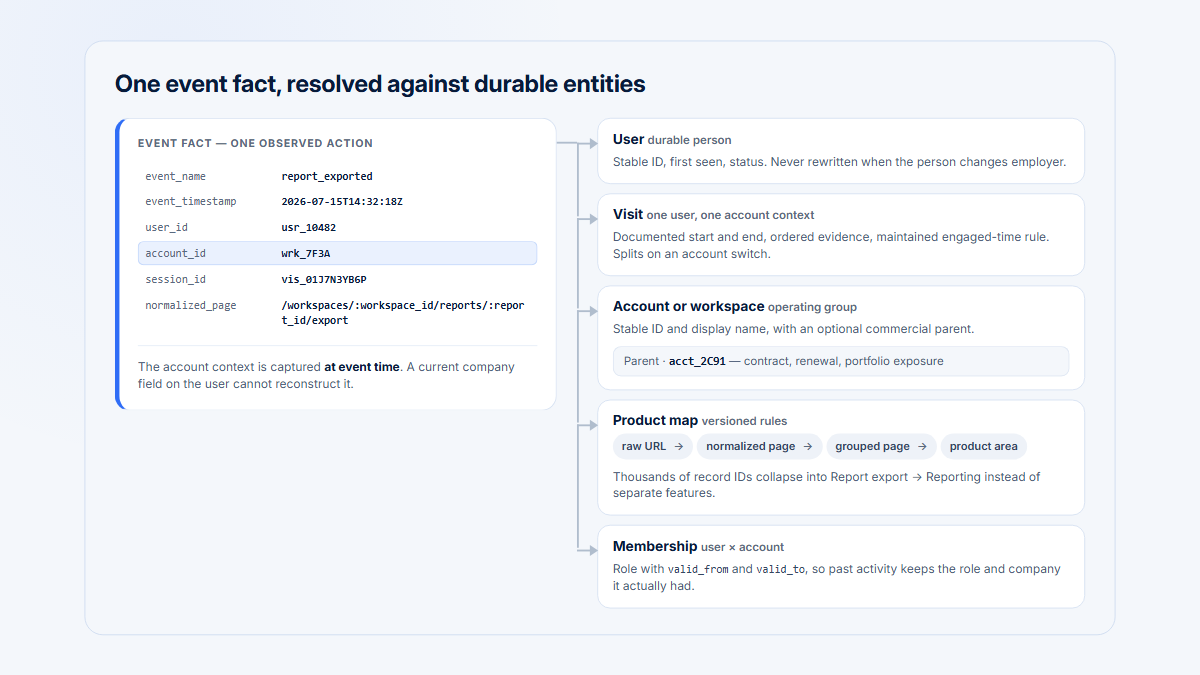
Hymetry is account-centric product intelligence, not an in-app engagement platform. It connects product areas, Pages, customer Companies, Users, account adoption, adoption breadth, user penetration, usage concentration, and Visits with inspectable session evidence.
That evidence can identify which companies have not discovered Reporting, whether usage depends on one champion, whether adoption broadened after a campaign, and which Visits explain abandonment. It does not establish that Appcues or Chameleon caused a change without an appropriate experiment.
| Layer | Primary job | Evidence produced |
|---|---|---|
| Appcues or Chameleon | Create, target, deliver, and test in-product guidance | Eligibility, exposure, interaction, configured Goals, feedback, and experiment output |
| Product and account analytics | Measure meaningful behavior over time and across the commercial customer | Repeat use, breadth, penetration, concentration, retention, and company change |
| Hymetry | Connect company adoption and user distribution to relevant Visit evidence | Account signals, affected users, product areas, and inspectable sessions for investigation |
Hymetry does not currently replace tours, tooltips, banners, checklists, HelpBar, surveys, lifecycle email or push, Interactive Demos, in-app experimentation, localization, visual builders, or AI-generated interventions. It is newer, has a smaller ecosystem, fewer integrations, narrower analytics, and no mature independent review score.
A combined workflow is often the honest architecture: the engagement platform delivers the intervention; product and account evidence shows whether meaningful behavior repeated and spread. Explore the Hymetry demo project or inspect the open-source implementation.
Frequently asked questions
Is Appcues better than Chameleon?
Appcues is generally better for cross-channel and native-mobile engagement. Chameleon is generally better for web-first guidance, HelpBar, Interactive Demos, and campaign governance. Neither is universally better; the correct choice depends on delivery surface, operating model, and required proof.
Which is easier for product onboarding?
Both can handle a conventional web onboarding tour. Appcues becomes more attractive when onboarding includes native mobile, email, and push. Chameleon becomes more attractive when onboarding depends on flexible web patterns, self-serve help, demos, and visual customization.
Which has better checklists and resource centers?
Appcues has a dedicated Checklist object plus Launchpads. Chameleon configures checklist and resource-center patterns through Launchers, then adds HelpBar search, navigation, actions, targeted resources, and AI Answers. The stronger option depends on whether checklist logic or searchable self-service is primary.
Which supports mobile apps better?
Appcues. It supports native iOS and Android plus React Native, Flutter, and Ionic. Chameleon supports responsive mobile web and selected hybrid web contexts, but its official compatibility documentation says it does not support native-mobile applications.
Which has better A/B testing?
Appcues publishes the clearer built-in methodology for Flow holdouts, minimum detectable effect, sample size, duration, a seven-day Goal window, and 95% confidence. Chameleon provides A/B and control testing with persistent Testing IDs, but its public statistical documentation is less detailed.
Can either measure real product adoption?
They measure exposure, interaction, and configured Goals well. A stronger adoption claim needs a defined meaningful behavior, repetition threshold, eligible denominator, and time window. B2B adoption also needs company penetration, breadth, and concentration so one active champion does not hide weak distribution.
Can either target customer companies?
Yes. Appcues uses Group identity and properties; Chameleon uses Company records and properties. Both require a reliable link between the user and commercial customer. Targeting an account does not automatically measure whether use spread across its eligible users.
Where does Hymetry fit?
Hymetry supplies account-centric adoption and Visit evidence while Appcues or Chameleon supplies the in-product intervention. The combination is relevant when a team must move from a campaign result to repeated behavior, distribution across a company, and the sessions behind friction.
Sources
Methodology, disclosure, and source directory
Methodology
Official product pages, documentation, pricing, release information, developer references, and security materials were prioritized for product claims. G2 supplied a common ratings snapshot. Current pricing tables received more weight than older packaging guides, but conflicts are disclosed rather than silently resolved.
Research was verified on August 14, 2026. No authenticated hands-on test, paid vendor briefing, or benchmark was performed. Conclusions such as “better orchestration layer” and “richer web-only intervention layer” are Hymetry's reasoned interpretation of documented scope, not vendor claims.
Appcues official sources
- Pricing and plan limits
- Subscription and usage definitions
- Product and experience overview
- Supported technologies and frameworks
- Mobile experiences overview
- Workflows overview
- Group properties
- Launchpads
- Flow variation testing
- Control experiments
- AI experience authoring
- Captain AI guidance
- US and EU hosting environments
Chameleon official sources
- Pricing and current plan table
- Current Pro plan guidance
- Experience types
- Product and mobile compatibility
- Experience targeting
- Company properties
- A/B and control testing
- Experience analytics and Engagement Index
- HelpBar configuration and AI Answers
- Interactive Demos
- Interactive Demo availability guidance
- Customer.io lifecycle messaging integration
- OneSignal mobile messaging integration
- Ranger governance agent
- AI agents and availability claims
- Chameleon Trust Center