Quick comparison
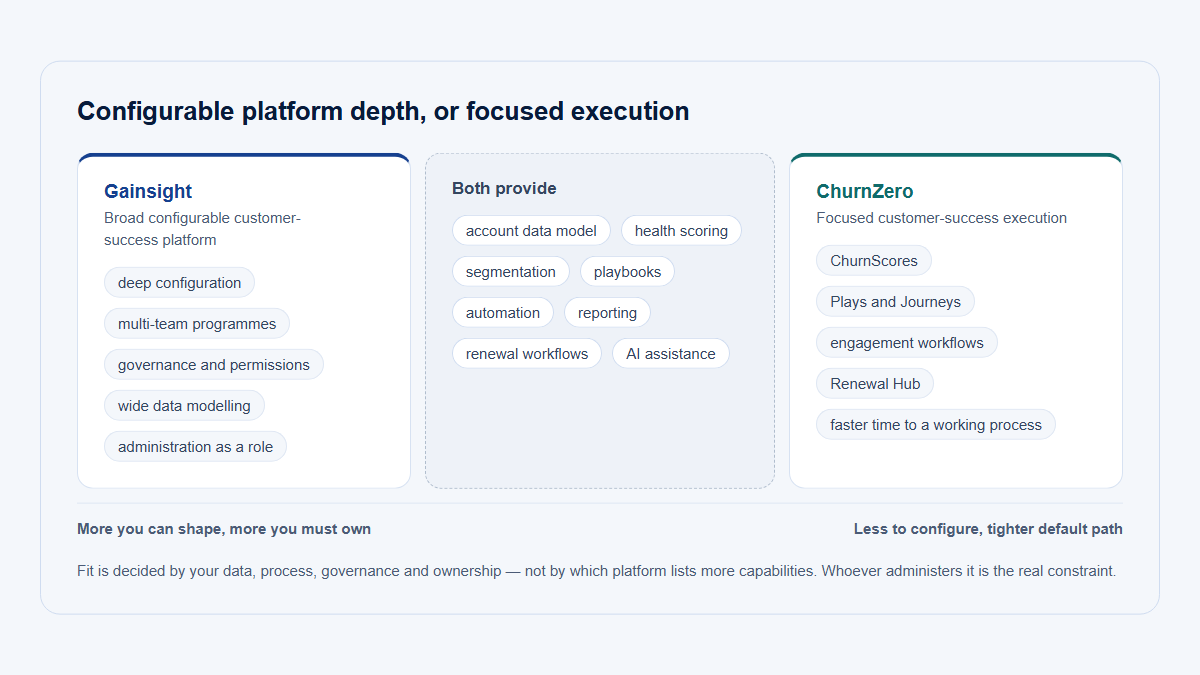
The practical split is structured customer-growth execution, collaborative CSM work, and lifecycle-wide platform extensibility—not a calculated product score.
Three products, three starting problems
ChurnZero
Structured customer-growth execution
Vitally
Collaborative CSM workspace
Planhat
Extensible lifecycle-wide customer platform
All three do health, automation and renewals. Where they differ is the first problem each was built to solve — which shows up as the default view and the person expected to maintain it.
ChurnZero is most distinct when native in-product engagement, prescriptive lifecycle execution, and CS-specific agents sit at the center of the requirement. Vitally is most distinct when the daily job is organizing people, customer data, Projects, Docs, tasks, views, and repeatable work.
Customer data, account health, and product usage
All three can produce an account 360 and a health model, but Planhat exposes the broadest platform model, Vitally clearly documents a flexible Organization–Account–User hierarchy, and ChurnZero is especially oriented toward turning account intelligence into CS action.
| Dimension | ChurnZero | Vitally | Planhat | What this means |
|---|---|---|---|---|
| Customer account | A real-time profile brings together usage, health, contacts, activity, history, and connected data. | Organizations and Accounts have configurable 360s consolidating data and work. | Companies sit within an extensible customer and commercial data model with custom profiles and pages. | All three form an account 360; compare the model surrounding it. |
| Contacts and stakeholders | Contact records, engagement history, relationship intelligence, and stakeholder agents support account work. | Users, Key Roles, CRM contacts, and account or organization associations support stakeholder management. | Contacts and end users relate to companies, commercial objects, projects, and custom models. | A stakeholder view is only as reliable as identity and relationship data. |
| Product users | Usage can associate with contacts and accounts and drive health, segments, alerts, and Plays. | Users connect to Accounts and Organizations; orphan and multi-account cases are documented. | End-user and usage data connects to companies, licenses, products, and time-series metrics. | Test champion concentration and user coverage. |
| Subscriptions | License utilization, account attributes, revenue, and renewal data can come from connected systems. | Revenue and subscription configuration distinguishes subscribed, trial, churned, and other lifecycle states. | Licenses, subscriptions, renewals, revenue, bookings, and custom models can coexist. | Test multiple products, contracts, terms, currencies, and renewal dates. |
| Product usage | Product and feature usage can feed ChurnScores, Success Insights, segments, Journeys, and engagement. | Events and Elements can arrive through SDK, API, analytics integrations, CRM, or warehouse. | Time series, metrics, transformations, integrations, APIs, and warehouses support adoption models. | Verify granularity, history, backfill, matching, and cadence. |
| Support | Support integrations and API data can contribute to profiles, health, risk, and workflows. | Support data can enter through integrations, custom objects, calculated traits, or warehouses. | Support and service data can be integrated, modeled, transformed, and used in health or automation. | Preserve ticket and escalation evidence behind an input. |
| Billing | Billing integrations can drive segments and renewal context. | Revenue data can arrive from CRM, warehouse, API, or custom objects. | Revenue, billing, subscriptions, bookings, and finance context can share the broader model. | Ask whether values are copied, calculated, reconciled, or linked. |
| CRM | Broad CRM integrations and API access support commercial context and coordinated actions. | Salesforce and HubSpot support accounts, contacts, tasks, notes, opportunities, and supported custom objects. | Planhat can integrate with a CRM or be deployed as the CRM application. | Establish one system of record and conflict-resolution rules. |
| Account hierarchy | Account and contact profiles are documented; complex multilevel hierarchy needs validation. | Organizations can contain Accounts and Users, created from CRM, warehouses, APIs, CSV, or UI. | Companies, contacts, operations, licenses, custom models, fields, and relationships support complex structures. | Parent-child and multiproduct hierarchies can be knockout requirements. |
| Custom objects | Custom data can enter through profiles, integrations, APIs, and warehouse imports, but generic model breadth is less prominent publicly. | Custom objects can sync from Salesforce and selected warehouses and participate in views and automation. | Custom models, fields, rules, profiles, pipelines, and Automations are central. | Planhat has the broadest public custom-model story; validate exact cases. |
| Health dimensions | Usage, engagement, journey progress, account attributes, support, satisfaction, and risk factors can contribute. | Success metrics, traits, usage, NPS, lifecycle data, account data, and manual context can contribute. | Usage, support, sentiment, time series, revenue, custom metrics, and enriched evaluations can contribute. | More dimensions do not guarantee a more accurate score. |
| Health flexibility | ChurnScores can vary by lifecycle stage, segment, region, industry, or account type. | Dynamic health can use different measures and views by lifecycle stage or segment. | Health Lab supports weights, thresholds, products, portfolios, segments, and custom models. | Test models, versioning, ownership, and historical comparability. |
| Risk reasons | Contributors, Success Insights, alerts, history, and agents provide investigation context. | Indicators, health inputs, metrics, views, notes, meetings, and summaries expose context. | Health contributors, conversations, time series, revenue, AI, and custom models support investigation. | Require visible evidence, not only a red or green label. |
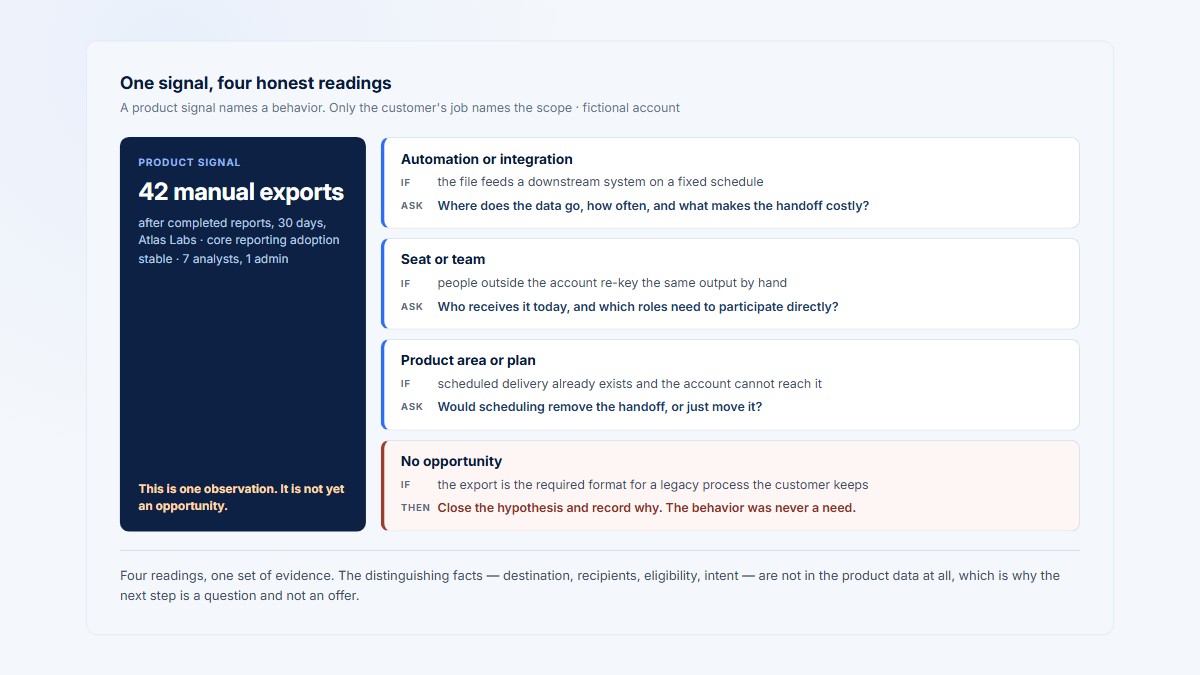
| Expansion signals | Usage, relationship, renewal, segment, and Beacon signals can initiate investigation or Plays. | Product data, custom objects, traits, segments, metrics, and CRM opportunities trigger workflows. | Usage, opportunity, revenue, relationship, health, and custom data feed cross-functional action. | An expansion signal is a hypothesis, not buying intent. |
| Segmentation | Segments drive scoring, alerts, Plays, Journeys, messaging, and reporting. | Segments and filtered views target Accounts, Organizations, Users, health, workflows, and reports. | Reusable filters and segments work across data, reporting, pages, automation, and AI. | Validate that definitions behave consistently. |
| Data freshness | Real-time profiles are positioned, but freshness depends on source and integration. | Some CRM sync is near real time; warehouse and source cadence varies. | Connected data can be current, but freshness depends on pipelines and model design. | Document sync expectations source by source. |
The distinctions above reflect current profile, health, integration, hierarchy, API, warehouse, and data-model documentation. ChurnZero’s Snowflake, BigQuery, and Amazon S3 connectors are documented as import-only; Vitally’s warehouse support and Planhat’s bidirectional Snowflake and BigQuery options vary by object and use case.
Everything downstream depends on the account layer
Inputs
The layer that decides everything
Outputs
Evaluate the account identity and metric layer first. It is the least demoable part of any of these platforms and the one that determines whether the rest is trustworthy.
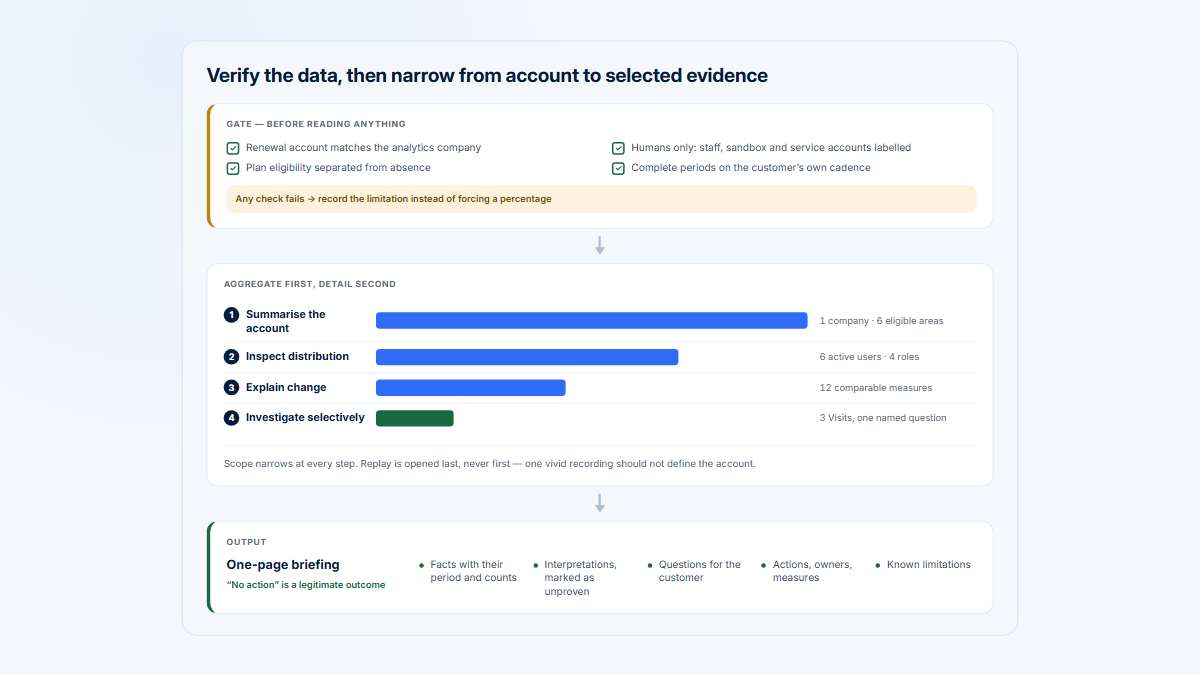
Begin with one documented customer-health model, several real at-risk accounts with product-usage evidence, and a representative product-usage-by-company view. Ask each vendor to reproduce the same identities, account relationships, usage measures, score contributors, and source links.
Projects, playbooks, journeys, and CSM workflow
Vitally has the clearest workspace-oriented daily experience, ChurnZero emphasizes repeatable CS execution and digital journeys, and Planhat connects project work to a wider customer and commercial platform.
| CSM workflow | ChurnZero | Vitally | Planhat |
|---|---|---|---|
| Customer workspace | Command Center, profiles, alerts, tasks, segments, and customer-growth workflows organize execution. | Hubs combine 360s, tables, boards, calendars, dashboards, Projects, and Docs. | Custom profiles, pages, dashboards, documents, tasks, projects, and data models form role-specific workspaces. |
| Onboarding | Journeys, Plays, in-app messages, WalkThroughs, Success Centers, milestones, and alerts. | Projects, Playbooks, Docs, tasks, notes, customer collaboration, and templates. | Templated projects, tasks, Automations, documents, portals, and optional service-delivery capabilities. |
| Projects | Success Plans and Journey milestones cover CS execution, but the product is not positioned as a general PSA. | Native, time-based Projects coordinate internal and customer tasks, milestones, owners, and progress. | Native Projects and Tasks can extend into resource, service, implementation, and PSA workflows. |
| Success plans | Native Success Plans, with assistants that can draft plans and summaries. | Goals, Projects, Docs, tasks, metrics, and shared content combine into a plan. | Objectives, projects, documents, custom models, and portals can represent plans and outcomes. |
| Tasks | Tasks can be created, prioritized, assigned, and triggered through Plays and account workflows. | Tasks are first-class collaborative objects inside Projects, Docs, views, and Playbooks. | Tasks include templates, custom fields, checklists, subtasks, bulk actions, and automation. |
| Playbooks | Plays are a prominent engine for automated and assisted CS actions. | Playbooks automate assignments, Projects, Docs, tasks, messages, Goals, traits, and other objects. | Templated and advanced Automations fill the playbook role across models and applications. |
| Journeys | Dedicated Journeys organize lifecycle stages, progress, and coordinated actions. | Journeys are assembled from lifecycle fields, segments, Hubs, Projects, Docs, views, and Playbooks. | Workflows, templates, projects, stages, filters, and Automations represent journeys. |
| Automated messages | Email, in-app announcements, surveys, Success Centers, and WalkThroughs target segments and workflows. | Conversations and email campaigns can launch manually or through Playbooks; surveys and Docs add touchpoints. | Email sequences and Automations are available; high-scale personalized email is an add-on. |
| Alerts | Real-time alerts can respond to account, contact, usage, health, and Journey changes. | Alerts and Indicators can surface changes and trigger Playbooks or assignments. | Alerts, filters, metrics, health changes, and Automations route work across roles. |
| Account reviews | Profiles, dashboards, Success Plans, reports, summaries, and presentation outputs support reviews. | 360s, Hubs, dashboards, Docs, Projects, notes, meetings, and summaries support preparation. | Dashboards, presentations, custom pages, documents, revenue views, and AI support reviews. |
| Collaboration | Internal work is paired with customer-facing Success Centers and in-app engagement. | Shared Docs, Projects, tasks, comments, Hubs, notes, and customer collaboration are central. | Documents, projects, portals, custom pages, permissions, and multiplayer AI support cross-functional work. |
| Templates | Journey, Play, Success Plan, message, walkthrough, and digital-CS templates. | Blueprints cover Projects, Docs, Notes, Playbooks, dashboards, views, boards, and messages. | Global templates cover workflows, projects, tasks, documents, pages, and Automations. |
| Customer-facing plans | Success Plans and Success Centers expose milestones, resources, progress, and communication. | Projects and Docs can be shared with customers for joint tasks, milestones, and updates. | Portals expose projects, documents, objectives, data, and shared work; Advanced Portals are separately packaged. |
| Workflow customization | Strong within CS-oriented Plays, Journeys, scoring, segmentation, messaging, and agents. | Flexible Playbook actions and workspace objects support CS Operations without becoming a general CRM. | Custom models, functions, AI steps, conditions, branching, webhooks, fields, pages, and applications provide the broadest scope. |
For a proof of concept, have each vendor build one real onboarding workflow, one health-driven intervention, and one renewal preparation process. Count the data dependencies, rules, templates, permissions, and manual handoffs that remain after the polished demo.
Renewals, expansion, digital CS, and lifecycle scope
ChurnZero offers the clearest native digital-CS toolkit, Vitally lets teams assemble renewal and expansion operations inside a collaborative CS workspace, and Planhat extends furthest into lifecycle-wide commercial and service workflows.
| Capability | ChurnZero | Vitally | Planhat |
|---|---|---|---|
| Digital customer success | In-app announcements, surveys, Success Centers, WalkThroughs, segmented messages, Plays, Journeys, and agents. | Segmented email, Playbooks, NPS, Docs, Projects, Hubs, and reporting without a prominent walkthrough layer. | Portals, native NPS, sequences, automation, AI, and an Email Marketing add-on across broader processes. |
| Renewal tracking | Dedicated Renewal and Forecast Hub plus profiles, Success Plans, Plays, alerts, and renewal signals. | Renewal dates, statuses, revenue, CRM opportunities, Projects, Playbooks, Hubs, and templates can form a process. | Renewal fields, licenses, revenue, opportunities, projects, forecasts, documents, and Automations share one model. |
| Forecasting | Dedicated renewal and expansion forecasting is part of the customer-growth proposition. | Configurable from CRM objects, formula fields, CSM inputs, revenue configuration, tables, boards, and dashboards. | Revenue and pipeline forecasting is native to the wider commercial-platform scope; confirm tenant availability for newer features. |
| Risk investigation | ChurnScores, Success Insights, alerts, activity, usage, engagement, surveys, support, and agents. | Health contributors, Indicators, metrics, conversations, notes, meetings, views, and summaries. | Health Lab, time series, conversations, support, revenue, AI workflows, custom models, and audit trails. |
| Expansion | Beacon and other signals can expose possibilities and connect them to Plays, segments, contacts, and forecasts. | Usage, custom traits, CRM opportunities, metrics, account data, and Playbooks coordinate work. | Opportunity, revenue, product, relationship, service, and account data participate in one workflow. |
| Customer outcomes | Success Plans, Journeys, milestones, centers, and AI-assisted plans support tracking. | Goals, Projects, Docs, tasks, success metrics, and shared work provide a flexible structure. | Objectives, projects, documents, portals, revenue, services, and custom models connect outcomes to delivery. |
| Executive reporting | Dashboards, account reporting, renewal forecasts, Success Insights, and presentation outputs. | Dashboards, Hubs, views, boards, tables, Docs, and revenue or health reporting. | Dashboards, presentations, profiles, pages, revenue analytics, audit history, and cross-application reporting. |
| Revenue context | Forecasts, expansion signals, billing integrations, CRM data, license usage, and attributes. | Revenue and subscription configuration, CRM opportunities, custom objects, traits, lifecycle data, and dashboards. | Revenue, pipeline, opportunities, bookings, licenses, services, forecasts, and customer data are first-class concerns. |
| AI summaries | Account intelligence, call and email summaries, Success Plan summaries, writing, and workflow assistants. | Account Summaries, meeting assistance in AI+, Ask AI, extraction, and AI-generated actions. | Coworker, conversational AI, writing assistance, AI workflows, custom models, and MCP assistants. |
| AI agents | More than 15 purpose-built agents and assistants are described in Agentic Essentials. | AI Copilot provides assistance and actions; AI+ adds broader context and meeting capabilities. | Agents and people work in one governed platform with configurable AI models and workflows. |
| No-code AI workflows | Ready agents can enrich data, produce output, and initiate actions; validate custom-agent requirements. | AI Actions produce structured work while Playbooks coordinate automation; validate custom generative workflows. | AI steps, model selection, prompts, branching, functions, and Automations support configurable workflows. |
| Approvals and governance | AI Email Play review is on by default; permission guardrails exist, but a universal per-step approval framework is not publicly documented. | Roles and permission-aware MCP are available; supported MCP writes run without a separate built-in confirmation step. | Human review can be added to any Automation step, with approvals, rejections, timeouts, fallbacks, permissions, and logs. |
AI should be evaluated as assisted or governed execution—not independent proof that an account will renew, expand, or achieve value. Pair the CSP workflow with direct product-usage evidence before a renewal meeting and a careful review of product-usage expansion opportunities.
Can one replace another?
| Replacement question | Concise answer | Validate before migrating |
|---|---|---|
| Can ChurnZero replace Vitally? | Often, when structured Plays, Journeys, digital engagement, renewal forecasting, and CS-specific agents matter more than workspace-style Projects and Docs. | Rebuild one collaborative onboarding Project, one shared plan, and the CSM’s daily workspace. |
| Can Vitally replace ChurnZero? | Often for data, health, Projects, Playbooks, reporting, renewal processes, and productivity—but not as a like-for-like replacement for WalkThroughs, Success Centers, or the dedicated forecast experience. | Inventory every in-app and digital-CS program and decide what will own it. |
| Can Planhat replace either? | Frequently, if the organization wants a broader data and action platform and can model and govern it. | Confirm CS-specific digital features, survey types, agents, shared plans, and daily CSM work. |
| Can either focused CSP replace Planhat? | Yes when the requirement is focused CS execution; no when Planhat also serves CRM, PSA, revenue, custom-model, or cross-functional roles. | Inventory every team, model, integration, workflow, report, portal, and system-of-record responsibility. |
| Should a company operate two CSPs? | Usually not. Two systems duplicate health logic, ownership, automation, permissions, and reporting. | Prefer one CSP with specialist systems unless a temporary migration requires overlap. |
AI, integrations, implementation, and governance
The main implementation risk is not the connector count; it is whether someone owns identity, data quality, health logic, permissions, automation, and ongoing model maintenance.
| Factor | ChurnZero | Vitally | Planhat |
|---|---|---|---|
| Implementation complexity | Medium-high editorial assessment. Usage, scores, segments, Plays, Journeys, engagement, forecasting, and AI create a substantial surface. | Medium editorial assessment. The workspace is approachable, but identity, imports, health, Projects, Playbooks, permissions, and reporting require design. | Medium-high to high editorial assessment. Complexity depends on a focused CSP versus a cross-functional CRM, CSP, PSA, and AI deployment. |
| Likely administrator | A trained CS Operations owner or dedicated administrator is advisable. | A CS Operations owner, with systems or data help for integrations and governance. | A platform owner plus CS Operations, RevOps, or data expertise for custom models or several applications. |
| CRM dependency | Not technically absolute, but a CRM normally supplies commercial, ownership, contract, and opportunity context. | Not absolute, but many renewal and forecast patterns rely on CRM opportunities, revenue fields, or equivalents. | Can integrate with an existing CRM or operate as the CRM, depending on application scope. |
| Warehouse support | Amazon S3, Snowflake, and BigQuery import accounts, contacts, activities or events, and custom objects; no warehouse write-back is documented. | PostgreSQL, Redshift, BigQuery, Snowflake, and MySQL are documented; custom-object support is narrower and warehouse sync is one-way into Vitally. | Snowflake and BigQuery support bidirectional static/custom-model data and inbound time series; PostgreSQL and MySQL are usage-only. |
| Public or custom price | Custom quote; no public platform list price. | Custom quote under Tech-Touch, Hybrid-Touch, or High-Touch. | Enquiry-based quote under CRM, CSP, or PSA packaging. |
| Billing unit | No complete formula is public. Get written terms for users, accounts, modules, services, credits, and overages. | No complete formula is public. Confirm full-access users, account volume, AI+, surveys, integrations, and services. | No complete formula is public. Confirm viewers, operators, models, portals, AI, and services. |
| Implementation services | Configuration, data, and customer-success support are described; optional Services Suite packages add help. | A personalized demo and trial sandbox are public; confirm migration, training, implementation scope, and fees. | Managed and professional services cover onboarding, technical and AI deployment, advisory, and premium support. |
| AI packaging | Agentic Essentials is an annual flat-fee subscription with a credit allotment and agent suite for Professional and Enterprise editions. | AI Copilot is included. Paid AI+ adds all-time context, Meeting Recorder, and Custom AI Summaries; no public add-on price. | Planhat AIP is included in all plans; an Upgraded AI Platform is an add-on. |
| Rating and count | G2: 4.7/5, 1,609 reviews. | G2: 4.5/5, 706 reviews. | G2: 4.5/5, 954 reviews. |
| Verification date | August 14, 2026 | August 14, 2026 | August 14, 2026 |
| Official links | ChurnZero · Features · Agentic Essentials | Vitally · Features · Pricing | Planhat · Pricing · Changelog |
The complexity labels are editorial assessments of documented scope, not implementation-time benchmarks. Pricing cells avoid unofficial contract estimates because all three products use sales-led pricing.
Data becomes evidence only after a person acts on it
1
Account view
The joined record for one customer company
2
Health or segment
A configured judgment about where the account sits
3
Trigger and preparation
Automation gathers context and drafts the next step
4
Human review
Someone decides whether the suggested action is right
Skipping this is how automation damages accounts
5
Customer action, then new evidence
What the customer did next feeds back into step 2
Every one of these platforms can run steps 1 to 3 automatically. The quality of the programme is set at step 4, and it is the step no product can supply for you.
A buyer should ask every vendor to document who can edit a score, publish a workflow, send a message, approve AI output, export customer data, alter a revenue field, and see a restricted account. Connector breadth matters, but governance determines whether the resulting system remains trustworthy.
Selected video
Pricing, ratings, and customer feedback
All three are sales-led products, so compare total first-year operating cost and contractual packaging rather than a headline subscription figure.
Commercial model
ChurnZero
Custom pricing
No current platform price table or complete edition comparison is public. Agentic Essentials is an annual flat-fee subscription with allotted credits; optional Services Suite packages add support.
Ask the quote to separate the platform, user types, managed accounts, integrations, implementation, AI credits, services, overages, and renewal increases.
Commercial model
Vitally
Custom pricing
All plans list core features, unlimited automations, unlimited observer seats, SSO, the integration library, and unlimited Docs. A dedicated trial sandbox can use the buyer’s data and team.
AI Copilot is included. AI+ is a paid add-on with all-time context, Meeting Recorder, and Custom AI Summaries, but no public price.
Commercial model
Planhat
Custom pricing
Planhat AIP is included in all plans. Upgraded AI Platform, Advanced Service, Email Marketing, and Advanced Portals appear as add-ons; managed and professional services are available.
Ask for application scope, user types, viewer access, portals, AI consumption, service packages, implementation, data pipelines, and later application expansion.
Current G2 snapshot and recurring review themes
G2 snapshot
ChurnZero reviews
The platform can support sophisticated execution, but buyers should fund administration, enablement, and model maintenance.
G2 snapshot
Vitally reviews
Interface quality may improve adoption, but the underlying data, health, and workflow design still needs an owner.
G2 snapshot
Planhat reviews
Extensibility is most valuable when a team governs the model instead of continually adding unowned fields and workflows.
Review themes summarize recurring G2 likes and dislikes, not universal findings. The rating decimal does not determine this article’s verdict.
Which one fits your scenario?
Start from the engagement model, data complexity, workflow scope, and available platform ownership, then validate the recommendation with real customer data and real work.
| Scenario | Starting product | Reason | Main caveat | Companion system |
|---|---|---|---|---|
| Early-stage CS team | Vitally, after repeatable processes and reliable account data exist. | A workspace model organizes context, Projects, Docs, tasks, health, and Playbooks without the broadest scope. | A CSP cannot create a missing strategy or repair poor identity data; a CRM and simpler process may be enough earlier. | CRM, support, and reliable product-usage evidence. |
| Collaborative scale-up | Vitally | Hubs, Projects, Docs, views, tasks, notes, meetings, reports, and Playbooks align with standardizing daily work. | Confirm forecasting, hierarchy, permissions, and digital-engagement needs instead of selecting on interface alone. | CRM, product intelligence, billing, and support. |
| Digital-CS organization | ChurnZero | In-app announcements, WalkThroughs, Success Centers, surveys, Journeys, Plays, segmentation, and agents create a distinct toolkit. | Automation still needs context, content governance, deliverability controls, and measurement. | CRM, support, product data, and possibly community or learning. |
| High-touch enterprise team | Planhat, when work spans commercial or service teams. | Custom models, portals, projects, documents, revenue, permissions, and cross-functional workflows support complex relationships. | “Enterprise” alone is not a reason; a focused CS team may prefer Vitally or ChurnZero. | Finance or ERP, contracts, warehouse, and CRM if needed. |
| Complex customer data | Planhat | Its public model is broad for custom models, relationships, time series, pipelines, commercial objects, applications, and governance. | Flexibility creates model sprawl without ownership and change control. | Warehouse, ETL or reverse ETL, identity rules, and data catalog. |
| Projects and onboarding | Vitally | Projects, customer tasks, Docs, Goals, templates, Playbooks, and Hubs provide a clear operational workspace. | Resource planning or billable services may point toward Planhat’s PSA scope. | CRM, implementation data, support, and dedicated PSA when accounting is complex. |
| Lifecycle-wide commercial workflows | Planhat | CRM, CSP, PSA, revenue, pipeline, forecasts, projects, portals, automation, and AI can share one model. | Broader scope increases implementation and governance needs and may duplicate established systems. | Finance, contract management, warehouse, or BI. |
| AI-assisted automation | ChurnZero for ready CS-specific agents. | Agentic Essentials emphasizes a broad collection of embedded customer-growth agents and assistants. | Validate credits, review, write permissions, customer-facing actions, and whether custom flows need Planhat’s documented approval layer. | Conversation, support, product, and CRM data plus human-review policy. |
| CS Operations with a warehouse | Planhat for complex models; evaluate Vitally for a narrower hierarchy. | Both document direct warehouse support, while Planhat goes further into custom models and lifecycle-wide operations. | A flexible platform does not remove source ownership, tests, monitoring, and reconciliation. | Warehouse orchestration, identity governance, observability, and BI. |
Fictional customer-success scenario
The following company is fictional and exists only to make the operating differences concrete.
| Task | ChurnZero | Vitally | Planhat | Best fit for this task |
|---|---|---|---|---|
| Create account 360 | Combine usage, contacts, health, CRM, billing, support, and history. | Consolidate Organizations, Accounts, Users, custom objects, activities, Projects, and reports in 360s and Hubs. | Model companies, contacts, licenses, products, operations, revenue, and custom relationships. | Planhat for complex hierarchy; Vitally for a narrower CS hierarchy. |
| Calculate health | Configure segmented ChurnScores with Success Insights and alerts. | Build dynamic health from metrics, traits, usage, NPS, lifecycle, and context. | Use Health Lab, time series, custom metrics, segments, products, and enrichment. | Test one transparent model; Planhat offers broad modeling and ChurnZero connects scoring closely to execution. |
| Run onboarding | Use Journeys, Plays, WalkThroughs, Success Centers, messages, milestones, and alerts. | Launch templated Projects, Docs, customer tasks, notes, Goals, and Playbooks. | Trigger projects, tasks, portals, documents, Automations, and service workflows. | Vitally for collaborative high-touch onboarding; ChurnZero for a digital journey. |
| Manage projects | Track outcomes through Success Plans and Journey milestones. | Run CS Projects with tasks, owners, deadlines, and templates. | Run Projects and Tasks that extend into professional services and resources. | Vitally for CSM-owned Projects; Planhat when work is service delivery. |
| Create playbook | Build a Play responding to health, usage, lifecycle, survey, or account conditions. | Create Projects, Docs, tasks, messages, assignments, Goals, and updates through Playbooks. | Automate across models with branches, conditions, waits, functions, webhooks, and AI. | ChurnZero for prescriptive CS, Vitally for collaborative objects, Planhat for cross-functional orchestration. |
| Automate digital journey | Target email, in-app messages, surveys, Success Centers, and WalkThroughs. | Use segmented conversations, NPS, Docs, Projects, and Playbooks. | Use portals, email sequences, Automations, and optional Email Marketing. | ChurnZero for the clearest native in-product engagement. |
| Prepare renewal | Combine the Renewal and Forecast Hub, Success Plan, profile, health, relationships, and Plays. | Create a renewal Project and Hub using CRM opportunities, revenue, tasks, Playbooks, Docs, and dashboards. | Connect renewal, revenue, opportunity, forecast, project, relationship, and service data. | ChurnZero for focused CS renewal; Planhat for a wider commercial model. |
| Forecast risk | Use ChurnScores, Success Insights, renewal data, engagement, alerts, and agents. | Use health, Indicators, metrics, notes, meetings, product data, and dashboards. | Combine health, time series, revenue, support, relationships, models, and AI. | No platform proves risk. Planhat provides broad context; ChurnZero offers a direct signal-to-action path. |
| Identify expansion | Use usage, relationship, renewal, segment, and Beacon signals to create follow-up. | Use traits, metrics, custom objects, CRM opportunities, segments, and Playbooks. | Use revenue, opportunities, adoption, relationships, services, and Automations. | Planhat for cross-functional opportunity management; ChurnZero for CS-focused action. |
| Deploy AI workflow | Start with agents and assistants that summarize, enrich, draft, detect signals, or guide action. | Use Ask AI, summaries, AI Actions, Playbooks, and permission-aware MCP access. | Insert AI into Automations, select models, add human review, use MCP, and audit actions. | Planhat for a custom governed workflow; ChurnZero for ready CS agents. |
| Report to leadership | Report on health, renewals, retention, expansion, customer growth, and execution. | Use Hubs, dashboards, tables, boards, revenue views, health, Projects, and activity. | Build dashboards spanning CS, revenue, services, pipeline, health, and automation. | Planhat for lifecycle-wide reporting; ChurnZero for focused customer growth. |
For Northbridge Cloud, Planhat is the most plausible starting point if one platform must represent the hierarchy and commercial lifecycle. ChurnZero is stronger if digital CS and structured retention execution dominate. Vitally is stronger if CSM productivity, collaborative Projects, and onboarding operations are the priority.
Where Hymetry fits
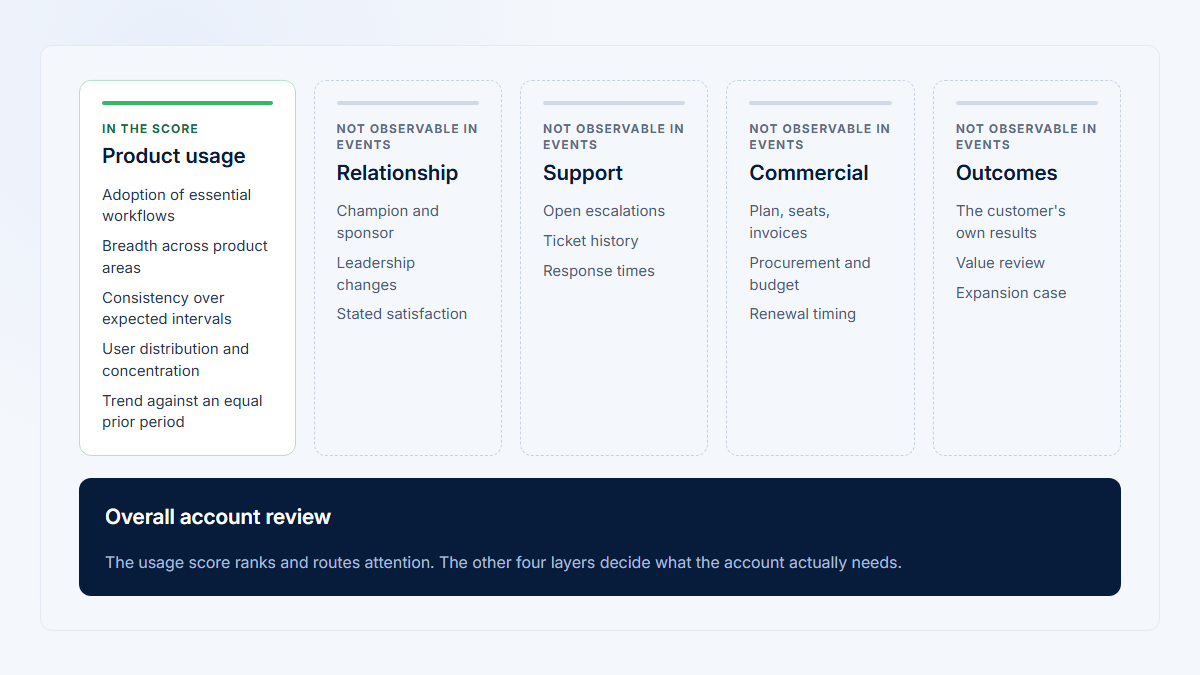
Hymetry complements these platforms by supplying account-centric product evidence; it does not replace a customer-success platform.
| Need | Hymetry’s contribution | What remains the CSP’s responsibility |
|---|---|---|
| Understand product adoption | Product areas, grouped Pages, Companies, Users, account adoption, breadth, penetration, and concentration. | Combine product evidence with relationship, support, billing, CRM, health, lifecycle, renewal, and ownership context. |
| Investigate a signal | Pages, Companies, Users, and Visits connect aggregate patterns to session evidence. | Assign work, run Projects and playbooks, communicate with customers, manage renewals, and govern customer-facing action. |
| Supply evidence to a CSP | Hymetry may provide product-usage evidence through a data path confirmed in the current implementation; no unverified integration is promised. | Ingest evidence, calculate configured health models, trigger approved workflows, and maintain the operational customer record. |
Hymetry is account-centric product intelligence for B2B SaaS. It helps teams understand which product areas and grouped pages an account adopts, whether use is broad or concentrated, which users drive the pattern, and which Visits contain supporting session evidence. It does not replace health scoring, Projects, playbooks, renewals, digital CS, CRM context, or AI customer-success workflows.
Review Hymetry’s customer-success use case and the broader comparison of product analytics tools to assess that boundary.
FAQ, methodology, and sources
Is ChurnZero better than Vitally?
Not universally. ChurnZero is the stronger starting point for native digital engagement, dedicated Journeys and renewal forecasting, and a broad CS-specific agent suite. Vitally is stronger when the primary requirement is a collaborative CSM workspace built around Hubs, Projects, Docs, tasks, Playbooks, and flexible reporting.
Is Planhat better than ChurnZero?
Planhat is a better fit for an extensible platform spanning custom data models, commercial workflows, revenue, CRM, PSA, portals, and governed AI. ChurnZero is a better fit for a focused customer-growth platform with strong digital-CS and CS-execution capabilities.
Which is easiest to implement?
Vitally has the narrowest platform proposition and may be the easiest starting point for a CS-focused workspace, but that is editorial inference—not a measured benchmark. Identity quality, integrations, hierarchy, health design, workflow count, permissions, and migration can make any of the three substantial.
Which is best for digital customer success?
ChurnZero has the clearest native digital-CS advantage because it combines segmentation, Journeys, Plays, in-app announcements, surveys, Success Centers, and WalkThroughs. Vitally and Planhat support scaled email, workflows, portals, NPS, and collaborative motions, but neither emphasizes the same native in-product engagement set.
Which is best for complex customer data?
Planhat is the strongest starting point for a deeply extensible customer and commercial model. Vitally also supports Organizations, Accounts, Users, custom objects, APIs, and several warehouses. Give every vendor a representative hierarchy and difficult identity cases instead of relying on a generic architecture slide.
Should a company use more than one customer-success platform?
Usually not. Two CSPs duplicate account ownership, health logic, workflows, permissions, customer communication, and reporting. The normal architecture is one CSP combined with the CRM, warehouse, support, product-intelligence, billing, and other specialist systems it genuinely needs.
Where does Hymetry fit?
Hymetry supplies account-centric product evidence: product areas, grouped pages, Companies, Users, account adoption, adoption breadth, user penetration, usage concentration, and Visits. It does not replace the health, workflow, communication, renewal, or customer-management responsibilities of ChurnZero, Vitally, or Planhat.
Sources
Methodology and evidence limits
This article was researched and verified from public evidence available August 14, 2026. Official evidence included vendor homepages, product and pricing pages, help centers, developer documentation, release notes, and packaging announcements. Aggregate customer feedback came from current G2 seller ratings and recurring review themes.
Independent editorial material was supplementary only. Operating-model recommendations and implementation-complexity labels are editorial inferences from documented scope, not measured tests. “Configurable” means a workflow can be assembled from documented objects, fields, reports, or automation; “publicly unclear” means the reviewed sources do not support a firm conclusion.
No hands-on product testing, private demo, procurement quote, contract review, customer interview, controlled test, or benchmark was conducted. No vendor competitor page was treated as neutral evidence, and vendor case studies or claimed ROI were not used to predict results.
Official ChurnZero product documentation
Official Vitally product documentation
Official Planhat product documentation
Pricing and packaging
Customer ratings and review themes
- ChurnZero seller page on G2
- Vitally seller page on G2
- Planhat seller page on G2
- ChurnZero review themes
- Vitally review themes
- Planhat review themes
Ratings and counts were read from the live G2 seller pages on August 14, 2026. Themes summarize recurring review patterns and do not establish universal product outcomes.
Official video
The exact title, Planhat channel, November 27, 2025 upload date, 7:52 duration, live status, and embeddability were verified August 14, 2026. The video illustrates workflow mechanics and predates Planhat’s June 2026 native human-review control.
Hymetry product sources
The repository’s canonical Hymetry context is the source of truth for Hymetry terminology, positioning, capabilities, and limits.