Quick comparison
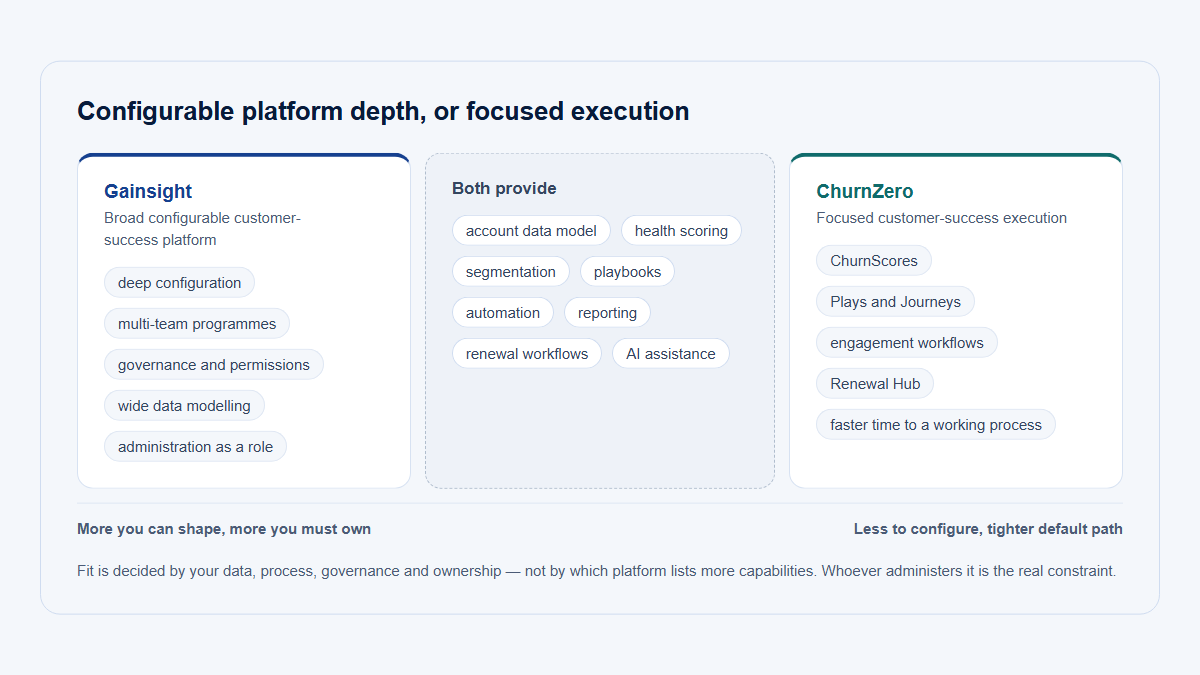
Gainsight provides the more configurable customer-success operating environment, while Vitally concentrates more of the daily CSM experience into a collaborative workspace.
Both can cover account profiles, health, product data, tasks, automation, reporting, surveys, renewals, and AI through core or separately entitled capabilities. The clearest difference is how much specialized structure the team wants to design and govern.
An operating platform, or a workspace CSMs live in
Gainsight
Highly configurable customer-success operating platform
Overlapping ground
Vitally
Modern collaborative CSM workspace
Configured centrally, then rolled out Adopted by the people doing the work
Both cover the shared middle. The real question is where the work happens day to day: in a configured programme, or in a workspace the CSM keeps open.
Account data, health, and segmentation
Gainsight has the deeper account and relationship modeling toolkit; Vitally makes a substantial customer-data model more immediately available inside the CSM workspace.
| Capability | Gainsight Customer Success | Vitally | What this means |
|---|---|---|---|
| Customer account | C360 combines configurable data, health, Timeline, people, plans, usage, reports, and Renewals when entitled. | Organization and Account 360 combine traits, users, activity, subscription context, health, Projects, and dashboards. | Both can be the operational account record; prototype the required sections. |
| Stakeholders | Person records and People Maps support roles, influence, sponsors, and relationship context. | Users, key roles, champions, and decision-makers surface in profiles, segments, and workflows. | Gainsight is more formal; Vitally keeps stakeholders close to workspace objects. |
| Product users | Adoption Explorer can model person-level usage when identity is supplied. | Users carry traits, events, metrics, and account associations in the Organization → Account → User model. | Test identity resolution, account membership, and users who change accounts. |
| Subscriptions and contracts | Standard or custom objects, Product Catalog, Renewals, CRM data, and layouts represent commercial context. | Lifecycle/revenue settings, traits, CRM deals, and custom objects represent subscriptions and contracts. | Neither replaces a governed commercial source of truth. |
| CRM data | Connectors include Salesforce, Microsoft Dynamics, HubSpot, Pipedrive, and Zoho, plus APIs and data tools. | Official material documents Salesforce and HubSpot account, contact, opportunity, activity, and custom-object use cases. | Map system-of-record and write-back ownership first. |
| Billing data | Connectors, files, APIs, databases, warehouses, and custom objects can ingest financial data. | Stripe, Chargebee, Recurly, custom traits, and warehouse sources are documented. | Invoice, subscription, and account identifiers must reconcile. |
| Support data | Documented connectors include Zendesk, Freshdesk, Jira, and ServiceNow. | Zendesk, Intercom, and conversation sources can enrich customer records. | Model severity, age, trend, and resolution—not ticket count alone. |
| Product usage | Adoption Explorer supports company/person usage, derived metrics, entitlements, and C360 sections. PX is a separate possible source. | Events, metrics, traits, users, warehouses, APIs, Segment, Mixpanel, Amplitude, Pendo, and RudderStack can feed the model. | Test identity, taxonomy, backfill, freshness, and explainability. |
| Account hierarchy | Company Hierarchy supports multiple levels; Relationships model units, products, regions, implementations, or use cases. | Organization → Account → User plus custom objects and linked records. | Gainsight is safer for unusually complex structures; prove Vitally fit with a real object diagram. |
| Custom objects | Standard/custom objects, joins, calculations, and Data Designer outputs. | Custom objects represent deals, risks, subscriptions, implementations, requests, or other linked records. | Compare object behavior, not the checkbox. |
| Health dimensions | Company and Relationship scorecards can contain multiple measure groups, measures, and score types. | Categories can combine usage, support, sentiment, survey, commercial, and other metrics. | Both support multidimensional health; defensible components and follow-through create value. |
| Health configuration | Manual or rules-driven measures, weights, exceptions, numeric/letter grades, and multiple scorecards. | Weights, equations, conditions, thresholds, categories, and distinct segment/lifecycle models. | Gainsight offers formal governance; Vitally offers strong segment-specific configuration. |
| Risk reasons | Components, CTAs, reason fields, Timeline, alerts, reports, and playbooks expose context. | Components, Indicators, traits, events, activities, segments, and Playbook conditions expose context. | Every state should point to source evidence. |
| Expansion indicators | CSQLs, Renewals data, scorecards, usage, account intelligence, and workflows route hypotheses. | Indicators, revenue/usage traits, custom objects, CRM deals, segments, and Playbooks route hypotheses. | A signal is not proof of budget, authority, need, or intent. |
| Segmentation | Rules, filters, reports, layouts, JO audiences, scorecards, and models support differentiated motions. | Saved account, organization, or user segments use lifecycle, plan, health, usage, revenue, ownership, or traits. | Vitally foregrounds segmentation; Gainsight connects it to more governed layers. |
| Data freshness | Depends on source, connector, rule schedule, and Adoption Explorer project; usage imports are not universally real time. | Depends on source; events/APIs, CRM, and warehouse syncs have different schedules. | Require source-by-source latency and visible last-success timestamps. |
Interpretation boundary
A health score is a configured operating model
Its output depends on selected data, thresholds, weights, freshness, and assumptions. Use it to prioritize investigation—not to prove satisfaction, value, churn, or expansion—and expose the component reasons behind every account state.
Model three representative accounts during evaluation: a simple customer, a parent with subsidiaries, and a customer with several products or business units. Load the required product, CRM, billing, support, stakeholder, and renewal fields, then ask a CSM to explain every change without administrator reconstruction.
For the measurement discipline behind that exercise, see the customer health score guide and the guide to investigating at-risk accounts with product usage.
Projects, success plans, playbooks, and CSM productivity
Gainsight is stronger at formalizing a governed CS operating model; Vitally is stronger at making Projects, Docs, data, and collaboration feel like one day-to-day workspace.
| Workflow | Gainsight Customer Success | Vitally | Editorial edge |
|---|---|---|---|
| CSM workspace | Gainsight Home, Cockpit, C360, Timeline, scorecards, reports, and Success Plans. | Hubs combine Tables, Boards, Dashboards, Docs, Projects, and account views. | Gainsight for specialized layers; Vitally for a unified configurable workspace. |
| Customer projects | Success Plans, objectives, tasks, CTAs, and templates can represent onboarding or implementation work. | Projects are collaborative objects with internal/customer tasks, owners, dates, progress, automation, and Doc embedding. | Vitally when collaborative delivery projects are central. |
| Success plans | Dedicated plans with objectives, tasks, owners, dates, status, progress, Gantt views, templates, and external sharing. | Projects, Tasks, Docs, traits, and Goals workflows assemble the plan; Goals+ is listed as an add-on. | Gainsight for formal governance; Vitally for flexible collaborative plans. |
| Tasks | Tasks live in CTAs, Playbooks, Success Plans, Cockpit, and Timeline-connected workflows. | Tasks live in Projects, accounts, Playbooks, Docs, and team workflows with internal or customer ownership. | Fit depends on whether formal structure or collaboration matters more. |
| Playbooks | Standardize CTA and Success Plan actions, owners, due dates, dependencies, and repeatable processes. | Automate triggers, conditions, branches, delays, emails, assignments, Projects, Goals, traits, and other actions. | Gainsight for governed depth; Vitally for accessible cross-object automation. |
| Automated workflows | Rules Engine, JO, CTAs, scorecards, notifications, and plan automation coordinate complex motions. | Playbooks enroll records, branch on data, update traits, communicate, assign work, and create objects. | Gainsight has more specialized depth; Vitally presents a consolidated model. |
| Templates | Success Plan, Playbook, Journey, report, dashboard, survey, and Success Snapshot templates. | Project, Doc, Goal, Playbook, Hub, dashboard, email, and activity templates, subject to entitlement. | Both require owners, naming standards, and lifecycle management. |
| Meeting preparation | C360, Timeline, AI Cheat Sheet, Success Snapshots, reports, health, usage, and renewal data. | Account 360, Hubs, history, Docs, AI summaries, Projects, health, and licensed Meeting Recorder. | Vitally foregrounds workspace context; Gainsight assembles a governed review pack. |
| Notes and collaboration | Timeline captures activity; Success Plans can be shared; Sally and CRM surfaces extend access. | Docs provide customer-facing workspaces with live Projects, Goals, Tasks, and account data. | Vitally for live collaboration; Gainsight for structured operating records. |
| Account reviews | Success Snapshots, reports, C360, Timeline, scorecards, objectives, and Renewals support reviews. | Docs, Hubs, dashboards, Projects, Goals, health, and activity summaries support recurring reviews. | Gainsight for standardized packs; Vitally for living documents. |
| Portfolio management | Dashboards, Cockpit, Home, reports, scorecards, CTAs, and Renewals views. | Hubs, Tables, Boards, Dashboards, segments, Indicators, and owner-based views. | Gainsight for complex reporting; Vitally for daily portfolio navigation. |
| Alerts | Rules, notifications, CTAs, score changes, Timeline activity, and renewal signals. | Indicators and Playbooks respond to traits, health, events, dates, lifecycle, and activity. | Both need thresholds, deduplication, routing, and closure rules. |
| Customer-facing plans | Success Plans share controlled objectives and tasks externally; Gantt views support plan tracking. | Docs can expose embedded Projects, Goals, Tasks, status, and context. | Gainsight for formal plans; Vitally for collaborative workspaces. |
| Customization | Rules, Data Designer, objects, layouts, permissions, plans, JO, and specialized modules. | Hubs, objects, traits, views, segments, Playbooks, Docs, Projects, and dashboards. | Gainsight has the higher ceiling; Vitally often has the lighter model. |
The revealing test is not whether each product has tasks or playbooks. Build one onboarding motion, one risk escalation, and one quarterly review. Count the objects, administrators, rule layers, customer artifacts, and manual handoffs required to keep each understandable after six months.
Data, health, plan, play, outcome
1
Inputs
CRM, billing, support, product usage, relationship data
2
Health and segmentation
A defined score, then the accounts it groups together
Both are choices you made, not facts you found
3
Project or success plan
The agreed objective for this account, with dates and owners
4
Playbook
The repeatable steps that plan turns into
5
Renewal or expansion
The commercial workflow the whole chain exists to serve
Step 3 is where these two products differ most in feel. A success plan is a shared document in one and a configured object in the other — which decides who maintains it.
Digital CS, renewals, expansion, and AI
Gainsight offers the more specialized digital-CS and renewal stack, while Vitally assembles scaled communication, collaborative work, renewal operations, and AI within its workspace model.
| Capability | Gainsight Customer Success | Vitally | Practical interpretation |
|---|---|---|---|
| Onboarding | Success Plans, objectives, CTAs, Playbooks, JO, Timeline, surveys, and dashboards. | Projects, Tasks, Goals, Docs, segments, Playbooks, emails, and dashboards. | Gainsight suits governed programs; Vitally suits collaborative delivery. |
| Digital journeys | JO supports simple/advanced programs, email, surveys, branching, and account/contact audiences. In-app delivery requires separate PX. | Playbooks automate communication and workflow; Docs and Projects support asynchronous collaboration. No native in-app guide product was documented. | Separate email, surveys, in-app guidance, self-service, and collaborative plans. |
| Scaled communication | JO manages multi-step programs and survey-driven flows. | Playbooks send email, wait, branch, follow up, update data, and create work. | Test suppression, replies, localization, consent, limits, and ownership. |
| Renewal tracking | Renewals provides a purpose-built workspace, data, risk context, forecasting, and workflows; packaging varies. | Dates, lifecycle/revenue data, CRM deals or objects, Projects, Docs, Playbooks, segments, Hubs, and dashboards. | Gainsight has the specialized layer; Vitally has a configurable operating pattern. |
| Risk investigation | Score components, usage, support, Timeline, CTAs, reports, sentiment, Renewals, and account context. | Health components, Indicators, events, activities, support context, traits, 360 views, and AI summaries. | Neither establishes causality; CSM review remains necessary. |
| Expansion | CSQLs, health, usage, Renewals, Company Intelligence when entitled, rules, and account workflows. | Indicators, objects, CRM deals, product/revenue traits, Playbooks, Hubs, and dashboards. | Treat indicators as qualification inputs, not purchase intent. |
| Forecasting | Renewals supports account-based and opportunity-oriented forecasting, including Gainsight-only or CRM-backed configurations. | Official guidance constructs forecasting with lifecycle/revenue data, CRM or custom data, Projects, Playbooks, Hubs, and dashboards. | Specialized product versus configurable process construction. |
| Customer outcomes | Success Plans connect objectives, tasks, owners, progress, and context. | Projects, Tasks, Docs, traits, and Goals workflows represent outcomes and delivery; Goals+ is listed as an add-on. | Define outcomes separately from activity completion. |
| Surveys and feedback | Surveys and analytics are included in current CS packaging and feed scorecards, programs, and reports. | Survey data can feed profiles, health, segments, and Playbooks. Custom Surveys is an add-on; buyers can try it with up to 100 responses, after which additional responses are hidden until upgrade. | Confirm entitlement and account for response bias and sample size. |
| AI summaries | Both plans list AI Cheat Sheet, Follow-Up, Takeaways, writing, Impact Analyzer, and Scorecard Optimizer. | Included Copilot covers Ask AI, AI Actions, account summaries, and 90 days of context. | Summaries save time only when source records remain inspectable. |
| Agents and MCP | CS and Staircase MCP are live; Staircase needs a separate subscription. Agent Studio is waitlisted; Atlas is a managed renewal service. | AI+ adds all-time context, Meeting Recorder, and custom summaries. MCP is documented with full/read-only endpoints; plan entitlement is undisclosed. | Compare licensed actions, sources, permissions, retention, confirmation, and rollback. |
| AI-action governance | CS MCP uses OAuth/PKCE and existing permissions, has no tool-level scoping, and counts against tenant API limits. A Super Admin remains unrestricted even with a read-only OAuth app; customer-facing MCP audit reporting is incomplete. | MCP honors user roles/Access Groups; writes have no built-in confirmation. A server-enforced read-only endpoint is available, with a default limit of 100 requests per minute per user. | Require least privilege, human review, action inventory, audit expectations, and rollback. |
Integrations, implementation, and governance
Gainsight provides more mature configuration and governance depth but usually asks more of its administrator; Vitally is comparatively lighter while still requiring deliberate data, access, and workflow ownership.
| Buying question | Gainsight Customer Success | Vitally | Buying implication |
|---|---|---|---|
| Implementation | Objects, scorecards, rules, layouts, plans, journeys, reports, permissions, and renewals can form a substantial design program. “As little as two weeks” is marketing, not a universal result. | A trial sandbox supports representative data. Hubs, objects, segments, health, Playbooks, Projects, Docs, and integrations still need an operating design. | Compare minimum viable and mature-state implementations separately. |
| Administrator | A named administrator or CS Operations owner is normally important for governance, rules, reports, permissions, releases, and maintenance. | A systems or operations owner remains important, although fewer specialized modules may reduce platform-specific administration. | No-code does not mean no owner. |
| Relationships services | Official FAQ says deploying Relationships requires Gainsight Professional Services; contract terms determine whether that package is included. | Public material does not disclose whether hierarchy/custom-object design or onboarding services are required, included, or separately priced; no universal mandatory fee was found. | Price complex-model design and migration explicitly. |
| CRM dependency | Can ingest many sources. Renewals can use Gainsight-only or CRM-backed opportunities, depending on configuration. | Can ingest CRM, warehouse, API, billing, support, and product sources; CRM deals or custom objects support revenue workflows. | Name the source of truth for account, contact, contract, owner, opportunity, and renewal. |
| Integration model | Connectors, APIs, Bulk API, Data Management, Data Designer, Rules, files, databases, warehouses, and Adoption Explorer; up to five Sightline integrations per package. | All plans advertise the full library. REST/analytics APIs, warehouses, CRM, support, billing, analytics, and Zapier are documented. | Count production connections, transformations, backfills, volume, and monitoring. |
| Roles | User management, permission bundles, data permissions, field-level permissions that require support enablement, reports, dashboards, and Enterprise Company Teams. | Admin, Leader, Team Member, and Observer roles; Hub permissions and account/organization access add control. | Prototype executive, manager, CSM, operations, revenue, support, and external access. |
| Granular data access | Company Teams is unavailable in Essentials and included in Enterprise; other permission systems exist in both. | Add-on Data Access supplies All/Owned/None and Access Groups; Admins remain unrestricted. Organization access includes child Accounts, and Access Groups are managed in-app rather than through SSO. | Confirm the quote covers the exact row-level model. |
| SSO | SAML 2.0 and several authentication paths are documented; confirm package, provisioning, and enforcement. | All plans advertise SSO; SAML JIT and role assignment are documented. Public evidence did not establish SCIM. | Verify enforcement, deprovisioning, provisioning, break-glass access, and sessions. |
| Audit history | Subsystem logs exist for users, data, connectors, and Timeline. Public docs do not establish one universal platform-wide action log. | Playbook history and up to 90 days of trait/key-role history exist; Meeting Recorder lacks a dedicated access audit log. Confirm wider coverage. | Treat auditability as a security-review requirement. |
| Free plan or trial | No public free CS plan or self-serve CS trial; do not import the separate PX free trial. | No public free plan is listed; a dedicated sales-led trial sandbox is available. | Use representative data and roles in a scoped proof of concept. |
| Public price | Custom quote; no standard dollar amount. | Custom quote; no standard dollar amount. | There is no defensible public-price winner. |
| Package and billing dimensions | Published package dimensions include Full Users, customer records, per-user customer allowances, Viewer/Viewer+, storage, API, and integration limits; the quote formula is undisclosed. | Tracked subscribed/trial Accounts or Organizations and Admin/Leader/Team Member seats are billable dimensions; Observers do not require paid seats. | Normalize three-year quotes using the same users, accounts, data, services, and add-ons. |
| Public limits | Essentials includes 10 Full Users/1,000 customer records; Enterprise 20/4,000. Allowances are 100/200 customers per Full User; Viewers are unlimited; Viewer+ is 2/4 per Full User; Essentials has a 50-Full-User maximum. API is 100/200 per minute and 100,000/day; storage is 60/150 compressed-GB units. | Unlimited Observers/automations/Docs are advertised. Exact tracked-account caps, seat rates, storage, and overages are undisclosed; REST defaults to 1,000 requests per minute and MCP to 100 requests per minute per user. | Put every quantity, overage, and uplift in the commercial comparison. |
| Implementation services | No universal mandatory public fee; scope is quote-specific, with Relationships a documented services exception. | No universal public fee or standard timeline; demo and trial sandbox are documented. | Separate migration, design, training, build, testing, and post-launch support from subscription. |
| AI packaging | Core AI appears in both packages; Renewal Prediction needs Renewals. Staircase is separate; Agent Studio is waitlisted; Atlas is a managed renewal service; MCP entitlement is undisclosed. | Copilot included; AI+ paid add-on with all-time context, five Recorder seats, Meeting Recorder, and custom summaries. MCP entitlement undisclosed. | Require a line-item AI entitlement schedule. |
| G2 rating | 4.5/5 · about 1,760 reviews | 4.5/5 · about 710 reviews | Sentiment does not establish requirements fit or total cost. |
| Verification date | Recheck volatile terms before procurement. |
Can one replace the other?
| Question | Short answer | Main compromise |
|---|---|---|
| Can Gainsight replace Vitally? | Yes, when the organization implements collaborative and operational workflows within Gainsight’s more specialized model. | More implementation, training, administration, and object complexity than daily collaboration requires. |
| Can Vitally replace Gainsight? | Yes, when hierarchy, health, reporting, renewal, governance, and integrations cover the actual requirements. | Less specialized Success Plan, relationship-model, Renewals, reporting, or granular-governance depth. |
| Should a company run both? | Usually no; reserve overlap for migration, acquisitions, or genuinely separate business units. | Duplicate records, health logic, tasks, automation, communication, reporting, ownership, and forecasts. |
Begin replacement planning with current workflows and data contracts. Assign ownership for every account state, health component, task, customer communication, project, renewal forecast, and expansion handoff before comparing feature names.
Pricing and customer feedback
Neither vendor publishes enough commercial detail for a credible public cost winner, and the equal G2 rating should not decide the purchase.
Commercial model
Gainsight Customer Success
Custom quote
Published user, record, storage, API, and integration dimensions help normalize a quote. Renewals, advanced tools, services, Staircase, and other boundaries still need line items.
Commercial model
Vitally
Custom quote
Tracked accounts/organizations and full-featured seats are billable dimensions. Confirm caps, rates, AI+, Data Access, Goals+, Surveys, services, and overages.
G2 snapshot
Gainsight Customer Success reviews
G2 snapshot
Vitally reviews
Recurring customer-review themes
| Product | Common praise | Common criticism | What reviews suggest |
|---|---|---|---|
| Gainsight Customer Success | Configurability, breadth, C360, health, playbooks, JO, standardization, and community. | Setup, maintenance, learning, administrator dependence, reporting complexity, heavier views, and opaque pricing. | Value is strongest when process maturity and ownership can use the depth. |
| Vitally | Interface, integrated context, Hubs, Projects, Docs, automation, preparation, integrations, and support. | Advanced learning, integration edges, reporting limits, historical or revenue workflows, evolving AI, and opaque pricing. | Workspace consolidation still needs a data model, owner, controls, and requirements review. |
These themes summarize recurring G2 material; they do not describe every reviewer or a controlled sample. Normalize subscription, implementation, migration, administrator time, integrations, add-ons, support, overages, and renewal increases across three years.
Which one fits your scenario?
Choose the starting product that matches the operating model you can sustain, not the stereotype attached to your company stage.
| Scenario | Recommended start | Reason | Main caveat | Companion system if needed |
|---|---|---|---|---|
| Early-stage CS team | Vitally | Hubs, account views, Projects, Docs, Playbooks, and reporting consolidate work without the deepest specialized model. | Assign an owner and start with a small data model. | CRM, billing, support, and product-usage sources. |
| Scale-up with several CSMs | Vitally, unless mature CS Ops already exists | Room to standardize onboarding, portfolios, collaboration, communication, and reviews while keeping workflows accessible. | Reassess hierarchy, reporting, permissions, and renewals before the mature state. | Warehouse or product intelligence when evidence is fragmented. |
| Complex account hierarchy | Gainsight Customer Success | Company Hierarchy, Relationships, R360, objects, scorecards, permissions, reports, and specialized modules. | The advantage requires funded architecture, administration, governance, and adoption. | CRM, warehouse, billing, support, identity, and possibly separate PX. |
| High-touch CS | Gainsight for formal governance; Vitally for collaborative delivery | Gainsight formalizes plans, health, reviews, and renewals. Vitally makes customer Projects and Docs natural. | Choose the harder problem: operating control or live collaboration. | CRM and product evidence. |
| Pooled or digital CS | Gainsight for specialized JO/renewals; Vitally for email automation/workspace consolidation | Both segment and automate; Gainsight adds specialized journey and renewal structure. | Gainsight in-app guidance needs separate PX; Vitally has no documented native guide layer. | In-app engagement or digital-adoption product. |
| Collaborative implementation projects | Vitally | Projects, customer tasks, Docs, Goals, Playbooks, and live context align with collaborative delivery. | Confirm add-ons, external permissions, notifications, reporting, and archival needs. | PSA tool when resources, budgets, or billing must be managed. |
| Dedicated CS Operations | Gainsight Customer Success | An owner can use deeper models, health governance, rules, reports, plans, journeys, and Renewals. | Do not choose depth unless the modules solve real requirements. | Warehouse, CRM, and product evidence. |
| Fast workflow iteration | Vitally | Hubs, segments, objects, Projects, Docs, dashboards, and Playbooks support rapid iteration in one model. | Pair speed with naming, tests, change control, and cleanup. | Data-quality monitoring and dependable source systems. |
Fictional B2B SaaS scenario
Northbridge Cloud is fictional. It has 800 customer accounts across SMB, mid-market, and enterprise segments, several user roles, dedicated CS Operations, and CRM, billing, support, and product-usage data.
| Step | Gainsight Customer Success | Vitally | Additional evidence or system |
|---|---|---|---|
| Account profile | C360, hierarchy, Relationships, People Maps, layouts, and connected objects. | Organizations, Accounts, Users, traits, key roles, objects, and 360 views. | CRM identity, contracts, ownership, external IDs, hierarchy rules. |
| Health | Segment-appropriate company/relationship scorecards with governed rules and inputs. | Categories and segment-specific equations, weights, conditions, and components. | Usage, billing, support, survey, stakeholder, and CSM evidence with freshness. |
| Segmentation | Data, reports, rules, layouts, scorecards, JO audiences, and relationship context. | Saved account/organization segments using lifecycle, plan, health, revenue, usage, ownership, and traits. | Shared definitions and change-control owner. |
| Onboarding | Success Plans, objectives, CTAs, Playbooks, JO, Timeline, surveys, and dashboards. | Projects, Tasks, Goals, Docs, Playbooks, email, and dashboards. | Milestones, adoption evidence, customer responsibilities, escalation policy. |
| Success plan | Dedicated plan module with objectives, tasks, owners, dates, progress, Gantt, and sharing. | Goals, Projects, Tasks, Docs, account data, and customer collaboration. | Measurable outcomes separate from task completion. |
| Playbook | Rules trigger CTAs, tasks, plan actions, notifications, or Journey programs. | Playbooks trigger branches, assignments, email, trait updates, Projects, Goals, and tasks. | Enrollment, suppression, exceptions, tests, ownership, rollback. |
| Account review | C360, Timeline, Success Snapshot, reports, health, usage, stakeholders, and renewal data. | 360, Hubs, Dashboards, Docs, Projects, health, activity, product data, and AI summary. | Commercial status, qualitative context, product evidence, support, outcomes. |
| Digital CS | JO for email/surveys; separate PX for in-app engagement. | Segments, Playbooks, email, Docs, Projects, and asynchronous workflows. | Consent, deliverability, localization, content, and in-app system if needed. |
| Renewal | Renewals, opportunity/account data, forecasts, risk, plans, scorecards, playbooks, and judgment. | Dates, revenue traits, deals/objects, Projects, Docs, Playbooks, Hubs, dashboards, and judgment. | Contracts, billing, buyer process, stakeholders, forecast governance. |
| Expansion | CSQLs, usage, health, product/relationship context, Renewals data, and routing. | Indicators, product/revenue traits, objects, CRM deals, segments, and Playbooks. | Adoption breadth, penetration, need, authority, timing, budget, qualification. |
| Leadership reporting | Horizon Analytics, dashboards, Data Designer, Adoption Explorer, scorecards, snapshots, and Renewals. | Hubs, Dashboards, Tables, Boards, objects, health, lifecycle, revenue, and activity data. | Metric definitions, snapshots, lineage, forecast policy, data-quality checks. |
Dedicated CS Operations makes Gainsight credible for Northbridge because hierarchy, governance, formal plans, digital programs, and specialized renewals are substantial. Vitally remains credible if collaboration is the priority and its hierarchy, access, reporting, add-ons, and configurable renewal model pass the proof of concept.
Where Hymetry fits
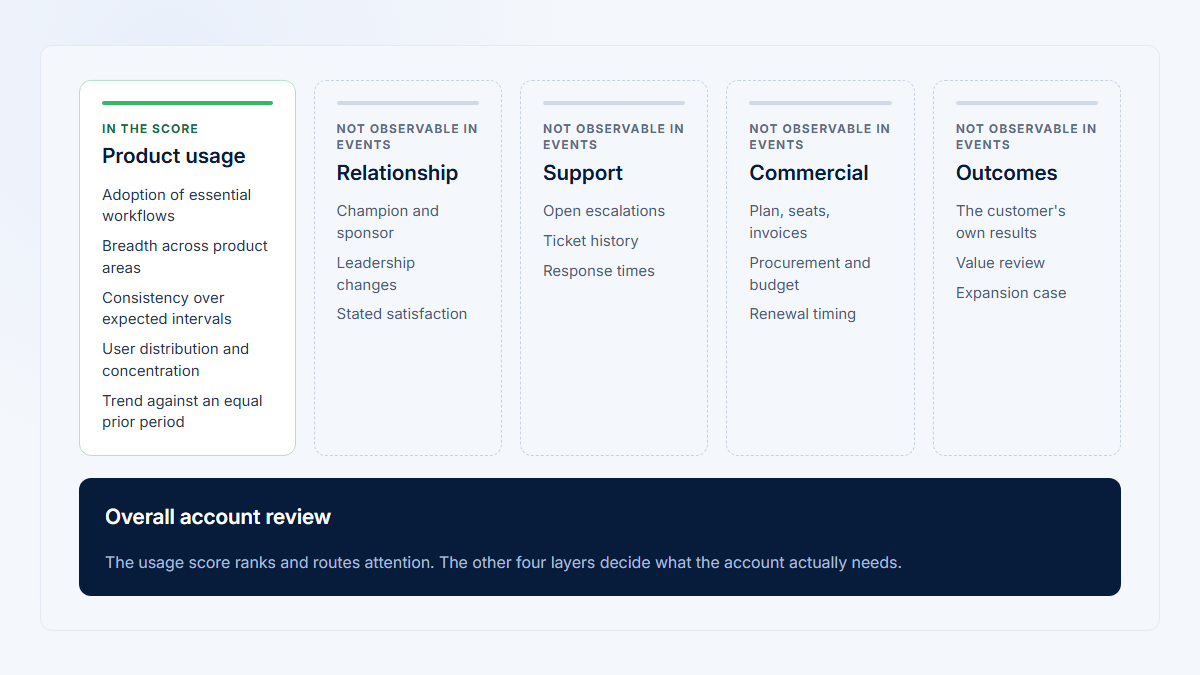
Hymetry is not a customer-success platform. It is a possible product-evidence layer beside either Gainsight or Vitally.
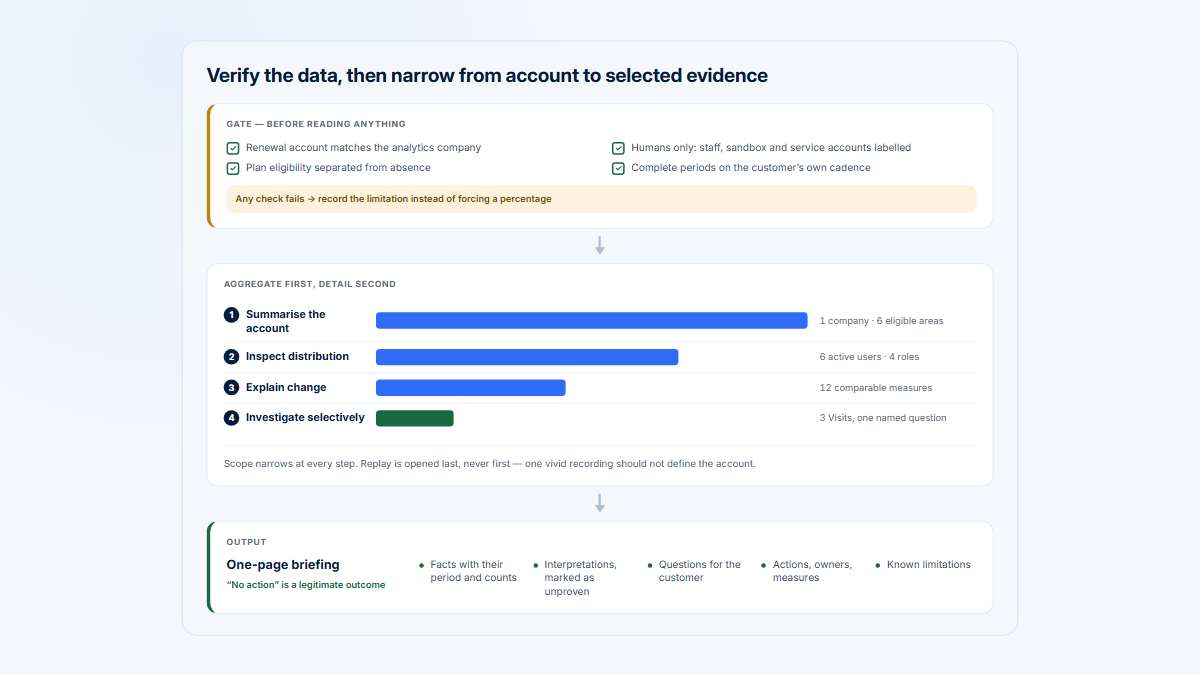
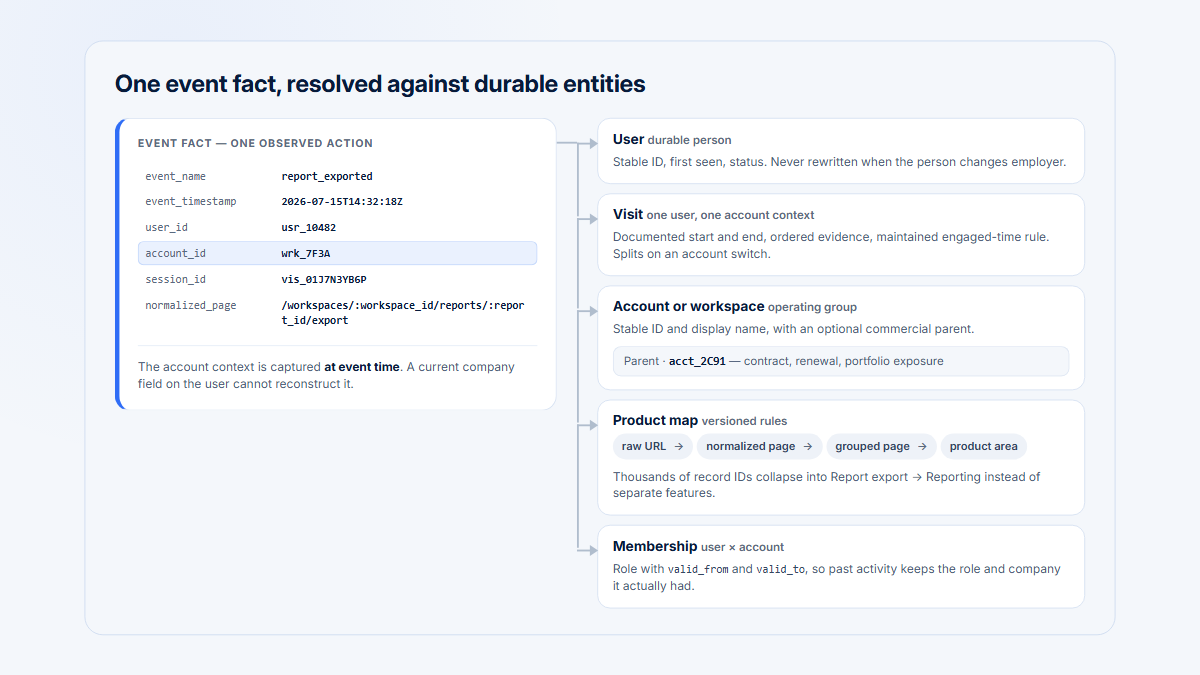
Hymetry connects product areas and grouped pages with Companies, Users, account adoption, adoption breadth, user penetration, usage concentration, and Visits.
Hymetry does not replace health-score configuration, Projects, Success Plans, playbooks, renewal management, CRM context, digital journeys, customer communication, forecasting, or the CSM workspace.
Related workflows include product usage by company, usage before a renewal meeting, product evidence for expansion, and the customer-success use case.
One account investigation, five possible next moves
Converging context
Account investigation
It may inform
“May inform” is deliberate. An investigation that ends in no action is a legitimate result, and recording that is what keeps the health model honest.
FAQ, methodology, and sources
Is Vitally better than Gainsight?
Not universally. Vitally is generally the better start for an integrated, collaborative CSM workspace and comparatively lighter administration. Gainsight is generally better for deeper account modeling, governed health, formal Success Plans, specialized journeys, renewal operations, and extensive configuration.
Can Vitally replace Gainsight?
Yes, when Vitally’s hierarchy, data model, health configuration, reporting, integrations, renewal process, permissions, add-ons, and automation cover the actual requirements. Prove them with representative accounts and workflows instead of assuming similar feature names are equivalent.
Which is easier to implement?
Vitally will usually be lighter because its workspace, Projects, Docs, Hubs, data, and automation share a consolidated model. Gainsight markets Essentials as capable of starting in as little as two weeks, but either implementation depends on data, hierarchy, health, permissions, reporting, migration, and ownership.
Which is better for complex enterprises?
Gainsight is usually the safer start for complex hierarchies, several relationship types, mature CS Operations, formal governance, specialized Success Plans, scaled programs, and dedicated renewal processes. Company size alone is insufficient; a large organization with a simple model may prefer Vitally.
Which is better for collaborative CSM workflows?
Vitally has the clearer advantage when customer-facing Projects, Tasks, Goals, and live Docs are central to onboarding, implementation, and collaboration. Gainsight is stronger when those workflows must sit inside formal CTAs, Success Plans, scorecards, reports, and renewal governance.
Should a company use both?
Usually not. Two overlapping CSPs can duplicate account data, health definitions, tasks, playbooks, communication, reporting, ownership, and forecasts. Using both is more defensible during migration, after an acquisition, or across genuinely separate business units.
Where does Hymetry fit?
Hymetry can supply account-centric product evidence—such as adoption breadth, user penetration, usage concentration, and Visit evidence—to a Gainsight or Vitally investigation. It does not replace either platform’s health, plans, projects, playbooks, communication, renewals, CRM context, or workspace.
Methodology and evidence limits
Research was verified on August 14, 2026. The process scoped Gainsight strictly to Customer Success; reviewed current official product, pricing, packaging, workflow, integration, API, governance, security, AI, and MCP material for both vendors; used G2 for common rating snapshots; and summarized recurring themes without treating individual reviews as universal experience.
No implementation, private demo, procurement quote, contract review, customer interview, controlled test, or benchmark was performed. Vendor documentation establishes available capabilities, not implementation quality or guaranteed outcomes. Scenario recommendations and the platform-versus-workspace distinction are editorial synthesis.
Dynamic changes found during reverification: Vitally MCP is no longer labeled beta and now documents full/read-only endpoints; tracked accounts and full-featured seats are public billing dimensions; Gainsight CS/Staircase MCP are live, Agent Studio remains waitlisted, and Atlas AI Agents / Atlas AI Native Services is a managed renewal offer.
Publisher disclosure
Hymetry publishes this comparison and sells adjacent account-centric product intelligence. It may complement a customer-success platform with product and session evidence. Hymetry is not affiliated with Gainsight or Vitally, received no compensation from either vendor, and did not perform a sponsored product test.
Sources
All source groups were last accessed . Links use descriptive labels; volatile pricing, packaging, review counts, AI status, and media metadata should be rechecked during procurement.
Official Gainsight Customer Success documentation
- Gainsight Customer Success overview
- Gainsight CS Packaging Overview
- Gainsight connectors documentation
- Adoption Explorer overview
- Gainsight API documentation overview
- Scorecard measures and measure groups
- Gainsight Home for CSMs
- Gainsight 360 overview
- Gainsight Company Hierarchy
- Gainsight People Maps
- Create and track a Gainsight Success Plan
- Share a Gainsight Success Plan
- Gainsight CTAs, Tasks, and Playbooks
- Gainsight Timeline overview
- Gainsight CSQL overview
- Gainsight Horizon Reports and Dashboards
- Journey Orchestrator and separate PX integration
- Renewals/Renewal Center overview
- Relationships implementation FAQ
- Gainsight SSO documentation
- Gainsight Permission Bundles
- Gainsight Data Permissions
- Gainsight Field-Level Permissions enablement
- Gainsight User Activity Logs
- Gainsight Data Management Activity
- Gainsight connector Activity Page
- Gainsight Timeline activity and edit history
- Gainsight MCP availability
- Gainsight CS MCP FAQ
- Staircase/Insight Agent subscription prerequisites
- Gainsight Agent Studio waitlist
- Atlas AI Agents / Atlas AI Native Services
Official Vitally product documentation
- Why Vitally
- Vitally Help Center
- Vitally Health Scores
- Hierarchy at Vitally
- Vitally Custom Objects
- Vitally Projects
- Vitally Docs
- Vitally Goals and Goals+
- Vitally Hubs
- Vitally Integrations overview
- Vitally data-warehouse sync schedules
- Vitally Salesforce integration
- Building a renewal and forecasting process
- Vitally Dashboards
- Vitally Data Access add-on
- Vitally Automated Playbook history
- Vitally Trait and Key Role history duration
- Vitally AI and AI+ packaging
- Vitally MCP Server
- Vitally REST API overview
- Lifecycle tracking and billable accounts
- Organization billing and add-ons
- Vitally user roles and permissions
- Vitally full-featured and Observer seat billing guidance
- Vitally SAML SSO
- Vitally Custom Surveys allowance
- Vitally AI Meeting Recorder and audit limitation
Official pricing
Neither vendor publishes a standard dollar price. Public technical limits are not substitutes for contracted commercial allowances.
Customer reviews
- Gainsight Customer Success reviews on G2
- Gainsight Customer Success pros and cons on G2
- Gainsight multi-product seller profile on G2
- Vitally seller profile on G2
- Vitally product reviews on G2
Ratings and counts were verified on August 14, 2026. Themes are directional and do not create a statistically controlled comparison.
Official vendor video and metadata
- Vitally renewal-workflow article
- Vitally renewal-workflow media on Wistia
- Wistia oEmbed metadata
- Wistia media metadata
The media, oEmbed, and click-to-load embed resolved during verification. The media is vendor-produced workflow orientation, not neutral performance evidence. No current neutral Gainsight-versus-Vitally video met the selection threshold.
Hymetry product sources
The repository’s canonical marketing context is the source of truth for Hymetry terminology, positioning, capabilities, and limitations.