Quick comparison
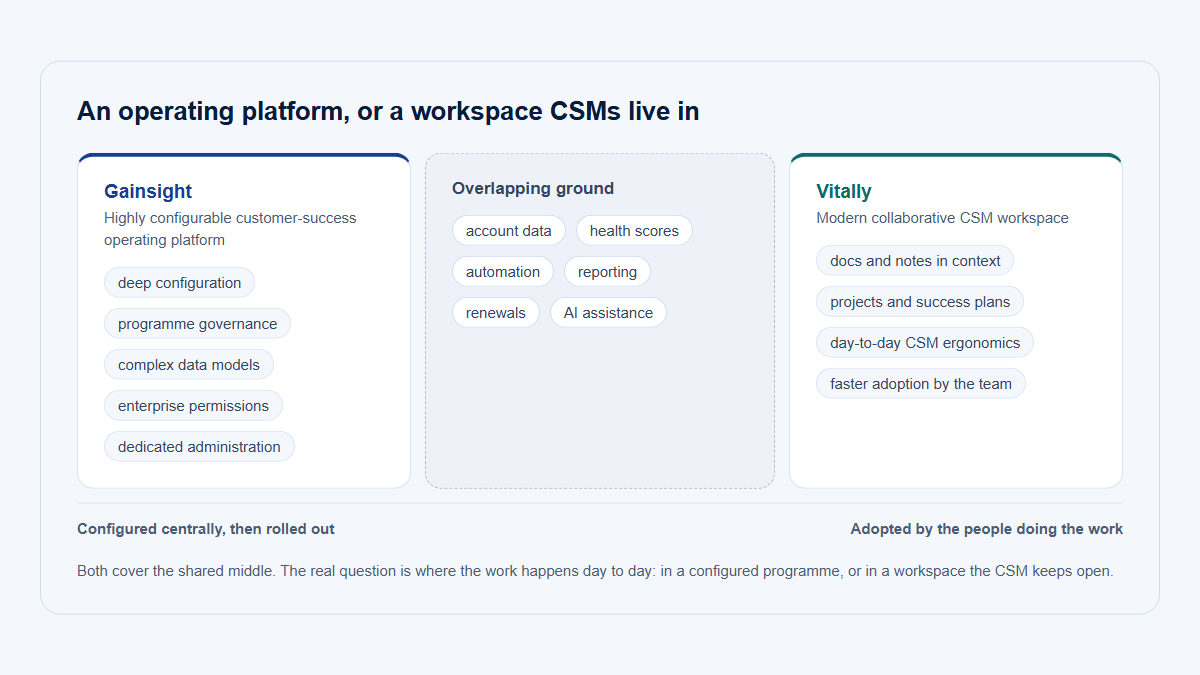
The clearest way to compare Gainsight and HockeyStack is to start with the operating decision each system supports.
Gainsight Customer Success begins with the post-sale account. It brings product usage, support history, stakeholder relationships, communications, health measures, plans, tasks, journeys, renewals, and expansion context into a system that a customer-success organization can act on.
Before the sale, and after it
HockeyStack
Go-to-market and revenue analysis
What connects them
Gainsight Customer Success
Post-sale account action
Winning the customer Keeping and growing the customer
These are not competing purchases for most teams. They answer different questions on either side of the contract, joined by shared identity and data rather than by a native integration.
HockeyStack begins with the GTM journey. It connects campaigns, website activity, contacts, accounts, CRM activity, opportunities, sales touchpoints, product telemetry, and revenue so marketing, sales, and RevOps teams can investigate how pipeline and revenue developed.
Feature overlap does not make the products interchangeable. Both may display an account, contact, product activity, and revenue. The difference is whether those objects support a CS operating process or a GTM measurement and revenue process.
Accounts, CRM, identity, and data sources
Gainsight builds an operational customer record; HockeyStack builds an analytical GTM journey. The same CRM account may appear in both systems, but each gives different weight to the surrounding objects.
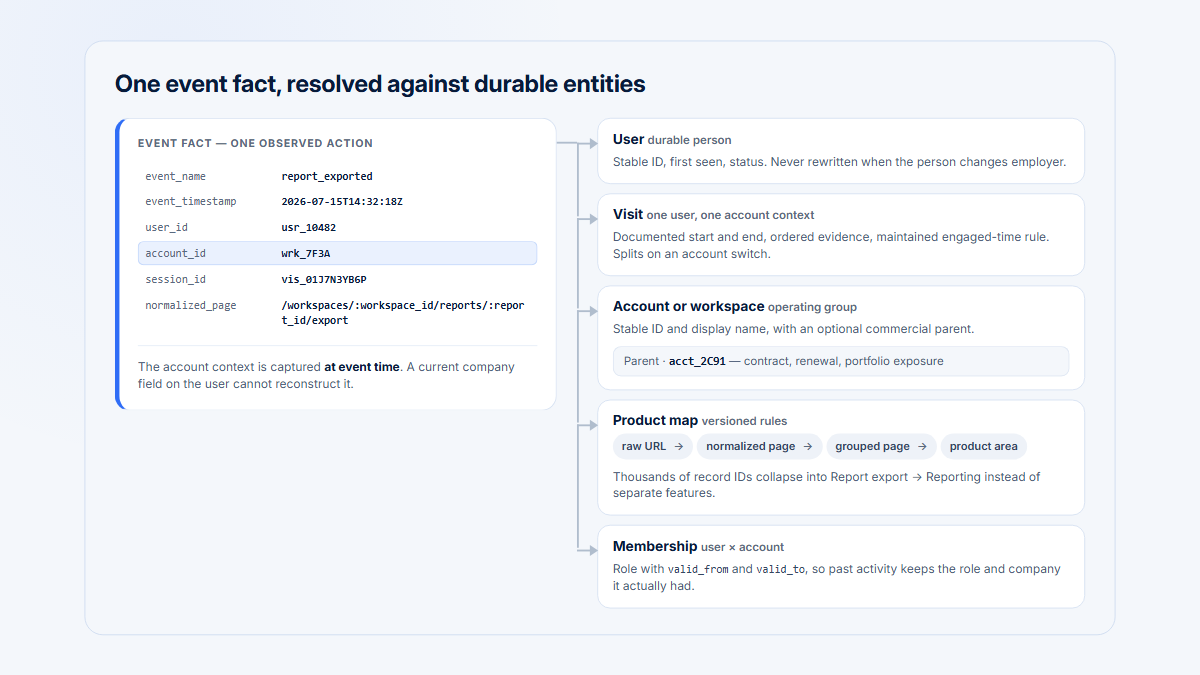
Gainsight’s Customer 360 collects context a CSM or CS leader needs after the sale: people, health, adoption, support history, timeline activity, objectives, renewal information, and account actions. HockeyStack connects companies, contacts, opportunities, campaign touches, sales activity, website behavior, custom actions, and revenue to reconstruct account and deal journeys.
| Data object | Gainsight Customer Success | HockeyStack | What this means |
|---|---|---|---|
| Contact | Person records connected to companies, relationships, CRM, and CS activity. | CRM contacts and identified people connected to company, journey, and deal activity. | Gainsight emphasizes post-sale relationships; HockeyStack emphasizes GTM participation. |
| Customer account | Customer 360 is a central operational record. | Company or account is a central analytical and agent object. | Both are account-aware; the surrounding workflow differs. |
| Product user | Person-level usage can enter Adoption Explorer and health or adoption analysis. | Identified product activity can enter as telemetry or custom actions. | Gainsight operationalizes adoption for CS; HockeyStack relates usage to journeys and revenue. |
| Stakeholder | People Maps, sponsor context, and stakeholder tracking support account management. | Stakeholder discovery and personas support buying-committee and sales research. | Gainsight is stronger after the sale; HockeyStack during buying and deal work. |
| Opportunity | Can ingest CRM opportunity context and support CSQL, renewal, or expansion workflows. | Deal and opportunity analysis is central. | HockeyStack provides deeper acquisition-pipeline analysis. |
| Contract or subscription | Represented through CRM and renewal data; Renewal Center supports commercial workflows. | Imported from CRM, custom sources, or a warehouse; no dedicated CS contract workspace. | Having contract data is not managing a renewal process. |
| Product event | Adoption Explorer accepts company- and person-level usage data. | Product telemetry and custom actions can become journey touchpoints. | Both can use events; neither should treat one event as complete customer truth. |
| Health signal | Native health scorecards combine configurable measures. | Intent, account, engagement, and deal scores support GTM prioritization. | HockeyStack scoring is not a CS health model. |
| Campaign | Campaign data may be ingested or used in journeys; attribution is not the core model. | Campaign touches and attribution are central. | Choose HockeyStack for marketing pipeline or revenue credit. |
| Sales activity | CRM and timeline activity inform the customer record. | Calls, emails, meetings, and CRM activity contribute to buyer and deal journeys. | HockeyStack analyzes sales touches as GTM evidence. |
| Support interaction | Support history can contribute to Customer 360, health, and risk investigation. | May enter as custom or warehouse data; support workflow is not core. | Gainsight gives support evidence a clearer post-sale role. |
| Revenue | Renewal, retention, and expansion context. | Pipeline, deal value, revenue, and attribution reporting. | Gainsight supports commercial CS action; HockeyStack supports GTM revenue analysis. |
| Account hierarchy | Business models, relationships, and account structures support complex customers. | Company, contact, opportunity, and buying-committee relationships. | Gainsight is better suited to operational customer hierarchies. |
| Warehouse data | Snowflake, S3, APIs, and data-management tools can feed CS analysis. | Imports and syncs connect warehouse and custom data with GTM journeys. | A warehouse helps consistency but still needs shared definitions. |
The practical question is not whether a record can enter each platform. It is whether the platform gives the responsible team the workflow, permissions, calculations, and actions needed to use it consistently.
Customer health, playbooks, and post-sale operations
Gainsight Customer Success is substantially stronger for running a customer-success organization. HockeyStack can reveal useful account and product signals, but it does not reproduce Gainsight’s post-sale operating model.
Gainsight combines configurable health measures with Success Plans, playbooks, tasks, digital journeys, surveys, stakeholder information, renewal context, and CSM collaboration. A risk signal becomes more useful when it can be assigned, investigated, discussed, and followed through a repeatable process.
| Workflow | Gainsight Customer Success | HockeyStack |
|---|---|---|
| Onboarding | Success Plans, playbooks, tasks, journeys, milestones, and account context. | Can analyze activity; no native CSM onboarding-plan system. |
| Success Plans | Native | Not core |
| Health scores | Native configurable scorecards and measures. | No equivalent CS health-score operating model. |
| Account segmentation | For CS programs, reporting, journeys, and scorecards. | Company, deal, intent, and saved-view segmentation for GTM use. |
| Playbooks | Native CSM playbooks and calls to action. | Agent tasks and GTM workflows are not CS playbooks. |
| Tasks | Within playbooks, calls to action, plans, and CS workflow. | Supported for select customers with Revenue Agents enabled. |
| Digital journeys | Journey Orchestrator and digital-CS functions. | Can analyze journeys; not a digital-CS orchestration platform. |
| Renewal management | Renewal Center is a paid Essentials add-on and included with Enterprise. | Can analyze expansion or opportunity data; no complete renewal process. |
| Expansion workflows | CSQL, playbooks, health, account context, and Renewal Center can support expansion. | Can reveal signals and analyze related pipeline or revenue. |
| Customer feedback | Native surveys and survey analytics. | No native CS feedback program identified in reviewed materials. |
| Stakeholder tracking | People Maps, sponsor tracking, relationships, and timeline context. | Buying-committee and stakeholder discovery for sales; less complete post-sale. |
| CSM collaboration | Shared timeline, tasks, plans, scorecards, and account views. | Collaboration centers on GTM research, reports, deals, agents, and tasks. |
| Risk investigation | Combines health, adoption, support, stakeholders, activity, and action workflow. | Can reveal account changes but lacks the full CS investigation-and-action framework. |
HockeyStack may reveal that an account’s activity, product usage, opportunity history, or engagement changed. That is supporting evidence for GTM analysis or prioritization, not a native customer-success workflow system.
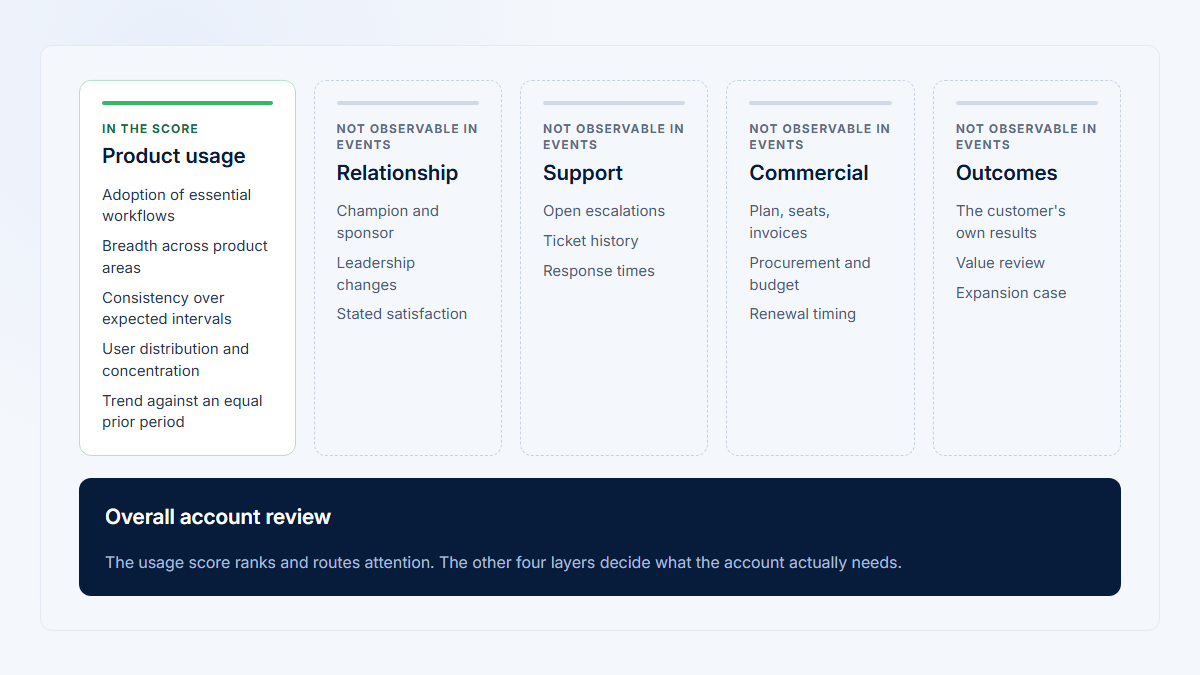
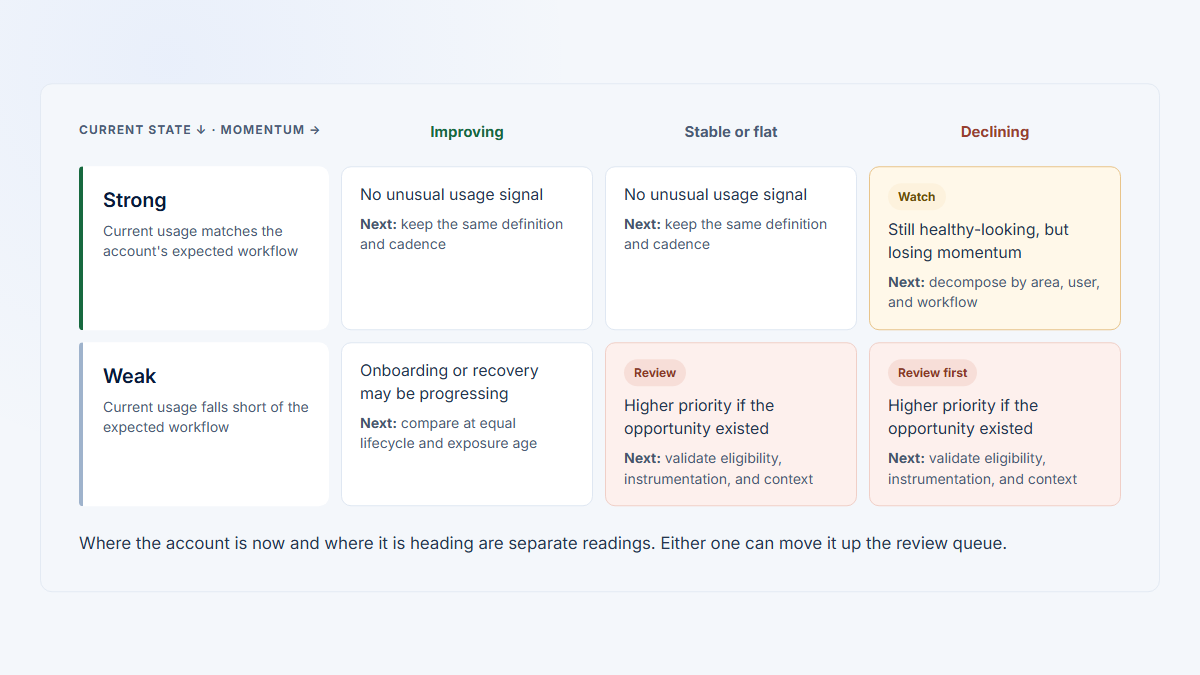
A customer health score is most useful when its components remain visible. A usage drop deserves attention, but a CSM should inspect affected users, product areas, support context, commercial state, and objectives. The same principle applies to finding at-risk accounts from product usage.
Attribution, pipeline, and revenue intelligence
HockeyStack is stronger for explaining GTM journeys and assigning pipeline or revenue credit. Gainsight’s post-sale depth does not substitute for a purpose-built attribution and revenue-intelligence model.
HockeyStack combines campaign activity, website behavior, contacts, companies, CRM records, sales touches, opportunities, product telemetry, and revenue. Teams can apply attribution models, inspect account and deal journeys, report on pipeline, and—where enabled—use agent workflows to research or act on GTM signals.
| Workflow | Gainsight Customer Success | HockeyStack |
|---|---|---|
| Campaign attribution | Not core. | Core |
| Account journey | Strong post-sale customer timeline and activity context. | Strong pre-sale and revenue-oriented account journey. |
| Buyer touchpoints | May appear through CRM or timeline integrations; not the primary analytical model. | Core across marketing, website, sales, and custom activity. |
| CRM activity | Ingested for post-sale context and workflow. | Central to journey, deal, pipeline, and agent analysis. |
| Pipeline | Relevant renewal, expansion, or imported opportunity context. | Core |
| Opportunity analysis | Post-sale commercial context and expansion signals. | Core deal and opportunity analysis. |
| Deal journey | Not a primary acquisition-analysis workflow. | Core |
| Revenue reporting | Stronger for retention, renewal, and expansion operations. | Stronger for GTM-sourced pipeline and revenue reporting. |
| Marketing ROI | Not core. | Core, subject to the attribution model and cost data. |
| Sales reporting | CS-oriented account and commercial reporting. | Sales-touch, opportunity, deal, account, and agent reporting. |
| Product-usage contribution | Adoption can influence health and CS action. | Telemetry can be analyzed with opportunities and revenue. |
| Executive reporting | Customer health, retention, adoption, and renewal views. | Marketing, sales, pipeline, attribution, and revenue views. |
Gainsight can ingest CRM activity and commercial data, and support renewal and expansion reporting. It is not the neutral system for multi-touch marketing attribution, paid-channel ROI, or acquisition-pipeline analysis.
One lifecycle, different questions per team
1
Campaign
2
Multiple buyers
3
Opportunity
4
Contract
5
Onboarding
6
Adoption
7
Renewal and expansion
HockeyStack focus
Gainsight focus
Shared product evidence
Handover risk
The same customer generates different questions for marketing, RevOps, product, sales and customer success. Context is most often lost at the contract-to-onboarding handover — that gap is organisational, and no tool closes it by itself.
Product usage, AI, integrations, and implementation
Product usage answers different questions in each platform
Gainsight Customer Success uses product data for adoption analysis, health, segmentation, risk review, renewal preparation, and CSM action. Adoption Explorer can model company- or person-level usage, and receive data through connectors, APIs, S3, Snowflake, or Gainsight PX.
HockeyStack can ingest PLG telemetry and custom user or company actions, placing them beside campaign, website, sales, CRM, opportunity, and revenue activity. That supports questions such as whether engagement appeared before an assisted conversion or expansion opportunity. It is not a dedicated product-analytics workspace or complete customer-success adoption model.
AI is packaged around different work
Gainsight CS packaging lists Impact Analyzer, Scorecard Optimizer, Write with AI, AI Cheat Sheet, AI Follow-Up, and AI Takeaways. Its MCP is live, but public packaging is not stated. Agent Studio currently invites buyers to a waitlist. Named Handoff, Risk, and Expansion analysts appear in Staircase materials and require a separate Staircase subscription, so they should not be assumed in every CS package.
HockeyStack uses AI for GTM analysis, account research, stakeholder discovery, deal work, recommendations, and tasks. Current docs label the relevant Revenue Agents pages as limited access for select customers. Agent Credits are usage-metered at published per-action rates; contract bundles and prices are not public. Do not conflate Gainsight’s Atlas services with HockeyStack’s Atlas data foundation.
Integration breadth does not remove implementation work
Gainsight implementation requires a company and person model, health-score governance, roles and permissions, playbooks, lifecycle definitions, integration work, and ongoing administration. Essentials is marketed with a faster onboarding path, but no implementation-time claim is guaranteed.
HockeyStack requires reliable website and identity tracking, clean CRM objects, opportunity and revenue definitions, channel-cost data where ROI is calculated, attribution governance, and report validation. The Self-Serve plan is self-implemented; assisted deployment depends on the agreement. Warehouse imports and exports require the Data Warehouse add-on.
Shared architecture
GTM evidence layer
HockeyStack
- Campaigns and buyer journey
- Sales touchpoints
- Pipeline and revenue
- Attribution
Post-sale action layer
Gainsight Customer Success
- Post-sale account context
- Health and Success Plans
- Playbooks and CSM workflows
- Renewal and expansion operations
A shared CRM account ID can connect the layers. Product usage can enter both for different purposes, while a warehouse can hold normalized account, user, product, support, and commercial data. The architecture works only when identity rules and metric definitions are governed across teams.
One governed account identity, three different workflows
Sources
Governed account data
Consumers
A governed account identity can feed distinct GTM, customer-success and product-evidence workflows. Assume you are building that join, not buying it.
Useful videos
The selected videos show current positioning and workflows. They are orientation material, not neutral proof of product performance.
Pricing and customer feedback
Gainsight is quote-based; HockeyStack now has both a public Self-Serve offer and sales-led custom pricing. Compare package boundaries and cost drivers, not an invented like-for-like seat price.
Gainsight publicly identifies Essentials and Enterprise but requires a pricing request. Its packaging documentation gives more detail than the pricing page about full users, customer records, Viewer entitlements, advanced modules, and limits.
| Pricing or review item | Gainsight Customer Success | HockeyStack |
|---|---|---|
| Free plan or trial | No public self-serve CS free plan or standard trial identified; request a demo or quote. | No permanent free plan. Self-Serve has a 14-day card-required trial; cancel before it ends to avoid charge. |
| Public or custom pricing | Custom pricing for Essentials and Enterprise. | Self-Serve $1,250/month with no annual commitment; broader plans custom-built and startup pricing advertised. |
| Billing unit | Quote combines package, full users, customer records, modules, services, and entitlements. | Self-Serve monthly price; broader plan billing unit is not publicly disclosed. |
| Account or user limits | Essentials: 10 full users, 1,000 records, 100 records/full user, 2 Viewer+ per full user, unlimited Viewers, 50-full-user cap. Enterprise: 20 full users, 4,000 records, 200 records/full user, 4 Viewer+ per full user, unlimited Viewers; the full-user-limit field is N/A. | Self-Serve: up to 5 team members and 20,000 tracked users/month. Broader public limits are not disclosed. |
| AI or service packaging | Named AI functions in CS packages; Renewal Prediction depends on Renewal Center. MCP packaging undisclosed; Agent Studio waitlisted; Atlas is separate managed service. | Relevant Revenue Agents are limited to select customers; public per-action credit rates, but bundles and contract price are undisclosed. |
| Implementation services | Vendor, partner, and packaged options; scope depends on data and operating design. | Self-Serve is self-implemented with async support and no dedicated CSM; assisted scope depends on the agreement. |
| Integration dependencies | CRM, usage, support, communication, and warehouse inputs determine Customer 360 and health quality. | Tracking, CRM, marketing, sales, cost, telemetry, and warehouse inputs determine journey and attribution quality. |
| G2 rating and review count | 4.5/5 from 1,754 reviews. | 4.5/5 from 81 reviews. |
| Verification date | ||
| Official links | Customer Success · Packaging · Pricing | Self-Serve · Platform · Pricing |
Quote-based CS packages
Gainsight Customer Success
Custom quote
Essentials and Enterprise differ in included users, customer records, Viewer+ entitlements, advanced modules, and Renewal Center packaging.
Public entry offer
HockeyStack
$1,250/month
Self-Serve Marketing Intelligence, no annual commitment, 14-day card-required trial, up to five team members and 20,000 tracked users/month. Broader plans are sales-led.
G2 snapshot
Gainsight Customer Success
G2 snapshot
HockeyStack
A matching average does not mean matching evidence. Gainsight’s review base in this snapshot is more than twenty times larger, and the products serve different categories. Use reviews to identify implementation and usability themes, not to declare a numerical winner.
Compact review themes
| Product | Recurring praise | Recurring friction | Evidence caution |
|---|---|---|---|
| Gainsight Customer Success | Broad CS functionality, configurable Customer 360 views, workflow standardization, automation, and support for mature post-sale programs. | Implementation complexity, administrator dependence, learning curve, and deliberate configuration. | Qualitative summary of public reviews, not measured frequency. |
| HockeyStack | Flexible attribution, connected journey visibility, cross-channel reporting, and pipeline or revenue context. | Initial data connection, report complexity, model interpretation, and occasional reliability or support concerns. | Smaller sample; do not generalize to every implementation. |
Which one fits your scenario?
The best product depends on the team that owns the decision and the action that must follow it.
| Scenario | Recommended fit | Why | Watch-out |
|---|---|---|---|
| Customer-success operations team | Gainsight Customer Success | Native health, plans, playbooks, journeys, tasks, surveys, renewals, and account workflow. | Requires governance and administration. |
| Demand-generation team | HockeyStack | Campaign, buyer-journey, attribution, pipeline, and marketing-ROI analysis. | Document and understand attribution settings. |
| RevOps organization | HockeyStack for acquisition and pipeline; both when RevOps also governs retention. | HockeyStack matches the pre-sale revenue model; Gainsight provides post-sale operating depth. | Avoid conflicting account, opportunity, or revenue definitions. |
| Enterprise CSM team | Gainsight Customer Success | Customer 360, complex stakeholders, health, plans, renewals, and coordinated account action. | Implementation breadth can become overhead. |
| PLG SaaS with sales assistance | Often both | HockeyStack relates engagement to buyer and revenue journeys; Gainsight turns adoption into post-sale action. | Product identity and account matching must be consistent. |
| Company preparing renewals | Gainsight Customer Success | Renewal context, health, stakeholders, plans, risk, and CSM workflow are central. | Do not reduce readiness to product usage alone. |
| Organization evaluating expansion | Gainsight for account workflow; HockeyStack for touchpoint and revenue analysis. | Expansion requires customer evidence and commercial context. | An expansion signal is not proof of purchase intent. |
| Pre-sale and post-sale account intelligence | Both | Each platform answers a distinct lifecycle question. | Added cost, integration, governance, and overlapping dashboards. |
For a deeper view, see product usage and expansion opportunities and product usage before a renewal meeting.
Compact customer-lifecycle scenario
Fictional scenario: BluePeak Cloud attracts several people from one prospect, creates an opportunity, signs a contract, onboards multiple users, sees Reporting adoption and support tickets, approaches renewal, and considers expansion.
| Lifecycle question | Gainsight Customer Success | HockeyStack | Recommended owner |
|---|---|---|---|
| Which campaign created pipeline? | Not the primary system. | Attributes campaign and touchpoint credit under the selected model. | Demand Generation or Marketing Ops |
| What was the buyer journey? | May retain selected CRM context after the sale. | Reconstructs account, contact, website, campaign, sales, and opportunity activity. | RevOps |
| What is the onboarding plan? | Success Plans, playbooks, tasks, and journeys. | Can show activity but does not manage the CSM plan. | CSM or CS Ops |
| Are users adopting Reporting? | Uses product data for account and user adoption context. | Can include Reporting activity in the account or revenue journey. | Product Ops with CS |
| What is the account’s health? | Applies the organization’s configurable health model. | Provides engagement or intent signals, not a native CS health score. | CSM |
| Do support tickets create risk? | Combines support context with health and account action. | May ingest support activity; lacks the full post-sale workflow. | CSM with Support |
| What should be prepared for renewal? | Health, plans, stakeholders, adoption, support, outcomes, and commercial context. | Contributes original acquisition, engagement, and revenue context. | Account owner or renewals team |
| What supports expansion? | Adoption gaps, active users, stakeholders, health, and CSQL workflow. | Product, sales, opportunity, campaign, and revenue signals. | CSM and account executive |
| How should revenue credit be assigned? | Not a marketing-attribution system. | Applies the selected attribution model. | Marketing Ops or RevOps |
| What should the CSM do next? | Turns evidence into a plan, playbook, task, journey, or account action. | Can reveal signals but not the complete CSM workflow. | CSM |
No single metric settles every row. BluePeak needs consistent account identity and shared definitions so its campaign, opportunity, contract, users, support activity, renewal, and expansion do not become separate versions of the customer.
Can one replace the other?
| Question | Short answer | Main compromise |
|---|---|---|
| Can Gainsight replace HockeyStack? | Generally no when the organization needs marketing attribution, detailed buyer journeys, pipeline analysis, and GTM revenue reporting. | Gainsight can hold commercial context but does not reproduce HockeyStack’s attribution and acquisition-journey model. |
| Can HockeyStack replace Gainsight? | Generally no when the organization needs a full customer-success operating system. | HockeyStack lacks native Success Plans, CS health governance, CSM playbooks, digital-CS programs, and complete renewal workflow management. |
| Should a B2B SaaS company use both? | Often, when mature pre-sale and post-sale teams have distinct operating needs. | Additional cost, integration, identity governance, overlapping reports, and ownership questions. |
The decision is not “Gainsight or HockeyStack?” in the abstract. It is whether the immediate gap is post-sale customer-success execution, pre-sale GTM intelligence, or the connection between them.
Where Hymetry fits
Hymetry is an account-centric product-intelligence and product-evidence layer for B2B SaaS, not a full replacement for Gainsight Customer Success or HockeyStack.
It connects product areas and grouped pages with Companies, Users, account adoption, adoption breadth, user penetration, usage concentration, and Visits. Its Pages view helps teams organize behavior around meaningful workflows rather than only raw URLs or events.
Focused product evidence
How Hymetry complements them
Hymetry may supply focused usage evidence to a Gainsight workflow before a CSM acts. It may complement HockeyStack by explaining what users from a customer company do inside the product while HockeyStack connects GTM touchpoints with pipeline and revenue.
Deliberate boundary
What Hymetry does not replace
Hymetry does not replace Gainsight playbooks, Success Plans, renewals, stakeholder and CRM context, or broader CS operations. It does not replace HockeyStack attribution, buyer journeys, pipeline analysis, or revenue intelligence.
Evidence discipline
What the evidence can support
Product data is one part of a wider customer decision. It should not be treated as automatic proof of health, churn, renewal, expansion, attribution, or commercial intent.
See the Hymetry customer-success use case for the product-evidence perspective.
FAQ, methodology, and sources
Frequently asked questions
Is HockeyStack a Gainsight alternative?
Only for a narrow overlap in account, CRM, product, and revenue visibility. HockeyStack is plausible when the real requirement is GTM intelligence, attribution, account journeys, pipeline, or revenue analysis. It is not a direct alternative to Gainsight’s Success Plans, health scorecards, CSM playbooks, digital-CS programs, and renewal operations.
Can Gainsight replace HockeyStack?
Not for organizations that need detailed campaign attribution, buyer-journey reconstruction, marketing ROI, deal-journey analysis, and acquisition-pipeline reporting. Gainsight can ingest related CRM and commercial data, but Customer Success is organized around post-sale action.
Which is better for customer success?
Gainsight Customer Success. It is purpose-built for Customer 360, health, plans, playbooks, digital journeys, feedback, stakeholders, renewals, expansion, and CSM collaboration. HockeyStack can contribute account evidence but is not a full customer-success operating system.
Which is better for attribution and revenue?
HockeyStack. Attribution, buyer and account journeys, campaign touches, sales activity, opportunities, pipeline, and revenue reporting are central to its GTM model. Attribution remains a selected credit-assignment rule rather than causal proof.
Which uses product-usage data?
Both can. Gainsight uses product data for adoption, health, segmentation, renewal preparation, and CS action. HockeyStack can include telemetry or custom actions in account, deal, attribution, and revenue analysis. Neither should treat activity as the complete explanation for an outcome.
Should a B2B SaaS company use both?
Possibly. The combination is most defensible when marketing, sales, RevOps, and customer success have mature but distinct workflows and share reliable account identity. A smaller team should first identify the decision it cannot make today before accepting two broad platforms.
Where does Hymetry fit?
Hymetry provides account-centric product evidence across product areas, grouped pages, Companies, Users, adoption, and Visits. It may feed or complement decisions made in Gainsight and HockeyStack, but does not replace their CS workflow or GTM revenue functions.
Methodology
Research method and evidence limits
This desk-research comparison was verified . No hands-on implementation or controlled product test was performed.
- Current official product and packaging documentation.
- Current official pricing pages.
- Official integration and data-model documentation.
- G2 pages for comparable rating snapshots and qualitative themes.
- Selected videos for current product and market context.
- High confidence: current names, packages, documented modules and data sources, pricing posture, and dated rating snapshot.
- Editorial comparison: workflow-fit judgments derived from documented product models.
- Qualitative: recurring review themes, without statistical-frequency claims.
- Unproven: vendor outcomes, health predictions, attribution causality, and AI-generated outcomes; none are treated as established facts.
Prices, packages, counts, availability, and videos can change. “Not identified” describes reviewed public evidence, not contractual impossibility.
Sources
All source groups were last accessed .
Official Gainsight product and packaging sources
Official HockeyStack product and data sources
Pricing sources
Customer ratings and review context
Review themes are directional. Different sample sizes, buyer contexts, categories, and implementations prevent a numerical winner.
Independent and video material
- Gainsight Demo — AI-Native Customer Success and Retention in Practice
- The End of GTM Sprawl: How HockeyStack Is Rebuilding Go-to-Market Around AI, with Emir Atli
- GTMnow companion episode page
Both videos were live and embeddable at verification. Each includes a vendor representative and is orientation material, not independent product testing.