Quick comparison
Pendo and Gainsight Customer Success overlap around product usage at the account level, but they start from different operating questions. Searches for a “Pendo alternative” or “Gainsight alternative” often mix categories: these are not interchangeable B2B SaaS customer-lifecycle products.
Pendo starts with product behavior. Its current Software Experience Management platform collects or receives user and account activity, lets teams define pages, features, and events, analyzes journeys, connects aggregate patterns to replay, and can target in-product interventions. Gainsight Customer Success starts with the customer account. It consolidates product-usage summaries with CRM, support, billing, relationship, renewal, survey, and communication data, then applies health models and operational workflows.
Where the categories diverge
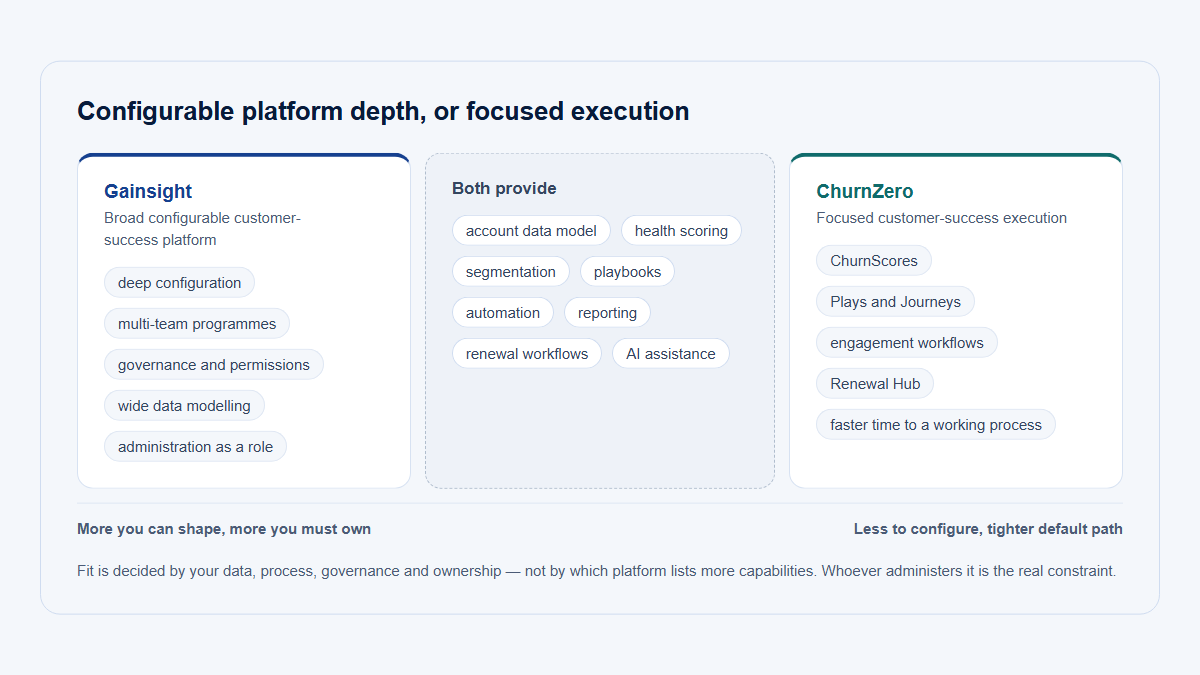
That difference matters more than the length of either feature list. A product team investigating an onboarding drop-off needs event-level journey analysis and replay. A CSM preparing a renewal needs a 360-degree account record, stakeholders, contractual timing, open risks, tasks, and a repeatable process. Product analytics can strengthen the renewal conversation, but it does not create the commercial context or own the follow-through.
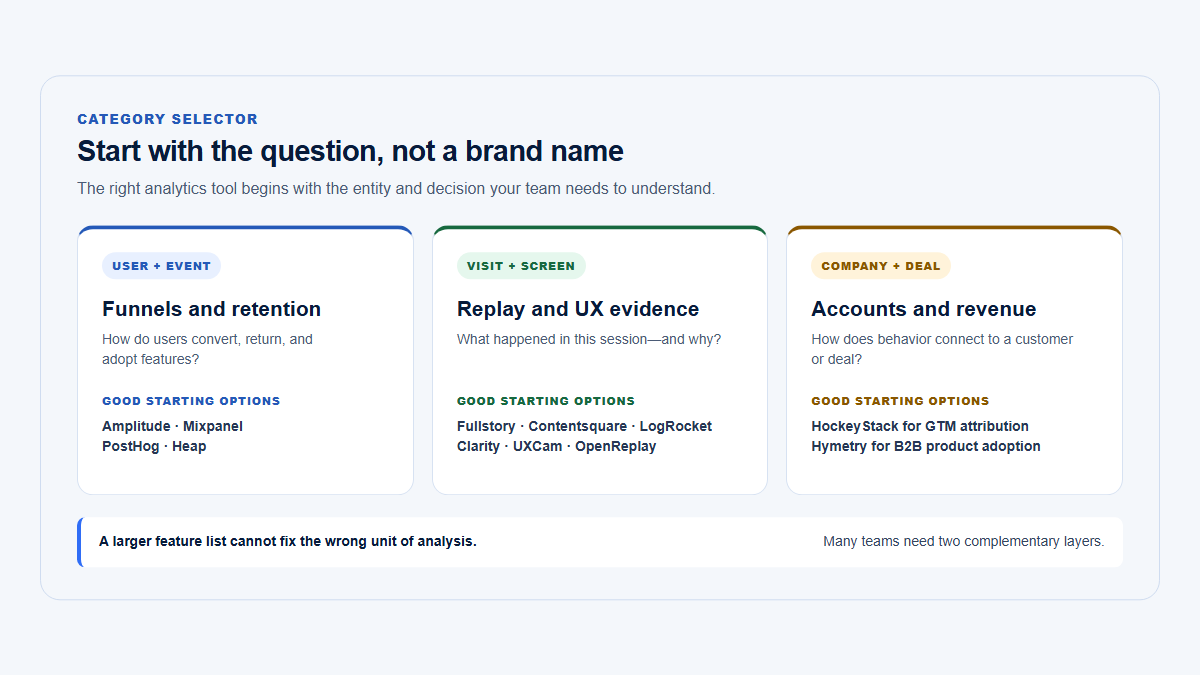
For broader category context, see the product analytics tools comparison.
| Question | Pendo | Gainsight Customer Success | What this means |
|---|---|---|---|
| Which features do users adopt? | Direct answer: Pages, Features, Track Events, segments, retention, and account reports | Adoption Explorer reports imported usage; optional Adoption Tracker captures a bounded set of mapped web features prospectively | Use Pendo for behavioral detail; use Gainsight to operationalize selected metrics for account teams |
| Where do users abandon onboarding? | Funnels, paths, workflows, and replay isolate the drop-off | Can show an onboarding-stage account with weak usage but does not reconstruct a native journey | Diagnose the product journey in Pendo; coordinate intervention in Gainsight |
| Which in-app guide improves completion? | Guide analytics compare reach and behavior around interventions | Gainsight CS alone does not build the in-app guide | This is a Pendo workflow unless the Gainsight stack separately includes PX |
| Which accounts have weak product usage? | Account reports, metadata, segments, and usage trends | Adoption Explorer, C360, rules, scorecards, and optional Adoption Tracker can surface account-level usage | Both help; Gainsight adds wider customer context and an action system |
| Which stakeholders own the relationship? | Visitor/account metadata adds context, but stakeholder mapping is not the core model | People, organizational maps, sponsor tracking, roles, and relationship records | Gainsight is the stronger system for relationship ownership |
| Which accounts need a CSM playbook? | Can produce a usage segment or alert input | Rules, health changes, CTAs, playbooks, and Cockpit assign work | Pendo supplies evidence; Gainsight owns repeatable CSM action |
| Which renewals require attention? | Reveals adoption change but lacks a renewal pipeline/workflow | Renewal Center, health, timelines, forecasts, and CRM context prioritize renewals | Commercial prioritization belongs in the CS/revenue operating layer |
| Which behavior supports an expansion discussion? | Identifies adoption breadth, feature demand, seats/users, and growing engagement | Combines usage with contract, relationship, goals, CSQL, and opportunity context | Behavior is evidence, not buying intent; Gainsight can route the follow-up |
| Can the platform prove churn or renewal intent? | No. Usage is a signal; Predict is a separate modeled product | No. Configured health and forecasts do not reveal intent with certainty | Require source evidence and human review in either system |
| Question | Short answer | Main compromise |
|---|---|---|
| Can Pendo replace Gainsight Customer Success? | Usually no when the team needs a formal CS operating system | Health, stakeholder context, CSM tasks, success plans, renewals, and cross-functional governance must exist elsewhere |
| Can Gainsight Customer Success replace Pendo? | Usually no when the team needs granular product journeys, replay, and native in-app guidance | Adoption Explorer and optional Adoption Tracker can operationalize usage, but CS alone does not provide the same investigation and guide-building loop |
| Should a B2B SaaS company use both? | Often yes when product behavior materially informs onboarding, health, renewal, or expansion | The stack only works well when identity, account matching, metric ownership, and freshness are governed |
In-product adoption and post-sale customer-success operations
In-product behaviour, or post-sale account operations
Pendo
In-product behaviour
They meet here
Gainsight Customer Success
Post-sale account operations
“Is the feature working?” “Is the account healthy?”
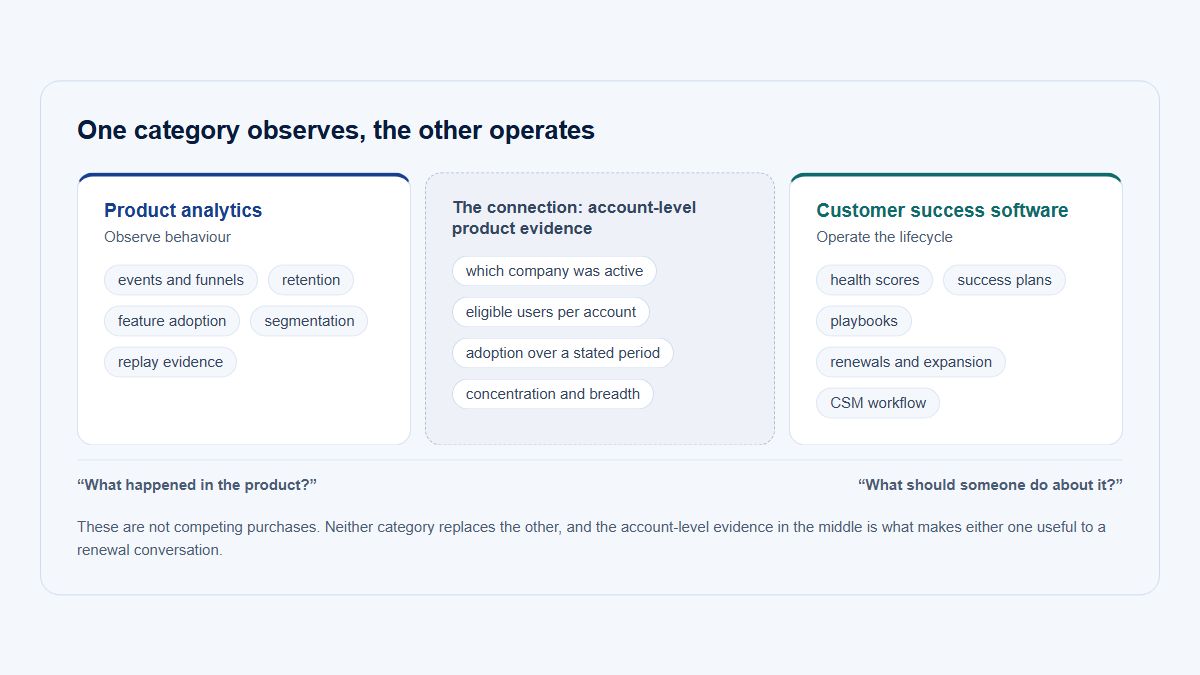
The overlap is narrow and specific: account-level product usage. Most teams need both sides, and the interesting question is which system owns that shared middle.
Users, accounts, product usage, and identity
The most important technical difference is not simply “users versus accounts.” Both platforms can work with people and customer companies. The difference is what each data model is expected to do.
Pendo’s product data is organized around Visitors, Accounts, apps, Pages, Features, Track Events, guides, and sessions. A product event can carry a Visitor ID and Account ID, while account and visitor metadata support segmentation.
Identity and account context
Teams can compare behavior by role, plan, region, account, or another supplied attribute. Pendo can also handle anonymous visitors, subject to implementation and subscription details, then connect behavior to an identified profile when identity is configured correctly.
Gainsight Customer Success is designed around customer Companies, People, Relationships, hierarchies, timelines, health, activities, goals, CTAs, and commercial records. Core Adoption Explorer ingests company- and person-level product-usage information, daily or weekly time-series metrics, and entitlements, then surfaces aggregates in C360, reporting, and rules. The separately purchased Adoption Tracker add-on can collect prospective web usage for a bounded set of mapped products and features. Neither route recreates Pendo’s broader journey-analysis surface.
- Read account-level versus user-level adoption for the underlying B2B measurement problem and product usage by company for a practical account model.
| Data object or context | Pendo | Gainsight Customer Success |
|---|---|---|
| Anonymous user | Supported in product analytics when configured; identity mapping and packaging details can apply | Not the primary CS model; anonymous behavior normally arrives from an upstream system |
| Identified product user | Visitor ID, metadata, activity, segments, timelines, guides, and replay context | Person and Company Person records, roles, communications, relationships, activities, and imported usage |
| Company or account | Account ID, metadata, reports/details, segments, and account-level product activity | Core Company/C360 record with business, health, relationship, activity, product, support, and renewal context |
| User-to-company relationship | Event/account association and visitor/account metadata follow the implementation’s identity rules | Company Person and Relationship Person models support roles, reporting, and stakeholder context |
| Account hierarchy | Limited as a CS operating construct; model through metadata or external systems | Native company hierarchy and relationship structures for parent/child and business-unit scenarios |
| Product events | Native Page, Feature, Track Event, guide, and related behavior | Core CS imports usage metrics; paid Adoption Tracker can prospectively collect mapped web feature/page-view data within documented limits |
| Product pages and features | Native visual tagging, definitions, Product Areas, event reporting, and retroactive analysis for supported event types | Not a Pendo-style feature tree in core CS; Adoption Tracker supports up to three products and 50 mapped features per product, without backfill |
| CRM contacts | Available as metadata through integrations, but Pendo is not the contact system of record | Central to the Person, Company, Relationship, and CRM-linked model |
| Stakeholders | Metadata can identify role or account context | People Maps, organizational roles, sponsor tracking, and relationship context; packaging varies |
| Contracts and renewals | Imported metadata or downstream integration; no native renewal process | Opportunity context, Renewal Center, forecasts, timelines, CTAs, and reports; confirm package |
| Product-usage summaries | Native visitor/account analytics and exports | Adoption Explorer time series, derived metrics, entitlements, C360 usage sections, and optional Adoption Tracker |
| Support and billing data | Brought in as metadata or combined downstream | Connected from support, CRM, billing, and warehouse sources into the customer model |
| Account health | Product behavior can be a component; not a full CS health-governance system | Configurable scorecards with measures, groups, weights, exceptions, manual inputs, and automation |
| Data export | APIs, report exports, and Data Sync for supported bulk destinations and plans | Report/dashboard exports, rules/data exports, APIs, connectors, and warehouse/object workflows |
Interpretation boundary
Product behavior is one input to customer health
Low usage can reflect natural cadence, role specialization, successful automation, seasonality, or lack of opportunity. High usage does not prove satisfaction, value realization, renewal intent, or expansion intent. Show the component metrics and source evidence behind every account conclusion.
A health score becomes useful when its inputs, thresholds, owners, and update cadence are explicit. It becomes dangerous when a color is treated as an objective diagnosis. See how to use a customer health score without hiding the evidence.
User behavior to account usage, health, and CSM action
Four stages from one person's click to a reviewed action
1
Individual product behaviour
One user, one action, one timestamp
2
Account usage
Aggregated by company, over a stated period, against eligible users
3
Contextual health
Usage placed beside CRM, support, billing and relationship context
Usage alone is not health
4
Reviewed customer-success action
A person judges it, then contacts the customer
The aggregation at step 2 is the part teams get wrong: without eligible-user denominators and event-time company context, steps 3 and 4 inherit an error that looks like a confident signal.
Product analytics, guides, replay, and feedback
Pendo has the clearer advantage when the work begins inside the product. Its current analytics surface includes Pages, Features, Track Events, Data Explorer, paths, funnels, workflows, retention, account and visitor reporting, and segmentation. Page and Feature definitions can be applied to captured behavior after installation for supported event types, while Track Events cover actions that require explicit instrumentation. Pendo also connects analytics with replay and qualitative feedback.
A product team can identify an onboarding funnel drop, inspect paths around it, segment affected roles or accounts, watch representative sessions, and target an in-app guide or survey. Guide analytics then help the team assess reach and the surrounding behavior. This is more direct than exporting a weak-usage metric into a customer-success platform and asking a CSM to investigate every account manually.
Listen, AI, and environment boundaries
Pendo’s broader platform covers feedback, discovery, and roadmapping through Listen, with packaging that varies. Classic Pendo Feedback was retired on August 1, 2026; current product-discovery references should be read as Listen rather than the retired module. Leo is listed across Pendo plans, while Predict remains a separately purchasable AI product. AI-assisted analysis is not the same as a modeled churn or expansion prediction.
Pendo is not equally native in every environment. Standard web and supported mobile SDK experiences can combine analytics and in-app guidance. In non-web-view environments such as native desktop applications, Pendo documents a Track Event approach that supports analytics and behavior-based segmentation but not automatic capture, retroactive analytics, in-app guides, polls, NPS, Resource Center, or the wider Listen feedback workflow in that environment.
What Gainsight CS adds to product usage
Gainsight Customer Success can still make product data operationally valuable. Adoption Explorer ingests company- or person-level usage, calculates derived metrics, and exposes them in C360, reports, scorecards, rules, and programs. Adoption Tracker can add bounded prospective web-use collection as a paid add-on. What CS still does not do by itself is recreate Pendo’s path analysis, funnels, replay library, or guide-building loop.
The same distinction applies to feedback. Pendo supports in-product polls/NPS and broader Sentiment, discovery, and feedback workflows depending on plan. Gainsight CS supports surveys, survey analytics, and email/digital programs in the customer-success workflow. In-product surveys or engagements delivered through Gainsight require a separate Gainsight PX subscription and connector.
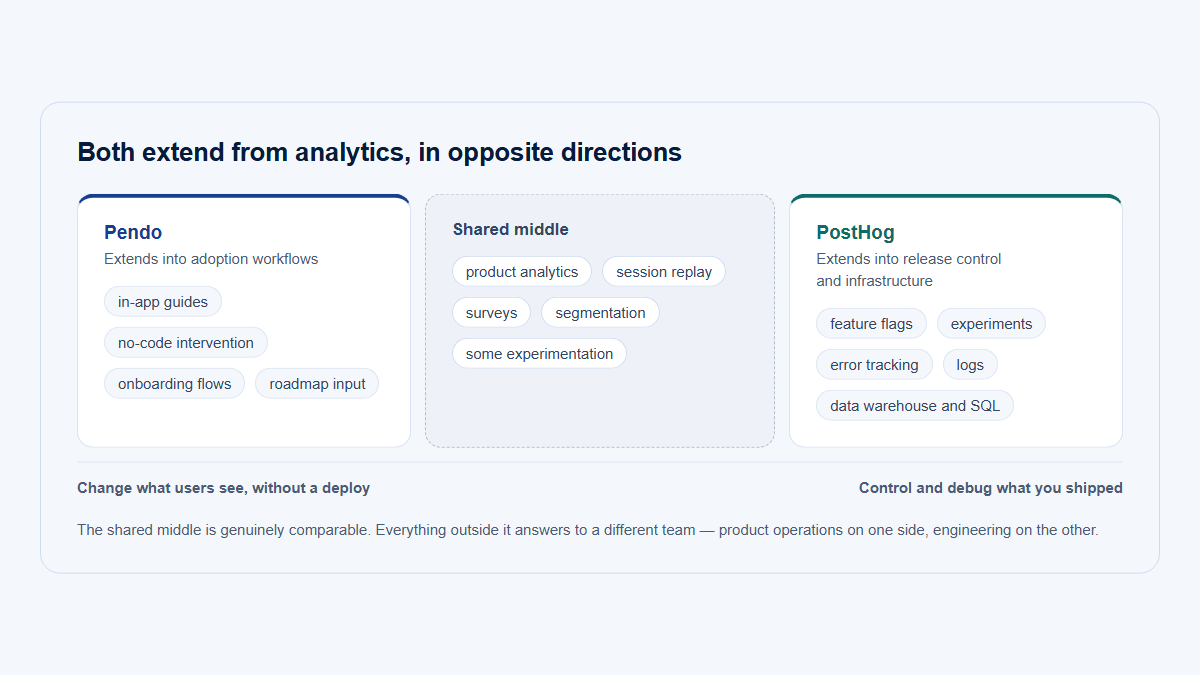
- For a more direct product-analytics comparison, see Pendo vs PostHog.
| Workflow | Pendo | Gainsight Customer Success |
|---|---|---|
| Funnels | Native Ordered Page, Feature, and Track Event analysis with drop-off | Not native Can report milestones but not an equivalent journey funnel |
| Paths | Native Behavior before or after a selected event | Not native Use upstream product analytics |
| Session replay | Plan-dependent Native and linked to product analytics | Not native No CS replay surface |
| Guides | Native Supported web/mobile experiences | Separate product In-product guides require Gainsight PX |
| Checklists/onboarding modules | Guide and Resource Center patterns, subject to package and implementation | Manages onboarding tasks/programs; no native in-product checklist without PX |
| Surveys | In-product polls/NPS and broader sentiment by plan | CS surveys and email programs are native; in-product delivery requires PX |
| Account targeting | Product segments use account and visitor metadata for guides and analysis | Company/person segments and rules target programs, CTAs, tasks, reports, and outreach |
| Health scores | No full CS scorecard operating model | Native Configurable scorecards and health workflows |
| Playbooks | No CSM Cockpit/playbook system | Native CTAs, tasks, playbooks, rules, and Cockpit |
| Success plans | No customer outcome-plan workflow | Native Objectives, tasks, milestones, templates, snapshots, and progress |
| Digital customer success | In-product guidance plus cross-channel orchestration where licensed | Journey Orchestrator, surveys, email, CTAs, and handoffs; PX is separate for in-app engagement |
| Renewal preparation | Product-use evidence and account segments | Renewal Center/CRM context, health, timeline, forecast, tasks, and reports |
| Expansion workflow | Surfaces growing adoption, breadth, seats, or feature interest | Combines usage with relationship/commercial context, routes CSQLs, and coordinates follow-up |
| Customer feedback | In-product feedback, NPS, and Listen/discovery depending on plan | Surveys, communications, timeline, analysis, and CS follow-through; package-dependent |
Health, playbooks, renewals, and expansion
Gainsight Customer Success has the clearer advantage when the question is not merely “what happened in the product?” but “what should the customer team do next, who owns it, and how does it affect the commercial relationship?”
Customer 360 and Relationship 360 bring together health scorecards, product-usage summaries, support history, stakeholder context, timeline activity, customer goals, renewals, and reporting. Cockpit and playbooks convert a trigger into assigned work. Success Plans structure objectives, tasks, milestones, and progress. Journey Orchestrator automates segmented programs and human handoffs. Renewal Center supports renewal and expansion management, although package and add-on terms require contract-level verification.
Health models and AI boundaries
The strength is operational consistency, not automatic truth. Administrators configure scorecard measures, groups, weights, exceptions, validity windows, data sources, and sometimes manual inputs. A green or red score therefore reflects a chosen model and its data quality.
A renewal forecast supports decision-making; it does not prove what a buyer will do. Current packages include documented CS-native AI assistance, with Renewal Prediction conditional on Renewal Center. Staircase AI and Atlas AI Agents are separately marketed products or services and must not be silently added to a standard CS license.
Product evidence in the CS workflow
Pendo can improve these workflows with first-party product evidence. A CS team might care about active users per account, adoption of Reporting or Integrations, invitation of teammates, concentration in one champion, or a decline relative to the account’s own baseline. Pendo can calculate or export relevant behavior; Gainsight can place selected metrics beside relationship, support, commercial, and timeline context and trigger an appropriate playbook.
Pendo alone does not provide the same CSM operating layer. Its account analytics, guides, surveys, orchestration, and optional Predict product may support customer-facing teams, but they do not create a full Customer 360, stakeholder map, success-plan system, renewal pipeline, or Cockpit. Conversely, Gainsight CS—including the optional Adoption Tracker—does not replace Pendo’s deep journey analysis and replay.
- For practical application, read how to use product usage before a renewal meeting and how to investigate product usage for expansion opportunities.
| Lifecycle task | Pendo | Gainsight Customer Success | Recommended owner |
|---|---|---|---|
| Track onboarding | Measure the event/page journey and drop-off | Track account stage, milestones, tasks, and risk | Product/growth for the journey; CS Ops for the account process |
| Deliver a guide | Build and target the in-app guide | Requires Gainsight PX for in-product delivery | Product or digital-adoption team |
| Measure feature adoption | Analyze users, accounts, Pages/Features, events, paths, and trends | Consume selected metrics in Adoption Explorer/C360; optional tracker is bounded | Product analytics or Product Ops |
| Inspect replay | Open relevant web/mobile sessions where available | No native CS replay | Product, UX, or support investigation owner |
| Survey users | Run in-product poll/NPS/sentiment workflows by plan | Run CS surveys or email programs; use PX for in-app surveys | Product for experience feedback; CS for relationship feedback |
| Summarize account usage | Produce account and user behavior measures | Place summaries beside CRM, health, support, goals, and renewal context | Product Ops defines metrics; CS Ops operationalizes them |
| Calculate health | Supply transparent product-use components | Own the configured model and scorecard governance | CS Ops with cross-functional metric owners |
| Trigger a CSM playbook | Send a segment, metric, or signal downstream | Create the CTA, tasks, owner, due date, and playbook | CS Ops and the CSM |
| Prepare renewal | Provide adoption, breadth, user, and trend evidence | Coordinate forecast, risks, stakeholders, tasks, and commercial context | CSM or renewal owner |
| Identify expansion | Surface growing usage, gaps, seat/activity patterns, or demand signals | Qualify with contract, goals, stakeholders, CSQL, and opportunity context | CS and Sales, with Product evidence |
| Track stakeholders | Limited to user/account metadata and imported attributes | Maintain people, roles, sponsor context, timeline, and relationships | CSM or account owner |
The clean division is not “Pendo before renewal, Gainsight at renewal.” Pendo remains useful throughout the lifecycle as a source of product behavior. Gainsight remains useful throughout the lifecycle as the system that assigns, records, and governs customer-success work.
Integration architecture, implementation, and governance
A combined Pendo–Gainsight architecture works when the products have clear responsibilities and share a reliable identity model.
Product evidence
Pendo owns
- Product events and supported retroactive Page/Feature definitions
- Visitor and account behavior
- Funnels, paths, workflows, retention, and replay
- Guides, onboarding, and in-product feedback where licensed
- Transparent product-usage measures sent downstream
Account action
Gainsight Customer Success owns
- The operational Company/Relationship record
- CRM, stakeholder, support, billing, goal, and renewal context
- Health-score governance
- CTAs, playbooks, tasks, and success plans
- Digital-CS programs, renewal workflow, expansion routing, and CSM reporting
Use one canonical user ID and one canonical company/account ID across the application, Pendo, CRM, warehouse, and Gainsight wherever possible. Map Pendo’s Account ID to the external company key used by Gainsight instead of relying on account names. Preserve user-to-company relationships when users can belong to more than one account or workspace.
Aggregate product behavior into a small, governed set of account metrics before loading it into Gainsight. Examples include active users in 30 days, percentage of eligible licensed users active, adoption of a required workflow, number of relevant product areas used, concentration in the top user, days since last meaningful activity, and change from the account’s own baseline.
Evidence detail and data routes
Keep detailed events and replay evidence in the product-intelligence layer and pass links or identifiers where the integration supports them.
Pendo documents a Salesforce-mediated Gainsight connection that sends measures such as login frequency, time in app, Features used, and users per account into Gainsight, while pulling visitor/account metadata into Pendo. The documented Salesforce exchange runs every 24 hours or on demand.
Freshness and governance
A warehouse-centered route can use Pendo Data Sync or APIs, transform authoritative account metrics, and load them through Gainsight connectors or APIs. Do not describe either path as universally real time: document the actual lag, retries, and owner.
Avoid duplicated health logic. Pendo may define a product-usage risk segment, but Gainsight should own the cross-functional health model when it is the customer-success system. Do not maintain one undocumented “health” number in Pendo, another in the warehouse, and a third in Gainsight. Name each component, preserve its formula, show when it last updated, and keep source evidence inspectable.
Operating ownership
Implementation ownership spans two operating groups. Product analytics/Product Ops and engineering own the Pendo snippet or SDK, identity, tagging/event definitions, replay privacy, and product metrics. CS Ops/Gainsight administration, CRM/data owners, and customer-success leadership own the Gainsight data model, permissions, scorecards, playbooks, renewal workflows, and adoption by CSMs.
The technical installation is only part of the work. Governance includes taxonomy changes, ID merges, account hierarchy, privacy controls, segment definitions, scorecard thresholds, stale data, backfills, and who can change a metric that triggers customer outreach.
Shared Pendo and Gainsight architecture
Shared IDs are what connect the two systems
Source
Governed account metrics
Consumer
This is an architecture you assemble and govern. The shared identity layer is the whole dependency — if two teams define “adopted” differently, both dashboards will be right and disagree.
Pricing and customer feedback
Neither paid enterprise product has a public price that supports a reliable dollar-for-dollar comparison. Compare the billable unit, required modules, implementation scope, data volume, user/customer allowances, and operating cost—not only the plan name.
Pendo offers a free-forever plan for up to 500 monthly active users with product analytics, in-app guides, Pendo-branded roadmaps, and Pendo-branded NPS surveys. Its 30-day trial exposes the wider platform.
Pendo paid packaging
Paid Base, Core, and Ultimate plans use custom pricing based on MAU volume and selected functionality: Base centers analytics and guides; Core adds Session Replay; Ultimate bundles Session Replay, Sentiment, Orchestrate, Listen, and Data Sync. Some capabilities are purchasable as add-ons, and Predict remains separate.
Gainsight package caveats
Gainsight Customer Success publishes Essentials and Enterprise packaging but not dollar pricing. The marketing grid lists 10 or 20 included full users, 100 or 200 customers per full user, and unlimited Viewer licenses.
Detailed package documentation instead lists 1,000 or 4,000 customer records and only two or four Viewer+ licenses per full user. It also shows Renewal Center and Sponsor Tracking as Essentials add-ons and Enterprise inclusions, despite the marketing grid showing renewal/expansion forecasting and organizational mapping/sponsor tracking in both tiers. Treat the package document and order form as authoritative for the purchased SKU.
| Buying or implementation factor | Pendo | Gainsight Customer Success |
|---|---|---|
| Typical implementation owner | Product Ops/product analytics with engineering and privacy support | CS Ops/Gainsight admin with CRM, data, security, and CS leadership |
| SDK or data integration | Web snippet/SDK, mobile SDK, Track Events/APIs; non-web environments require explicit Track Events | Connectors, APIs, objects, Rules Engine, Adoption Explorer, CRM/warehouse sources; Adoption Tracker is a paid web-capture add-on |
| CRM dependency | Helpful for metadata and downstream workflow, but not required for core product analytics | Usually central to account/commercial workflow even when Gainsight stores the operational copy |
| Product-data flow | Native capture/Track Events → analytics → reports, guides, replay, and exports | Upstream data → Adoption Explorer/objects → C360, scorecards, rules, programs, and renewals; optional tracker adds bounded capture |
| Free or trial option | Free to 500 MAUs; 30-day broader-platform trial | No public Gainsight CS free tier or trial verified; the pricing-page free trial belongs to Product Experience |
| Public or custom pricing | Free tier is public; Base, Core, and Ultimate are custom | Essentials and Enterprise are custom quote |
| Billing/contract unit | MAUs plus selected functionality/modules | Package, full users, customer records, modules/add-ons, and negotiated scope; verify the quote |
| Implementation services | Available; onboarding and service fees are quote-specific | Not publicly priced; confirm migration, admin enablement, onboarding, and SOW |
| G2 rating and count | 4.4/5, 1,808 reviews | 4.5/5, 1,754 reviews |
| Verification date | August 14, 2026 | August 14, 2026 |
| Official links | Pendo pricing and Pendo + Gainsight integration | Gainsight pricing and Gainsight Customer Success |
Public entry signal
Pendo
Free up to 500 MAUs
Pricing combines MAUs and functionality. Confirm Replay, Sentiment, Listen, Data Sync, integrations, Predict, services, support, and contract terms.
Public package signal
Gainsight Customer Success
Essentials or Enterprise
Model full users, customer records, Viewer/Viewer+ terms, Adoption Tracker, Renewal Center, Sponsor Tracking, implementation, integrations, and administration separately.
G2 snapshot
Pendo reviews
G2 snapshot
Gainsight Customer Success reviews
| Product | Common praise | Common criticism | What the reviews suggest |
|---|---|---|---|
| Pendo | Product analytics, user-behavior visibility, in-app guides/onboarding, usability for common tasks, and support | Learning curve, tagging/setup effort, guide governance at scale, and gaps for specialized workflows | Strongest when teams use analytics and in-product action together and own taxonomy, tagging, and guide quality |
| Gainsight Customer Success | Flexibility, centralized account view, scorecards, Journey Orchestrator, reporting, and playbooks | Learning/admin curve, implementation and data complexity, navigation overhead, and performance in heavier configurations | Can become a mature CS operating system, but value depends on administration, data, process design, and enablement |
This is a qualitative synthesis of recurring themes, not statistical sentiment analysis and not evidence that every customer has the same experience. G2 supplied ratings and the primary review sample; Capterra and Gartner Peer Insights were directional cross-checks only.
The displayed counts come from the same-day research capture: a final direct G2 fetch was bot-blocked, while near-current G2 widgets showed 1,807 Pendo and 1,753 Gainsight CS reviews, consistent with a one-review increase for each profile.
Budget for total operating cost
There is no credible “price winner” without quotes. A smaller product team can begin with Pendo Free when the MAU limit fits. A CS organization evaluating Gainsight should budget for the customer-data model, administration, process design, migration, enablement, and ongoing governance in addition to subscription cost.
Detailed pricing and packaging cautions
Confirm billing units, MAUs or customer records, included apps and environments, events, full users, viewers, modules, retention, exports, integrations, replay volume, surveys, support, implementation, overages, term, renewal, and termination in writing.
Gainsight discrepancy: the current marketing grid shows renewal/expansion forecasting, organizational mapping/sponsor tracking, and unlimited Viewer licenses across both CS packages. Detailed package documentation instead makes Renewal Center and Sponsor Tracking paid Essentials add-ons and Enterprise inclusions.
The Viewer and Viewer+ terms may refer to different roles, but the public pages do not reconcile them. Use the package documentation and signed order form.
Pendo additions outside the core bundles: the pricing page separately advertises Predict, Agent Analytics, and a free-beta Novus product. They are not assumed to be included in ordinary Base/Core/Ultimate use unless the order form says so.
Which one fits your scenario?
| Scenario | Recommended fit | Why | Watch for |
|---|---|---|---|
| Early-stage product team | Pendo first, especially when Free fits the MAU limit | Faster path to product analytics, onboarding guidance, and user feedback without buying a CS operating system | Define activation and account identity before adopting a broad platform; paid pricing is custom |
| Growth team needing in-app onboarding | Pendo | Guides, account/user segments, guide analytics, funnels, paths, and replay form an observe–intervene–measure loop | Guide accessibility, governance, over-messaging, and mobile/non-web differences |
| Enterprise product-adoption team | Pendo, often connected to CRM, warehouse, or CS systems | Stronger journey analysis, account segmentation, replay, guides, feedback, and multi-app workflows | MAU/module economics, taxonomy, privacy, and cross-app identity |
| High-touch customer-success organization | Gainsight Customer Success | Customer 360, stakeholders, health, playbooks, success plans, timelines, and account workflow match the operating model | Admin capacity, data integration, process maturity, and CSM adoption |
| Digital-CS team | Gainsight CS for programs; Pendo for in-product action | Gainsight coordinates segmented journeys and handoffs; Pendo delivers product-native guidance | Gainsight in-app engagement requires PX, so avoid overlapping surfaces without a channel plan |
| B2B SaaS preparing renewals | Gainsight CS with product-use evidence from Pendo or another source | Renewals need commercial, stakeholder, risk, goal, support, and product context together | Product usage is not renewal intent; document score and forecast evidence |
| Company already using one product | Add the other only when the missing operating layer is material | Pendo users add CS operations; Gainsight users add granular journey analysis/replay/guides | Avoid duplicate dashboards, health formulas, surveys, and outreach ownership |
| Organization deciding whether it needs both | Both, when product behavior regularly triggers governed CS work | Each system has a distinct job and can share account/product signals | Shared IDs, data lag, contract overlap, privacy, duplicate metrics, and two-admin cost |
A practical buying sequence is to identify the unresolved decision first. “We need a better view of product adoption” points toward Pendo or another product-intelligence layer. “We need every CSM to execute a consistent, evidence-based account process” points toward Gainsight Customer Success. “We need usage changes to trigger governed account action” is the case for an integrated architecture.
Where Hymetry fits
Hymetry sits between raw product analytics and customer-success operations. It is account-centric product intelligence for B2B SaaS: it connects product usage across Companies, Users, Pages, and Visits so teams can inspect account adoption, breadth, user penetration, usage concentration, grouped-page and product-area usage, and the session evidence behind a signal.
Hymetry is relevant when a B2B team needs account-level product evidence but does not need Pendo’s complete guide-building, survey, discovery, or cross-channel product-experience surface. It can also supply governed product evidence to a Gainsight-style customer-success workflow: which product areas an account adopted, whether activity is broad across users, whether use depends on one champion, and which Visits deserve review.
What Hymetry does not replace
Hymetry does not replace Gainsight Customer Success health governance, CRM and stakeholder context, playbooks, success plans, renewal management, expansion routing, digital programs, or CSM workflow. No native Gainsight integration is claimed here; the architecture describes feeding governed product evidence into a CS data layer.
See the customer-success use case for the evidence-first workflow.
FAQ, methodology, and sources
Is Pendo a Gainsight alternative?
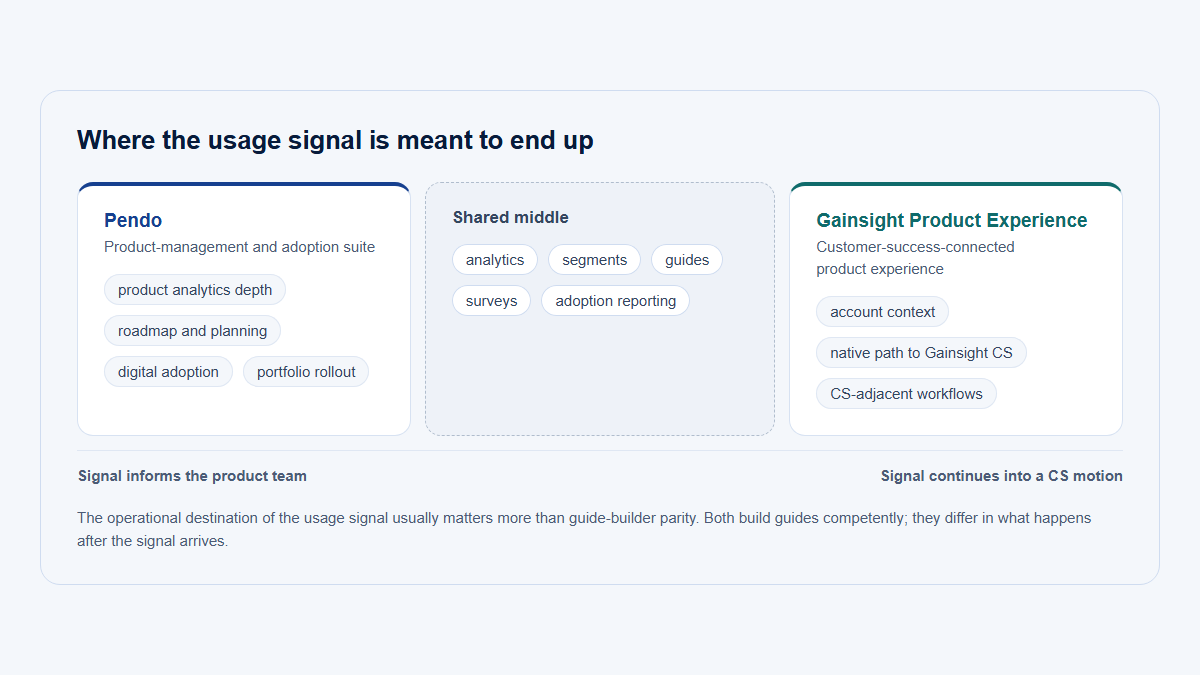
Pendo is an alternative to part of a Gainsight-centered stack when the buyer mainly needs product analytics, replay, in-app guidance, onboarding, and product feedback. It is not a direct replacement for Gainsight Customer Success when the requirement includes Customer 360, health governance, stakeholder context, CSM playbooks, success plans, renewals, and expansion workflow. Gainsight Product Experience—not Gainsight Customer Success—is the closer direct Pendo competitor.
Can Pendo replace Gainsight?
Usually not for a mature customer-success operation. Pendo provides account-level usage, segments, surveys, guides, and product evidence, but the organization still needs another system or custom process for CSM work queues, success plans, relationship history, health governance, renewal operations, and cross-functional account ownership.
Which is better for product adoption?
Pendo is usually the stronger fit for measuring and changing adoption inside the product because it combines native product analytics, paths, funnels, replay, guides, onboarding, and in-product feedback. Gainsight Customer Success is useful after selected adoption metrics are aggregated into the account model and need to drive CS workflow. Its paid Adoption Tracker adds bounded prospective web tracking, not the full Pendo workflow.
Which is better for customer success?
Gainsight Customer Success is usually the stronger fit for formal CS operations: Customer 360, health scorecards, stakeholders, playbooks, success plans, digital programs, renewals, and expansion. Pendo can strengthen those workflows with product evidence but is not a full CS operating platform.
Can Gainsight use Pendo product data?
Yes. Pendo documents a Salesforce-mediated path that sends selected usage measures into Gainsight, and teams can also use a warehouse/API architecture. Map stable user and account IDs, define authoritative metrics, document freshness, and avoid a second undocumented health model.
Should a B2B SaaS company use both?
Use both when product behavior regularly changes how customer teams prioritize onboarding, risk, renewal, or expansion—and when the company can govern two systems. Use one when the missing layer is not operationally important. Buying both without clear ownership often creates duplicated dashboards and conflicting account conclusions.
Where does Hymetry fit?
Hymetry provides account-centric product evidence across Companies, Users, Pages, product areas, grouped pages, adoption breadth, user penetration, usage concentration, and Visits. It can support product and customer-success investigation without Pendo’s guide-building surface and without claiming to replace Gainsight’s CRM, health, playbook, success-plan, renewal, or expansion workflows.
Sources
Methodology, verification date, and evidence limits
This comparison was verified on August 14, 2026 using a documentation-led editorial method rather than undisclosed hands-on testing. The process was:
- Define the products as Pendo versus Gainsight Customer Success, excluding Product Experience capabilities unless labeled as a separate subscription or integration.
- Review official product pages and documentation for analytics, identity, replay, guides, surveys, Adoption Explorer, Adoption Tracker, Customer 360, health, playbooks, plans, digital programs, renewals, integrations, exports, mobile/non-web support, and AI packaging.
- Review current public pricing and packaging, recording where marketing and detailed package documentation conflict.
- Recheck the exact Pendo and Gainsight Customer Success G2 profiles and synthesize recurring review themes, with independent review pages as directional cross-checks.
- Verify the current official media assets, use the shared click-to-load facade for Pendo’s supported Wistia host, and leave Gainsight’s unsupported Vidyard asset as a linked fallback.
- Make the recommendation from the job each system performs, not a claim that either universally replaces the other.
Evidence level: high for documented feature scope and public packaging; medium for implementation effort and review themes; no claim of hands-on product testing. Vendor outcome claims, predictive claims, and marketing benchmarks were not treated as neutral evidence.
Publisher disclosure
Hymetry publishes this article. Hymetry overlaps with account-centric product intelligence and may be considered alongside or between product analytics and customer-success systems. No customer result, paid placement, affiliate payment, private vendor briefing, or hands-on test is claimed here. Product names and trademarks belong to their respective owners. Readers should verify security, privacy, implementation, contract, pricing, and package details with each vendor.
Official Pendo product documentation
Links and current availability verified August 14, 2026.
- Pendo Analytics
- Pendo Session Replay
- Current Pendo product areas
- Events overview
- Track Events
- Data Explorer
- Funnels
- Paths
- Workflows
- Account details
- Visitor and account metadata
- Anonymous visitors
- Session Replay overview
- Classic Pendo Feedback retirement and Listen migration
- Track Events in non-web environments
- Mobile low-code tracking and Track Events
- Data Sync overview
- Methods for exporting Pendo data
- Pendo + Gainsight integration
- Connect Pendo to Gainsight through Salesforce
Official Gainsight Customer Success documentation
Links and current availability verified August 14, 2026.
- Gainsight Customer Success
- Gainsight CS feature overview
- Customer 360 and Relationship 360 overview
- C360/R360 sections and widgets
- Adoption Explorer overview
- Adoption Explorer project and data model
- Adoption Tracker paid add-on
- Scorecards overview
- CTAs, tasks, and playbooks
- Success Plans overview
- Journey Orchestrator overview
- Journey Orchestrator and PX subscription requirements
- Relationships overview
- Company hierarchy
- People Maps
- Connections list
- Report and dashboard exports
Pricing and packaging
Links and current availability verified August 14, 2026.
- Pendo pricing and plan matrix
- Gainsight pricing and marketing package grid
- Gainsight CS package overview and limits
The Gainsight marketing grid and package document differ on Viewer/Viewer+ allowances and Essentials treatment of Renewal Center and Sponsor Tracking. The page records the discrepancy rather than treating either summary as a complete order form.
Customer ratings and review evidence
Ratings and review counts verified August 14, 2026; themes are directional.
- Pendo reviews on G2
- Pendo pros and cons on G2
- Gainsight Customer Success reviews on G2
- Gainsight Customer Success pros and cons on G2
- Pendo reviews on Capterra
- Gainsight reviews on Capterra
- Gainsight Customer Success on Gartner Peer Insights
Independent sources were used only to cross-check recurring themes. No customer quotation is reproduced, and rounded ratings are not treated as a controlled benchmark.
Official vendor videos
Assets and media metadata verified August 14, 2026.
- Pendo Analytics source page and Pendo Analytics - Micro Demo (Wistia, 2:26)
- Gainsight Customer Success Demo Center and Scale & Grow Your Programs - Gainsight Demos (Vidyard, 5:01)
The shared click-to-load player supports the verified Pendo Wistia asset and emits one VideoObject from the same visible facade; it makes no Wistia request before activation. Gainsight’s current asset uses unsupported Vidyard, sits behind the Demo Center gate, and did not expose captions, so it remains a linked facade without video schema.