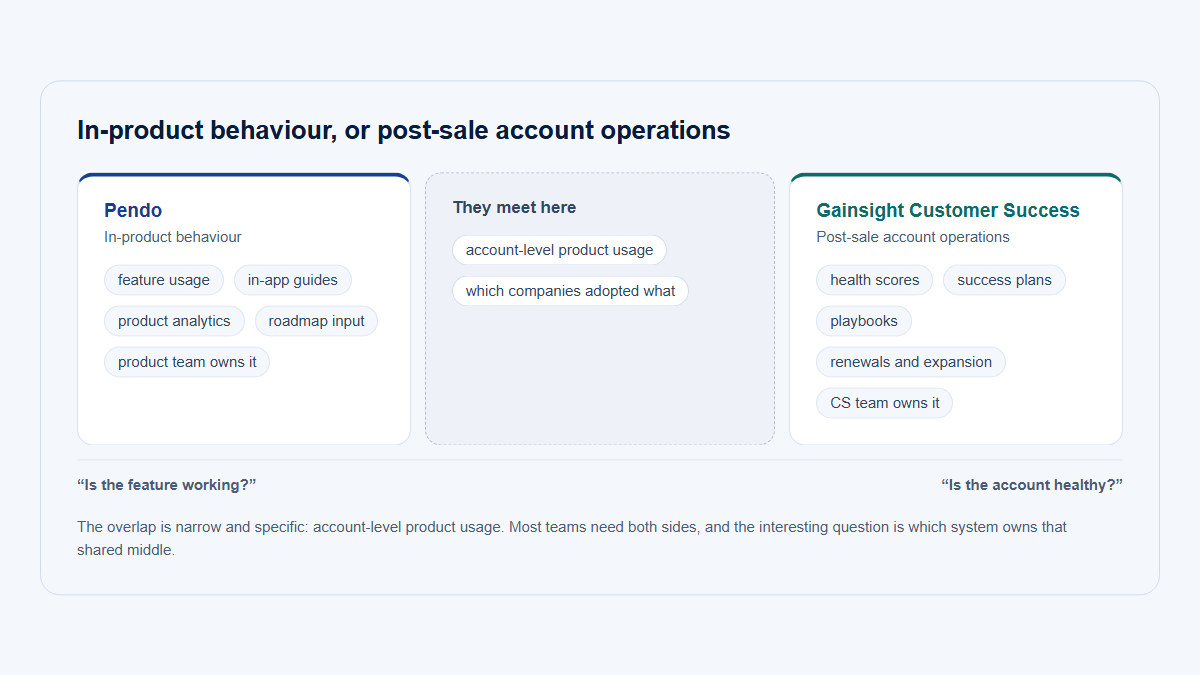
One category observes, the other operates
Product analytics
Observe behaviour
The connection: account-level product evidence
Customer success software
Operate the lifecycle
“What happened in the product?” “What should someone do about it?”
These are not competing purchases. Neither category replaces the other, and the account-level evidence in the middle is what makes either one useful to a renewal conversation.
Questions, data models, and users
What is a product analytics platform?
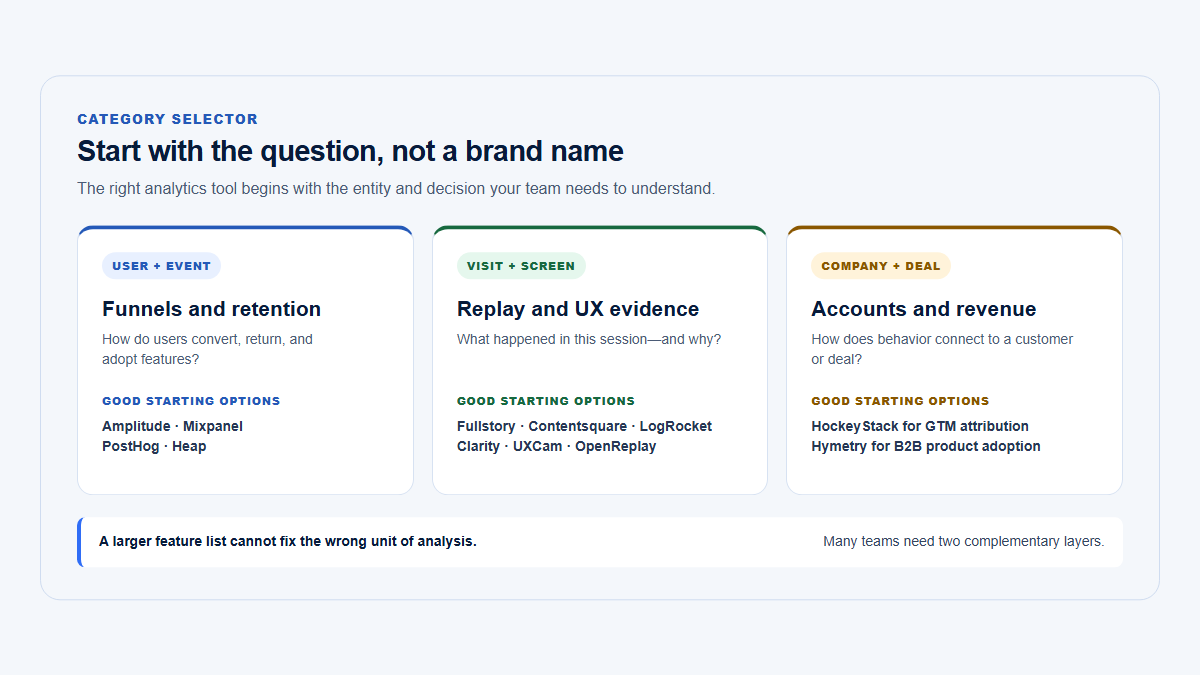
A product analytics platform is a system primarily designed to collect or analyze behavior inside a digital product. Its working objects commonly include events, pages, users, devices, sessions, groups or accounts, properties, funnels, retention, cohorts, feature adoption, paths, replay, flags, and experiment exposure.
The category begins with observable product behavior. Its purpose is not merely to report logins but to help a product team ask how a workflow is discovered, where a user abandons it, whether people return, how adoption differs by segment, and which sessions provide useful evidence.
For the B2B-specific model, see the B2B product analytics guide and account adoption versus user adoption.
What is a customer success platform?
A customer success platform is a system primarily designed to manage the post-sale customer lifecycle. It brings together customer account profiles, CRM and commercial context, health scores, segmentation, success plans, playbooks, CSM tasks, digital journeys, renewal preparation, expansion work, and stakeholder context.
The category begins with the customer account and the operating process around it. Its job is to help a post-sale team decide which accounts need attention, why they need it, who owns the response, which repeatable workflow should run, and how the team prepares for a customer milestone.
Where the categories overlap
Product analytics platforms can support company or group identifiers. Mixpanel, for example, can analyze behavior using an identifier such as company or account rather than only an individual user. PostHog can aggregate funnels, retention, and other analyses by a configured group. Amplitude offers an Accounts (Group) expanded package for account-level analytics.
That account key is useful, but it does not automatically supply the customer’s contract, renewal date, stakeholder roles, support history, success plan, CSM owner, or commercial relationship.
| Question | Product analytics | Customer success platform | Best owner |
|---|---|---|---|
| Which feature do users adopt? | Primary: measure users, events, pages, cohorts, and repeat use | Consumes a feature-adoption result when relevant to an account | Product manager or product analyst |
| Where do users abandon onboarding? | Primary: build the funnel and inspect affected users or sessions | Uses completion or drop-off status to prioritize follow-up | Product, growth, or onboarding lead |
| Which companies use Reporting? | Primary when company identity and the Reporting definition are reliable | Displays the resulting account metric and connects it to customer work | Product plus CS Operations |
| Which users contribute inside each company? | Primary: compare active users, roles, penetration, and concentration | Uses the result to understand contacts, champions, or adoption risk | Product and customer success |
| Which sessions show friction? | Primary through session analysis and replay | Links to evidence when a CSM, support agent, or account owner needs context | UX, product, or support |
| Which accounts need a CSM review? | Supplies account behavior and change signals | Primary: combines signals, segments the portfolio, assigns work | CSM and CS Operations |
| Which renewal is approaching? | Not a system of record; may filter behavior by an imported date | Primary operational workflow, often with CRM or contract data | Customer success, RevOps, or finance |
| Which stakeholder owns the relationship? | Normally an imported property, not a relationship model | Primary account and stakeholder context | CSM or account executive |
| Which playbook should run? | Can create a cohort or signal, but does not normally own the CS process | Primary: selects, triggers, assigns, and tracks the workflow | CS Operations |
| Which accounts may have expansion potential? | Supplies adoption, breadth, seat, and workflow evidence | Combines product, commercial, relationship, and timing context to prioritize action | CSM and account executive |
| Can the platform prove churn or customer value? | No. It provides behavioral evidence | No. It combines signals and operating context | Leadership, research, finance, and the customer |
| Object | Product analytics platform | Customer success platform | Typical system of record |
|---|---|---|---|
| Project | Common container for one app, product, environment, or dataset | May map product data to one or more customer records | Analytics configuration and source application |
| Event | Native atomic behavioral fact with timestamp and properties | Usually summarized, transformed, or selectively ingested | Event pipeline or warehouse |
| Page or feature | Native product taxonomy used for adoption, paths, and funnels | Used as an account-level adoption or workflow input | Product tracking plan or maintained analytics taxonomy |
| User | Behavioral identity connected to events and sessions | Customer user, end user, or contact when relevant to the account | Application identity for product use; CRM for relationship records |
| Company or group | Aggregation key when reliably instrumented | Primary customer-account entity | Application or identity service for the key; CRM/CSP for commercial context |
| Visit or session | Native behavioral sequence and possible replay evidence | Linked evidence rather than the central operating object | Product analytics or replay store |
| CRM contact | Commonly an imported property or joined record | Central contact record | CRM |
| Stakeholder | Usually not a native relationship model | Role, sponsor, champion, decision-maker, or relationship context | CRM or CSP |
| Contract | Usually an imported filter or property | Core account context | Contract, CRM, or subscription system |
| Renewal | Imported date or cohort criterion | Operational milestone with tasks and forecasting context | CRM, contract system, or CSP according to governance |
| Billing | Imported account property or analytical dimension | Commercial input to health and account review | Billing or finance system |
| Support | Imported signal or link to cases | Common health and workflow input | Support platform |
| Health score | Can calculate a usage score, but that is not complete customer health | Configured composite model combining selected inputs | CSP configuration and documented metric catalogue |
| Success plan | Not a normal product-analytics object | Goals, milestones, owners, tasks, and customer work | CSP |
| Customer outcome | Can observe product-behavior proxies | Can record goals, progress, and customer context | Direct customer evidence plus the relevant business system |
A shared company ID connects layers; it does not erase their responsibilities. A stable account key must still be paired with rules for user membership, historical changes, subsidiaries, workspaces, plans, entitlements, and deleted or merged accounts.
Product behavior and account-health workflows
Consider a fictional B2B SaaS company called OrbitDesk. It sells a collaboration product to customer accounts containing administrators, contributors, and executive viewers. Onboarding includes connecting Integrations and creating a first Report. The company captures product events and session replay, stores contacts and contracts in a CRM, tracks support tickets, maintains configured health scores, runs CSM playbooks, and prepares renewals and expansion conversations.
| Question or action | Product analytics | Customer success platform | Other evidence required |
|---|---|---|---|
| Measure onboarding funnel | Defines eligible users or accounts, steps, conversion, time, and drop-off | Consumes completion status or an account-level onboarding input | Instrumentation quality and an agreed eligibility denominator |
| Measure account adoption | Aggregates Reporting and Integrations usage by company | Displays the metric in the customer account and uses it in segmentation | Plan entitlements, lifecycle stage, and account identity |
| Inspect a failed session | Finds the affected Visit and replay evidence | Links the account or task back to the evidence | Application logs, support context, or customer report when relevant |
| Identify user concentration | Measures whether usage depends on one or a few people | Uses concentration as a possible continuity or enablement signal | User roles, invited seats, permissions, and organizational context |
| Calculate a health input | Supplies a documented adoption, breadth, penetration, or trend metric | Combines that input with other configured components | CRM, support, billing, survey, relationship, and outcome data |
| Trigger a playbook | Produces a cohort, alert, or account signal | Owns the playbook trigger, tasks, assignees, timing, and completion | Process owner, contact policy, and escalation rules |
| Prepare a renewal | Provides usage trends, adopted workflows, relevant users, and sessions | Coordinates the renewal workflow and account review | Contract terms, billing, goals, stakeholder feedback, and commercial context |
| Validate a customer outcome | Observes product actions that may be related to the outcome | Records goals, milestones, notes, and progress | Customer confirmation and evidence from the customer’s business |
| Identify expansion | Shows broad adoption, limits reached, additional use cases, or increasing participation | Prioritizes and coordinates a possible expansion motion | Entitlements, budget, need, stakeholder intent, and purchasing process |
| Contact the customer | Does not normally own the relationship or outreach workflow | Assigns the owner and structures the contact or digital journey | Current contact details, consent, relationship history, and human judgment |
The two categories are most useful together when OrbitDesk can move from a measurable product signal to the correct customer account, responsible person, relevant evidence, and a proportionate action. Sending every event into a CSP or reducing every account to one opaque health score is not the goal.
For practical metric guidance, see how to measure product usage by company and how to build a customer health score.
Can one category replace the other?
| Question | Short answer | Main gap |
|---|---|---|
| Can product analytics replace a CSP? | Usually no | It does not normally own customer relationships, stakeholder context, success plans, CSM tasks, playbooks, renewals, or expansion processes |
| Can a CSP replace product analytics? | Usually no | It depends on upstream product data and normally provides less depth for event exploration, funnels, retention, paths, replay, and experiments |
| Can a CRM replace both? | No | A CRM can own contacts and commercial records, but it does not automatically provide deep product behavior or a full customer-success operating system |
| Does every SaaS company need both? | No | Use both only when both analytical and operational jobs are real, important, and maintainable |
A CSP such as Gainsight cannot replace Mixpanel when the blocked decision requires trustworthy event exploration, funnels, retention, or session evidence. Mixpanel cannot replace Gainsight when the blocked decision requires account ownership, health operations, success plans, playbooks, and renewal coordination.
How product analytics feeds customer success
The most useful hybrid architecture does not copy an uncontrolled stream of raw events into a customer-success platform. It creates a governed account-level metric contract and preserves a path back to underlying evidence.
A CSP may need a small number of reliable inputs such as:
- onboarding completion;
- active users compared with eligible users;
- Reporting adoption;
- Integrations adoption;
- adoption breadth;
- user penetration;
- usage concentration;
- meaningful activity trend;
- last relevant activity;
- a link to affected users or Visits.
The product analytics or warehouse layer should define those inputs. The CSP should decide how they contribute to segmentation, health, playbooks, CSM work, and renewal preparation.
| Layer | Product analytics role | Customer success platform role | System of record | Implementation control |
|---|---|---|---|---|
| Product instrumentation | Capture valid events, pages, identity, timestamps, and safe context | No substitute for missing instrumentation | Source application and event collector | Tracking plan, privacy rules, QA, and versioning |
| Event or page model | Normalize behavior into meaningful events, grouped pages, features, or product areas | Consume only the definitions relevant to customer work | Maintained product taxonomy or warehouse semantic layer | Definition owner and change history |
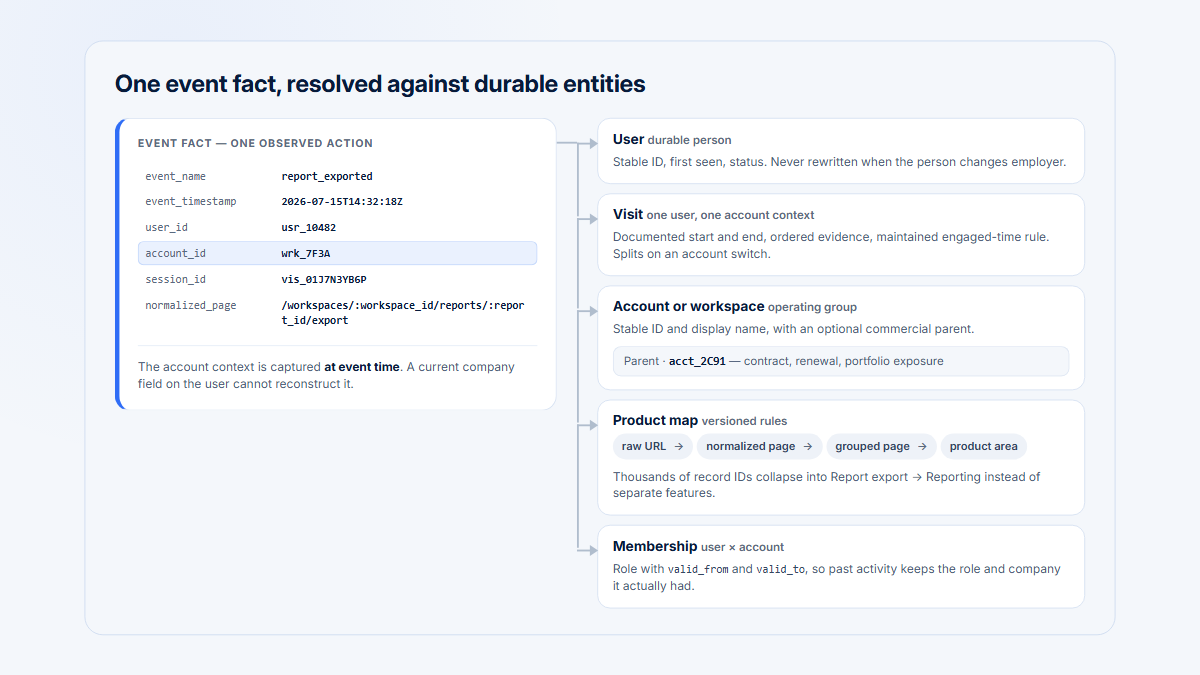
| User-to-company identity | Associate activity with a stable user and company key | Match the same company key to the customer account | Application identity service or governed warehouse mapping | Temporal membership, merges, subsidiaries, and unknown identities |
| Account-level aggregates | Calculate adoption, breadth, penetration, concentration, trend, and other agreed metrics | Display and use the resulting components | Product analytics or governed warehouse metric layer | Denominator, window, freshness, and eligibility definition |
| Warehouse or integration | Move selected fields, retain history, and reconcile sources | Receive reliable account inputs and return workflow context where appropriate | Warehouse, integration platform, or documented API pipeline | Sync direction, latency, retries, deletion, and monitoring |
| CSP health inputs | Supply transparent product components rather than an unexplained verdict | Combine product, relationship, support, commercial, survey, and lifecycle inputs | CSP model configuration | Weighting, segmentation, missing-data behavior, and calibration |
| Playbook or CSM workflow | Provide the triggering evidence and drill-through | Create tasks, assign owners, enforce timing, and track completion | CSP | Idempotent triggers, suppression, escalation, and audit trail |
| Relevant Visits | Preserve the user, company, page sequence, and replay evidence | Link the CSM or account owner to the evidence when review is justified | Product analytics or replay store | Privacy, access control, retention, and representative sampling |
| Customer confirmation | Show what was observed inside the product | Record the customer conversation, goal, objection, or confirmed outcome | CRM, CSP, survey, meeting notes, and the customer’s business system | Human review and distinction between evidence and inference |
Official product documentation shows several versions of this pattern: product-usage depth and breadth can feed Gainsight scorecards and playbooks; Vitally can use product metrics to trigger alerts, tasks, and playbooks; Planhat can launch workflows when usage, health, or renewal conditions change. These are examples of data-to-action architecture, not proof that a particular metric predicts churn or that an automated action causes a customer outcome.
From one product event to a confirmed outcome
1
Product event
One user, one action, with the active company attached
2
Company-level adoption metric
Aggregated against eligible users, over a comparable window
Without a denominator this stage produces confident nonsense
3
Customer-success health input
One input among several — not the score itself
4
CSM action
A person decides, then contacts the customer
5
Customer confirmation
What the customer says, which closes the loop back to step 3
Step 5 is the only place the model gets corrected. Skip it and a health score keeps producing plausible prioritisation that nobody has ever checked against reality.
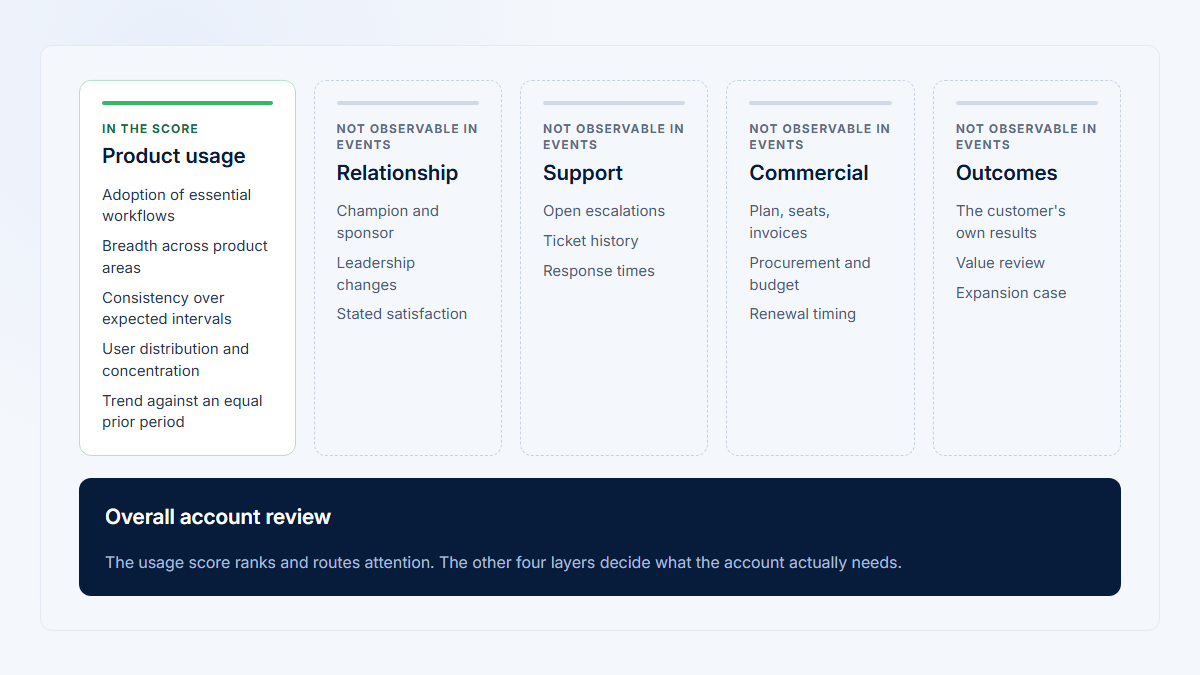
Before a renewal, the useful output is not simply “health is 72.” It is a reviewable chain: which account behavior changed, how the metric was calculated, which users and product areas contributed, how fresh the data is, which other customer signals agree or disagree, and what a human should verify. See product usage before a renewal meeting and how to investigate at-risk accounts with product usage.
Representative platforms and pricing
The following products are a compact, representative set—not a ranking of eight interchangeable tools. Amplitude, Mixpanel, PostHog, and Hymetry illustrate different product-analytics centers of gravity. Gainsight Customer Success, ChurnZero, Vitally, and Planhat illustrate different customer-success operating models.
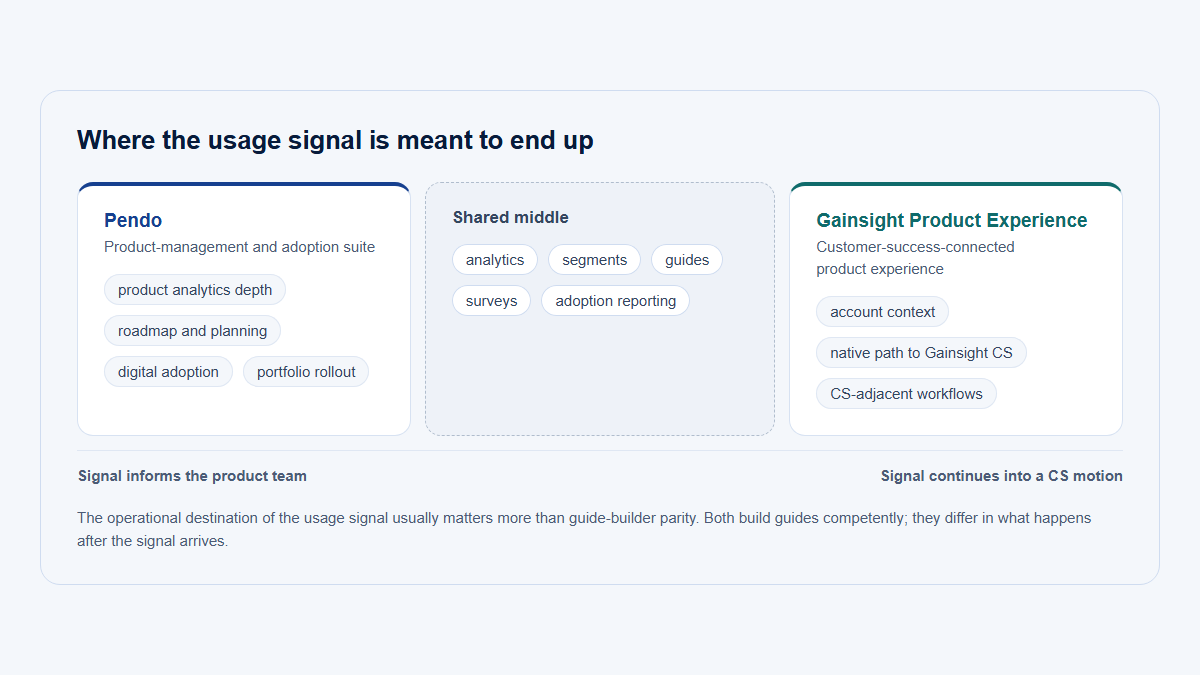
Gainsight Product Experience is referenced only where official documentation demonstrates product usage feeding Gainsight Customer Success. It should not be conflated with Gainsight Customer Success itself.
Product analytics pricing
Public entry tiers and usage models
Free tiers are common
Amplitude, Mixpanel, and PostHog publish usage-based entry allowances. Hymetry publishes fixed hosted tiers. Account or group analytics, replay, experiments, data movement, and governance can change total cost.
Customer success pricing
Sales-led pricing
Request or enquire
Gainsight and Vitally request pricing, Planhat uses “Enquire,” and ChurnZero directs buyers to a demo without a public list price. Implementation and administration remain material cost inputs.
G2 point-in-time scope
Product analytics representatives
Each rated product is 4.5/5 in the current snapshot; review counts differ materially. Hymetry has no meaningful G2 product listing. This is not a category average or ranking.
G2 point-in-time scope
Customer success representatives
The visible range summarizes separate seller or product snapshots, not a controlled comparison or category score.
| Product | Category | Distinctive model | Account support | Replay | Playbooks or CS workflow | Current pricing snapshot | G2 snapshot | Best fit |
|---|---|---|---|---|---|---|---|---|
| Amplitude Analytics | Product analytics | Broad, governed product-intelligence platform with analytics and adjacent product capabilities | Accounts (Group) is an expanded package for account-level analysis | Native, plan and package dependent | No full CS workflow | Free includes 2M events/month and 10K replays; Plus starts at $0 with the first 2M monthly events free; Growth and Enterprise are custom | 4.5/5 · 2,977 product-specific reviews | Mature product and data programs needing broad analytical and governance capabilities |
| Mixpanel | Product analytics | Focused self-service behavioral analysis across insights, funnels, flows, retention, cohorts, and replay | Group Analytics is a Growth or Enterprise add-on | Native | No full CS workflow | Free includes 1M events/month and 10K replays; Growth starts at $0; Enterprise uses quote-based pricing | 4.5/5 · 1,371 reviews | Product managers and analysts prioritizing fast behavioral exploration |
| PostHog | Product analytics | Developer-oriented product and data suite connecting analytics, replay, feature flags, and experiments | Group Analytics is a paid add-on | Native | No full CSP layer | Usage-based after free tiers; current free allowances include 1M product-analytics events and 5K recordings/month | 4.5/5 · 1,054 reviews | Engineering-led teams wanting several product tools in one technical stack |
| Hymetry | Product analytics / account-centric product intelligence | Begins with B2B company context and connects Pages, Companies, Users, and Visits | Companies is a core product layer | Visits and session evidence | No CSP workflow | 60-day hosted pilot; listed hosted plans are $149, $349, and $799 per month; Open Source is free software with self-managed infrastructure | Not rated; no meaningful G2 product listing was located in the August 14, 2026 check | B2B teams prioritizing account adoption, breadth, user penetration, concentration, and evidence |
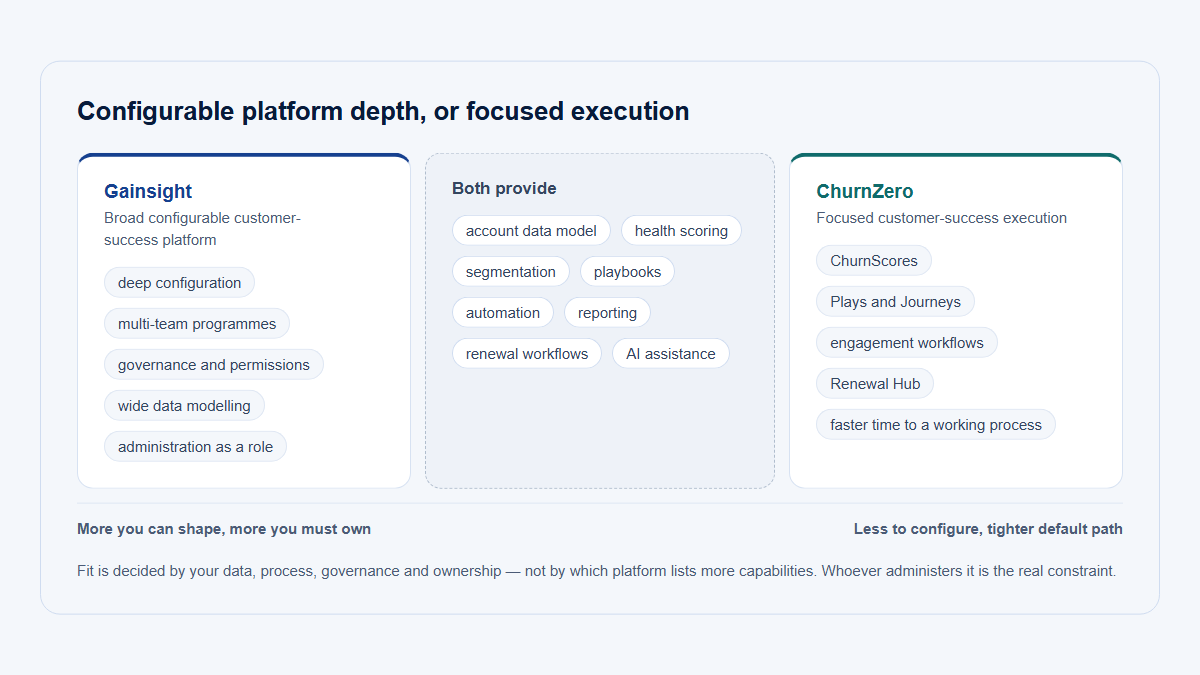
| Gainsight Customer Success | Customer success | Enterprise customer-success operating system with Customer 360, health, success plans, playbooks, journeys, and renewal context | Core account model | Not core to Gainsight CS; product context can come from PX or integrations | Yes | Essentials and Enterprise use request pricing | 4.5/5 · 1,756 product-specific reviews | Mature and complex customer-success organizations |
| ChurnZero | Customer success | AI-powered customer-success platform centered on account health, journeys, plays, automation, and forecasting | Core account model | Not a defining category capability | Yes | No public list price located; the official site directs buyers to book a demo | 4.7/5 · 1,609 reviews | B2B customer teams running proactive portfolio workflows |
| Vitally | Customer success | Flexible CS workspace combining customer data, health, automation, projects, and collaboration | Core account model | Not a defining category capability | Yes | Tech-Touch, Hybrid-Touch, and High-Touch plans all use request pricing | 4.5/5 · 706 reviews | Modern CS teams combining digital, pooled, and high-touch motions |
| Planhat | Customer success | Flexible customer platform spanning customer data, health, collaboration, projects, sequences, and workflows | Core company and account model | Not a defining category capability | Yes; current terminology uses Workflows, including Projects and Sequences | No public list price; the current pricing page uses “Enquire” for plans and add-ons | 4.5/5 · 954 reviews | Teams needing a configurable post-sale data and workflow layer |
There is no single “best tool for product and customer success” across this table. The products solve different primary jobs, and even products in the same category vary significantly in scope, implementation model, packaging, governance, and account support.
Which should you choose?
Choose the layer that resolves the immediate blocked decision. A broad feature checklist is less useful than one production-like test using your identity model, account hierarchy, data freshness, and operating workflow.
| Scenario | Start with | Likely companion or next step | Main caveat |
|---|---|---|---|
| Early-stage product team | Product analytics | CRM and lightweight customer operations | Keep the event and feature model small enough to maintain |
| Company with no reliable instrumentation | Neither purchase solves the root problem | Fix product identity, event quality, taxonomy, privacy, and QA first | A CSP cannot reconstruct missing behavior; an analytics UI cannot correct invalid data automatically |
| B2B SaaS company with high-touch CSMs | CSP when portfolio execution is the immediate bottleneck | Add a reliable product-analytics or warehouse feed when usage matters | Do not send login counts and call the result customer health |
| PLG company with no CSM team | Product analytics | CRM, billing, support, and lifecycle automation as required | A full CSP may add process without a team that owns it |
| Scale-up preparing renewals | CSP plus trustworthy account-adoption inputs | Product analytics or a governed warehouse metric layer | Renewal evidence also needs contracts, relationships, support, goals, and direct customer feedback |
| Company with complex account hierarchy | Evaluate explicit company, workspace, parent-child, and membership requirements in both layers | Shared identity or warehouse model | A single group property may not represent subsidiaries, workspaces, or historical membership correctly |
| Product and CS teams sharing one warehouse | Product analytics or BI for metric computation; CSP for customer action | Governed semantic layer and reverse data movement | The warehouse centralizes data, not definitions, ownership, or customer workflow |
| Company choosing only one platform initially | Choose according to the blocked decision | Add the second layer only after a repeatable need appears | Do not buy the broader suite merely to postpone deciding who owns each metric and workflow |
| Mature organization needing both | Product analytics plus CSP | CRM, warehouse, billing, support, surveys, and direct customer evidence | Maintain a shared identity contract, freshness rules, metric ownership, and drill-through |
A practical buying test uses the same small set of accounts in every candidate. Verify that the product layer calculates the intended user and company metrics, then verify that the customer-success layer places those metrics in the correct account, preserves freshness, explains missing values, and produces a proportionate workflow.
Implementation, ownership, and common mistakes
Use a clear responsibility model:
Product analytics
- raw behavior
- product taxonomy
- user and account adoption
- funnels, retention, replay

Customer success platform
- customer account context
- health and segmentation
- playbooks and CSM workflow
- renewal and expansion
A warehouse can become the governed metric layer between them. A CRM can remain the commercial relationship system. Billing, support, survey, and meeting systems can remain authoritative for their respective evidence. “Single source of truth” should mean a documented source for each object and definition—not copying every field into one application.
Where each layer sits in a B2B SaaS stack
Where evidence originates
Where it is joined
Systems that stay authoritative
The stack only works when the join layer is governed. Most disagreements between a product dashboard and a health score come from two teams defining “active” differently, not from bad data.
Shared company ID
The product event, analytics group, warehouse account, CRM company, and CSP account need a durable mapping. Define how aliases, mergers, subsidiaries, multiple workspaces, trials, deleted accounts, and users who change companies are handled. Do not overwrite historical membership with a user’s current company and assume the past is still correct.
Data freshness
Document when each metric is calculated, when it arrives in the CSP, what happens after a failed sync, and how missing data differs from zero activity. A daily account metric and a real-time task trigger should not be presented as though they have the same latency.
Denominator definitions
“Adoption” can mean the share of active companies using a feature, the share of entitled companies, the share of all paying accounts, or the share of users inside adopting accounts. Store the numerator, denominator, eligible population, date window, and version of the definition.
Duplicate health logic
Do not calculate one usage score in product analytics, a second in the warehouse, and a third inside the CSP without ownership. Prefer transparent components and one governed definition. The CSP can combine those components with relationship, support, billing, survey, lifecycle, and commercial context.
Metric ownership
Product or data teams should normally own product taxonomy, behavioral definitions, and account-adoption calculations. CS Operations should normally own health-model configuration, segmentation, playbook rules, and operational response. CRM, billing, support, and finance owners remain responsible for their source records.
Access to underlying evidence
A CSM should be able to see why a signal changed rather than receiving only a label. Preserve links to the account metric, contributing users, relevant product areas, the comparison period, and selected Visits when privacy and access rules permit.
Common mistakes
- Treating login count as customer health.
- Sending a metric without its denominator, time window, eligibility rules, or freshness.
- Using a current user-to-company property to rewrite historical account behavior.
- Letting product analytics and the CSP calculate “adoption” differently.
- Triggering repeated playbooks from stale, partial, or oscillating data.
- Collapsing usage, support, commercial, relationship, and survey inputs into an opaque score.
- Interpreting high activity as satisfaction, customer value, or expansion intent.
- Watching a convenient replay and treating it as representative evidence.
- Purchasing both categories before assigning ownership for the integration and operating process.
- Assuming every connector supports the required history, direction, granularity, deletion behavior, and account hierarchy.
Where Hymetry fits
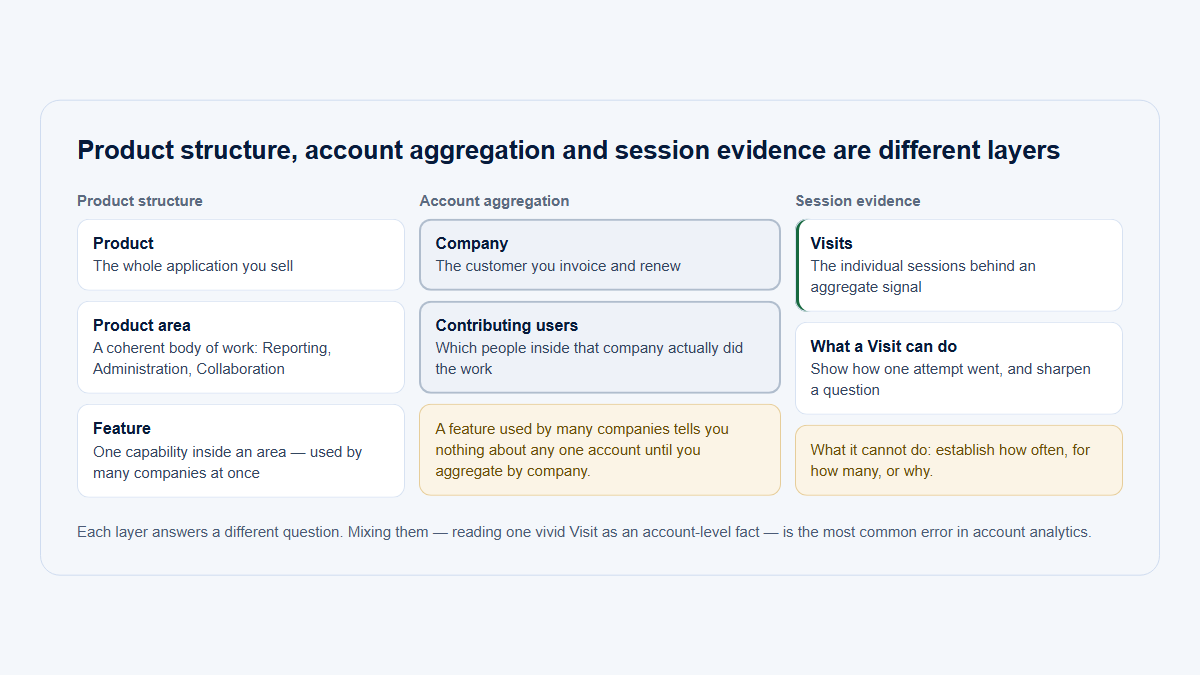
Hymetry sits in the product-analytics layer, but it begins with B2B company context rather than treating the individual user as the only meaningful entity.
Its connected model includes:
- product areas;
- grouped pages or features;
- Pages;
- Companies;
- Users;
- account adoption;
- adoption breadth;
- user penetration;
- usage concentration;
- Visits and session evidence.
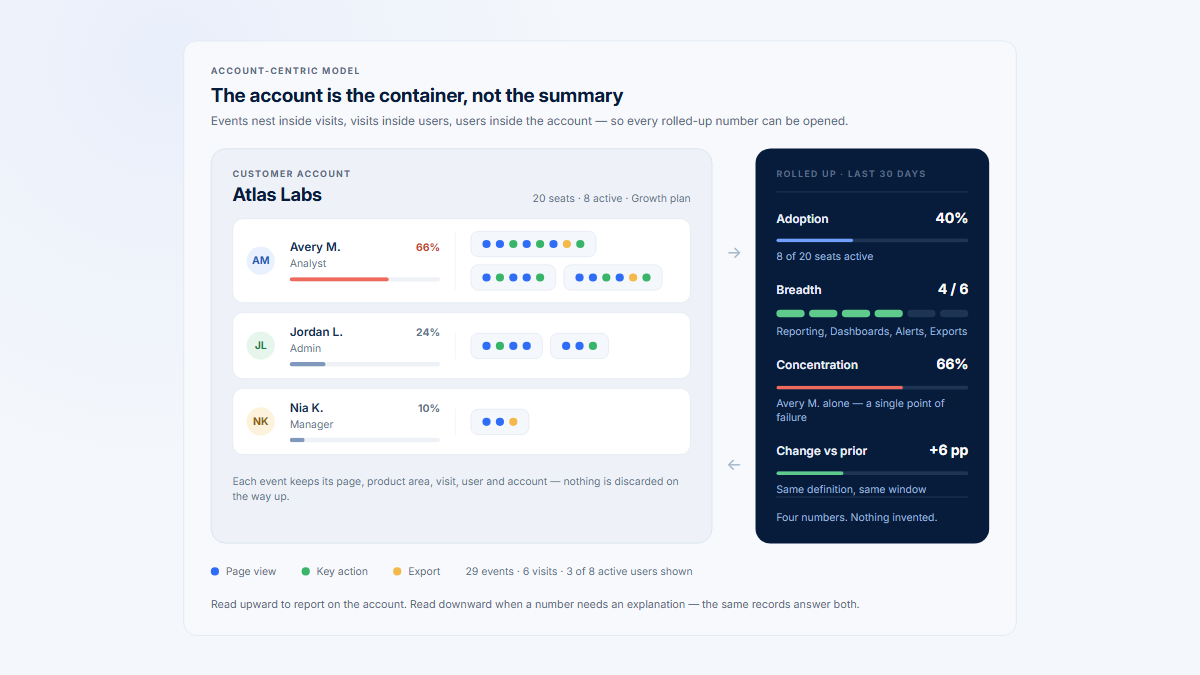
A grouped page such as Reporting can be analyzed by the companies that adopted it, the users who contribute inside those companies, the breadth and concentration of usage, and the Visits worth reviewing. This provides more useful upstream evidence than a login count or an unexplained account label.
Hymetry does not replace:
- CRM and commercial context;
- stakeholder and relationship management;
- configurable CSP health-score models;
- success plans;
- CSM tasks and playbooks;
- digital customer journeys;
- renewal workflows or forecasting;
- billing, support, or survey systems;
- direct customer confirmation.
A founder-led or product-led B2B company may use Hymetry without a CSP when product and founder teams still handle customer operations directly. A mature customer-success organization may connect Hymetry’s account-level evidence to a CSP so product behavior informs an established operating process.
Current boundaries
Hymetry is newer and narrower than the mature platforms represented above. Its ecosystem and independent review footprint are smaller. No meaningful G2 product listing was located during the August 14, 2026 research check.
Do not present Hymetry as a replacement for a general-purpose experimentation and feature-flag suite, CRM, CSP, support desk, billing system, warehouse, or BI program. Do not invent integrations, scale claims, customer outcomes, security certifications, or fully autonomous churn and expansion predictions.
Explore the connected product layers:
FAQ, methodology, and sources
Frequently asked questions
What is the difference between product analytics and customer success software?
Product analytics measures and investigates behavior inside a digital product. Customer success software organizes post-sale work around customer accounts, health, relationships, plans, playbooks, renewals, and expansion. The categories can share data, but they own different decisions.
Can a CSP replace product analytics?
Not when the company needs deep event analysis, funnels, retention, paths, account-behavior exploration, replay, or experiments. A CSP can consume selected product metrics, but it still depends on reliable upstream instrumentation and definitions.
Can product analytics replace Gainsight or ChurnZero?
Normally not. Product analytics can identify adoption changes and accounts worth reviewing, but it does not normally replace Customer 360 context, CSM ownership, success plans, health operations, journeys, playbooks, stakeholder management, or renewal workflows.
Does every B2B SaaS company need both?
No. A PLG company without a CSM team may need product analytics but not a CSP. A high-touch organization with strong warehouse metrics may need a CSP before another analytics application. Both are justified when product behavior is an important input to a repeatable customer-success process and the integration has a clear owner.
How should product usage feed customer health?
Send a small number of governed, segment-appropriate components such as onboarding completion, active-user penetration, adoption breadth, key-workflow usage, concentration, or a meaningful trend. Preserve the definition, denominator, window, freshness, missing-data behavior, and drill-through. Combine product usage with relationship, support, billing, survey, lifecycle, contract, and customer-outcome evidence.
Which system should own account-adoption metrics?
The product analytics or governed warehouse layer should normally own the behavioral definition and calculation. The CSP should consume the result and own how it contributes to segmentation, health, playbooks, and customer work. Document one accountable owner and avoid parallel calculations with the same name.
Where does Hymetry fit?
Hymetry is account-centric product intelligence for B2B SaaS. It connects product areas and grouped pages with Companies, Users, account adoption, adoption breadth, user penetration, usage concentration, and Visits. It can supply product evidence to a CSP, but it does not replace customer-success workflow, CRM, renewals, or stakeholder context.
Methodology
Research scope and evidence limits
This is a category-versus-category editorial comparison, not a controlled product benchmark.
The representative set was selected to show common category patterns without turning the article into a ranking. Official product documentation and pricing pages were used first. Current G2 seller or product pages supplied a common customer-rating snapshot. Vendor videos were used for workflow orientation only.
No authenticated implementation, data-quality audit, performance benchmark, support test, security assessment, or contract review was performed. “Not documented” or “no public list price located” means the reviewed current official materials did not establish the claim; it does not guarantee that a capability or commercial term is unavailable.
Pricing, ratings, review counts, packaging, integrations, and video availability can change. They were reverified on August 14, 2026. Do not compare G2 scores across categories as a universal measure of product quality or suitability.
Product usage can support investigation and prioritization. It does not by itself prove causality, satisfaction, churn, renewal, expansion, customer value, or purchase intent.
Disclosure
Hymetry publishes this article and appears as one representative account-centric product-analytics option because the comparison directly concerns account-level product evidence. The article should remain useful to readers who never choose Hymetry. No affiliate relationship is assumed for the representative vendors, G2, or the selected videos.
Sources
Category definitions and official documentation
- Amplitude — What Is Product Analytics?
- Mixpanel — Introduction
- Mixpanel — Group Analytics
- PostHog — Product Analytics
- PostHog — Group Analytics
- Gainsight — Customer Success Features Overview
- Gainsight — PX and CS Integration
- ChurnZero — Customer Success Software
- ChurnZero — Customer Health Scores
- Vitally — Product Usage Data for Customer Success
- Vitally — Health Framework
- Planhat — Buyer’s Guide to Customer Success Software
- Planhat — Customer Success Playbooks
- Planhat — Customer Lifecycle Management
- Planhat — Current Glossary
Representative-product pricing
Customer reviews
Video orientation
- The Product Folks with Rafael Loh of Mixpanel — Introduction to Product Analytics
- ChurnZero — How to Understand Usage Data
- ChurnZero video on YouTube
Both videos were available on August 14, 2026. They provide vendor or vendor-participant workflow orientation, not neutral performance evidence.