What account-based product analytics means
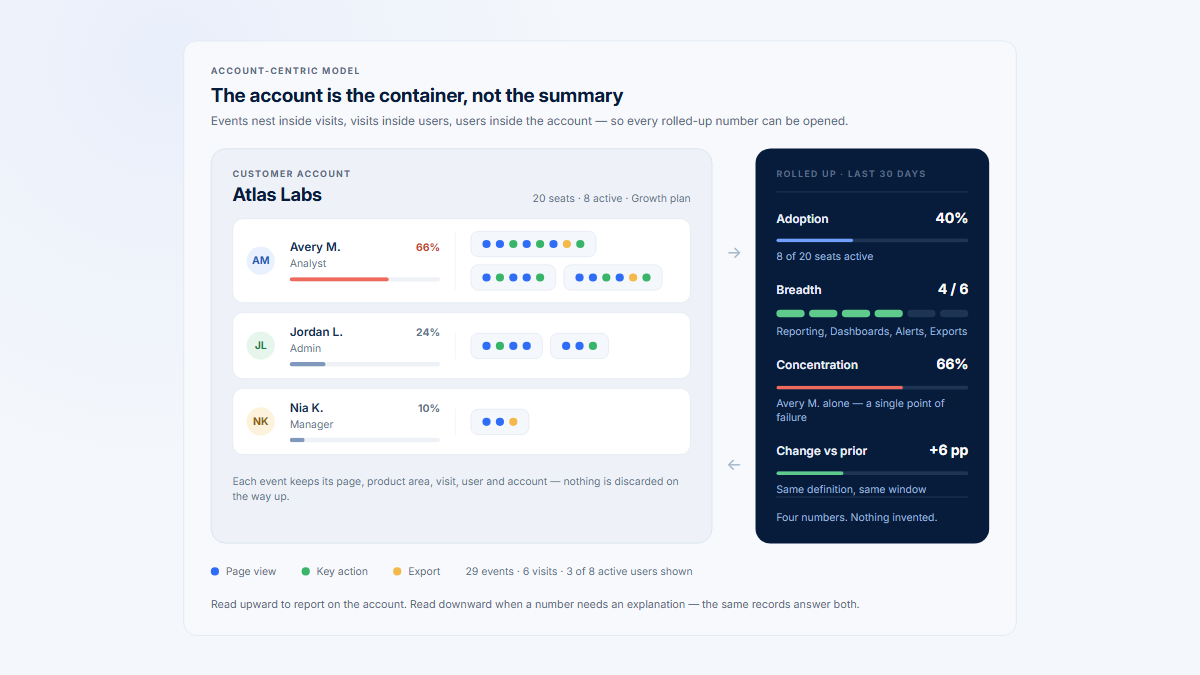
Account-based product analytics changes the analytical unit from one person to the commercial or operational group that receives value. A platform does not become account-centric merely because events contain a convenient company property.
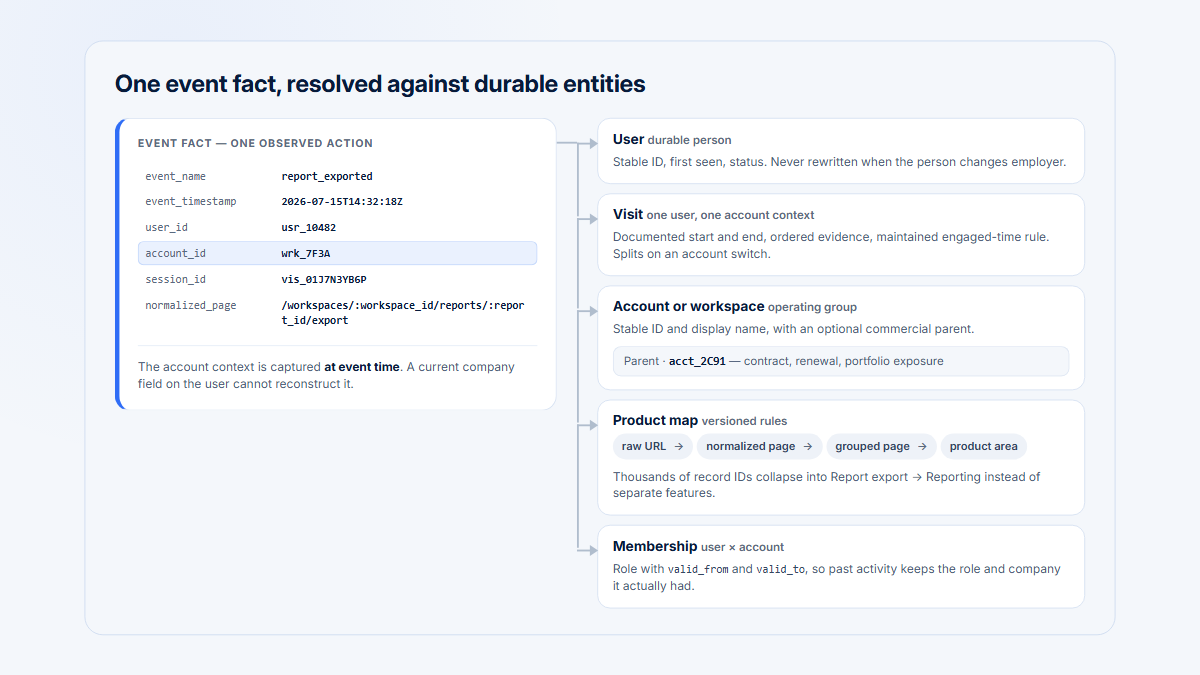
A company_id can make account counts possible. It does not create membership history, account profiles, penetration metrics, concentration analysis, hierarchy, or an account-to-user-to-session investigation path.
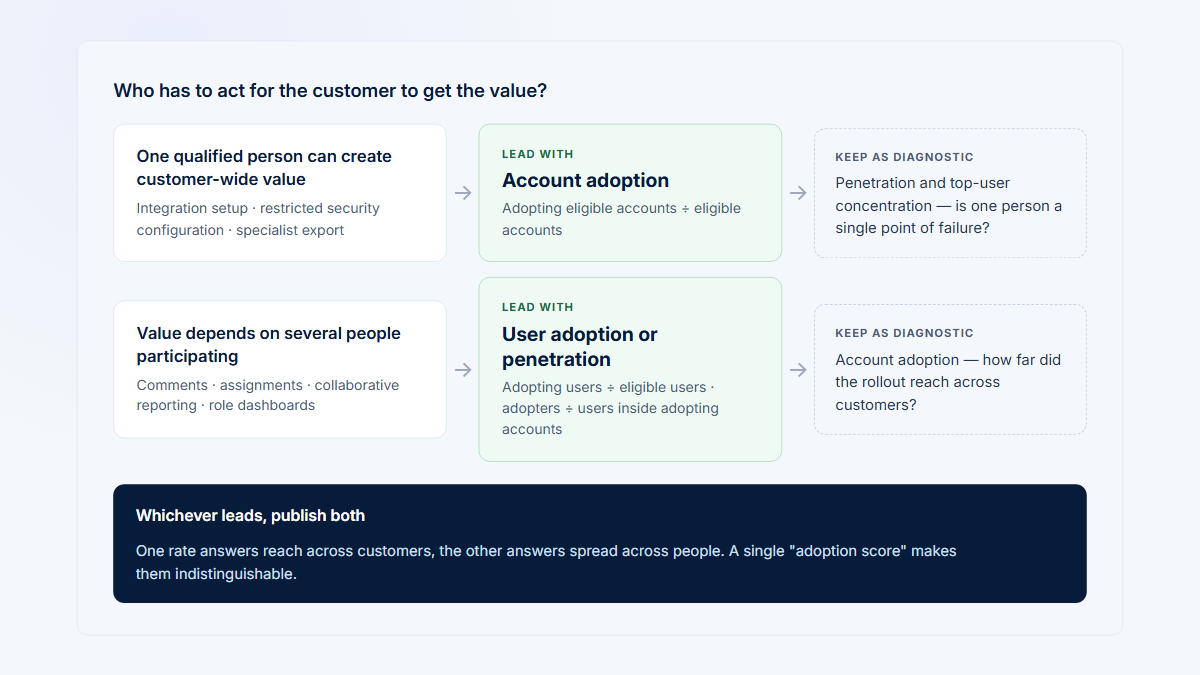
Three account metrics that should not be confused
Multi-account users require event-time context
A consultant, partner, agency employee, or administrator may work in several customer accounts. Keep the stable person, person-to-account membership, active account at event time, and analysis of that person inside each account as separate concepts.
Product structure, account aggregation and session evidence are different layers
Product structure
Account aggregation
Session evidence
Each layer answers a different question. Mixing them — reading one vivid Visit as an account-level fact — is the most common error in account analytics.
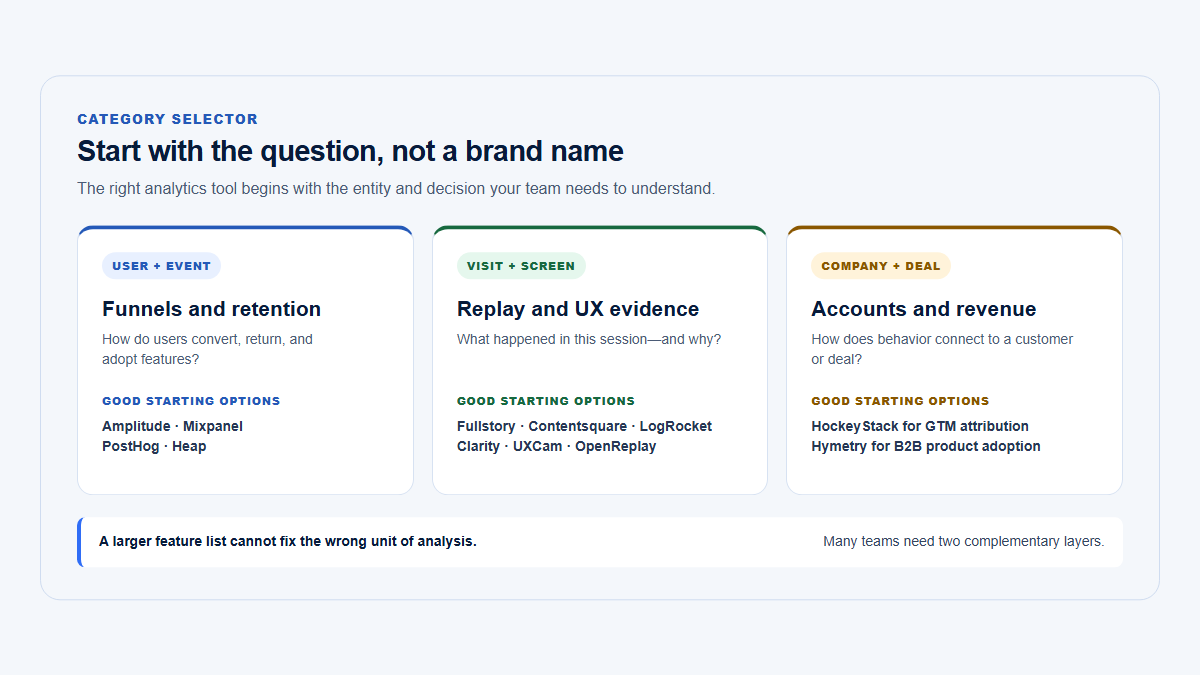
Category boundaries
Account-first product analytics
The account is primary, and the UI begins with company adoption, user distribution, product areas, and evidence.
General product analytics with groups
Events and users come first, with organizations or groups added for funnels, retention, paths, cohorts, and experiments.
Product-adoption platforms
Usage analytics sits beside guides, onboarding, surveys, product mapping, and in-app engagement.
Customer, GTM, or revenue analytics
Product signals feed health, renewal, CRM, pipeline, attribution, or revenue workflows rather than replacing deep product analysis.
Category emphasis, not ranking
General product analytics
Starts from the event
Account-first analytics
Starts from the customer company
Product adoption and guidance
Starts from the in-app experience
Customer success and revenue
Starts from the commercial relationship
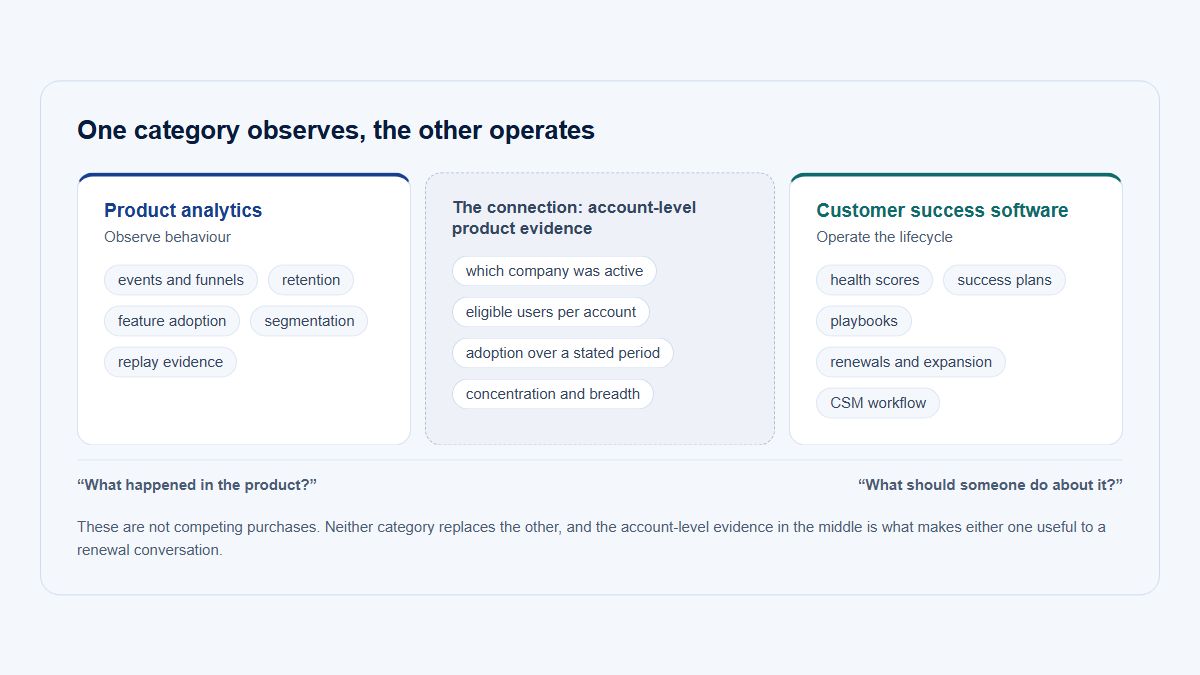
Adjacent categories overlap heavily, and several products span two. What separates them is the operating problem each was built to answer first — which shapes the default view, the data model and the team that owns it.
Account model and identity depth
The most important differences appear before a chart is created. Inspect how each platform represents stable accounts, membership, event-time context, hierarchy, retention, and drill-down.
Table 2
| Tool | Stable account | Membership | Multi-account users | Event-time account | Account properties | Hierarchy | Account funnels | Retention | Penetration | Concentration | User drill-down | Session drill-down | Important limitation |
|---|---|---|---|---|---|---|---|---|---|---|---|---|---|
| Amplitude | Strong | Strong | Available | Strong | Strong | Limited | Strong | Strong | Limited | Limited | Strong | Strong | Accounts is package-dependent; some properties apply prospectively |
| Mixpanel | Strong | Strong | Strong | Strong | Strong | Limited | Strong | Strong | Strong | Available | Strong | Strong | Group Analytics is paid; hierarchy is not central |
| PostHog | Strong | Available | Limited | Strong | Strong | Limited | Strong | Strong | Available | Available | Strong | Strong | One same-type group per event; no group lifecycle or user paths |
| Heap by Contentsquare | Strong | Strong | Limited | Available | Strong | Limited | Strong | Strong | Available | Available | Strong | Strong | Account analytics is Pro; public multi-account guidance is limited |
| Pendo | Strong | Core | Available | Strong | Strong | Available | Available | Strong | Available | Available | Strong | Strong | Parent accounts require configuration |
| Gainsight Product Experience | Strong | Strong | Limited | Strong | Strong | Via integration | Strong | Available | Strong | Available | Strong | Via FullStory | A PX user is normally associated with one PX account |
| Hymetry | Core | Core | Limited; verify implementation | Core | Core | Limited | Core adoption; limited arbitrary funnels | Available recurring use | Core | Core | Core | Core | Newer model with less arbitrary event-analysis breadth |
| HockeyStack | Core for GTM accounts | Available | Limited | Available | Strong | Strong through CRM | Limited | Limited | Limited | Limited | Strong for stakeholders | Limited | Commercial intelligence rather than deep product identity modeling |
| Vitally | Core | Core | Available | Available | Core | Core | Limited | Limited | Strong via Success Metrics | Limited | Core | No native replay | Product behavior is an input to a CS model |
- Amplitude, Mixpanel, PostHog, and Heap are strongest for mature event analysis aggregated by company or group.
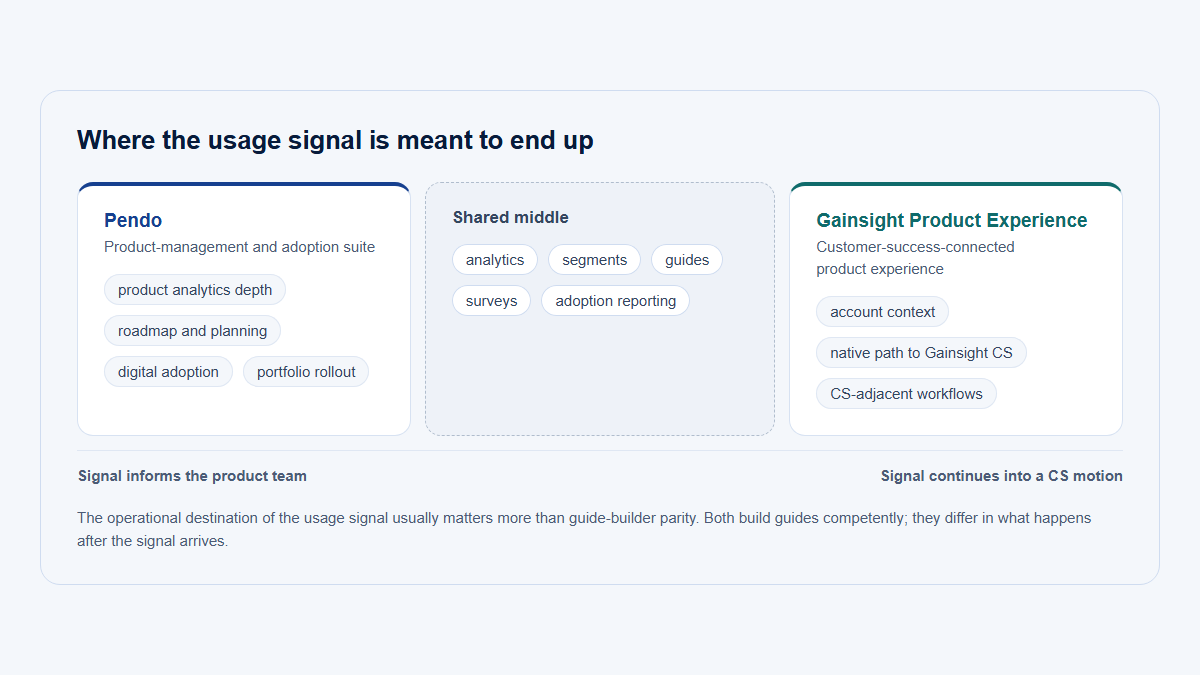
- Pendo and Gainsight PX provide more ready-made account and adoption workflows alongside engagement.
- Hymetry starts from companies, users, product structure, and session evidence but has less event and ecosystem breadth.
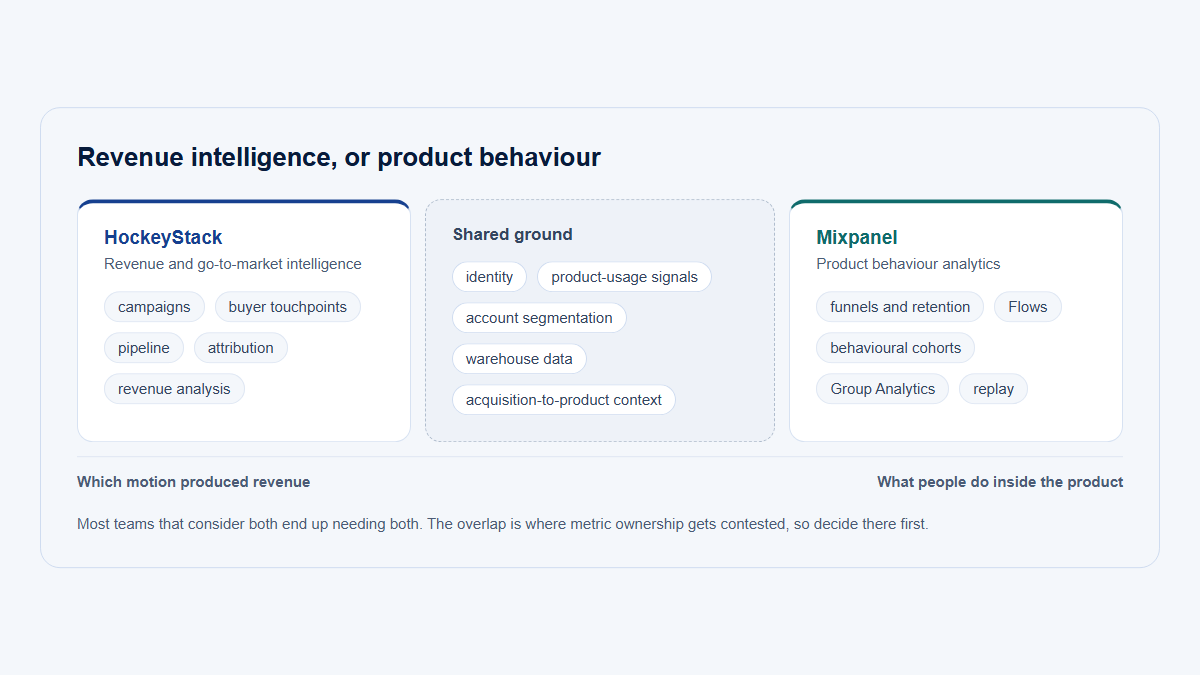
- HockeyStack and Vitally have strong commercial entities without becoming equivalent to deep product analytics.
- Multi-account behavior is decisive; test it with production-like identities and event-time account context.
Product analysis, replay, and adoption
An account model matters only when it answers real behavioral questions. Event platforms excel at arbitrary analysis; adoption platforms connect insight to in-app intervention; account-first tools emphasize collective use and explainable evidence.
Table 3
| Tool | Custom events | Page or feature model | Funnels | Retention | Cohorts | Paths | Product-area adoption | Replay | Experiments | In-app guidance | Mobile | Metric governance |
|---|---|---|---|---|---|---|---|---|---|---|---|---|
| Amplitude | Core | Available | Core | Core | Core | Core | Strong | Strong | Strong | Available | Strong | Strong |
| Mixpanel | Core | Available | Core | Core | Core | Core | Strong | Strong | Strong | No full guide builder | Strong | Strong |
| PostHog | Core | Available | Core | Core | Core | Limited for groups | Strong | Core | Core | Surveys and adjacent tools | Strong | Strong |
| Heap by Contentsquare | Strong, including autocapture | Strong | Core | Core | Strong | Strong | Strong | Add-on | Via integration or adjacent tools | Via integration | Strong | Strong |
| Pendo | Available | Core | Strong | Strong | Strong | Strong | Core | Strong | Adoption and guide testing | Core | Core | Strong |
| Gainsight Product Experience | Available | Core product mapping | Strong | Available | Available | Available | Core | Via FullStory | Limited | Core | Core | Available |
| Hymetry | Limited versus event platforms | Core grouped pages and product areas | Limited | Available | Available | Page flows | Core | Core | No | No | Limited | Strong for normalized product structure |
| HockeyStack | Product and GTM signals | Limited | Limited | Limited | Limited | GTM journeys | Limited | No | No | No | Limited | Strong unified GTM data |
| Vitally | Through event ingestion | Limited | Limited | Limited | Segments | No | Success Metrics | No | No | No in-product builder | Limited | Strong CS metrics |
What the capability table means
Depth and account context are separate dimensions
A platform can be exceptional at funnels and retention while requiring custom work for account breadth, penetration, or champion concentration.
Replay should connect to a signal
A replay library shows what happened. An account workflow also explains why the session matters and which company-level change led to it.
Product areas are not raw events
A stable Reporting or Collaboration model is easier to interpret than implementation-level noise, but it cannot replace arbitrary event exploration.
From an aggregate signal to supporting evidence, before acting
1
Account signal
An aggregate moved: fewer active users, narrower breadth, a dropped workflow
2
Product area
Which part of the product the change sits in
3
Users
Which people changed behaviour, and whether roles changed with them
4
Sessions
Selected Visits that show how specific attempts went
Opened last, never first
5
Customer context
CRM, renewal date, support history, the customer-success review
Usage evidence informs judgment; it does not prove intent. Move from the aggregate to the supporting evidence before taking commercial action — and record what you could not observe.
Customer-success, CRM, and revenue context
Product behavior becomes commercially useful when it connects to account attributes, customer-success work, renewals, or revenue. High usage can support a health assessment, but it does not prove renewal, expansion, or advocacy.
Table 4
| Tool | CRM integration | Account attributes | CS integration | Health input | Renewal or expansion | Pipeline and revenue | Stakeholders | Warehouse | Alerts and workflows |
|---|---|---|---|---|---|---|---|---|---|
| Amplitude | Via integration | Strong | Via integration | Available | Modeled data and integrations | Warehouse or revenue data | Available | Strong | Available |
| Mixpanel | Via integration | Strong | Via integration | Available | Company Analytics and warehouse data | Revenue Analytics and integrations | Available | Strong | Available |
| PostHog | Via integration | Strong | Via integration | Available | Limited without commercial data | Warehouse and integrations | Available | Core | Available |
| Heap by Contentsquare | Strong integrations | Strong | Via integration | Available | Available | Through integrations | Available | Strong on higher plans | Higher plans |
| Pendo | Strong | Strong | Strong | Available | Strong account context | Through integrations | Strong | Available | Strong |
| Gainsight Product Experience | Strong | Strong | Core with Gainsight CS | Core with Gainsight CS | Core with Gainsight CS | Gainsight and CRM context | Core | Plan-dependent | Core with Gainsight |
| Hymetry | Limited; verify current integrations | Core | Limited | Directional usage signals | Evidence for human review | No native revenue system | Core company and user context | Limited; verify implementation | Limited |
| HockeyStack | Core | Core | Strong through CRM and GTM | Account-intelligence input | Strong | Core | Core | Core | Core |
| Vitally | Core | Core | Core | Core | Core | Connected revenue and CRM data | Core | Strong integrations | Core |
Pricing and customer feedback
Pricing cannot be reduced to one monthly number. These products bill by events, sessions, recordings, MAU, functionality, custom contracts, or several independent meters. Account features and replay may sit on a higher plan or add-on.
Events and package
Amplitude
Free: 2M events + 10K replays
Accounts is an add-on or qualifying-package capability.
Events and replay
Mixpanel
Free: 1M events
Free includes 10K replays; Group Analytics is an add-on.
Usage-based products
PostHog
Free: 1M events
First 5K recordings are free; Groups is a paid add-on.
Monthly sessions
Heap by Contentsquare
Free: 10K sessions
Account analytics is Pro; replay is a Pro or Premier add-on.
MAU and functionality
Pendo
Free: 500 MAU
Replay is a Base add-on and is included in Core and Ultimate.
Request pricing
Gainsight Product Experience
Essentials or Enterprise
Custom-priced packages retain PX data for 36 months; replay uses FullStory.
Hosted or open source
Hymetry
Hosted from $149
Includes a 60-day pilot; the self-managed open-source edition is free.
Custom pricing
HockeyStack
Request pricing
No public free plan or dollar entry amount was confirmed.
Request pricing
Vitally
Three paid plans
Tech-Touch, Hybrid-Touch, and High-Touch use request pricing.
Rating note: the G2 scores and counts above are a dated editorial snapshot from 14 August 2026. Review samples cover different categories, customer mixes, and attempted jobs. They are not marked up as Hymetry-authored ratings and should be rechecked before purchase.
Table 5
| Tool | Free plan or trial | Entry model | Billing unit | Account dependency | Replay dependency | G2 | Reviews | Volume warning | Verified | Official links |
|---|---|---|---|---|---|---|---|---|---|---|
| Amplitude | Free plan | 2M monthly events and 10K replays free | Events and package | Accounts add-on or qualifying package | 10K replays included; higher use is plan-dependent | 4.5/5 | 2,976 | No | 14 Aug 2026 | Pricing · Accounts · G2 |
| Mixpanel | Free plan | 1M events and 10K replays free; Growth starts at $0 within allowance | Events and replay | Group Analytics add-on | Volumes vary by plan | 4.5/5 | 1,371 | No | 14 Aug 2026 | Pricing · Groups · G2 |
| PostHog | Usage-based free tiers | 1M analytics events and 5K recordings free | Separate product meters | Groups is paid and bills identified events | Separate replay usage | 4.5/5 | 1,054 | No | 14 Aug 2026 | Pricing · Groups · G2 |
| Heap by Contentsquare | Free plan | 10K monthly sessions free; higher plans custom | Sessions and plan | Account analysis on Pro | Pro/Premier add-on | 4.4/5 | 1,097 | No | 14 Aug 2026 | Pricing · Account analysis · G2 |
| Pendo | Free plan and trial | Free to 500 MAU; paid plans custom | MAU and functionality | Advanced scope varies by subscription | Base add-on; Core/Ultimate included | 4.4/5 | 1,808 | No | 14 Aug 2026 | Pricing · Parent accounts · G2 |
| Gainsight Product Experience | Free trial | Essentials and Enterprise; request pricing | Not publicly stated | PX packages; Gainsight CS context is separately contracted | FullStory integration; 36-month PX retention | 4.4/5 | 243 | Smaller sample | 14 Aug 2026 | Pricing · Packages and retention · Accounts Explorer · G2 |
| Hymetry | 60-day pilot; open source | $149, $349, or $799 monthly, invoiced quarterly by default | Events, recordings, retention, and support | Companies, Users, Pages, and Visits included | Recording quotas; 30-day hosted replay retention | Not rated | — | No mature sample | 14 Aug 2026 | Pricing · Companies · Open source |
| HockeyStack | No public free plan confirmed | Custom pricing | Not publicly stated | Account intelligence is central | No native product replay found | 4.5/5 | 82 | Small sample | 14 Aug 2026 | Account Intelligence · Pricing · G2 |
| Vitally | Sales-assisted sandbox | Three request-pricing plans | Not publicly stated | Accounts, organizations, users, and Success Metrics are central | No native replay | 4.5/5 | 705 | No | 14 Aug 2026 | Pricing · Success Metrics · G2 |
Review themes that matter to a buying decision
These themes are directional, not statistically exhaustive. Individual reviews are not quoted, and scores from different platforms are not merged.
| Products | Commonly valued | Decision caveats | Interpretation |
|---|---|---|---|
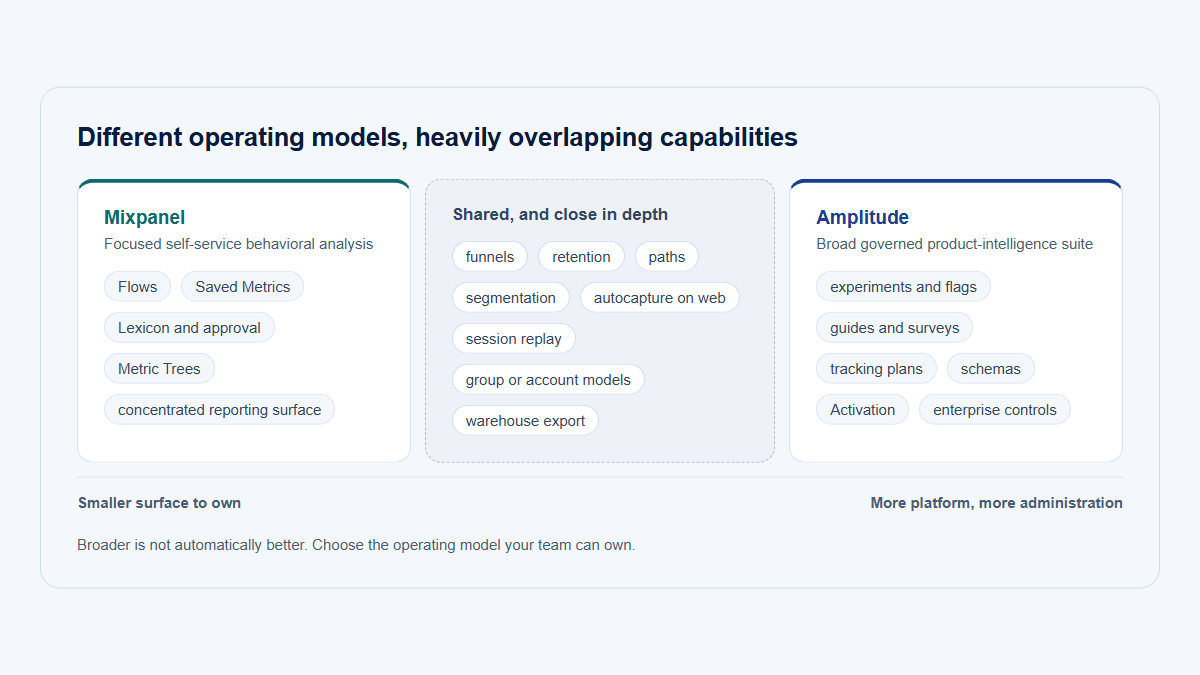
| Amplitude and Mixpanel | Analytical depth, self-service exploration, funnels, and segmentation | Learning curve, governance, taxonomy quality, and advanced-plan cost | Large samples; confirm account features in the proposed contract |
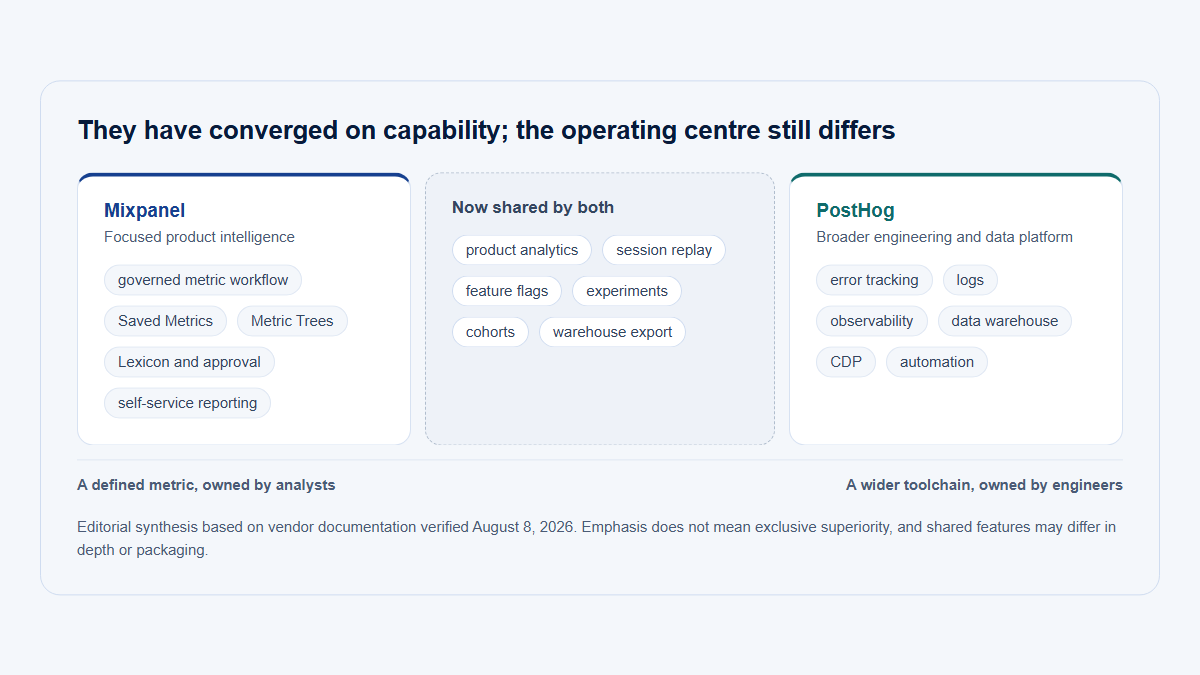
| PostHog | Engineering breadth, analytics plus replay, and rapid iteration | Advanced-product complexity and cloud versus self-hosting gaps | Confirm the exact cloud products and add-ons required |
| Heap by Contentsquare | Autocapture, retrospective definitions, and accessible reporting | Governance, definition quality, plan gates, and add-ons | Test whether autocapture reduces work without creating taxonomy debt |
| Pendo and Gainsight PX | Guides, product mapping, segmentation, and adoption visibility | Setup, custom pricing, configuration, and analytical limits | Gainsight PX carries a materially smaller review sample |
| HockeyStack and Vitally | Commercial context and centralized account workflows | Adjacent to deep product analytics; dependent on connected data | HockeyStack’s small sample needs an explicit warning |
| Hymetry | No mature independent pattern is available | Newer product, limited ecosystem, and no independent rating | Do not replace the absence with testimonials or a publisher score |
Which tool fits your scenario?
The right starting point depends on the workflow the team cannot currently perform, not the number of checked features.
Table 6
| Scenario | Starting tool or category | Why | Main caveat | Companion system |
|---|---|---|---|---|
| Early-stage B2B SaaS | Hymetry for account adoption and replay; Mixpanel or PostHog for arbitrary events | Aligns the first implementation with the main unknown | Hymetry is newer; general platforms add usage and package questions | CRM, then warehouse as complexity grows |
| Enterprise analytics team | Amplitude or Mixpanel | Mature funnels, retention, cohorts, governance, and warehouse connections | Account features and controls are contract-dependent | Warehouse, semantic governance, and CS platform |
| Engineering-led startup | PostHog | Analytics, replay, flags, experiments, and data tools together | Groups is paid; self-hosting is unsupported and omits Groups | CRM or CS platform |
| B2B product-growth team | Mixpanel or Amplitude; Pendo when guides decide | Choose deep analysis or direct in-product intervention | Identify whether analysis or activation is the bottleneck | Messaging, experimentation, or warehouse tools |
| Customer-success organization | Vitally, or Gainsight CS with Gainsight PX | Places usage inside health, renewal, and account work | Does not replace deep event analysis or replay | A product analytics or account-first platform |
| One administrator per account | General product analytics or Pendo | Account distribution matters less when one user represents the customer | The product may become collaborative later | CRM or support data |
| Many users per account | Hymetry, Mixpanel, Amplitude, or PostHog | Adoption, penetration, and distribution become central | Test multi-account users and concentration | CS platform for renewals |
| Self-hosting required | Hymetry Open Source | Account, user, page, Visit, replay, and source-code control | The customer owns infrastructure, security, upgrades, and operations | Warehouse, CRM, and monitoring |
| Usage connected to revenue | HockeyStack for GTM; Vitally for renewals; or warehouse-connected analytics | Connects behavior with commercial context | Usage is evidence, not proof of intent | Deep product analytics and governed warehouse data |
Fictional B2B SaaS example
A fictional product serves 100 companies with administrators, analysts, and managers. It has Reporting, Integrations, and Collaboration areas, multi-account users, session replay, customer-success reviews, and upcoming renewals.
| Task | Account-first | General analytics with groups | Product adoption | Customer or GTM |
|---|---|---|---|---|
| Account adoption | Hymetry centers companies and grouped product areas | Amplitude, Mixpanel, PostHog, or Heap aggregate events by account | Pendo or Gainsight PX report adoption against mapped features | Vitally can ingest the result; HockeyStack is not the first calculator |
| User penetration | Hymetry treats penetration as a core metric | Derive it from group and user analysis | Compare account and visitor use | Vitally Success Metrics can calculate account-user percentages |
| Product-area breadth | Hymetry uses product areas and grouped pages | Requires governed taxonomy or warehouse logic | Pendo Product Areas or Gainsight mapping provide a curated model | Usually consumes the resulting metric |
| User concentration | Compare account activity across users | Derive by grouping account activity by user | Inspect account users and feature use | Vitally can consume activity metrics; HockeyStack is not primary |
| Relevant sessions | Open Visits from the company, user, page, or signal | Connect analysis to replay, subject to plan | Pendo is native; Gainsight PX uses FullStory | No native deep product replay |
| Experiment | Not a current Hymetry capability | Amplitude, Mixpanel, and PostHog are the main starting points | Narrower engagement or guide tests | Not primary |
| In-app guide | Not a current Hymetry capability | Limited or separate | Pendo and Gainsight PX are designed for it | CS playbooks are not in-product guides |
| Renewal preparation | Account, user, adoption, and session evidence for review | Export or share behavior with CS | Gainsight PX is strongest with Gainsight CS | Vitally runs CS workflow; HockeyStack adds commercial context |
| Pipeline or revenue | Requires external CRM, warehouse, or GTM system | Join behavior to warehouse or revenue data | Use CRM or CS integrations | HockeyStack is direct GTM; Vitally is post-sale |
The categories can complement one another. An account-first or event platform may produce trustworthy product metrics, then send them to Vitally, Gainsight, HockeyStack, a CRM, or a warehouse for commercial action.
A score-free evaluation process
- Define the commercial customer. Choose company, workspace, project, team, property, or another value-receiving unit.
- Define accounts and membership. Document stable account IDs and user-to-account relationships.
- Identify multi-account users. Confirm how events retain the active account at use time.
- Define meaningful account adoption. Choose value-producing features or product areas.
- Decide whether penetration matters. Multi-role products need a different model from administrator-only tools.
- Decide whether replay is required. Determine whether aggregate metrics can explain the decision.
- Decide whether experiments or guides are required. Analysis and intervention are separate needs.
- Locate commercial context. Decide where plan, ARR, renewal, owner, lifecycle, and support data live.
- Verify plan dependencies. Confirm accounts, replay, retention, exports, integrations, and history.
- Test one real account workflow. Move from company to users, product-area signal, and supporting sessions.
- Keep metrics explainable. Expose the accounts, users, events, denominator, and time window behind a label.
- Verify export and migration. Confirm how data, definitions, properties, and history can leave.
Common mistakes
| Mistake | Why it misleads | Better approach |
|---|---|---|
Treating company_id as the whole model | Grouping does not supply membership, history, profiles, penetration, or drill-down | Test the complete account-to-user-to-evidence workflow |
| Measuring only account events | One automation or power user can dominate | Combine adoption, active users, penetration, breadth, and concentration |
| Ignoring user distribution | An active account may depend on one champion | Compare the top user or top N with total account activity |
| Counting one administrator as broad adoption | Setup can look like team use | Separate account adoption from user penetration |
| Ignoring multi-account users | Behavior can reach the wrong customer | Store membership and event-time account context separately |
| Summing daily distinct companies | The same company is counted on several days | Deduplicate across the complete period |
| Treating usage as renewal intent | Usage omits relationship and commercial context | Use it as one evidence source in a broader review |
| Comparing account and user adoption | The denominators represent different entities | Name both metrics and show their formulas |
| Using one time window everywhere | Onboarding, operations, seasonality, and renewals have different cycles | Match the period to the decision |
| Buying CS software for instrumentation | The CS system can only act on received data | Establish reliable product events and identities first |
| Buying event analytics for CSM workflow | A dashboard does not assign owners or run renewals | Add a customer-success operating system |
Decision rule: choose account-first analytics for collective adoption and explainable evidence; general group analytics for arbitrary behavior; adoption platforms for in-product intervention; and CS or GTM platforms for health, renewal, pipeline, and revenue workflows.
How Hymetry compares
Hymetry describes itself as account-centric product intelligence for B2B SaaS. It connects Pages, Companies, Users, and Visits so teams can move from account adoption to contributing users and session evidence.
Its advantage is not broader event analysis. Company adoption, product areas, user penetration, usage concentration, and account-to-session investigation are part of its default model.
| Dimension | Hymetry | General product analytics | Product adoption | Customer-success or GTM |
|---|---|---|---|---|
| Primary entity | Company linked to Users, Pages, areas, and Visits | User and event with optional groups | Visitor and account linked to mapped features | Customer, opportunity, or revenue account |
| Account-first UI | Core | Available or Strong with account packages | Strong | Core commercially; product behavior is often imported |
| Product areas | Core | Taxonomy, properties, or semantic governance | Strong through product mapping | Limited or imported |
| Company-to-user drill-down | Core | Strong with groups | Strong | Core stakeholders; behavioral depth varies |
| Replay | Core | Strong in major suites, plan-dependent | Pendo native; Gainsight PX via FullStory | Generally No |
| Experiments | No comparable platform | Strong in Amplitude, Mixpanel, and PostHog | Engagement or guide testing | No |
| In-app guides | No | Limited or separate | Core | CS playbooks are not guides |
| CRM and renewal | Limited | Via integration | Strong; Core for Gainsight PX with Gainsight CS | Core |
| Integrations | Smaller and fewer | Mature ecosystems | Mature ecosystems | Mature CRM, CS, and GTM ecosystems |
| Maturity | Newer; no mature independent rating | Mature | Mature | Mature in adjacent categories |
Where Hymetry is currently strongest
- Account-centric B2B modeling by default.
- Connected Companies, Users, Pages, and Visits.
- Grouped pages and product areas rather than raw URL noise.
- Adoption breadth, penetration, and concentration analysis.
- A path from account signal to user and session evidence.
- Free open-source self-managed evaluation and deployment.
Current limitations
- Newer product with a smaller ecosystem and fewer integrations.
- No mature independent customer-rating sample.
- Less analytical breadth than major event platforms.
- No comparable feature-flag or experimentation suite.
- No full in-app guide builder.
- No CS, CRM, renewal, pipeline, or revenue operating system.
- Multi-account behavior requires conservative verification.
For the underlying measurement model, read the B2B product analytics guide, product usage by company, and account versus user adoption. For narrower vendor decisions, see the analytics category comparison, Amplitude vs Mixpanel, Mixpanel vs PostHog, Pendo vs Gainsight Product Experience, and HockeyStack vs Mixpanel.
FAQ, methodology, and sources
What is account-based product analytics?
It measures product behavior at the company, organization, workspace, or account level while preserving the users and sessions that contributed. It suits B2B products in which several people collectively create adoption and value.
Which product analytics tools support company accounts?
Amplitude, Mixpanel, PostHog, Heap, Pendo, Gainsight Product Experience, and Hymetry support defensible portions of account analysis. Some add groups to event analytics; some center accounts in adoption; others connect usage to engagement.
Is Group Analytics the same as account-based analytics?
Not necessarily. Group Analytics aggregates events by an entity. A complete workflow may also require membership, multi-account handling, account profiles, penetration, concentration, hierarchy, and drill-down to users and sessions.
How do I measure account-level feature adoption?
Define eligible active accounts, count the distinct accounts using the feature during the selected period, and divide adopters by eligible accounts. Use a stable feature definition and deduplicate across the complete period.
How do I measure user penetration inside an account?
For adopting accounts, divide active users who used the feature by all eligible active users in those accounts. Keep this separate from account adoption because the denominators represent different entities.
Can a customer-success platform replace product analytics?
It can ingest metrics for health, renewals, and workflows, but normally does not replace detailed instrumentation, arbitrary behavioral analysis, replay, experimentation, or event governance. Many B2B teams use both categories.
Which account analytics tools can be self-hosted?
Hymetry has a free open-source self-hosted edition with account, user, page, Visit, and replay capabilities. PostHog also has self-hosting, but it is officially unsupported and omits paid cloud capabilities including Group Analytics.
Why is Hymetry included?
Hymetry publishes the comparison and has an explicitly account-centric model. The page applies the same fields and limitations, states the lack of independent ratings, and does not present Hymetry as a universal winner.
Methodology
Research method, evidence labels, and publisher disclosure
- Current official documentation and pricing came first; G2 supplied the common rating snapshot.
- Inclusion required more than an arbitrary
company_idfilter or sales-oriented account list. - Products were classified by primary workflow rather than ranked.
- Customer-success and GTM products are clearly labeled adjacent options.
- “No” means no support was found in reviewed official material, not that an undocumented beta cannot exist.
- Plan boundaries, multi-account gaps, and self-hosting parity are described conservatively.
- Prices use different units and were not normalized into a synthetic monthly score.
- Ratings were not averaged across platforms or used as an overall score.
- No vendor competitor page was used as neutral evidence.
- Dynamic facts were checked on 14 August 2026.
Disclosure: Hymetry publishes this comparison and is included because it is account-centric B2B product analytics. The same comparison fields apply to Hymetry and other products. Missing ratings or capabilities are stated explicitly.
Included evidence, exclusions, and remaining evidence gaps
Included: current account and group documentation, product and pricing pages, G2 product pages, official videos, and current Hymetry repository or project documentation.
Excluded: pricing aggregators, affiliate listicles, vendor competitor pages used as neutral evidence, invented ratings, unpublished roadmaps, and unsubstantiated customer outcomes.
Countly was excluded: current material supports users, events, sessions, privacy, and self-hosting, but reviewed Groups and Profile Groups do not establish a first-class commercial account entity with membership, account lifecycle aggregation, and account drill-down.
Appier AIRIS was excluded: current positioning centers on Customer 360, journeys, predictive customer data, marketing activation, and campaign ROI rather than a defensible B2B account-level product analytics workflow.
Public documentation remains incomplete for some multi-account workflows and plan boundaries. Four G2 counts are a dated editorial snapshot slightly ahead of accessible cached seller indexes and should be rechecked before procurement.
Sources
Official account and group documentation
- Amplitude account-level reporting
- Mixpanel Group Analytics and Account Analytics for B2B teams
- PostHog Group Analytics
- Heap Account Health Analysis, funnels, and journeys
- Pendo multi-level accounts and analytics updates
- Gainsight PX Accounts Explorer
- Vitally organizations, accounts, and users and Success Metrics
- HockeyStack Account Intelligence
- Hymetry Companies and Hymetry Visits
Official product, pricing, deployment, and integration pages
- Amplitude pricing
- Mixpanel pricing
- PostHog pricing, self-hosting, and self-hosting disclaimer
- Heap pricing
- Pendo pricing, Replay updates, and retention
- Gainsight pricing, PX packages, and FullStory integration
- Vitally pricing
- HockeyStack pricing and HockeyStack product overview
- Hymetry pricing and Hymetry open source
Official exclusion evidence
- Countly Basics, Profile Groups, and user management
- Appier AIRIS and its official launch announcement
These sources support the methodology exclusions; they are not used as evidence about an included product.
Customer-rating sources
- Amplitude Analytics on G2
- Mixpanel on G2
- PostHog on G2
- Heap by Contentsquare on G2
- Pendo on G2
- Gainsight Product Experience on G2
- HockeyStack on G2
- Vitally on G2
Scores and review counts shown in this article are a 14 August 2026 snapshot and can change.
Official video material
- PostHog: Group analytics in PostHog · 16:15
- Mixpanel: The value of Mixpanel as a tool for customer success managers · 1:47
Both videos were available and embeddable on 14 August 2026. They demonstrate vendor workflows and are not neutral comparative evidence.
Hymetry repository and project documentation
- Canonical Hymetry marketing context supplied with this comparison assignment.
- Current Hymetry repository implementation and maintained project documentation.
- Current public Pages, Companies, Users, Visits, pricing, security, and open-source pages.