Key differences
| Criterion | Mixpanel | PostHog |
|---|---|---|
| Center of gravity | Governed self-service behavioral analytics | Engineering, data, and product-building platform |
| Product analytics | Stronger focus for reusable report workflows | Strong analytics connected to a wider technical stack |
| Replay | Web and supported mobile; report-linked investigation | Web and mobile; connected to errors, logs, and feedback |
| Flags and experiments | Advanced capabilities are Enterprise/add-on sensitive | Native usage-metered products |
| Errors, logs, surveys | Not a native specialist suite | Native products with separate meters |
| B2B accounts | Paid Group Analytics; Company Profiles and activation workflows | Paid Group Analytics across insights, flags, and experiments |
| Warehouse and pipelines | Connectors, imports, exports, and paid Data Pipelines | SQL/HogQL, managed-warehouse beta, destinations, and batch exports |
| Self-hosting | No first-party self-hosted edition found | MIT-licensed hobby deployment; Cloud-only paid features |
| Pricing shape | Core event plan plus commercially important add-ons | Many product-specific usage meters |
They have converged on capability; the operating centre still differs
Mixpanel
Focused product intelligence
Now shared by both
PostHog
Broader engineering and data platform
A defined metric, owned by analysts A wider toolchain, owned by engineers
Editorial synthesis based on vendor documentation verified August 8, 2026. Emphasis does not mean exclusive superiority, and shared features may differ in depth or packaging.
Decision by scenario
| Scenario | Start with | Why | Important limitation |
|---|---|---|---|
| Product manager owns analysis | Mixpanel | Focused reports and reusable definitions | Instrumentation and governance still need owners |
| Engineering owns product tooling | PostHog | Analytics, replay, flags, and errors share context | Broader surface and variable product maturity |
| Analyst-led scale-up | Mixpanel | Boards, Lexicon, saved metrics, and behavioral workflows | High volume and add-ons change cost |
| Two-engineer startup | PostHog | One SDK can cover several product jobs | Easy to create noisy capture and activate many meters |
| B2B SaaS accounts | Evaluate both | Both sell group analytics | Attach company context at event time |
| Mobile-first product | Mixpanel | Mature focused analytics and supported replay | Verify SDK-level parity for the needed workflow |
| Self-hosting required | PostHog | Only current self-host path here | Unsupported hobby deployment shifts operations to you |
| Customer-success outreach | Another category | Neither is a full renewal/outreach workspace | Use behavioral evidence as an input, not the entire workflow |
Analytics, governance, and B2B accounts
Both answer sophisticated behavioral questions. Mixpanel makes governed analysis the product center; PostHog makes analysis one connected part of an engineering platform.
| Capability | Mixpanel | PostHog | Decision implication |
|---|---|---|---|
| Funnels | Advanced ordering, exclusions, windows, and breakdowns | Sequential, strict, and any-order modes | Test your exact sequence rules |
| Retention and cohorts | Reusable behavioral definitions across reports and activation | Reusable across analytics, flags, experiments, replay, and destinations | PostHog connects more engineering actions |
| Paths | Flows around preceding and following behavior | Paths and journeys connected to replay | Interface preference matters |
| Governance | Lexicon, ownership, verification, saved metrics, and Metric Trees | Descriptions, tags, verification, actions, schemas, and SQL models | Mixpanel centralizes the analyst language more visibly |
| Account analysis | Group funnels, retention, cohorts, Company Profiles, and activation metrics | Configured groups in insights, flags, and experiments | Both require paid packaging and explicit group identity |
| Replay evidence | Reports and cohorts lead to relevant recordings | Insights connect to replay, errors, logs, and feedback | PostHog has wider technical context |
A tool cannot repair an ambiguous event contract. Define stable user and company identifiers, authoritative server outcomes, event ownership, consent, deduplication, and event-time properties first. The product analytics instrumentation plan provides a practical sequence.
Where the two still diverge
Mixpanel
PostHog
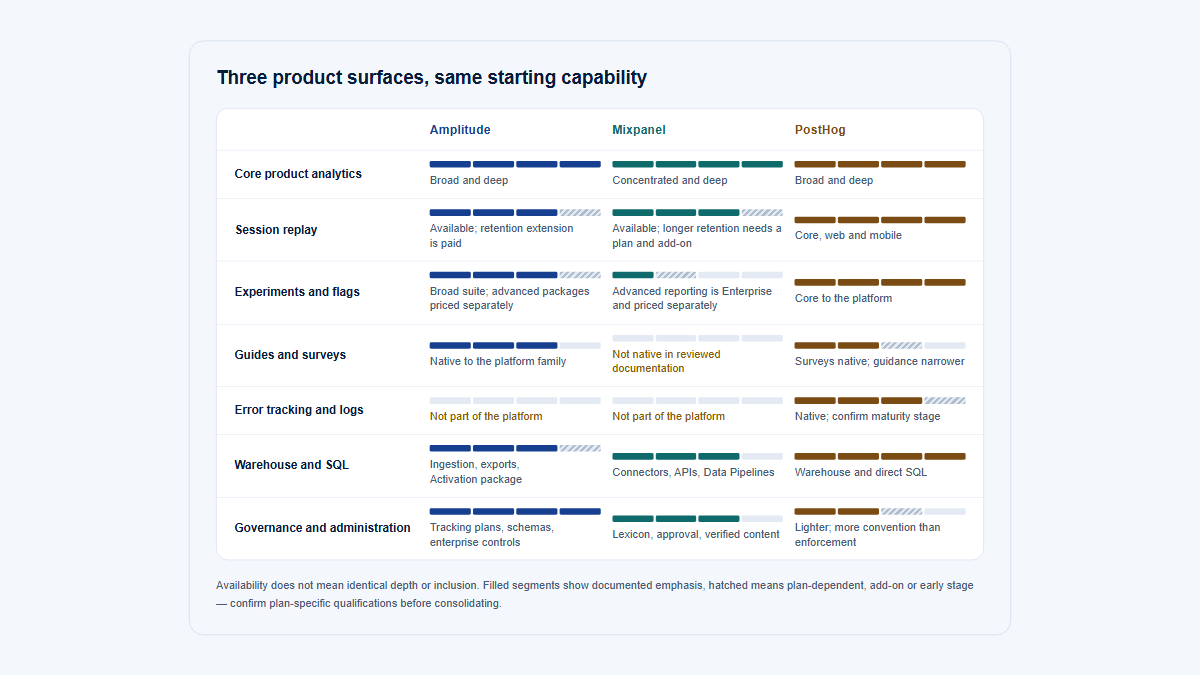
Core product analysis
Funnels, retention, Flows, Insights
Funnels, retention, paths, SQL
Governed metric workflow
Lexicon, approval, Saved Metrics, Metric Trees
Lighter; more convention than enforcement
Replay, flags and experiments
Available; advanced tiers priced separately
Core to the platform
Errors, logs and observability
Not part of the reviewed platform
Native; confirm the maturity stage per product
Warehouse, CDP and automation
Connectors and Data Pipelines
Warehouse, CDP and automation in-platform
Account and company analysis
Group Analytics add-on
Group analytics; verify report coverage
The core product-analysis stack has converged. Engineering breadth and metric workflow remain the differentiated ends. Hatched segments are plan-dependent or add-on.
Engineering, data, and deployment
PostHog’s differentiator is the amount of product-engineering context around the analytical event. Feature flags, experiments, replay, errors, logs, surveys, workflows, destinations, and AI products can share a platform. That can reduce integration boundaries, but it can also create more governance work and more pricing meters.
Mixpanel’s perimeter has expanded through replay, warehouse connectors, Data Pipelines, experiments, flags, AI assistance, and activation. It remains more natural when the analytical definition—not incident response or delivery—is the center of the operating model. Mixpanel is cloud-only in the reviewed material. PostHog offers an MIT-licensed self-hosted path, but its own documentation describes that path as a hobby deployment without support or guarantees; paid features remain Cloud-only.
| Question | Mixpanel | PostHog |
|---|---|---|
| Native error context | Use a companion integration | Source-mapped error tracking connected to replay and properties |
| Logs and observability | Not a native product family | Usage-metered logs and AI observability |
| Surveys | Use a companion product | Native response-metered surveys |
| Warehouse role | Warehouse-connected analytics and outbound activation | SQL/HogQL, connectors, destinations, and managed-warehouse beta |
| Operational risk | Add-on and cross-tool coordination | Platform breadth, changing interfaces, and many meters |
Pricing and customer ratings
Pricing was verified August 8, 2026. Model real anonymous and identified events, groups, replay, flags, experiments, pipelines, errors, logs, surveys, and retention rather than comparing only the free allowance.
Mixpanel pricing
Mixpanel
1M events
- Replay
- 10,000 monthly recordings on Free
- Growth entry rate
- $0.28 per 1,000 events after 1M
- Groups
- Paid add-on; documented 40% charge on relevant additional data
- Pipelines
- Paid add-on; documented 20% charge on relevant additional data
PostHog pricing
PostHog
1M events
- Replay
- 5,000 web and 2,500 mobile recordings
- Flags
- 1M requests free, then usage based
- Groups
- Paid add-on on all identified project events once enabled
- Other products
- Separate errors, logs, warehouse, survey, workflow, and AI meters
Detailed pricing cautions
Mixpanel listed unlimited seats and custom Enterprise pricing; an alternative MTU Enterprise option was documented from $20,000 annually. PostHog’s calculator separated anonymous, identified, and group-event treatment and published optional platform packages. Both can be inexpensive at low volume and costly under a poor capture design. Build current, 12-month growth, and noisy-capture cases before purchase, then confirm live rates contractually.
Equal rounded ratings do not imply equal scope or fit. Review themes can shape a pilot; they cannot prove accuracy, security suitability, statistical validity, or return on investment.
Which should you choose?
| Choice | Choose it when | Implementation caveat |
|---|---|---|
| Mixpanel | PMs and analysts need a governed behavioral-analysis home | Budget for groups, pipelines, experiments, flags, and companion technical tools |
| PostHog | Engineering wants to consolidate product and technical evidence | Govern each product meter and test specialist depth |
| Use both temporarily | You are migrating or running a controlled pilot | Define KPI ownership and a retirement date |
A B2B release is not only a flag and a funnel
1
Account cohort and flag
2
Experiment exposure
3
Product behaviour
4
Account adoption
5
Replay and technical evidence
6
Warehouse context and action
Mixpanel lane
PostHog lane
Prerequisites neither tool creates
Reliable evidence depends on identity, account context, server-side outcomes, replay, technical evidence and an action path. Editorial synthesis verified August 8, 2026.
Pilot the same funnel, retention definition, group analysis, replay investigation, release workflow, and governance task. Measure time to a trusted answer and maintenance burden, not the number of checked boxes.
Where Hymetry fits
Hymetry is narrower account-centric product intelligence for B2B SaaS. It is relevant when the customer company is the primary analytical unit and product or customer-success teams need to trace an account signal through its users, product areas, and Visits.
| Decision | Consider Hymetry when | Choose Mixpanel or PostHog when | Hymetry’s limitation |
|---|---|---|---|
| Primary view | Companies and their users are the starting point | General event analysis is the starting point | Less analytical breadth |
| Account evidence | Adoption breadth, concentration, and Visits belong together | You can configure account workflows from generic groups | Smaller ecosystem |
| Product engineering | A narrow B2B evidence path is sufficient | You need flags, experiments, errors, logs, or broad replay | No comparable general developer suite |
Explore Companies, Users, Pages, and Visits.
Frequently asked questions
Which has stronger product analytics?
Both are capable. Mixpanel is the safer default for analyst- and PM-led governance, reusable definitions, and a focused reporting workspace. PostHog is stronger when analysis must connect directly to engineering tools, SQL, replay, errors, and release delivery.
Which is better for engineers?
PostHog usually fits better because flags, experiments, errors, logs, workflows, replay, and developer tooling share a platform. Mixpanel fits engineering teams that want to enable a more focused analytical workspace for product and data partners.
Which supports B2B account analytics?
Both do through paid group packages. Mixpanel emphasizes group reports, Company Profiles, and activation metrics. PostHog connects groups to insights, flags, and experiments. Both need stable company identifiers attached to relevant events.
Which can be self-hosted?
PostHog has an MIT-licensed self-host path, but its documentation describes it as an unsupported hobby deployment without guarantees and excludes Cloud-only paid features. No current first-party Mixpanel self-hosted edition was found.
Which is cheaper?
There is no universal answer. Mixpanel concentrates billing around events and add-ons; PostHog exposes many product-specific usage meters. Price your actual event identities, groups, replay, flags, experiments, pipelines, errors, logs, surveys, and growth case.
Can PostHog replace Mixpanel?
Yes when its reporting and governance meet the team’s standards and engineering breadth is valuable. Historical cohorts, saved reports, group semantics, replays, and metric definitions are not automatically portable, so dual-run a small KPI set before cutover.
Sources
Disclosure: Hymetry publishes this comparison and appears only where its narrower B2B account model is relevant. Product claims, prices, ratings, and video metadata were verified August 8, 2026 and may change.
Methodology and evidence limits
Official product, implementation, pricing, privacy, and deployment documentation was prioritized. G2 supplied the shared rating source. The third-party video is commercially interested context; vendor videos demonstrate workflows but do not establish comparative quality.
No authenticated tenant or performance benchmark was used. Package, beta, and availability limits remain explicit.
Full source directory
Mixpanel official sources
- Pricing and billing documentation
- Funnels, Retention, and Flows
- Saved Metrics and Behaviors, Metric Trees, and Lexicon
- Group Analytics, Session Replay, Experiments, and Feature Flags
PostHog official sources
- Pricing and Product Analytics
- Group Analytics, Session Replay, Feature Flags, and Experiments
- Error Tracking, Logs, Data Warehouse, and self-hosting guidance
Ratings and video context
Additional preserved references
These references supported the original detailed article and remain available for claim verification and further reading.
- Mixpanel: What Is Mixpanel
- Mixpanel: Reports
- Mixpanel: Events And Properties
- PostHog: Actions
- Mixpanel: Javascript
- Mixpanel: Funnels Advanced
- PostHog: Funnels
- PostHog: Insights
- PostHog: Schema Management
- PostHog: How To Watch Recordings
- Mixpanel: Heatmaps
- PostHog: Heatmaps
- PostHog: Creating Feature Flags
- PostHog: Surveys
- PostHog: Start Here
- Mixpanel: Mixpanel Agent
- PostHog: Traces
- PostHog: Managed Warehouse
- Mixpanel: Data Pipelines
- PostHog: CDP
- Mixpanel: Export Methods
- PostHog: Self Driving
- Mixpanel: Sdks
- PostHog: Flutter
- Mixpanel: Concepts
- PostHog: official page
- Mixpanel: Group Analytics FAQ
- PostHog: Multiple Environments
- Mixpanel: Launchdarkly
- PostHog: Multi Project Feature Flags
- Mixpanel: Warehouse Connectors
- PostHog: Web App
- Mixpanel: Alerts
- Mixpanel: EU Residency
- Mixpanel: Session Replay Privacy Controls
- PostHog: Access Control
- Mixpanel: Startup Program
- G2: Reviews
- G2: Reviews
- PostHog: Testimonials
- Mixpanel: Mixpanel Account Analytics B2B
- Mixpanel: Agentic Automations
- Mixpanel: MCP
- Mixpanel: Mixpanel Headless
- Mixpanel: Experiments
- PostHog: official page
- PostHog: Workflows
- GitHub: Posthog
- B2B product analytics guide
- product usage by company
- the self-hosted product analytics guide
- autocapture and custom events