Key differences
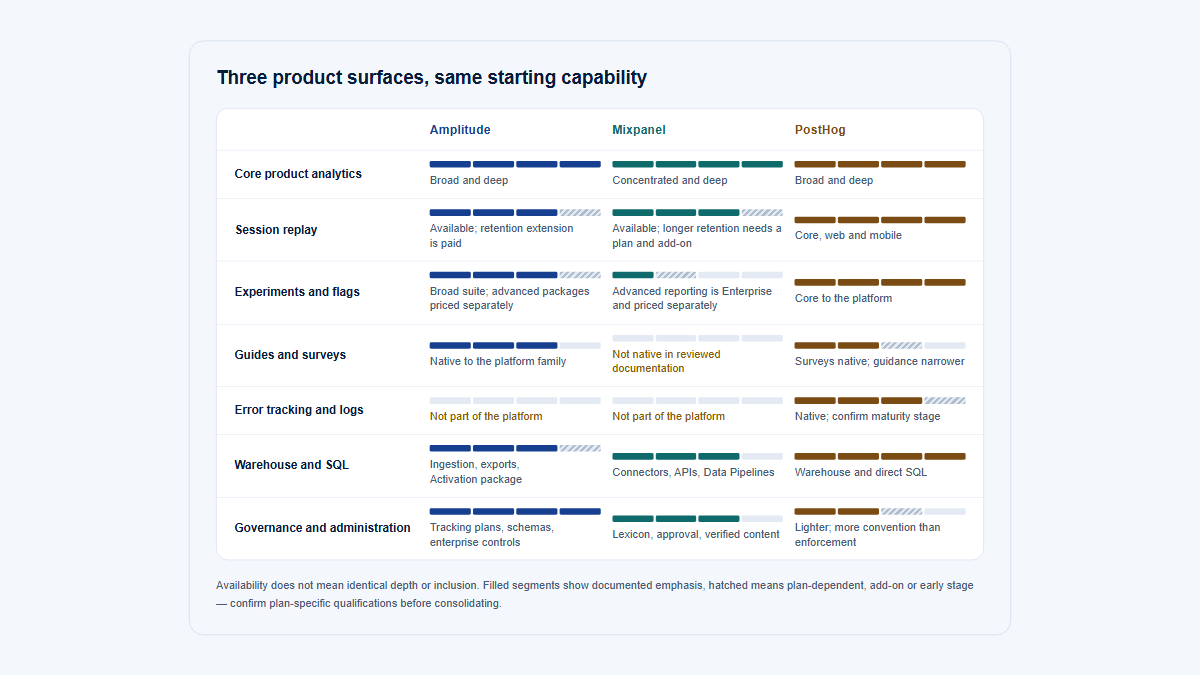
| Criterion | PostHog | Mixpanel | Heap by Contentsquare |
|---|---|---|---|
| Center of gravity | Engineering and product-building platform | Behavioral product intelligence | Autocapture-led product and experience analytics |
| Collection default | Explicit events plus web autocapture | Explicit events plus web autocapture | Strongest Broad web/mobile autocapture plus custom events |
| Historical reinterpretation | Actions over retained events | Custom Events over retained data | Retrospective UI labeling is central |
| Funnels and retention | Technical depth and SQL options | Strongest focus Rich self-serve controls | Strong over captured and defined behavior |
| B2B accounts | Paid Group Analytics add-on | Paid Group Analytics add-on | Account Analytics on higher plans |
| Replay | Deep engineering context | Integrated with reports and heatmaps | Connected to autocaptured journeys and experience analysis |
| Flags and experiments | Native Both | Native, package-dependent | No native assignment or delivery verified |
| Deployment | Cloud plus unsupported open-source self-host path | Cloud | Cloud |
| Primary cost risk | Many usage meters | Event volume and add-ons | Sessions, catalog, and add-ons |
Decision by scenario
| Scenario | Start with | Why | Check first |
|---|---|---|---|
| Small engineering-led product team | PostHog | One platform can replace several adjacent tools | Who will manage schemas, products, and usage meters? |
| PM and analyst self-service | Mixpanel | Focused reporting and reusable definitions | Is the event and identity model trustworthy? |
| Unforeseen historical UI questions | Heap | Broad capture supports later definition | Was the evidence retained and permitted? |
| B2B account analytics | Mixpanel or PostHog | Explicit group models work across behavioral reports | Model add-on cost and event-time company context |
| Feature delivery and analysis together | PostHog | Flags and experiments are core platform workflows | Evaluate latency, governance, and billing at expected traffic |
| UX evidence within Contentsquare | Heap | Product Analytics connects to the wider experience stack | Confirm the exact legacy or unified catalog |
| Strict self-hosting requirement | PostHog, with caution | Only verified open-source path here | It is unsupported; your team owns upgrades, scale, and security |
Collection and historical reliability
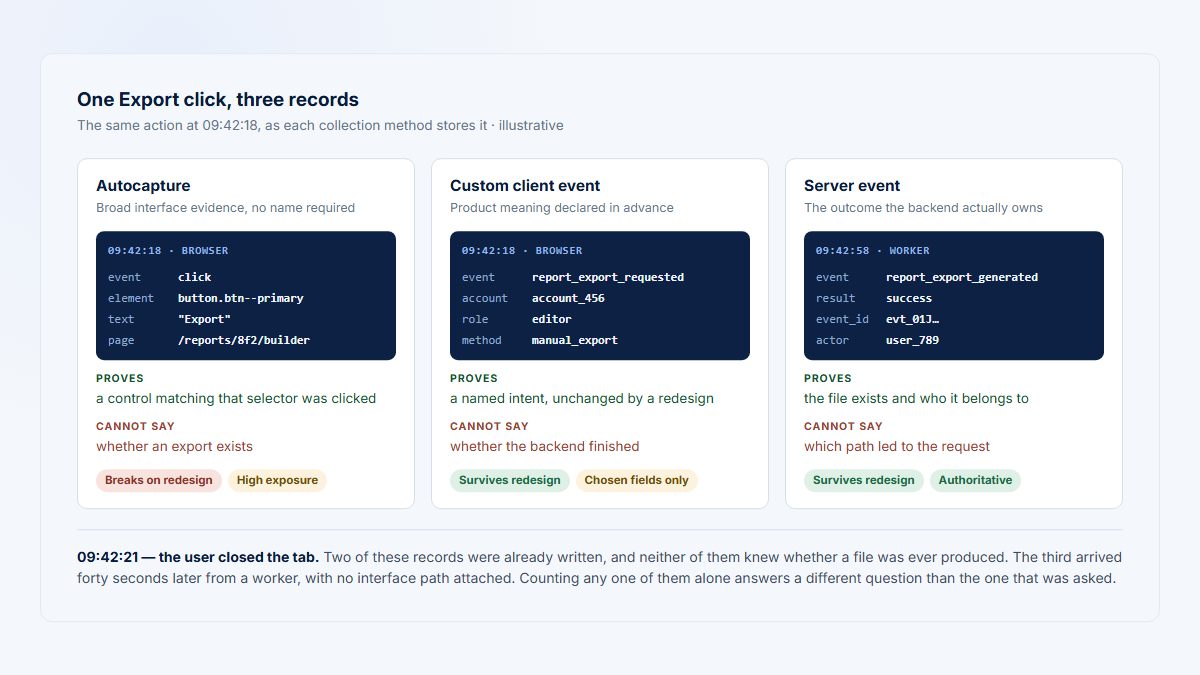
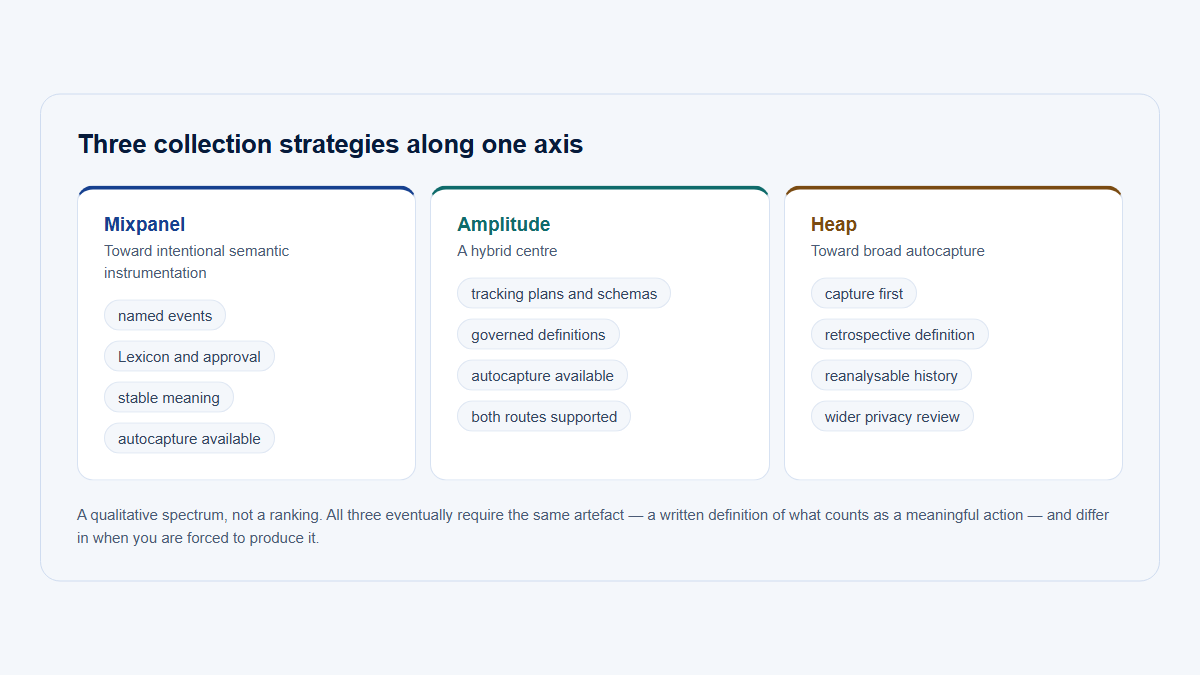
All three can combine autocapture and semantic events. The real decision is when meaning is assigned and how much raw interface evidence the team is willing to collect, govern, and pay for.
| Question | PostHog | Mixpanel | Heap |
|---|---|---|---|
| What is collected? | Explicit events and supported web interactions | Explicit events and supported web interactions | Broad frontend interactions plus sent events |
| How is meaning added later? | Actions | Custom Events | Visual or rule-based event definitions |
| What survives a redesign best? | Stable semantic events | Stable semantic events | Definitions built on durable selectors and attributes |
| How is backend success proven? | Server event or authoritative source | Server event or authoritative source | Custom/server event or authoritative source |
| What cannot be recovered? | Uncaptured data, missing account identity, intentionally masked values, expired history, or a backend result inferred only from a click | ||
Analytics, accounts, and product workflows
| Capability | PostHog | Mixpanel | Heap |
|---|---|---|---|
| Funnels | Ordered, unordered, repeated, exclusion, window, and SQL options | Rich ordering, re-entry, exclusion, property-holding, and windows | User, session, and beta account funnels |
| Retention | Standard and SQL-supported analysis | Broad return definitions and behavioral segmentation | Retention over defined or autocaptured events |
| Paths | Paths and replay drill-down | Flows | Journeys and effort analysis |
| Account model | Group types across analytics, flags, and experiments | Alternative group key and profiles | Selected Account ID; account funnels can span users |
| Replay context | DOM, events, console/network, performance, and heatmaps | Report drill-down, web heatmaps, and supported app platforms | Autocaptured event and journey context through current packaging |
| Experiments | Native assignment and analysis through flags | Native analysis and package-dependent flags | Can analyze externally assigned variants |
| Adjacent tools | Surveys, errors, logs, warehouse, and pipelines | Metric Tree, governance, warehouse connectors, and pipelines | Contentsquare experience capabilities and data export |
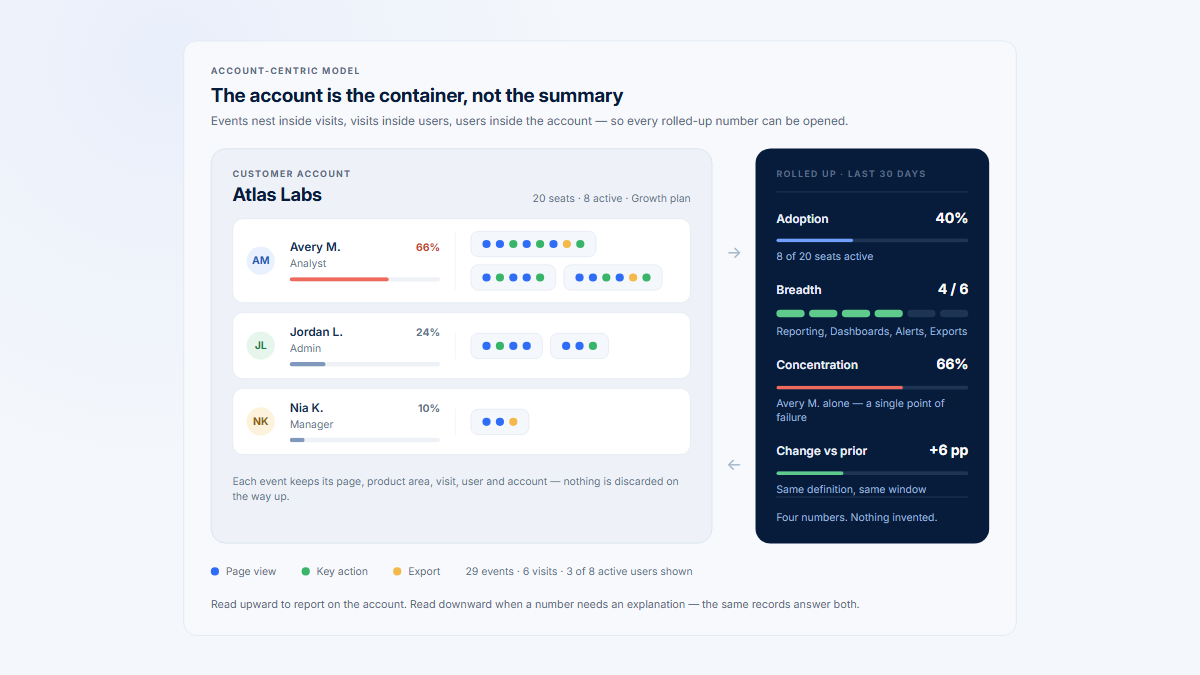
For B2B SaaS, do not treat company usage as a user total. Keep an event-time account key, then separate account adoption, user penetration, breadth, and concentration. PostHog and Mixpanel charge separately for group capabilities; Heap places account analysis on higher plans in both its legacy and unified catalogs.
Privacy, deployment, and ownership
What all three require
- Deliberate consent, masking, and exclusion rules.
- Stable identity and account-key governance.
- Retention and role policies matched to risk.
- Replay review before production rollout.
Where they differ
- PostHog offers cloud regions and an unsupported open-source self-host path.
- Mixpanel is cloud-delivered with regional and contract controls.
- Heap is cloud-delivered inside a changing Contentsquare catalog.
- Self-hosting transfers security, scale, backups, and upgrades to your team.
Autocapture and replay increase the value of explicit data minimization. Test masked inputs, dynamic pages, authenticated identifiers, and account boundaries in staging. A technically available field is not automatically appropriate to collect.
Pricing and rating snapshot
Usage-based
PostHog
Free allowances by product
- 1 million monthly analytics events
- 5,000 web and 2,500 mobile recordings
- Separate meters for flags, surveys, errors, warehouse, and pipelines
Events plus add-ons
Mixpanel
1 million events free
- Growth then lists $0.28 per 1,000 events before discounts
- 10,000 Free and 20,000 Growth monthly replay allowances
- Groups, pipelines, experiments, and flags can change the quote
Sessions plus packages
Heap by Contentsquare
Free, estimate, or quote
- Legacy Free lists up to 10,000 monthly sessions
- Legacy and unified catalogs use different plan names and allowances
- Replay, account analysis, and data export depend on package
Compare the bill with a shared workload: analytics events, sessions, recordings, retained history, group analysis, experiment traffic, flags, exports, warehouse rows, and governance effort. PostHog may consolidate vendor bills while exposing more meters; Mixpanel may reduce analysis time while requiring deliberate instrumentation; Heap may answer missed UI questions while increasing definition and catalog complexity.
G2 ratings and approximate review counts verified August 8, 2026. Review themes are directional evidence, not controlled product tests.
Which should you choose?
- Choose PostHog when engineering wants analytics beside feature delivery, replay, surveys, errors, logs, warehouse data, and pipelines.
- Choose Mixpanel when PMs and analysts need a focused environment for governed funnels, retention, cohorts, and shared metrics.
- Choose Heap when the decisive requirement is broad autocapture and defining historical UI behavior after release.
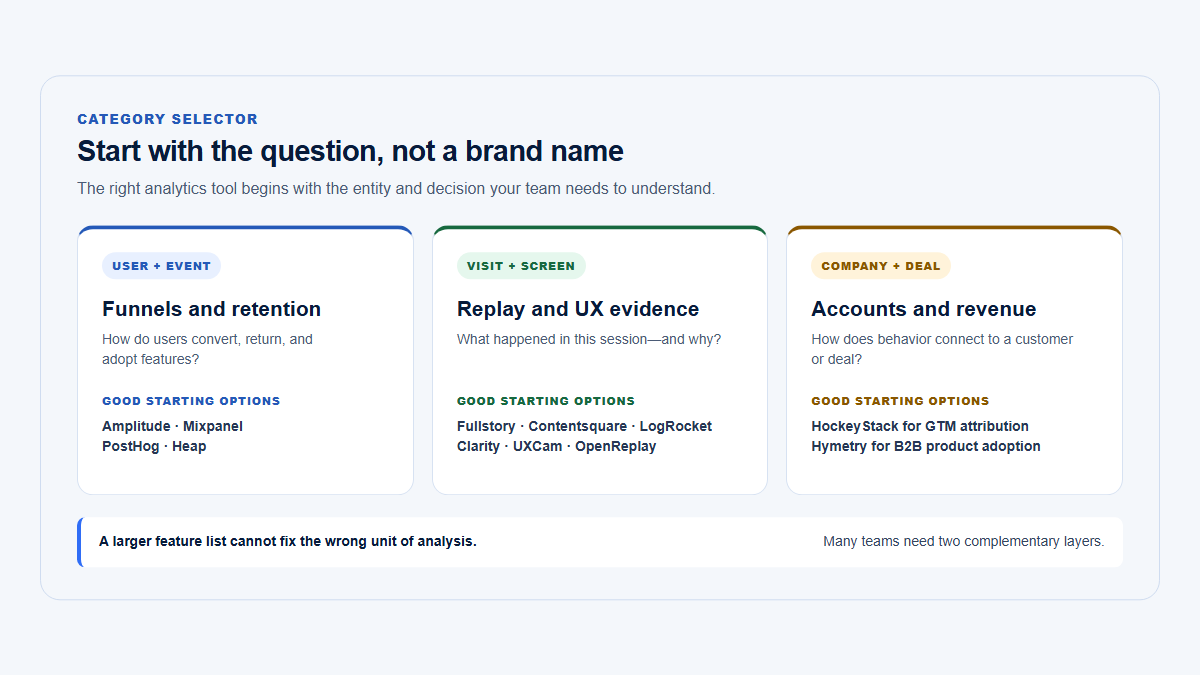
- Choose another category when public-site attribution, a CDP, warehouse BI, or enterprise digital-experience management is the actual primary job.
Before buying, run the same proof of concept in each finalist: one account-level funnel, one retention report, one replay-to-metric investigation, one redesign, one privacy review, and one projected invoice at 10 times current volume. The implementation should prove identity repair, event governance, and exportability—not only dashboard speed.
Where Hymetry fits
| Decision | Consider Hymetry | Choose the compared platforms | Hymetry limitations |
|---|---|---|---|
| Primary job | Company-level adoption and user participation | General event analysis, autocapture, experiments, or engineering workflows | Less analytical and platform breadth |
| Evidence | Companies, Users, grouped areas, and Visits | Deep funnels, replay, flags, pipelines, or broad UI evidence | Smaller ecosystem and fewer integrations |
| Best question | Which accounts adopted, who participates, and what session explains the signal? | How do users behave across a general analytics or product-building system? | Not a replacement for full experimentation or warehouse tooling |
For the account model, see product usage by company and session replay versus product analytics.
Frequently asked questions
Is PostHog better than Mixpanel?
PostHog is the better starting point for an engineering-led team that wants analytics and adjacent product-building tools in one platform. Mixpanel is the better starting point for PMs and analysts prioritizing focused behavioral analysis and governed metrics.
Is Heap better than Mixpanel?
Heap is better when broad automatic collection and later UI-event definition are central. Mixpanel is better when the team can maintain a semantic event model and prioritizes funnels, retention, cohorts, and repeatable self-serve analysis.
Can autocapture replace custom events?
No. Autocapture helps with discovery and unforeseen interface questions. Stable semantic and server-side events remain necessary for durable product concepts, account context, and authoritative backend outcomes.
Which product is strongest for B2B account analytics?
PostHog and Mixpanel both offer explicit paid group models; Heap offers account analysis on higher plans. The better choice depends on whether engineering workflows, analyst usability, or autocaptured evidence is more important.
Which has the best free plan?
PostHog has the broadest bundle, Mixpanel a strong analytics-focused allowance, and Heap a session-based entry plan. Compare the billing unit and required add-ons against your own workload.
Can a company use two of them?
Yes, if each has a distinct responsibility. Document which system owns collection, definitions, experimentation, replay, KPI reporting, retention, and deletion so duplicate data does not become permanent.
Sources
Primary documentation, pricing pages, and review listings were checked on August 8, 2026. Product behavior was not independently benchmarked.
PostHog sources
Mixpanel sources
Heap and Contentsquare sources
Methodology and disclosure
Recommendations prioritize collection model, analytical workflow, B2B account support, replay context, experimentation, deployment, and total operating cost. Pricing and ratings are snapshots, not guarantees. Hymetry is the publisher's product; no vendor paid for inclusion and no affiliate links are used.
Additional preserved sources and related reading
PostHog sources
- PostHog documentation: CDP
- PostHog documentation: Data warehouse
- PostHog documentation: Error tracking
- PostHog documentation: Paths
- PostHog documentation: Retention
- PostHog documentation: Support
- PostHog documentation: How to watch recordings
- PostHog documentation: Surveys
Mixpanel sources
- Mixpanel documentation: Lexicon
- Mixpanel documentation: Concepts
- Mixpanel documentation: Export methods
- Mixpanel documentation: Annotations
- Mixpanel documentation: Metric tree
- Mixpanel documentation: Pricing
- Mixpanel documentation: Flows
- Mixpanel documentation: Funnels advanced
- Mixpanel documentation: Root cause analysis
- Mixpanel documentation: Heatmaps
- Mixpanel documentation: Warehouse connectors
- Mixpanel documentation: Overview
Heap and Contentsquare sources
- Contentsquare: Contentsquare completes acquisition heap
- Contentsquare documentation: Documentation home
- Contentsquare documentation: Connect
- Heap Help Center: Data history
- Heap Experience Analytics setup
- Heap Help Center: Why did my event stop working
- Heap Help Center: Heap Connect Data Schema
- Heap and Contentsquare: A B Testing
- Heap server-event guidance
- Heap Help Center: Step 1 Enrich Your Dataset Via APIs
- Heap Help Center: Events overview
- Heap Help Center: Journeys overview
- Heap Help Center: Understanding Heap s Data Model
- Heap: Mobile