Menu
B2B product analytics

Amplitude vs Mixpanel vs Heap: Which Product Analytics Approach Fits?

Compare Amplitude, Mixpanel, and Heap across instrumentation, autocapture, analysis, replay, governance, pricing, and B2B account reporting.

Comparison snapshot: verified . Product packaging, allowances, review counts, and prices can change after publication.

Choose Amplitude if

Your organization wants a broad product-analytics system with deliberate governance. Amplitude combines event analysis with cohorts, account-level reporting on applicable packages, session replay, experiments, flags, guides, and surveys. Its hybrid collection approach lets teams define important semantic events while using autocapture for supported browser and mobile observations.

The trade-off is breadth: packaging is layered, mature governance takes work, and its older warehouse-native mode is now explicitly legacy and unavailable to new customers.

Choose Mixpanel if

Your priority is fast, approachable analysis of a clean semantic event model. Mixpanel is especially strong for funnels, retention, cohorts, flows, and flexible breakdowns. It supports web autocapture, replay, mobile and server ingestion, while keeping its center of gravity in event-based product questions.

The trade-off is that Group Analytics, outbound Data Pipelines, Experiments, and Feature Flags are separately packaged. Current pricing places the last two on Enterprise; Mixpanel does not currently list a native in-app guides or surveys product.

Choose Heap if

Your decisive requirement is to collect broad interface interactions first and define useful events later. Heap’s autocapture-first model is valuable when product teams cannot predict every future question, when analysts need to inspect a historical interaction, or when implementation capacity is scarce.

The trade-off is a larger collection and privacy-review surface. Heap is part of Contentsquare, but that ownership should not be read as automatic inclusion of every Contentsquare module. Replay, heatmaps, account analytics, data history, and warehouse features depend on plan or add-on.

Choose another category if

Choose a warehouse-native BI tool when governed warehouse models are the sole source of truth; a replay or observability product when debugging is the main job; or a narrower account-centric layer when B2B company adoption and visit evidence matter more than general-purpose product analytics. See the broader product analytics tools comparison before forcing an adjacent problem into one of these three.

At-a-glance comparison

Current product direction and important packaging qualifications, verified August 6, 2026
DimensionAmplitudeMixpanelHeap by Contentsquare
Center of gravityBroad governed product analytics and product-building suiteFocused self-service semantic event analysisAutocapture-first discovery and retrospective definition
Collection philosophyHybrid: planned events plus supported autocaptureEvent-first, with web autocapture availableObserve broadly, define virtual events later, add server events for critical outcomes
Account analysisAccounts expanded package on Growth and Enterprise; up to five group typesGroup Analytics add-on on Growth and EnterpriseAccount-Based Analytics on Pro and Premier
ReplayNative; monthly allowance and retention depend on plan or expanded packageNative; base allowance on current plans and paid retention options on EnterpriseExperience Analytics add-on on Pro and Premier; not an ongoing Free allowance
Experiments and flagsNative feature and web experimentation plus feature flagsSeparate Enterprise add-ons; experiment billing uses monthly experiment usersExperiment analysis and integrations, but no verified native flag-delivery product
Guides and surveysNative Guides & Surveys with plan limitsNo current native product listed in pricing or docs indexDo not confuse analytical “Guides” with in-app product tours; use integrations for delivery/research
Warehouse postureExports and destinations; warehouse-native mode is legacyInbound Warehouse Connector on qualifying paid contracts; outbound Data Pipelines add-onHeap Connect and warehouse integrations by plan or add-on
Best default forPlatform breadth and governanceAnalyst and PM self-serviceHistorical flexibility after broad capture

1. The core difference is when meaning is assigned

All three can answer event-based questions. Their operating models differ in when a raw interaction becomes a governed business concept.

Mixpanel sits toward the intentional-instrumentation side: define the behavior worth measuring, send a stable event and useful properties, then let product teams explore. Amplitude now supports a meaningful hybrid, but its strongest organizational story still includes taxonomy, ownership, planning, and governance. Heap sits furthest toward autocapture: collect supported interface interactions, identify useful patterns later, and promote definitions without waiting for a new deploy.

This is a spectrum, not a binary. The most durable implementation usually combines deliberate server-confirmed outcomes with enough client context to investigate the path around them. Read autocapture versus custom events and the product analytics instrumentation plan before choosing by feature count alone.

A qualitative spectrum places Mixpanel toward intentional semantic instrumentation, Amplitude in a hybrid center, and Heap toward broad autocapture with retrospective event definition.
Collection strategy is a continuum: Mixpanel favors defined semantic events, Amplitude combines governed events with autocapture, and Heap emphasizes broad observation before retrospective definition.

2. Positioning and primary buyers

Amplitude increasingly presents a digital analytics platform rather than one analysis application. It fits product-operations teams that want one governed system across analytics and adjacent activation or experimentation work.

Mixpanel remains easiest to understand as a product analysis workspace. Product managers and analysts can build a funnel, compare cohorts, inspect retention, and move between aggregate behavior and sessions without first adopting a large suite.

Heap’s differentiation remains collection. It appeals to teams that fear missing a question because an event was never planned, and to analysts who need to define an interaction retroactively. Its place inside Contentsquare expands the surrounding company context, not the entitlements of an individual Heap subscription.

Independent practitioner context: “Best Product Analytics Tools (2026) - My Honest Review,” published by Vision Labs on October 23, 2025 (9:35). Use it as an opinionated orientation, not as evidence for current pricing. Watch on YouTube.

3. Event, user, and identity models

A comparison begins with three layers: the event, the actor, and the account. A browser click can be observed automatically, but a business outcome such as report_saved should normally come from the backend after persistence succeeds. A user identity can be merged or aliased, but account membership may change over time and must be modeled deliberately.

Amplitude distinguishes users, events, user properties, event properties, and—through its Accounts package—groups. Group property changes are not retroactive, so teams should not assume a current account property rewrites historical membership. Mixpanel provides events, user profiles, and Group Analytics; group analysis requires the group key on the relevant historical events and cannot invent it retroactively. Heap combines users, sessions, autocaptured interactions, defined events, and account analysis on eligible plans.

For B2B software, include stable identifiers such as user_id and account_id, but avoid sending sensitive business data simply because a property slot exists. A durable identity specification should cover anonymous-to-known transitions, membership changes, test accounts, internal users, and cross-device behavior. See account versus user adoption.

4. Semantic events, autocapture, and the collection philosophy

How the products collect evidence and turn it into governed behavior
QuestionAmplitudeMixpanelHeap
Planned custom eventsFirst-class and strongly governedFirst-class and central to the product modelSupported, including precise server-side outcomes
AutocaptureWeb and platform-specific native mobile collectionWeb autocapture; mobile uses separate SDK instrumentationCore web and mobile collection philosophy, subject to supported interactions and configuration
Define after collectionPossible for supported captured data and derived definitionsPossible with captured event data, but historical answers still depend on what was sentCore strength through retrospective virtual-event definition
Server truthServer SDKs and HTTP APIsServer SDKs and HTTP ingestionServer events for identified users; recommended for precise mission-critical outcomes
Main governance riskSuite breadth and overlapping definitionsEvent-plan drift or inconsistent propertiesHigh-volume raw observation and proliferating virtual definitions

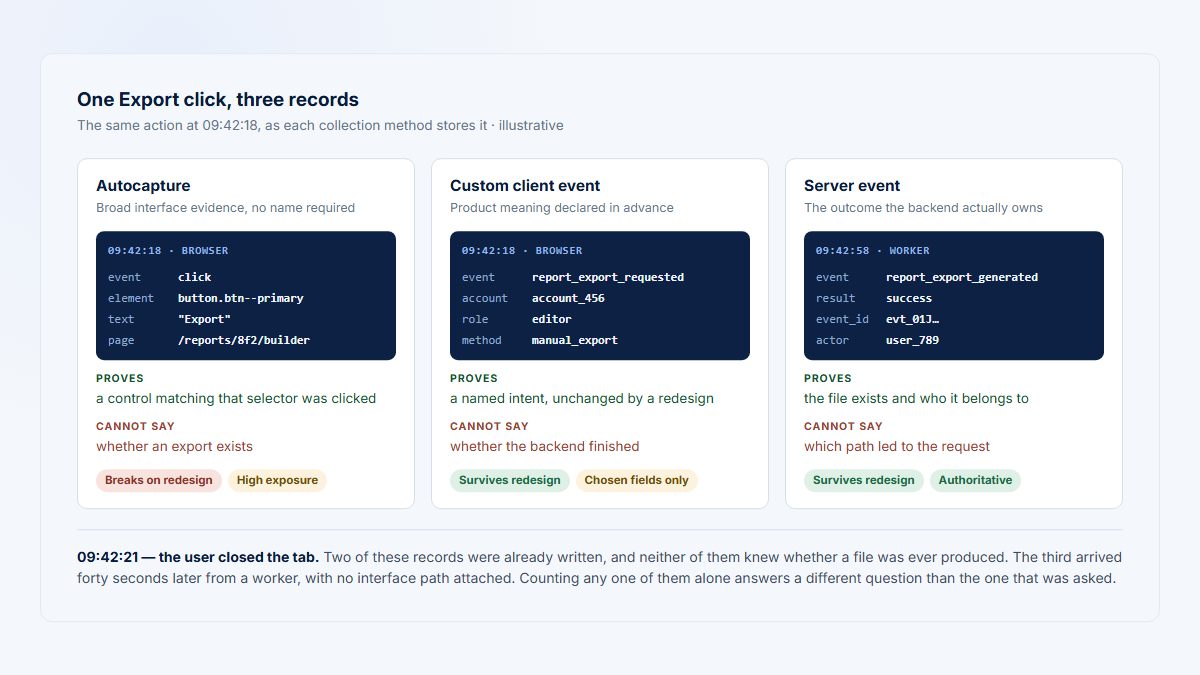
Autocapture reduces the chance of an entirely missing click, but it does not automatically create business meaning. A selector-defined interaction can break when UI structure changes. Conversely, a custom event can remain stable across redesigns but only if the implementation, naming, and QA process are maintained.

An event lifecycle links user action, browser observation, collection, semantic definition, account context, metric, and investigation, while a parallel backend lane sends a server-confirmed report_saved outcome into account metrics.
The collection layer records evidence; semantic definitions and account context make it decision-ready. Critical outcomes should be confirmed by the system that knows they succeeded.
Data-model context: “Building the behavioral backbone of your analytics | CX Circle NYC 2025,” published by CX Circle | by Contentsquare on October 29, 2025 (29:51). The event date and YouTube publication date are not the same. Watch on YouTube.

5. Retroactive analysis: what can really be recovered?

Heap has the clearest retrospective proposition: if a supported interaction was captured, an analyst can define a virtual event later and apply it to the available history. This is powerful for a question nobody anticipated at implementation time.

There are limits. No product can reconstruct data it never received, reliably infer a server outcome from a browser gesture, restore history beyond retention, or recover an account key that was absent from old events. DOM changes can also alter the meaning of selector-based definitions. Amplitude and Mixpanel can reinterpret properties and build new cohorts from retained data, but they share those same physical limits.

The practical rule is to treat autocapture as investigative coverage, not as a substitute for a stable metric contract. Use server-confirmed semantic events for business outcomes and broad client evidence for paths, friction, and discovery.

6. Funnels, retention, cohorts, paths, and analytical depth

Analytical strengths are directional; exact limits and advanced features depend on plan
Analysis jobAmplitudeMixpanelHeap
FunnelsDeep behavioral funnels, cohorts, and account-aware optionsFast, flexible self-service funnels and breakdownsFunnels over defined and autocaptured behavior
RetentionStrong product and lifecycle analysisOne of the clearest self-service retention workflowsRetention with retrospective event flexibility
CohortsBehavioral cohorts connect across the broader suiteApproachable cohorts for analysis and activationSegments derived from collected behavior
Paths and journeysBroad journey analysis and adjacent replay contextFlows and journeys around event sequencesStrong exploration because many interface actions already exist
Best analytical advantagePlatform breadth plus governanceSpeed and clarity for everyday product questionsNew questions against prior captured behavior

The products overlap enough that a benchmark using your own event model is more useful than a screenshot tour. Ask the same five questions in each trial: activation by cohort, multi-step conversion, return behavior, unexpected paths, and account participation. Record not just whether an answer is possible, but who can produce it, how long it takes, and what governance or add-on is required.

7. Account and group analytics for B2B products

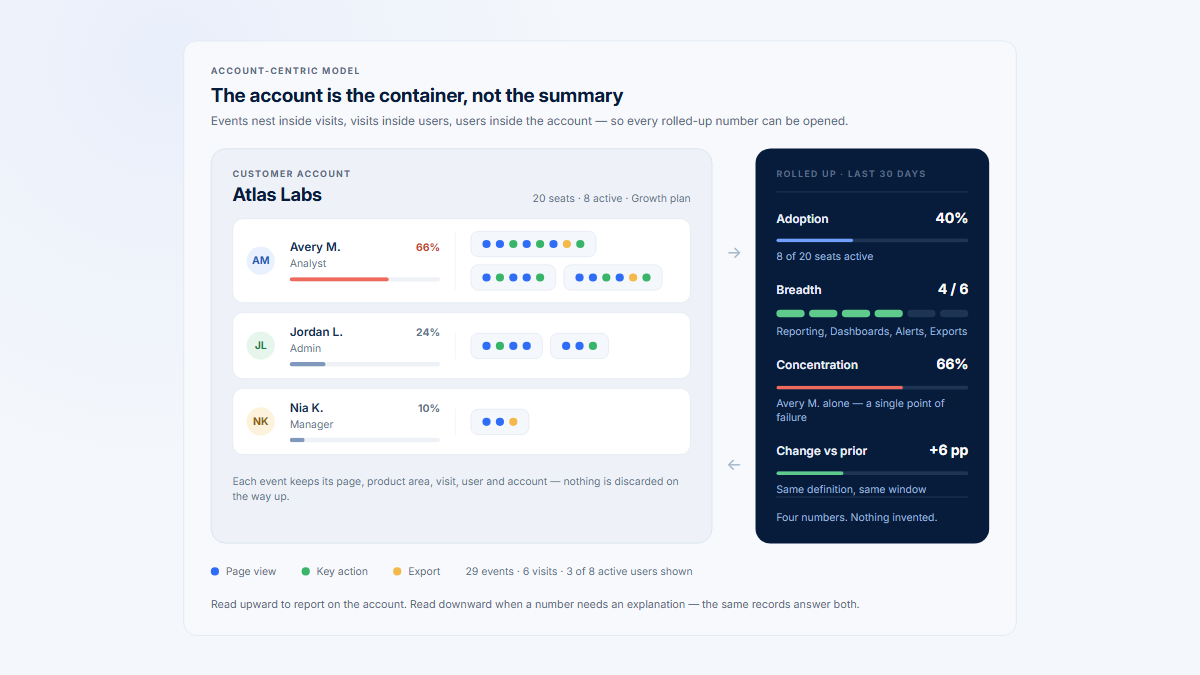
User-level product analytics can mislead a B2B team. One power user may make a customer look healthy while the rest of the account never adopts. Account analysis should distinguish breadth, depth, recency, role coverage, and sustained use.

Amplitude’s Accounts package is available on Growth and Enterprise and supports up to five group types per project. Mixpanel’s Group Analytics is a Growth and Enterprise add-on; the group key must have been present on historical events. Heap lists Account-Based Analytics on Pro and Premier. In all three, confirm whether your contract, project, and retention settings cover the account questions in your evaluation.

None of these packaging labels solves account modeling. Define a canonical account_id, decide how users with multiple memberships are handled, and keep entitlement, plan, region, and lifecycle properties free of avoidable personal data. For measurement patterns, read how to measure product usage by company and peer baselines for B2B SaaS.

8. Session replay and heatmaps

Replay is now part of the decision, but it is packaged differently. Amplitude currently includes monthly replay allowances that rise by plan and offers expanded retention. Mixpanel includes a base monthly allowance, with configurable retention available through an Enterprise replay add-on. Heap does not advertise an ongoing replay allowance on Free; Experience Analytics is an add-on for Pro and Premier.

A replay allowance is not the same as retained analytical events, and a replay is not a literal screen recording. Each system reconstructs an experience from captured data under masking, sampling, SDK, retention, and browser constraints. Before enabling it, inventory forms, free-text fields, credentials, customer data, financial data, health data, internal admin surfaces, and network payloads. Read session replay versus product analytics before treating the two evidence types as interchangeable.

9. Experiments and feature flags

Amplitude has the broadest native story here: Feature Experiment, Web Experiment, and feature flags sit beside analytics, with limits and expanded packages varying by plan. Its experiment support for groups should still be treated cautiously because current documentation marks that capability Early Access.

Mixpanel currently sells Experiments and Feature Flags as separate Enterprise-only add-ons. Experiment billing uses monthly experiment users. Without the Experiment add-on, a project can create up to three experiments, and that limit is irreversible rather than a rolling active-experiment quota.

Heap can analyze experiment cohorts and integrate with delivery systems, but we did not verify a current native flag-delivery product comparable to Amplitude Feature Experiment or Mixpanel Feature Flags. If flag lifecycle, assignment consistency, kill switches, and exposure logging are primary, evaluate the delivery layer separately from the analytics interface.

10. Guides, surveys, and in-product activation

Amplitude lists native Guides & Surveys, with limited usage on Free and Plus and expanded packages on Growth and Enterprise. This can reduce context switching between discovery and in-product activation, but it also expands the platform’s governance surface.

Mixpanel’s current pricing and complete documentation index do not list a native guides or surveys product. Heap pricing uses the word “Guides” for analytical guidance; that should not be read as proof of an in-app product-tour builder. Teams needing tours, onboarding prompts, or surveys should verify the relevant integration and audience-sync path.

11. Warehouse, raw data, replay, and product-building tools

Current data movement and adjacent product capabilities
CapabilityAmplitudeMixpanelHeap
Inbound warehouse dataWarehouse and cloud-source imports; verify connector and cadenceWarehouse Connector for qualifying paid event-based organizations at update or renewalWarehouse integration listed for Premier
Outbound/raw dataBatch exports, recurring exports, streaming destinations, and paid Snowflake Data ShareData Pipelines is a separate Growth/Enterprise add-onHeap Connect on Pro as an add-on and included on Premier
Warehouse-native query modeLegacy and unavailable to new customersConnector imports modeled warehouse data into MixpanelWarehouse integration and Connect, not a blanket claim that all analysis remains in place
Replay and heatmapsNative with plan allowances and packagesNative replay and heatmapsExperience Analytics add-on on eligible plans
Experiments and flagsNative suiteSeparate Enterprise add-onsAnalyze via cohorts/integrations; no verified native delivery layer
Guides and surveysNative packageNot currently listed as nativeUse integrations; pricing “Guides” is analytical guidance

“Warehouse integration” is not one capability. Separate inbound sync, outbound export, streaming latency, schema control, delete propagation, regional availability, backfill behavior, and cost. Amplitude’s older Warehouse Native mode is explicitly legacy; it should not be presented to new buyers as the default architecture.

12. Mobile support

All three support mobile product analysis, but capture behavior is not identical. Amplitude’s autocapture documentation covers native iOS and Android signals with platform-specific behavior. Mixpanel’s autocapture is currently web-only; mobile analysis and replay use separate mobile SDKs. Heap supports mobile SDK collection, but the exact automatic and custom events differ from web DOM autocapture.

A mobile proof of concept should test cold starts, upgrades, offline buffering, background transitions, deep links, WebViews, identity changes, replay masking, crash interactions, and app-version properties. Do not infer mobile parity from a web feature name.

13. Privacy, governance, and collection risk

Collection breadth changes the risk review. An intentional event plan can minimize volume and make each property easier to approve, but it can omit future evidence. Autocapture preserves more investigative context, but creates a broader surface for masking, exclusion, retention, access control, and definition governance.

Privacy is not a product checkbox. Review the SDK configuration, data regions, subprocessors, retention, deletion behavior, IP handling, session replay masking, selector exclusions, role-based access, audit logs, and the exact payloads your implementation sends. Minimize before collection; do not rely on a dashboard setting to repair unnecessary data already captured.

A qualitative matrix compares setup speed, historical flexibility, semantic stability, data volume, privacy-review surface, and maintenance burden for Amplitude, Mixpanel, and Heap without assigning numeric scores.
Governance is a set of trade-offs, not a leaderboard: broader collection improves historical flexibility while increasing volume and privacy review; stronger semantic contracts improve stability while requiring ongoing maintenance.

14. Implementation and maintenance

Heap can shorten the time to a first interface question because broad capture arrives before a finished taxonomy. Amplitude and Mixpanel can also begin quickly through SDKs and supported autocapture. Production readiness is different from first data, however.

A realistic implementation includes identity rules, account context, consent, masking, environment separation, internal-traffic handling, schema ownership, validation, monitoring, and a release process. It should also state which layer is authoritative for each outcome. Browser observation can explain the path; the backend should confirm persistence, payment, export completion, or another state change.

Maintenance follows the model. Semantic event plans need contract tests and change review. Autocapture needs selector and UI-change review. Hybrid plans need both, plus clear rules preventing the same behavior from being counted twice.

15. Pricing and total cost

Public starting allowances and important cost drivers, verified August 6, 2026; contracts and packaging may differ
Cost factorAmplitudeMixpanelHeap
Public Free allowance2 million events/month; 10,000 replay sessions/month; unlimited seats1 million events/month; 10,000 replay sessions/month; five saved reports; unlimited seatsUp to 10,000 monthly sessions and six months of data history
Self-serve paid signalPlus includes the first 2 million monthly events free and scales publicly through stated event bandsGrowth includes the first 1 million monthly events, then lists $0.28 per 1,000 events before discountsGrowth is custom session-based pricing
ReplayBase monthly allowances rise by plan; expanded retention is separately packagedGrowth includes 20,000 and can be customized; paid Enterprise retention can be 7–360 daysExperience Analytics is an add-on on Pro and Premier
Account analysisAccounts expanded package on Growth/EnterpriseGroup Analytics add-on on Growth/EnterpriseAccount-Based Analytics on Pro/Premier
Other driversEvents, replay, retention, experimentation, guides/surveys, data share, supportEvents, replay, experiments by MEU, flags, groups, pipelines, supportSessions, history, replay/heatmaps, Connect, environments/projects, support

Heap’s public pricing page is internally ambiguous about the exact number of Pro projects or environments: its plan matrix and an add-on card use different counts. This comparison therefore does not publish an exact Pro count. Ask sales to put the contracted number, overage behavior, and add-on entitlements in writing.

Total cost includes engineering time, analyst enablement, governance, data cleanup, replay review, privacy operations, and duplicate tools. A cheaper collection unit can still cost more if teams cannot trust the metric or if every question requires a specialist.

16. Customer ratings and review themes

G2’s Product Analytics theme page, updated July 5, 2026, reported Amplitude Analytics at 4.5/5 from 2,962 reviews and Mixpanel at 4.5/5 from 1,371 reviews. Heap’s current public profile signal is approximately 4.4/5 from 1,100 reviews. We round counts below because review totals move continuously and direct G2 product pages may challenge automated access.

Review snapshot and recurring qualitative themes; themes are directional, not a substitute for reading recent reviews
Review signalAmplitudeMixpanelHeap
G2 snapshot4.5/5, about 2,960 reviews4.5/5, about 1,370 reviews4.4/5, about 1,100 reviews
Commonly valuedAnalytical breadth, cohorts, charts, integrations, maturing suiteApproachable reports, funnels, retention, fast self-serviceAutocapture, retroactive definition, discovering unplanned behavior
Common cautionsLearning curve, governance, packaging complexity, cost at scaleCost growth, taxonomy discipline, advanced add-on packagingData volume, definition management, query learning, plan complexity
What to read forReviews from similarly governed multi-team organizationsReviews from teams with a similar event volume and analyst mixReviews with similar traffic, replay needs, and autocapture governance

17. Standardized B2B Reporting scenario

Use one scenario to expose the products’ operating differences. A B2B reporting application wants to measure whether customer accounts configure, save, and repeatedly use scheduled reports.

Event contract

The browser emits report_configuration_started when the configuration workflow actually begins. The backend emits report_saved only after the report and schedule are persisted. Both carry a stable account_id; the save event also includes governed properties such as report type and schedule cadence.

report_configuration_started {
  user_id,
  account_id,
  report_type,
  entry_point
}

report_saved {
  user_id,
  account_id,
  report_id,
  report_type,
  schedule_cadence,
  is_first_saved_report
}

Metric definitions

  • Configuration completion: accounts with a server-confirmed report_saved within seven days of report_configuration_started, divided by accounts that started.
  • Account adoption: eligible accounts with at least one saved scheduled report in the measurement window.
  • Breadth: distinct active members who saved or viewed a report per adopting account.
  • Sustained use: adopting accounts with report activity in at least three separate weeks, not simply three events in one session.

How each product would approach it

Amplitude: govern both semantic events in the tracking plan, send the saved outcome from the server, attach the account group, build account-aware funnels and cohorts through the applicable Accounts package, and connect results to replay or experiment audiences where entitled.

Mixpanel: send the two stable events, attach the Group Analytics key to every relevant event, build the funnel and retention reports, and use replay to inspect friction. If testing an intervention, verify the separate Experiment or Feature Flags add-on and exposure logging.

Heap: use autocapture to investigate the configuration path and define supporting interactions retroactively, while sending report_saved from the server for precise success. Use Account-Based Analytics on an eligible plan and retain the virtual-event definitions as governed assets.

How the same reporting-adoption workflow exposes each product’s operating model
Scenario needAmplitudeMixpanelHeap
Discover unplanned form frictionAutocapture plus replay where configuredWeb autocapture plus replay where configuredStrong autocapture-first retrospective exploration
Confirm successful saveServer eventServer eventServer event for an identified user
Analyze by accountAccounts packageGroup Analytics add-onAccount-Based Analytics on Pro/Premier
Govern metric meaningTracking plan and governed taxonomySemantic event and property contractGoverned virtual event plus server outcome
Distinctive advantageConnect analysis to a broad native suiteFast self-service around clean eventsRecover supporting UI questions from captured history

18. Migration considerations

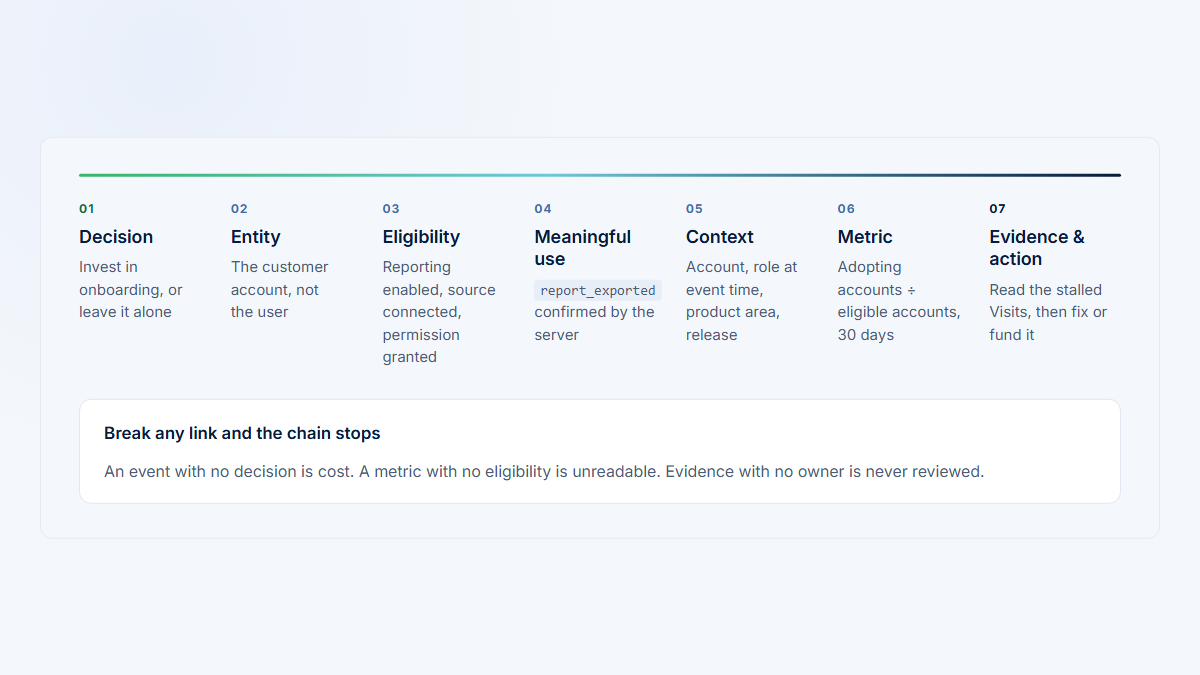
Do not begin migration by translating every old event name. Begin with the decision system: core business outcomes, identity, accounts, eligibility, cohort rules, historical needs, activation destinations, dashboards, and regulatory constraints.

Moving to Amplitude

Use the move to establish ownership, schemas, and account groups. Decide which prior events deserve clean semantic equivalents and which exploratory interactions belong in autocapture. Do not design around the legacy warehouse-native mode.

Moving to Mixpanel

Keep the event model small enough to understand, preserve stable identifiers, and attach the group key before historical account analysis is needed. Inventory any dependence on native guides, surveys, or bundled experiments because those expectations may require another tool or add-on.

Moving to Heap

Define masking and exclusions before broad capture, then establish a review process for virtual events. Preserve server events for critical outcomes. Confirm data-history, account-analysis, replay, Connect, and project entitlements in the contract.

Validate in parallel

Run both systems long enough to compare event counts, identities, account membership, conversion windows, timezone behavior, bot/internal exclusions, late events, and deletion. Expect small differences; investigate unexplained large ones before changing executive metrics.

19. Decision by buyer and scenario

Directional recommendation after confirming the required package and running a proof of concept
Buyer or situationBest starting pointWhyVerify before signing
Product operations and governanceAmplitudeBroad suite, planning, cohorts, and adjacent activationPackage boundaries, event volume, account and replay entitlements
PM and analyst self-serviceMixpanelFocused reports, funnels, retention, and approachable explorationGroup, experiment, flag, replay, and pipeline add-ons
Unknown historical UI questionsHeapAutocapture and retrospective virtual-event definitionMasking, volume, history, replay, accounts, and Connect
One governed warehouse truthAnother category or complementary BIWarehouse models and SQL may be the operating centerWhether product teams still need low-latency self-service behavior
Frontend debuggingReplay/observability categoryConsole, network, errors, traces, and releases may matter moreConnection back to product/account impact
B2B account adoption with visit evidenceComplementary account-centric layerCompany breadth, momentum, and sessions become the first-class objectsIntegration, identity, privacy, and authoritative outcomes

Final recommendation: Amplitude is the strongest default when breadth and governance are the buying center. Mixpanel is the strongest default when a product team wants focused self-service over a clean semantic model. Heap is the strongest default when autocapture-first discovery and retrospective definition outweigh the additional data-governance burden. The winner can change by team, and a serious proof of concept should use your real identities, accounts, volumes, and questions.

20. Where Hymetry fits

Hymetry is not presented here as a general replacement for Amplitude, Mixpanel, or Heap. Its narrower role is account-centric B2B product evidence: understanding adoption and friction by company, participation by user, product-area behavior by page, and the visits behind a signal.

That narrower model can complement a broader analytics stack when customer success, product, and growth teams need to move from “usage fell” to “which accounts changed, which people participated, and what happened in the relevant visits?” It still requires an honest identity model, privacy controls, and authoritative server outcomes. No customer logos, performance benchmarks, or results are implied.

21. Frequently asked questions

Which is best: Amplitude, Mixpanel, or Heap?

There is no universal winner. Amplitude is the strongest default for platform breadth and governance, Mixpanel for focused self-service semantic analysis, and Heap for autocapture-first retrospective definition. Run the same real workflow in each product before deciding.

Does autocapture remove the need for custom events?

No. Autocapture can preserve interface evidence and enable later questions, but critical outcomes such as a saved report or completed payment should normally be confirmed by the backend. A hybrid plan is usually more durable.

Can Heap answer any historical question?

No. Heap can retroactively define events from supported data that was captured and retained. It cannot recover an interaction, account key, server result, or period that was never collected or is no longer retained.

Do all three support B2B account analytics?

Yes, on specific packages: Amplitude Accounts on Growth and Enterprise, Mixpanel Group Analytics as a Growth/Enterprise add-on, and Heap Account-Based Analytics on Pro and Premier. Identity and account modeling remain your responsibility.

Do all three include session replay?

All three offer replay, but allowances and packaging differ. Amplitude and Mixpanel publish base monthly allowances. Heap lists Experience Analytics as an add-on on Pro and Premier rather than an ongoing Free replay allowance.

Which has native experimentation?

Amplitude has the broadest native experimentation and feature-flag story. Mixpanel offers Experiments and Feature Flags as separate Enterprise add-ons. Heap can analyze experiment behavior and integrate with delivery tools, but this review did not verify a comparable native flag-delivery product.

Are these warehouse-native tools?

They all move data to or from warehouses in different ways, but that phrase hides architecture and packaging differences. Amplitude’s older Warehouse Native mode is explicitly legacy. Verify where queries run, what is copied, cadence, deletes, schema control, and cost.

Which product is cheapest?

Public entry allowances use different units and do not settle total cost. Model your events or sessions, replay volume, history, account analytics, experiments, exports, support, engineering time, and governance under a written contract.

Can a team use more than one?

Yes, when responsibilities are explicit—for example a broad product analytics tool with warehouse BI, observability, or account-centric evidence. Avoid sending the same sensitive payload everywhere or maintaining duplicate executive metrics without an owner.

Disclosure

Hymetry publishes this comparison and is mentioned only where its narrower account-centric B2B model is relevant. Product capabilities, prices, ratings, packaging, ownership, and videos are verified against linked sources and may change after publication.

Methodology

This comparison was researched against public product and documentation pages available on . We prioritized official pricing, documentation, legal schedules, and product pages; used G2 for a dated ratings snapshot; and verified both video watch pages, channel names, dates, durations, and embed availability.

We compared the same jobs across all three products: collection, semantic definition, identity, account analysis, funnels, retention, paths, replay, experiments, guides, data movement, mobile support, privacy, implementation, pricing, and a standardized B2B reporting workflow. Qualitative judgments describe operating fit rather than numeric scores.

Known evidence limits remain visible. G2 product pages can block automated access, so counts are rounded from the accessible category signal and recent profile evidence. Heap’s pricing page presents inconsistent Pro project/environment counts, so no exact count is asserted. Feature availability can also depend on plan, add-on, region, contract date, or early-access status.

Sources

Amplitude official sources

Mixpanel official sources

Heap and Contentsquare official sources

Ratings and video sources

About Hymetry

Hymetry is account-centric product intelligence for B2B SaaS. It helps teams understand how customer companies and the users inside them adopt and use their product.