Quick comparison
PostHog is the broader product-engineering platform; Fullstory is the more specialized experience-investigation system. Fullstory is not merely a recording library, and PostHog is not merely analytics plus flags. The practical difference is the operating loop around their substantial overlap.
| Criterion | PostHog | Fullstory |
|---|---|---|
| Primary job | Measure, build, release, experiment, debug, and move product data | Investigate digital behavior, journeys, conversions, and experience evidence |
| Best team | Product engineering, growth engineering, product analytics, and data | Product, UX, design, research, CX, and digital analytics |
| Analytics | Native Trends, funnels, retention, paths, lifecycle, stickiness, cohorts, and SQL | Plan-dependent Metrics, funnels, segments, dashboards, Journeys, Retention, and Conversions |
| Account context | Paid add-on Group Analytics treats companies or other groups as analytical entities | Property-based Company IDs can support segments and unique-property metrics |
| Replay workflow | Connected to events, cohorts, flags, experiments, errors, console, and network evidence | Central to segments, Journeys, heatmaps, conversions, frustration signals, and collaboration |
| Build and release | Native General flags, experiments, surveys, and workflows | Add-on Guides, surveys, and experiments for delivered in-app content |
| Technical evidence | Dedicated Error Tracking, logs, source maps, releases, console, network, and replay | Replay-centered Dev Tools, errors, crashes, performance, and premium StoryAI Opportunities |
| Data and deployment | Managed warehouse, pipelines, US/EU cloud, plus unsupported self-hosted hobby deployment | Anywhere exports to customer systems; GCP-hosted SaaS in US or EU regions |
| Free and paid model | Permanent product-specific allowances, then transparent usage rates | Permanent 30,000-session Free plan; paid dollar pricing is custom |
| G2 snapshot | 4.5/5 from 1,054 reviews | 4.5/5 from 1,052 reviews |
Can one replace the other?
| Question | Short answer | Main compromise |
|---|---|---|
| Can PostHog replace Fullstory? | Often, for engineering-led teams that value consolidation | Less specialist journey, conversion-signal, heatmap, and research-collaboration depth |
| Can Fullstory replace PostHog? | Sometimes, when experience analysis is the real requirement | Flags, broad experiments, full-stack errors, logs, and managed warehouse remain elsewhere |
| Should a company use both? | Sometimes, when engineering and a centralized UX team have distinct needs | Duplicate capture, privacy rules, identity, cost, governance, and source-of-truth decisions |
Product engineering, or digital experience analytics
PostHog
Product engineering
Wide overlap
Fullstory
Digital experience analytics
Ship, measure, debug Investigate the experience
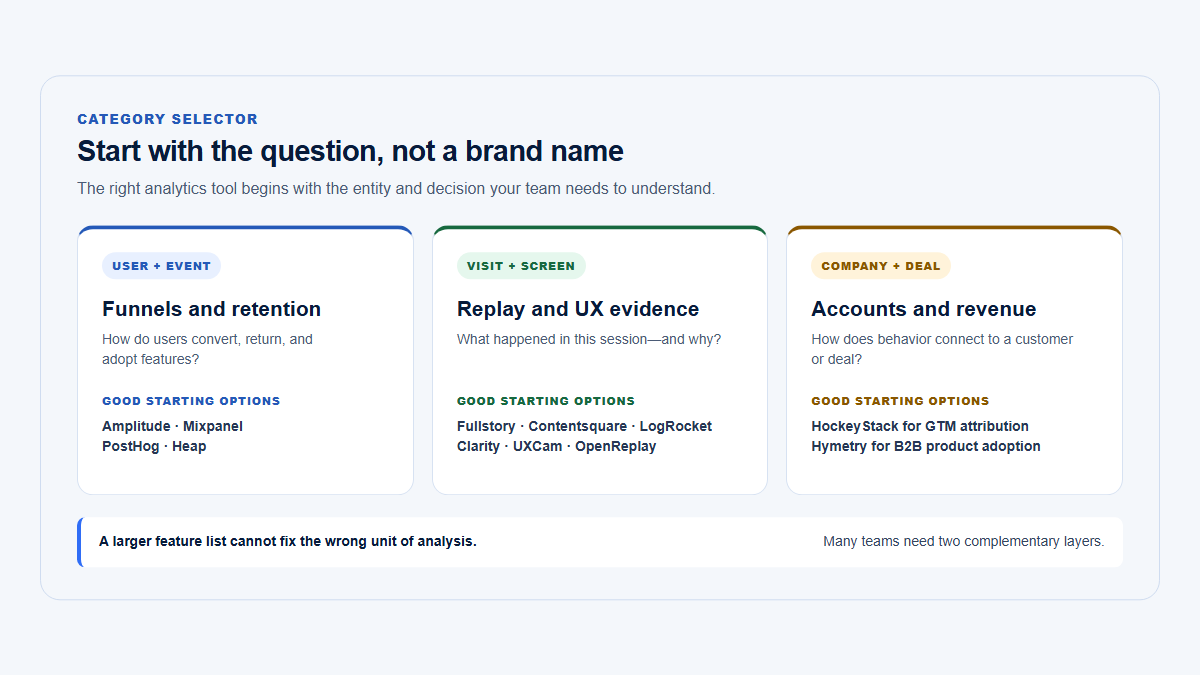
The overlap is the largest of any pair on this site, so feature lists will look nearly identical. What differs is which team the platform expects to own it.
Product analytics, funnels, and account context
Both products support structured behavioral analysis. PostHog is stronger when the model must connect events, SQL, experiments, warehouse data, and first-class groups. Fullstory is stronger when analysis is primarily a route into experience investigation.
| Workflow | PostHog | Fullstory | Practical difference |
|---|---|---|---|
| Funnels | Native Event or group funnels with cohorts, breakdowns, windows, and replay | Native Funnels connect drop-off, segments, signals, and sessions | PostHog fits event-and-release analysis; Fullstory fits conversion investigation |
| Retention | Native User or configured-group retention connected to cohorts | Advanced/Enterprise Event-to-event return analysis with session playlists | PostHog has broader surrounding analytics and a group model |
| Cohorts and segments | Behavioral and property cohorts feed analytics, flags, experiments, surveys, and replay | Saved behavioral segments organize metrics, funnels, Journeys, and sessions | PostHog cohorts connect more directly to product delivery |
| User profiles | Event history, properties, cohorts, flags, errors, and recordings | Sessions, events, properties, segments, and experience evidence | Both support user investigation; the next actions differ |
| Company or group context | Paid add-on Groups aggregate funnels, retention, trends, stickiness, flags, and experiments | Property-based Company properties support segments and unique-property metrics | Property filtering is not the same as a reusable group entity across the platform |
| Journeys and paths | Paths and funnels cover event and route sequences | Advanced/Enterprise Journeys use pages, events, and elements within or across sessions | Fullstory provides the more specialized journey workflow |
| Heatmaps | Native clickmaps and scrollmaps connected to replay | Native heatmaps central to experience analysis | Fullstory places heatmaps inside a deeper specialist workflow |
| Behavioral signals | Events, errors, performance, console, network, rage clicks, and dead clicks | Frustration, error, performance, form, refresh, watched-element, and premium StoryAI signals | Fullstory exposes the broader dedicated experience-signal taxonomy |
| Research collaboration | Dashboards, playlists, comments, insights, annotations, and session links | Session sharing, clips, comments, assignments, alerts, segments, and Opportunities | Fullstory is the stronger default when research collaboration is the primary job |
PostHog Group Analytics treats a company or another group as an analytical entity, but it is a paid add-on and requires stable event-time group mapping. Fullstory can attach company IDs and attributes to users or events, then use them in segments and metrics. The conclusion that this is less first-class is an inference from each vendor's documented data model.
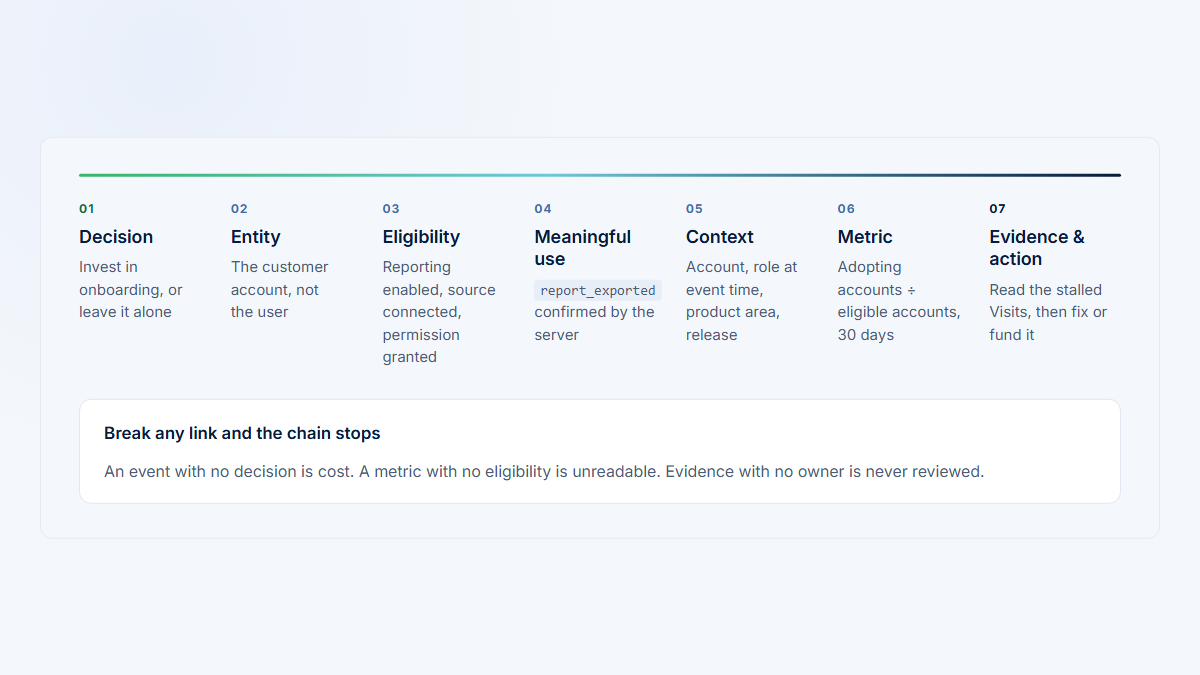
That distinction matters in B2B SaaS. Finding sessions from one company is useful, but it is not identical to calculating account adoption or user penetration across eligible people. See product usage by company and product analytics instrumentation planning.
Replay, journeys, and experience investigation
Fullstory has the stronger specialist experience-investigation workflow. PostHog has the stronger connection between replay and a broader product-engineering stack.
PostHog can move from a trend, funnel, cohort, group, error, or flag variant into matching recordings and technical context. Fullstory can move from a segment, funnel, Journey, heatmap, conversion problem, frustration signal, or StoryAI Opportunity into representative sessions and collaborative investigation.
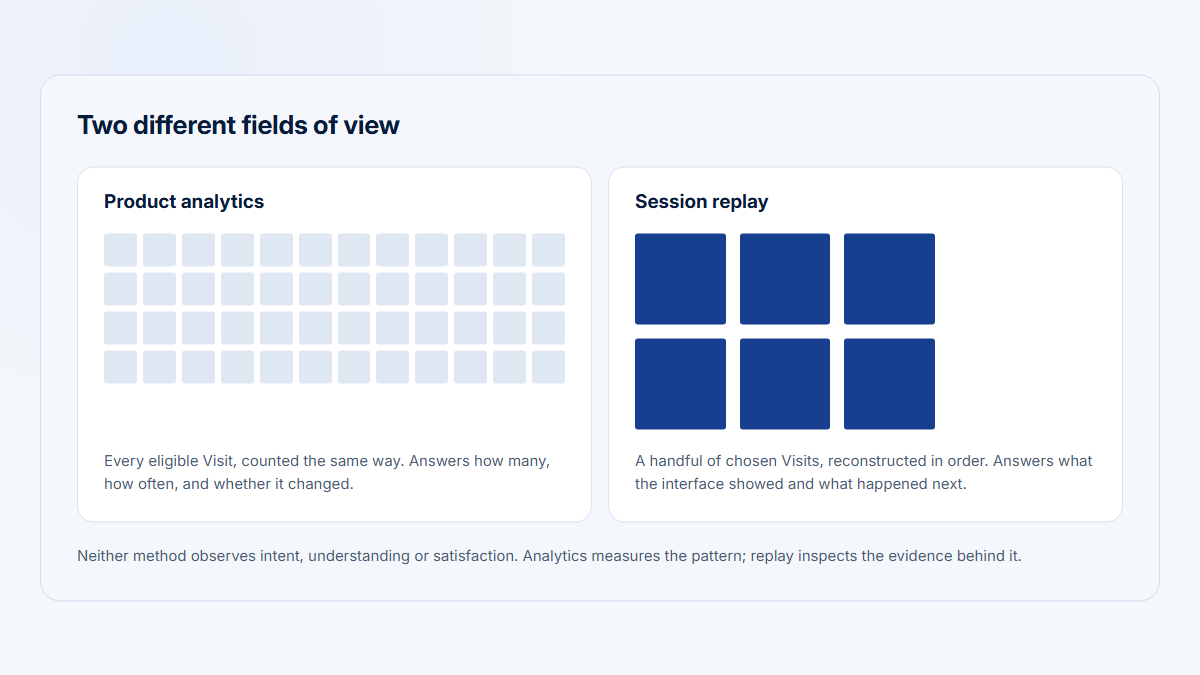
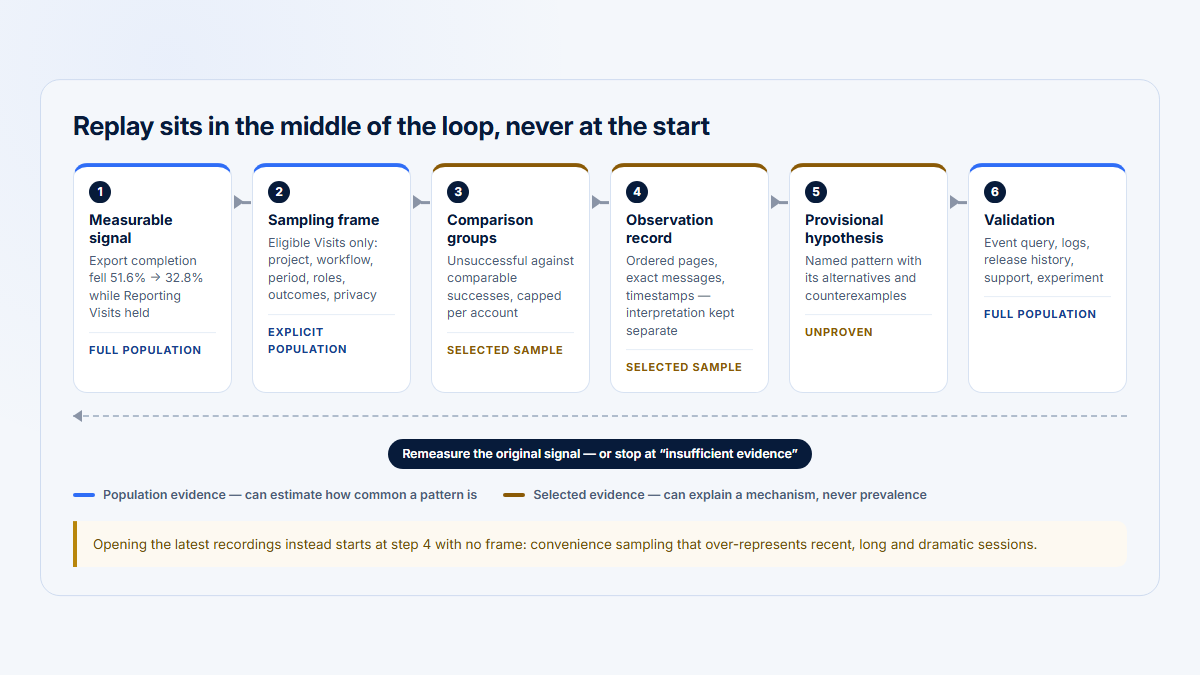
Replay workflow: PostHog connects replay to product delivery and engineering action. Fullstory connects replay to a mature experience-analysis loop. The player is only one stage; the signal before it and the action after it determine fit.
Decision-relevant video context
A shared first three stages, then two different actions
Shared, in order
PostHog-style action
Fullstory-style action
The first three stages are identical in both products. Choosing between them is really choosing which of the two closing actions your team performs most often.
Experiments, flags, errors, and data tooling
PostHog is substantially broader when a team wants to act on behavioral evidence inside the same platform. Fullstory provides strong technical and experience evidence, while several build, release, and data functions remain add-on or integration-led.
| Capability | PostHog | Fullstory |
|---|---|---|
| Feature flags | Native General rollouts, targeting, cohorts, and variants linked to analytics and replay | Not a native service External flag properties can support segmentation |
| Experiments | Native Product experiments connect flags, variants, metrics, cohorts, and replay | Qualified add-on Guides and Surveys can test delivered in-app content |
| Surveys and guides | Native Product surveys with targeting and response analysis | Paid add-on Tours, tips, checklists, banners, surveys, and content experiments |
| Error tracking | Dedicated product Issues, stacks, source maps, releases, assignments, web, backend, mobile, and replay | Replay-centered Console and network issues, crashes, error clicks, exceptions, and premium Opportunities |
| Console and network | Console, network, performance, events, DOM, and related evidence in replay | Dev Tools with console, errors, requests, responses, and page performance; capture rules apply |
| Logs | Native Application and service log product with a separate usage meter | Not a native service Browser console context does not replace backend log management |
| Warehouse | Managed warehouse and SQL layer for importing, modeling, querying, and joining external data | Anywhere: Warehouse sends raw or ready-to-analyze behavioral data to customer-managed destinations |
| Data movement | Native Sources, destinations, transformations, batch exports, and pipelines | Plan-dependent Anywhere Warehouse, Activation, Streams, APIs, and integrations |
Fullstory's Guides and Surveys means it is inaccurate to say the platform has no surveys or experimentation. The qualification is scope: its documented A/B capability tests in-app content, while PostHog provides a general feature-flag and experimentation system. Fullstory also exposes meaningful error and Dev Tools evidence without becoming a full-stack source-code error tracker.
Five layers: replay is the largest overlap
PostHog
Fullstory
Analytics
Events, funnels, retention
Present, oriented to experience questions
Session replay
Mature, web and mobile
Mature, with deep search
Experiments and delivery
Flags and experiments are core
Not the platform's purpose
Errors and technical evidence
Native errors and logs; confirm maturity
Available within investigation
Warehouse data movement
Warehouse and direct SQL
Exports and integrations
Filled segments show documented emphasis, not a score. Replay is where the two are closest; PostHog extends further into product engineering, Fullstory further into specialist experience investigation.
Privacy, implementation, and ownership
Both products require deliberate privacy, identity, and access design. Fullstory offers Private by Default on every plan; when enabled, it withholds text unless allowlisted. PostHog provides client-side masking and capture controls across web and supported mobile SDKs. Neither approach removes the customer's implementation responsibility.
| Area | PostHog | Fullstory |
|---|---|---|
| Masking | Inputs are masked by default; configure text, inputs, selectors, excluded elements, and mobile-specific controls | Private by Default is available on all plans; Exclude, Mask, and Unmask rules refine capture |
| Scope and URLs | Recording rules can use URLs, properties, sampling, triggers, and SDK conditions; query values can be redacted client-side | Domain, region, URL, element, network, and consent rules need production testing |
| Identity and accounts | Stable person IDs plus event-time group keys are required for first-class group analysis | Stable user identity and company properties support segmentation; account hierarchy remains property-based |
| Mobile capture | Replay is generally available for Android, iOS, React Native, and Flutter, with framework-specific capture modes | Android, iOS, React Native, and Flutter SDKs require the paid Mobile Analytics add-on; mobile is unavailable on Free |
| General analytics retention | Free: one year; pay-as-you-go: seven years | Free: 12 months; paid analytics retention is contractual |
| Replay retention | Free: up to 30 days; pay-as-you-go: 90 days; Boost/Scale: one year; Enterprise: up to five years | Free: 12 months; paid replay retention is contractual |
| Deletion and location | Deletion workflows plus US or EU cloud regions; verify each captured data surface | User/session deletion plus GCP-hosted US or EU data regions |
| Access and provisioning | Granular project/resource controls require paid packages; resource controls do not partition underlying project data from project members | Admin, Standard, and Guest span common plans; Architect, Explorer, SAML, and Okta SCIM require qualifying Enterprise access |
| Deployment | Cloud or an unsupported MIT-licensed, single-VM Docker Compose hobby deployment; no paid support or guarantees | No documented self-hosted analysis platform; locally hosting the capture script does not self-host the service |
| Likely owner and effort | Product engineering, data, platform, or growth; suite adoption adds taxonomy, group, flag, error, pipeline, privacy, and cost work | Digital analytics, product ops, UX research, design ops, or CX; production privacy, identity, mobile, definitions, segments, and governance still add work |
Masking is only one control. Test routes, queries, fragments, identity fields, network payloads, consent, deletion, retention, exports, and each role with deliberately seeded test-sensitive data. Use the instrumentation plan before treating a pasted snippet as a complete implementation.
Pricing and customer feedback
PostHog publishes product-by-product usage pricing. Fullstory offers a large permanent free plan but requires a sales process for paid pricing. Their headline allowances are not directly comparable because PostHog meters several product units while Fullstory primarily meters sessions and plan access.
| Pricing or review item | PostHog | Fullstory |
|---|---|---|
| Free entry | Permanent product-specific free allowances; no credit card required | Permanent FullstoryFree; no credit card required |
| Billing unit | Separate meters for analytics, web/mobile replay, flags, errors, surveys, warehouse, pipelines, logs, and other products | Session volume and plan access; some add-ons use additional units such as targeted users |
| Core allowance | 1M analytics events, 5,000 web recordings, and 2,500 mobile recordings monthly | 30,000 sessions monthly, up to 10 users, and 5,000 server-side events monthly |
| Other allowances | 1M flag requests, 100,000 exceptions, 1,500 survey responses, 1M warehouse rows, pipeline allowances, and 10GB logs | Core replay, basic analytics, integrations, and debugging; advanced features require paid plans or add-ons |
| Retention | Analytics: one year Free, seven years pay-as-you-go. Replay: 30 days Free, then 90 days to five years by package | Free includes 12 months for replay and analytics; paid retention is contractual |
| Published paid rates | After free allowances: analytics from $0.00005/event, web replay $0.005/recording, mobile replay $0.01/recording, flags $0.0001/request | No public paid dollar amounts |
| Advanced access | Usage plans and fixed-fee support/governance packages; Enterprise terms are quoted | Business, Advanced, and Enterprise are custom-priced; Mobile, StoryAI, Guides and Surveys, and Anywhere need explicit quoting |
| G2 snapshot | 4.5/5 from 1,054 reviews | 4.5/5 from 1,052 reviews |
| Verification date |
PostHog pricing
PostHog
1M events + 5K web replays
Paid usage starts separately by product and falls through volume bands. Model the real mix rather than multiplying one headline rate.
Fullstory pricing
Fullstory
30,000 sessions
Paid Business, Advanced, and Enterprise dollar pricing is not public. Advanced analytics and add-ons can change the quote.
Pricing caution: do not present 30,000 Fullstory sessions versus 5,000 PostHog web replays as a complete contest. Compare sessions, events, mobile use, retention, advanced-plan needs, support, expected growth, and the other tools each platform could replace.
G2 snapshot
PostHog reviews
G2 snapshot
Fullstory reviews
How to interpret public review themes
| Product | Frequently praised | Recurring reservations | Interpretation |
|---|---|---|---|
| PostHog | Connected scope, developer orientation, generous free allowances, and consolidation | Technical setup, learning curve, taxonomy work, and multi-meter forecasting | Strong fit for control and consolidation, but not automatically easiest for every researcher |
| Fullstory | Replay clarity, investigation context, collaboration, and support | Cost, recording volume, learning depth, and higher-plan capabilities | Strong when experience analysis is valuable, but segmentation and prioritization still matter |
Detailed pricing and review cautions
Confirm currency, taxes, commitments, session and event definitions, sampling, overages, retention, seats, mobile, add-ons, support, export, discounts, and termination terms in the final quote. PostHog's 10GB free log allowance currently has 14-day retention. Review themes are directional public evidence, not controlled measurements or promises about every customer.
Which should you choose?
Choose according to the workflow your team must own repeatedly, not the longest list of checkmarks. The better default can change when the investigator, decision, data direction, or deployment constraint changes.
| Scenario | Better default | Why | Main watch-out |
|---|---|---|---|
| Engineering startup | PostHog | Analytics, replay, flags, experiments, surveys, errors, logs, and data movement in one platform | Breadth needs an owner for taxonomy, privacy, and usage controls |
| Product analyst | PostHog, usually | Event analysis, cohorts, SQL, groups, and warehouse context | Fullstory may fit better when the output is UX investigation |
| UX researcher | Fullstory | Segments, Journeys, heatmaps, conversions, signals, sessions, and collaboration | Define the research question and sampling rule before replay |
| Frontend engineer | PostHog | Flags, experiments, errors, releases, logs, console, network, and replay | Fullstory can be stronger for subtle cross-session experience patterns |
| B2B product team | PostHog with Groups, or an account-centric layer | Company-level funnels, retention, flags, and experiments are possible | Paid Groups still needs adoption definitions and user penetration |
| Customer success | Fullstory for replay; neither as a CS platform | Experience evidence is easy to investigate and share | Commercial health, renewal, and outreach need other account context |
| Warehouse-led company | Depends on data direction | PostHog imports and queries context; Fullstory Anywhere exports behavioral data | Decide whether the tool should query the warehouse or supply it |
| Self-hosting requirement | PostHog, heavily qualified | An open-source hobby deployment exists | It is unsupported, single-VM oriented, and lacks paid features and guarantees |
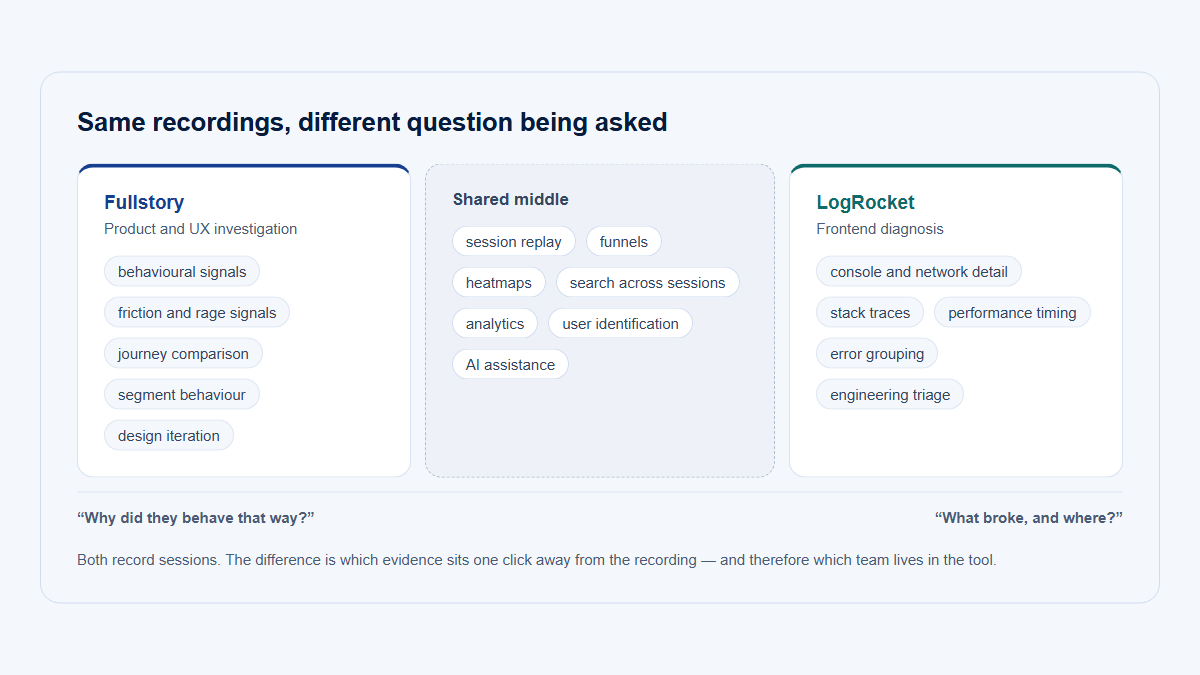
For adjacent choices, compare product analytics tools and the specialist Fullstory vs LogRocket decision.
Worked B2B scenario: onboarding and Reporting adoption
A fictional B2B SaaS team sees that new accounts enter onboarding, but only some adopt Reporting. It needs an eligible company denominator, the users inside each account, successful and failed behavior, session evidence, and a defensible next action.
| Task | PostHog | Fullstory | Additional evidence |
|---|---|---|---|
| Build the onboarding funnel | Native event or paid-group funnel | Native funnel; advanced Conversions adds prioritized signals | Explicit events and an eligible account denominator |
| Measure company adoption | Group Analytics when company identity is configured | Company properties, segments, and unique-property metrics | Account model or warehouse query |
| Measure user penetration | Model users and companies, then calculate the within-account denominator | Custom property analysis or export rather than a first-class hierarchy | Eligible user roster and time window |
| Review Reporting sessions | Filter by events, URLs, groups, cohorts, errors, or flags | Filter by segments, pages, events, Journeys, signals, or Conversions | Representative sampling rule |
| Compare success and failure | Contrast converters and drop-offs, then inspect replay and technical context | Contrast funnel outcomes, curated sessions, and experience signals | Qualitative question before assigning cause |
| Experiment and release | Native experiment tied to a feature flag | External experiment analysis or an in-app content test | Primary metric, guardrails, and release process |
| Prepare customer context | Groups, cohorts, analytics, and sessions | User/company properties, segments, and sessions | CRM, CS platform, warehouse, or account-centric layer |
The hard requirement is not replay: both products can provide recordings. It is joining a company-level denominator, user distribution, workflow adoption, outcome comparison, technical evidence, and operational context without letting one unusually active user represent an entire account.
Where Hymetry fits
Hymetry is relevant when the investigation should begin with the commercial customer account rather than treating company identity as another property on a user or session.
Hymetry connects product areas and grouped pages with Companies, Users, account adoption, user distribution, and Visits. A team can start with Reporting, find adopting companies, check whether usage is broad across eligible users, and inspect the Visits behind an unusual pattern.
Advanced friction detection, complete text-based replay narratives, and richer AI-session capabilities remain roadmap- or verification-sensitive for Hymetry. Dependable Companies and Users analysis also requires correct user and company identity.
FAQ, methodology, and sources
This is a desk-researched fit analysis, not a controlled benchmark, legal assessment, or hands-on product test.
Is PostHog better than Fullstory?
Not universally. PostHog is generally stronger for an engineering-led team that wants analytics, replay, flags, experiments, errors, logs, and data tooling together. Fullstory is generally stronger for a product, UX, or digital-experience team whose primary workflow is finding, segmenting, and investigating experience evidence.
Can PostHog replace Fullstory?
Often, when a team values stack consolidation and can build its replay-analysis process around events, funnels, cohorts, errors, and feature delivery. The compromise is some of Fullstory's specialist Journey, conversion-signal, heatmap, and collaborative investigation depth.
Which has stronger product analytics?
PostHog has the broader system, especially for event analysis, groups, SQL, warehouse context, experiments, and release workflows. Fullstory still has substantial structured analytics, including metrics, funnels, segments, higher-tier Retention and Journeys, and higher-tier Conversions. It should not be characterized as replay-only.
Which has stronger session replay?
Fullstory is the stronger default for specialist UX and digital-experience investigation. PostHog replay is more tightly connected to a broad engineering platform and can fit developers who need events, flags, errors, logs, console, network, and release context around a recording.
Which is better for engineers?
PostHog, in most cases. Native flags, experiments, Error Tracking, logs, APIs, warehouse data, pipelines, and replay create a more complete engineering loop. Fullstory remains valuable when engineers need polished session evidence and experience signals, but it usually complements delivery and observability systems.
Which is better for UX teams?
Fullstory is generally the stronger default because Journeys, heatmaps, segments, Conversions, frustration evidence, session collaboration, and Opportunities are organized around experience investigation. PostHog can still work well for technical UX or product teams that value close connections to event analytics and releases.
Where does Hymetry fit?
Hymetry fits B2B SaaS teams that want Companies, Users, product areas, grouped pages, account adoption, user distribution, and Visits in one investigation path. It complements rather than replaces PostHog's engineering platform or Fullstory's specialist experience workflow.
Sources
Disclosure: Hymetry operates in the broader product-intelligence and session-evidence market, which creates a commercial interest. Neither PostHog nor Fullstory paid for placement, reviewed the article, or provided private access. Pricing, packages, ratings, review counts, and retention are dated snapshots.
Methodology and evidence limits
- Official documentation was prioritized for scope, privacy, retention, mobile support, deployment, and packaging.
- Official pricing pages supplied public allowances and rates.
- G2 supplied same-day ratings, counts, and directional review themes.
- Independent media supplied buyer context; vendor media demonstrated only the vendor's own workflow.
- Capability labels separate native services, add-ons, plan dependencies, property models, and integrations.
- No authenticated tenant, SDK benchmark, contract review, customer interview, or hands-on test was used.
- "Broader" and "more specialized" are editorial conclusions from documented workflows, not benchmark scores.
Verified August 11, 2026. Private contract terms remain unresolved without vendor quotes, including paid Fullstory pricing and retention, add-on entitlements, support, and organization-specific governance.
Official PostHog product and documentation
Official Fullstory product and documentation
Pricing, ratings, and public review evidence
- PostHog pricing and free allowances
- Fullstory plans and FullstoryFree
- PostHog on G2
- PostHog G2 review themes
- Fullstory on G2
- Fullstory G2 review themes
Ratings verified August 11, 2026: PostHog 4.5/5 from 1,054 reviews; Fullstory 4.5/5 from 1,052 reviews.
Independent video, vendor media, and related context
- Vision Labs product analytics tools overview, uploaded October 23, 2025
- Fullstory session replay resource, currently embedding the one-minute rage-click clip
- Fullstory rage-click replay demonstration, uploaded May 5, 2026
- Fullstory vs LogRocket
- Product analytics tools comparison
- Product usage by company