Quick comparison
The products share many capabilities, but their strongest workflows point to different owners. Fullstory places replay inside a broader behavioral and digital-experience investigation surface. LogRocket places it beside errors, logs, requests, releases, and performance evidence.
| Criterion | Fullstory | LogRocket |
|---|---|---|
| Primary job | Behavioral analysis and digital-experience investigation | Replay-backed frontend diagnosis and product analytics |
| Best team | Product, UX, CX, support, and analytics | Engineering, product, and technical support |
| Investigation loop | Signal, segment or funnel, selected sessions, product or UX decision | Error, issue or slow request, affected sessions, technical evidence, fix |
| Behavioral analysis | Plan-dependent Funnels and segmentation are native; Page Flow is paid, while Journeys and Retention Analysis require Advanced or Enterprise | Native Funnels, paths, retention analysis, heatmaps, filters, and replay |
| Developer evidence | Limited Console, network when enabled, exceptions, and page performance | Native Issues, logs, requests, source maps, releases, and performance |
| Mobile | Plan-dependent Paid add-on for native and cross-platform applications | Native iOS, Android, React Native, and Flutter SDKs |
| Free option | Permanent FullstoryFree plan | 14-day trial; no permanent free plan listed |
| Paid model | Custom Business, Advanced, and Enterprise quotes; several add-ons | Captured-session pricing, qualified by seats, retention, and add-ons |
| G2 snapshot | 4.5/5 from 1,052 reviews | 4.6/5 from 2,399 reviews |
The operating-loop difference
Fullstory’s natural loop
Behavior first
Behavioral signal → segment or funnel → selected sessions → product or UX decision.
LogRocket’s natural loop
Issue first
Error, issue, or slow request → affected sessions → technical evidence → fix and verify.
Where they overlap
A broad shared middle
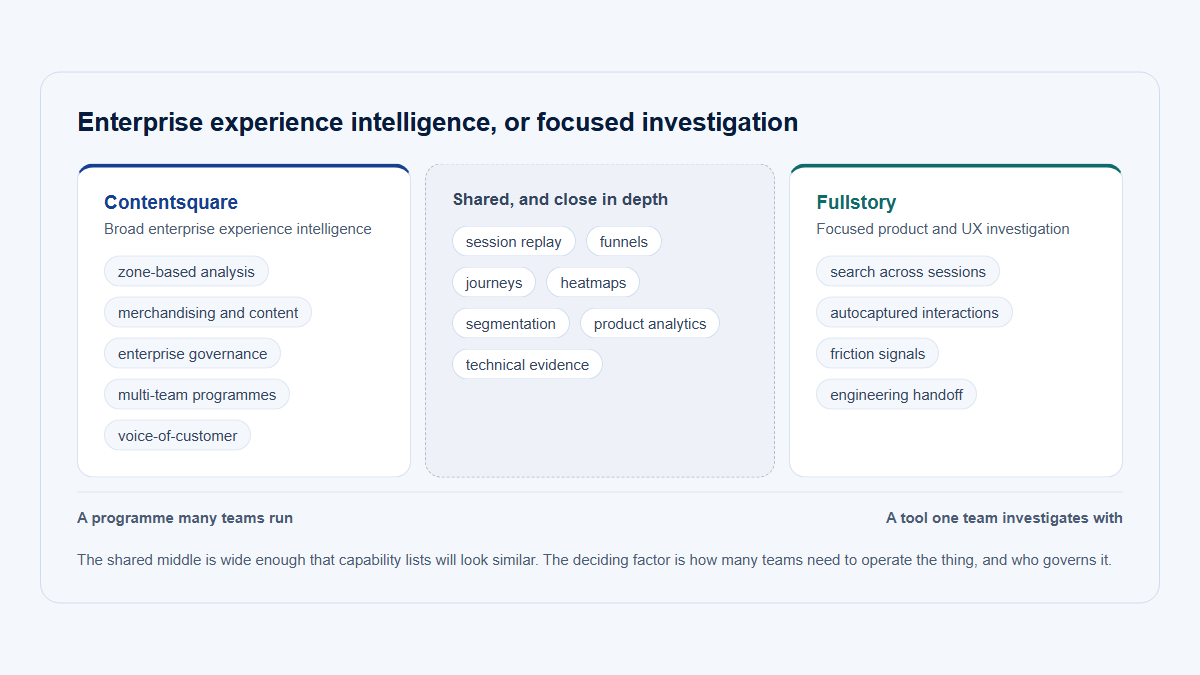
Both support replay, behavioral search, funnels, heatmaps, user identification, frustration signals, support investigation, technical context, and AI-assisted analysis. The distinction is emphasis, not exclusivity.
Same recordings, different question being asked
Fullstory
Product and UX investigation
Shared middle
LogRocket
Frontend diagnosis
“Why did they behave that way?” “What broke, and where?”
Both record sessions. The difference is which evidence sits one click away from the recording — and therefore which team lives in the tool.
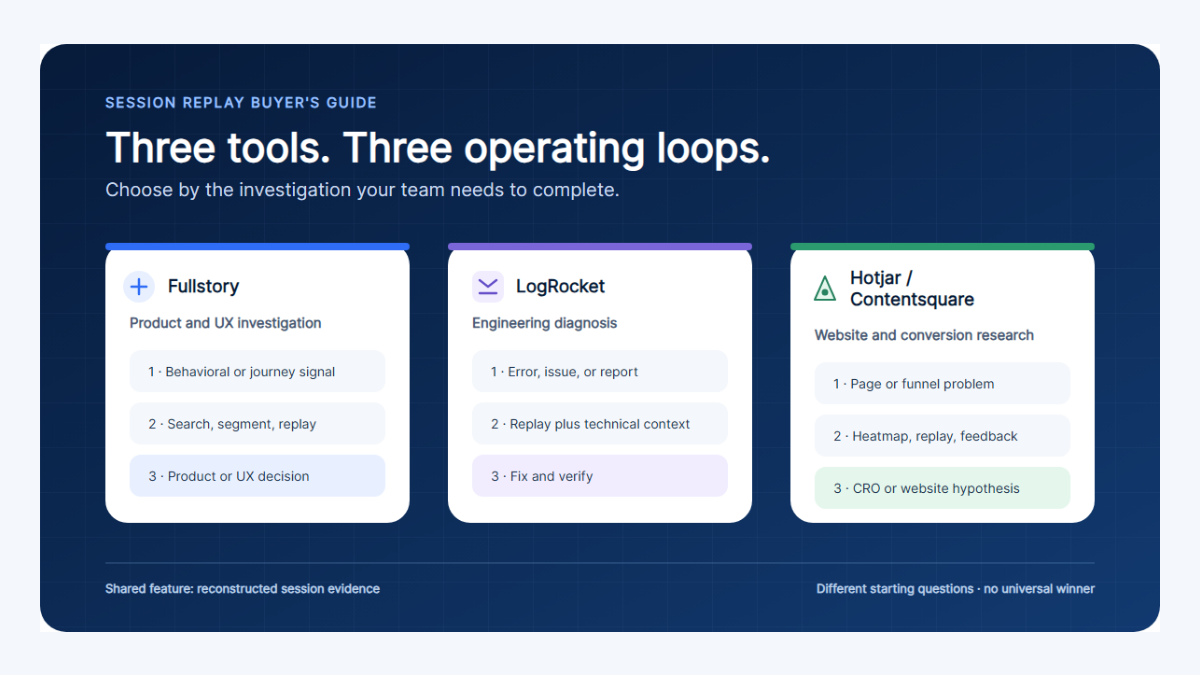
For wider context, compare Fullstory, LogRocket, and Hotjar or OpenReplay, LogRocket, and Fullstory.
Replay and behavioral analysis
Fullstory has the cleaner UX-first loop; LogRocket narrows the gap with funnels, paths, heatmaps, filters, and AI-assisted replay. The difference is the analysis around replay, not replay itself.
| Investigation capability | Fullstory | LogRocket |
|---|---|---|
| Replay workflow | Native Move from metrics, segments, funnels, flows, journeys, or heatmaps to sessions | Native Move from an Issue, filter, funnel, path, or heatmap to replay and technical evidence |
| Segmentation | Native Search properties, events, pages, elements, and behavior | Native Filter users, sessions, URLs, releases, Issues, requests, and performance |
| Funnel-to-replay | Native Compare converters and drop-offs, then open sessions | Native Open sessions matching a funnel or path |
| Successful versus failed sessions | Native Define cohorts from funnels, segments, metrics, and signals | Native Combine outcomes with errors, failed requests, Issues, and events |
| Heatmaps | Native Click, scroll, and page analysis | Native Click, heat, rage-click, and scroll analysis |
| Annotations | Plan-dependent Notes, comments, and analytics annotations vary by workflow and plan | Limited Sessions and Issues are shareable; no comparable UX-research workspace was verified |
| Collaboration | Plan-dependent Dashboards, Spaces, notes, comments, and access controls | Native Share sessions and Issues or connect ticketing and chat |
| User and account metadata | Native User properties can carry account data; portfolio analytics are not first class | Native User traits can carry account data; portfolio analytics are not first class |
| UX-research workflow | Native Pattern, cohort, selected replay, shared finding | Not primary Capable, but the interface leads toward diagnostic evidence |
| Customer support | Native Reconstruct a journey and share behavioral context | Native Reproduce an Issue with logs, requests, errors, or performance evidence |
Fullstory places Page Flow on paid plans; Journeys and Retention Analysis require Advanced or Enterprise, while StoryAI and Mobile depend on qualifying or add-on packaging. LogRocket Core includes analytics, paths, funnels, retention analysis, heatmaps, surveys, errors, logs, network evidence, and performance; Pro adds AI.
Five layers, each answering something the previous one cannot
1
Structured metric
A rate or count with a period, a denominator and an owner
2
Segment
Who is affected: role, plan, device, route, company
3
Replay
How a specific attempt actually unfolded
4
Technical evidence
Console, network, stack trace, timing — what the interface could not show
5
Operational context
Account, backend state, support tickets, direct feedback
A replay without layer 1 has no prevalence. A metric without layers 3 and 4 has no explanation. Investigations stall when a team owns only one layer.
Errors, console, network, and performance
LogRocket is stronger when replay must end in developer action, but Fullstory supplies useful console, network, exception, and page-performance context. The difference is diagnostic depth, not the presence of technical evidence.
| Developer evidence | Fullstory | LogRocket |
|---|---|---|
| JavaScript errors | Native Search captured exceptions and console errors | Native Connect errors and Issues to users and sessions |
| Stack traces | Native Exceptions can expose stack context; verify production minification | Native Join stacks to replay, Issues, logs, requests, and source |
| Source maps | Not primary No equivalent native workflow was verified | Native Host or upload maps by release |
| Console logs | Native Messages, warnings, errors, and exceptions in Dev Tools | Native Console and application logs are central replay layers |
| Network status | Native Enable capture for method, status, timing, and safe headers | Native Filter URL, method, status, duration, GraphQL, and body text |
| Request or response data | Native Other headers and bodies require explicit allowlisting | Native Capture, redact, or exclude data with sanitizers |
| GraphQL | Limited Appears as network traffic; no dedicated workflow was verified | Native Search requests and responses, subject to privacy controls |
| Performance | Not primary Page and request timing inside a session | Native Web Vitals, page load, CPU, long tasks, memory, crashes, and network speed |
| Release tracking | Not primary Use properties and connected engineering workflows | Native Filter sessions and associate source maps by release |
| Issue grouping | Plan-dependent Searchable signals do not form the same developer-first queue | Plan-dependent JavaScript Errors span plans; several network and usability Issue types require Pro |
| Alerting | Plan-dependent Metric, segment, opportunity, and Issue alerts vary by package | Native Core includes alerts; AI Issue capabilities require qualifying packaging |
| Engineering handoff | Via integration Pass sessions and behavior into existing tools | Via integration Send Issues to ticketing, chat, and engineering tools |
Fullstory documents console capture, searchable exceptions, opt-in network details, allowlisting, and page performance. LogRocket documents request search, source maps, release-aware stacks, grouped Issues, filters, and frontend performance.
Reporting failure investigation
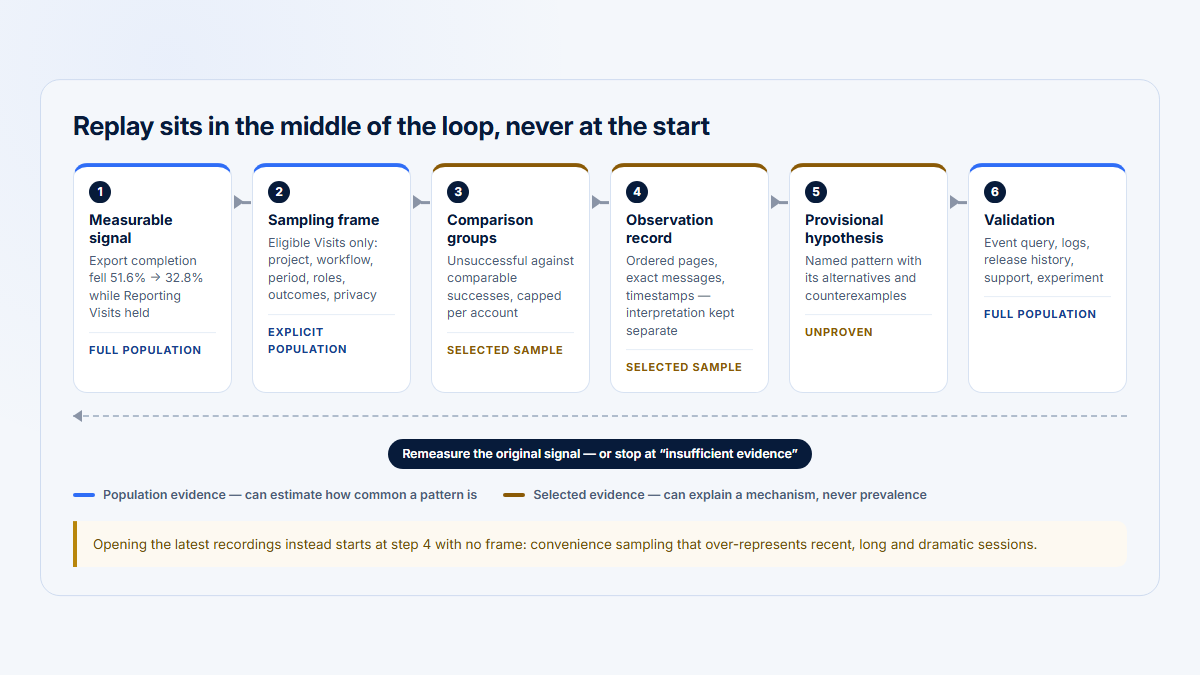
Fullstory is likely faster at defining the affected cohort; LogRocket is likely faster at isolating the frontend mechanism. Assume the 14-day company export-success rate—export_succeeded divided by export_started—falls against the prior 14 days while starts stay stable, errors rise, and several companies are affected.
| Investigation step | Fullstory | LogRocket | Additional evidence needed |
|---|---|---|---|
| Identify affected users | Segment Reporting, exports, failures, and properties | Filter URL, event, Issue, error, request, or release | Stable user ID and explicit outcome |
| Identify affected companies | Filter an account ID in user or event properties | Filter account traits on identified users | Reliable account ID and company layer |
| Open relevant sessions | Open the failed cohort or segment | Open from an Issue, error, funnel, request, or filter | Clear cohort rule |
| Inspect interface state | Use replay, event stream, page insights, and signals | Use replay, timeline, DOM state, and Issue markers | Same-release reproduction |
| Inspect errors | Review console and exception context | Review grouped Issues, stacks, source, and sessions | Backend logs for API failures |
| Inspect network | Review status, timing, safe headers, and allowlisted data | Review status, duration, data, and GraphQL context | Request ID and sanitized server traces |
| Inspect performance | Review page and request timing | Review metrics, slow requests, and long tasks | Server and infrastructure latency |
| Interpret repeated clicks | Treat them as a lead beside replay and timing | Treat rage or dead clicks as leads, not intent | UI timing, accessibility tests, comparison sessions |
| Estimate prevalence | Use metrics, funnels, segments, and affected users | Use Issues, timeseries, funnels, and affected sessions | Outcome denominator and server completion data |
Compare the same 14-day windows by account_id and release, then join API status, server logs, and selected sessions. Replay explains examples; it does not establish prevalence.
Worked example: export success rate is falling
Start from the aggregate
Branch: two kinds of evidence
Rejoin to decide
The branch matters: replay and technical evidence answer different halves of the question, and neither establishes how widespread the failure is. Only the rejoin does.
Product, UX, and support workflows
Fullstory is the easier cross-functional product and UX default; LogRocket is the easier engineering and technical-support handoff.
Product and UX investigation
Stronger default: Fullstory. Move from a funnel, flow, journey, heatmap, segment, or signal to comparison cohorts and selected sessions. Its advantage is the analysis around replay, not an absence of analytics in LogRocket.
Frontend diagnosis
Stronger default: LogRocket. Move from a bug, failed request, slow page, release, or Issue to source-mapped stacks, logs, request data, and performance. Fullstory still provides technical context.
Customer support
Depends on the ticket. Fullstory suits journey and experience context; LogRocket suits failed requests, console errors, releases, stack traces, crashes, and performance evidence.
AI-assisted investigation
Both overlap. Fullstory offers StoryAI through qualifying or add-on packaging. LogRocket Pro lists AI summaries, Issue detection, analysis insights, feedback analysis, and Ask Galileo. Verify every conclusion against source evidence.
Decision-relevant media
Official vendor tour · 4 minutes
See Fullstory in action
Fullstory’s official tour shows the vendor’s behavioral-capture and analysis workflow. It is orientation, not independent evidence.
Watch the official Fullstory product tour
Disclosure: vendor-produced material.
Privacy, implementation, and retention
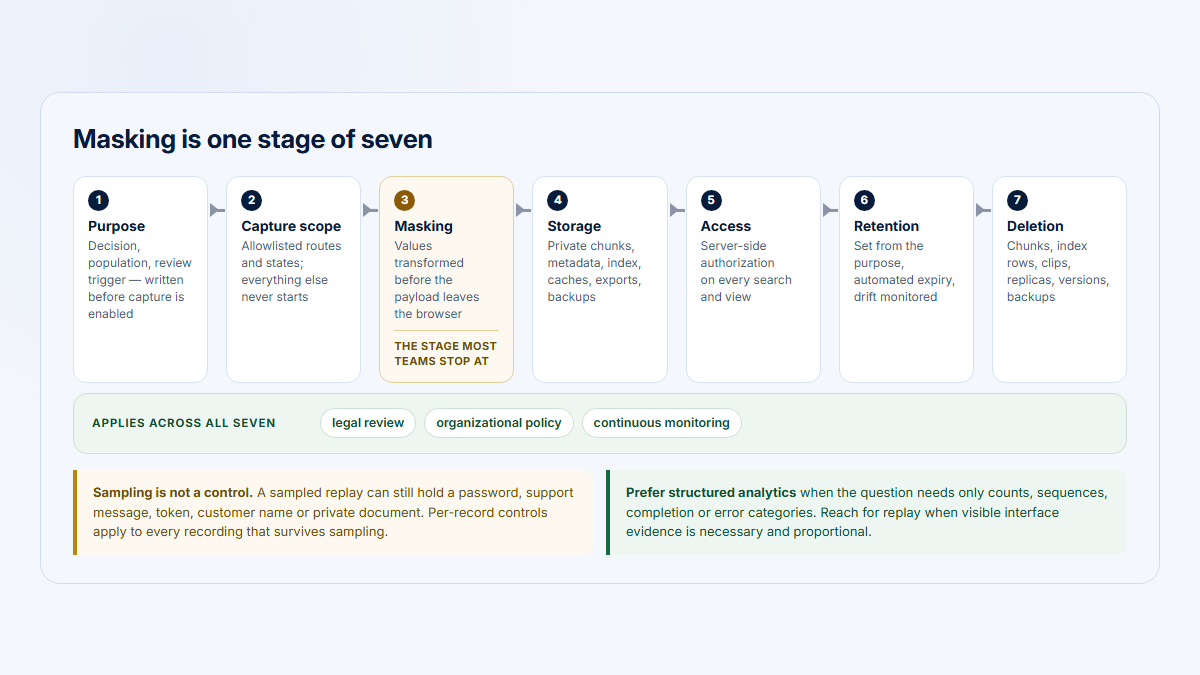
Masking alone does not make either product privacy-safe. Cover DOM, URLs, identity, network payloads, deletion, access, consent, retention, and every web or mobile route.
| Control or decision | Fullstory | LogRocket |
|---|---|---|
| DOM masking | Native Private by Default plus Exclude, Mask, and Unmask rules | Native Automatic text, input, and image sanitizing plus private selectors |
| Blocking or exclusion | Native Ignore excluded elements and children | Native Exclude DOM regions, network fields, Redux state, and other data |
| Excluded routes | Plan-dependent Combine consent, capture controls, and scoped rules | Plan-dependent Record conditionally and sanitize by URL; verify web and mobile |
| URL controls | Native Review paths, queries, identity, and searchability | Native Redact sensitive values with URL and request sanitizers |
| Network-body controls | Native Blocks unsafe headers; bodies require allowlisting | Native Redact fields, remove bodies, or ignore request pairs |
| Retention | FullstoryFree documents 12 months; paid terms are contractual | Plan-specific; qualifying watched sessions can reach 12 months within documented limits |
| User deletion | Native Documented deletion and data-request tooling | Native Permission-controlled GDPR and CCPA deletion |
| Access control | Plan-dependent Roles and Space access vary by plan | Plan-dependent Built-in roles; custom RBAC is listed with Pro |
| SSO | Plan-dependent Verify SAML packaging | Native SSO is listed in Core |
| Audit logs | Plan-dependent Confirm enterprise packaging | Plan-dependent Pro lists audit logging with RBAC |
| SDK setup | Web snippet plus identity, privacy, page, and optional network setup; mobile is an add-on | Web or mobile SDK plus identity, sanitizers, releases, and source maps |
| Likely owner | Product or UX with engineering, security, privacy, and legal | Engineering with product, security, privacy, and legal |
Use the privacy checklist and capture-boundary guide before rollout.
Pricing and customer feedback
Fullstory has the stronger free entry; LogRocket publishes a session calculator. Paid cost depends on package, captured volume, retention, seats, add-ons, support, and data access.
| Pricing or review item | Fullstory | LogRocket |
|---|---|---|
| Free or trial | Permanent FullstoryFree; no card required | 14-day trial; no permanent free plan listed |
| Included session allowance | FullstoryFree: 30,000 monthly sessions | Configurable captured-session volume |
| Retention | FullstoryFree: 12 months; paid terms are contractual | Plan-specific; qualifying watched sessions can reach 12 months |
| Seats or users | FullstoryFree: up to 10 users; paid access is contractual | Price depends partly on seats; Enterprise lists unlimited seats |
| Mobile | Excluded from FullstoryFree; sold as an add-on | The calculator uses a web + mobile volume selector; confirm contractual quota allocation |
| Packaging | Business, Advanced, and Enterprise; Mobile, StoryAI, and Guides and Surveys can be add-ons | Core includes replay plus unlimited analytics, error, and log events; Pro adds AI and RBAC; Enterprise adds scale, export, support, and self-hosting |
| Public paid price | Paid dollar amounts are not public | At 25,000 total sessions/month on the web + mobile selector: starting at $176/month |
| Price qualifier | Quote sessions, retention, users, add-ons, support, and access | Seats, retention, add-ons, and final web/mobile allocation can change the quote |
| G2 rating | 4.5/5 from 1,052 reviews | 4.6/5 from 2,399 reviews |
| Official pricing | Fullstory plans and packages | LogRocket pricing calculator |
| G2 profile | Fullstory on G2 | LogRocket on G2 |
Permanent free entry
Fullstory
30,000 sessions
Paid Business, Advanced, and Enterprise pricing is custom; add-ons can change the quote.
Public calculator signal
LogRocket
From $176/month
Seats, retention, add-ons, and quota allocation can change the final quote.
Pricing caution: compare equal volume, retention, seats, mobile use, AI, support, export, and contract terms—not $176 against “contact sales.”
G2 snapshot
Fullstory reviews
G2 snapshot
LogRocket reviews
Review themes are not controlled measurements. Ratings and counts are dated snapshots.
Detailed pricing cautions
Confirm currency, taxes, commitment, session definitions, overages, retention, seats, access, support, export, mobile and AI packaging, discounts, and termination terms in the final contracts.
Which should you choose?
Choose by the owner of the weekly investigation, then test that person’s exact workflow. Replacement is credible only when the team accepts what it loses.
| Scenario | Best starting point | Why | Watch-out |
|---|---|---|---|
| Product designer | Fullstory | UX-first analysis and replay | Do not infer intent from one session |
| Frontend engineer | LogRocket | Technical evidence is central | Configure sanitization and source maps |
| UX researcher | Fullstory | Move from cohorts to selected sessions | Define the research question first |
| Customer support | Depends | LogRocket for reproduction; Fullstory for journey context | Limit data and access |
| Product manager | Fullstory by default | Broad experience and product analysis | Prefer LogRocket when diagnosis dominates |
| B2B customer success | Neither alone | Neither is an account-adoption portfolio | Add company and lifecycle context |
| Mobile team | Depends | LogRocket for diagnosis; Fullstory add-on for experience analysis | Test framework, masking, crashes, and fidelity |
| Privacy-sensitive enterprise | Contract dependent | Both have controls; LogRocket advertises Enterprise self-hosting | Review security, residency, retention, and access |
| Existing product analytics | Keep it; add one replay layer | Fullstory for UX or LogRocket for diagnosis | Avoid duplicate taxonomies |
Fullstory’s paid mobile offering covers native and cross-platform apps, including Flutter. LogRocket documents iOS, Android, React Native, and Flutter with platform-specific support.
See product analytics tools and session replay versus product analytics.
Direct replacement and coexistence
| Question | Short answer | What may be lost |
|---|---|---|
| Can Fullstory replace LogRocket? | Sometimes, when UX investigation is primary and Dev Tools suffice. | Source maps, release-aware Issues, deeper requests, performance, and self-hosting |
| Can LogRocket replace Fullstory? | Sometimes, when engineering owns the loop and its analytics suffice. | UX-first analysis, Page Flow, Journeys, experience governance, and the permanent free entry |
| Should a team use both? | Only for distinct requirements and owners. | Duplicate capture, privacy, consent, cost, taxonomy, retention, and governance |
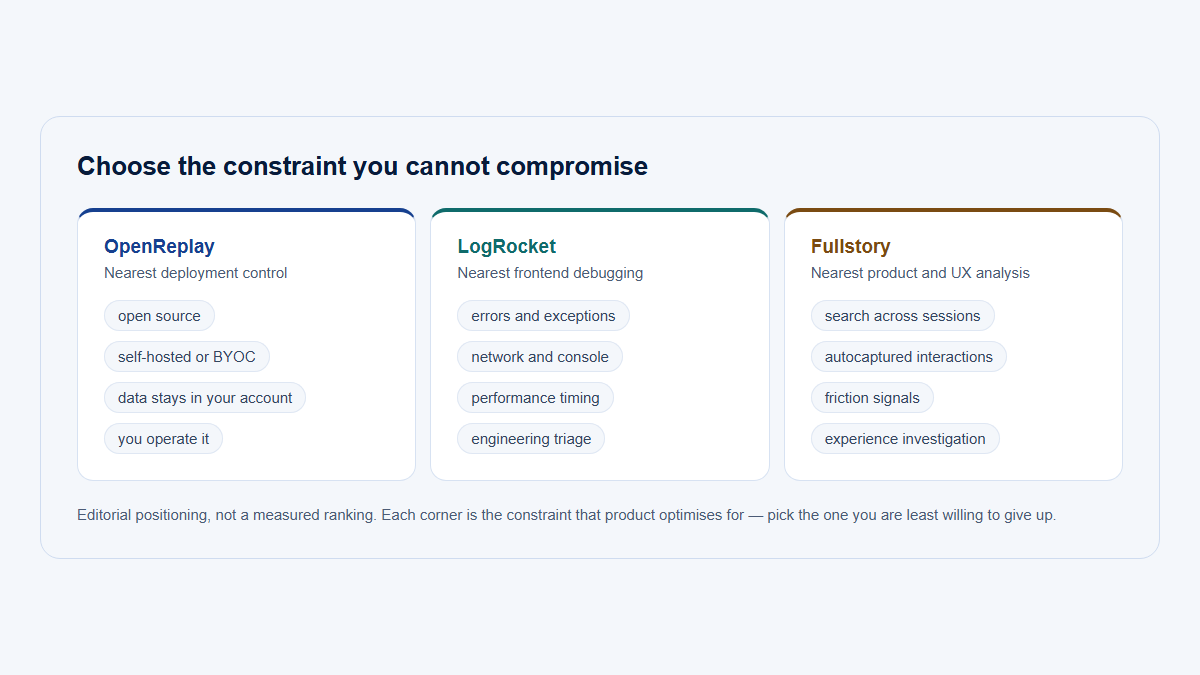
For self-hosting context, compare OpenReplay, LogRocket, and Fullstory.
Where Hymetry fits
Hymetry fits before replay when a B2B team must choose which company, user, product area, or visit deserves investigation. It is account-centric product intelligence, not a replacement for either vendor.
Grouped pages and product areas connect to Companies, Users, account signals, and Visits, moving from aggregate behavior to selected evidence instead of random recordings.
Learn about product usage by company, then explore Companies, Users, and Visits.
FAQ, methodology, and sources
This is a source-backed fit analysis, not a controlled benchmark or legal assessment.
Is Fullstory better than LogRocket?
Not universally. Fullstory usually suits product and UX investigation; LogRocket usually suits replay-backed frontend diagnosis.
Which is better for frontend debugging?
Usually LogRocket. It joins replay to errors, Issues, logs, requests, source-mapped stacks, releases, and performance. Fullstory offers useful Dev Tools, but diagnosis is not its center of gravity.
Which is better for UX research?
Usually Fullstory. Search, segments, heatmaps, funnels, Page Flow, Journeys, and replay form a natural research loop. LogRocket still supports UX work tied to technical failure.
Which captures console and network data?
Both. Fullstory captures console data by default and requires Network Data Capture to be enabled; unsafe headers are blocked and bodies require allowlisting. LogRocket provides request and response sanitizers. Both require privacy review.
Can either replace product analytics?
Sometimes. Both include funnels, filters, paths or journeys, heatmaps, dashboards, and other analytics. Specialized experimentation, warehouse models, or an established taxonomy may justify another platform.
Should a team use both?
Only when distinct product or UX and engineering requirements justify duplicate capture, consent, privacy, retention, taxonomy, procurement, and performance work.
Where does Hymetry fit?
Hymetry links a B2B product or account signal through a Company and User to a Visit. It complements, rather than replaces, the vendors’ investigation strengths.
Sources
Disclosure: Hymetry publishes this comparison and may overlap with both vendors in account-centric analytics and session-evidence use cases. Neither Fullstory nor LogRocket paid for placement or reviewed the conclusions.
Methodology and evidence limits
Verified August 11, 2026. Official product, pricing, technical, privacy, mobile, retention, and release documentation came first; G2 supplied ratings and review themes; independent material supplied context.
No SDK benchmark, fidelity or performance test, contract review, or customer interview was performed. Fit language is an editorial conclusion, not a laboratory measurement.
Check Plan-dependent capabilities against the final quote. Limited, Via integration, and Not primary are not absolute yes-or-no labels. Pricing, ratings, limits, retention, seats, add-ons, and enterprise terms are dated.
Official Fullstory product and documentation
- Fullstory plans and packages
- Fullstory product tour
- Fullstory mobile analytics
- Using the Fullstory Console
- Fullstory Dev Tools FAQ
- Fullstory Private by Default
- Fullstory uncaught exception capture
- Fullstory network allowlisting
- Fullstory Network view in Dev Tools
- Getting started with Fullstory for engineers
- Fullstory release notes
Official LogRocket product and documentation
- LogRocket pricing
- LogRocket product overview
- LogRocket Session Replay for developers
- LogRocket Session Replay documentation
- LogRocket filters
- LogRocket Retention Analysis
- Error reporting through LogRocket Issues
- JavaScript stack traces and source maps
- LogRocket frontend performance monitoring
- LogRocket privacy controls
- LogRocket network sanitization
- LogRocket GraphQL capture
- LogRocket mobile feature support
- Introduction to LogRocket Mobile
- LogRocket role-based access control
- LogRocket extended session retention
- LogRocket Ask Galileo
Pricing and customer ratings
- Fullstory plans
- LogRocket pricing calculator and packages
- Fullstory on G2
- Fullstory G2 pros and cons
- LogRocket on G2
- LogRocket G2 pros and cons
Pricing verified August 11, 2026. The LogRocket calculator used its 25,000 total sessions/month web + mobile selector; confirm final quota allocation.
Ratings verified August 11, 2026: Fullstory 4.5/5 from 1,052 reviews; LogRocket 4.6/5 from 2,399 reviews.
Independent video and Hymetry context
- EP 116 — Session Replay Wrap Up with Matt & Moshe, YouTube upload October 1, 2024; podcast release October 2, 2024
- Fullstory vs LogRocket vs Hotjar
- Session Replay vs Product Analytics