Product information, pricing, ratings, and video availability verified: .
Choose Google Analytics 4 if
Choose GA4 when paid acquisition, Google Ads, ecommerce merchandising, attribution, audiences, web-and-app measurement, or raw-event export to BigQuery are central to the measurement plan.
Its basic website tag is not inherently difficult to install, but a decision-grade setup usually requires an event taxonomy, key-event definitions, ecommerce instrumentation, consent configuration, channel governance, and reporting expertise. GA4 is strongest when the team will use its marketing depth rather than merely tolerate its interface.
Choose Matomo if
Choose Matomo when you want a broad Google Analytics alternative without giving up detailed traffic reports, events, goals, ecommerce, visitor profiles, funnels, cohorts, heatmaps, session recordings, and APIs.
Matomo Cloud reduces the operational burden and includes capabilities that are premium modules in many On-Premise installations. Matomo On-Premise provides much greater deployment and storage control, but the organization becomes responsible for infrastructure, backups, security updates, capacity planning, monitoring, and continuity. See Matomo pricing and packaging.
Choose Plausible if
Choose Plausible when a small company, publisher, founder, agency, or public-site team wants a fast, intentionally limited dashboard for traffic, pages, sources, campaigns, goals, events, funnels, and lightweight revenue attribution.
Plausible’s narrow data model is a product decision, not merely a missing-feature list. It does not create persistent visitor profiles or attempt to connect the same person across days and devices. That reduces user-level data and complexity, but rules out several kinds of retention, lifecycle, and authenticated-user analysis. See Plausible’s data policy.
Use another product for authenticated SaaS analytics if
Use another product analytics or account-intelligence layer when the important questions begin after signup:
- Which product areas has each customer company adopted?
- Is usage broad across the company or concentrated in one champion?
- Which identified users are active, passive, losing momentum, or no longer returning?
- Which workflows are repeatedly used?
- Which sessions explain a change in account adoption?
- How does acquisition connect to trial activation and eventual company-level product use?
GA4 and Matomo can collect authenticated events and user identifiers, but neither provides a native customer-company adoption model. Plausible deliberately avoids persistent identified-user tracking. None of the three is automatically a complete account-centric product analytics system.
At a glance
| Criterion | Google Analytics 4 | Matomo | Plausible Analytics |
|---|---|---|---|
| Primary category | Event-based web, app, acquisition, and marketing analytics | Full-featured web analytics with Cloud and On-Premise deployment | Aggregate-first, intentionally simple web analytics |
| Best for | Marketing and ecommerce teams invested in Google Ads and the Google ecosystem | Organizations needing broad analytics plus deployment and data-custody choices | Teams wanting a focused public-site dashboard with low training overhead |
| Primary unit | Event, with user and session reporting layered over events | Visit, action, visitor, event, and goal | Pageview or custom event, with daily aggregate visitor estimation |
| Page and traffic analysis | Extensive standard and custom reports | Extensive configurable reports | Clear one-page traffic and content overview |
| Campaigns | Strong UTM, channel, campaign, and advertising reporting | Strong campaign and referrer reporting | UTM, referrer, campaign, and automatic channel reporting |
| Acquisition | Deep acquisition reports and Google ecosystem connections | Detailed referrer, channel, campaign, and transition reports | Focused source, campaign, landing-page, and conversion reporting |
| Attribution | Data-driven, paid-and-organic last click, and Google paid channels last click | Core conversion attribution plus premium multi-channel attribution | Source and campaign attribution, including revenue on Business; not advanced multi-touch attribution |
| Ecommerce | Most complete of the three | Core ecommerce reports; advanced journey analysis may require premium modules | Revenue goals and funnels on Business; not a complete merchandising suite |
| Goals and conversions | Events marked as key events; Google Ads conversion integration | Goals and ecommerce conversions | Goals based on pages or custom events |
| Custom events | Yes | Yes | Yes |
| Funnels | Funnel explorations | Included in Cloud; premium module or qualifying bundle On-Premise | Business and Enterprise hosted plans; not Community Edition |
| Retention | Cohort exploration, user lifetime, and stickiness reports | Cohorts in Cloud or premium On-Premise packaging | No persistent cross-day visitor cohort model |
| User profiles | User Explorer and optional User-ID | Visitor Profile and optional User ID | No persistent individual visitor profile |
| Account or company analytics | No native company/account entity | No native company/account entity | No native company/account entity |
| Session replay | No native replay | Included in Cloud; premium On-Premise capability | No native replay |
| Heatmaps | No native heatmaps | Included in Cloud; premium On-Premise capability | No native heatmaps |
| Experiments | No native GA4 experimentation suite after Google Optimize’s sunset; use a third-party or in-house experiment runner | A/B Testing included in Cloud and available as a premium On-Premise capability | No native experimentation |
| Advertising integrations | Strongest: Google Ads audiences, linking, and conversion workflows | Advertising Conversion Export is included in Cloud and premium On-Premise packaging | Campaign measurement, but no comparable advertising-audience ecosystem |
| Warehouse or raw export | BigQuery raw-event export; separate BigQuery costs and limits apply | Analytics API; direct database access On-Premise; paid Cloud Data Warehouse Connector add-on | Aggregate API and CSV; Enterprise scheduled raw exports; direct ClickHouse access in Community Edition |
| API | Data API, Admin API, Measurement Protocol, and others | Analytics API and Tracking API | Stats API on qualifying hosted plans; Events API; Sites API on Enterprise |
| Self-hosting | No | Yes | Yes, through Community Edition |
| Hosted cloud | Yes | Yes | Yes |
| Cookies | First-party identifiers are used by default; Consent Mode and configuration affect collection | First-party cookies by default; cookieless modes can be configured | No cookies or persistent browser identifiers in the documented standard model |
| Data residency | Google-operated infrastructure; not a customer-selected first-party hosting model | Cloud primary data is documented as stored in Frankfurt, with backups in Dublin; On-Premise location is chosen by the operator | Cloud visitor data is documented as processed and stored in the EU; Community Edition location is chosen by the operator |
| Free option | Free hosted Standard property | Free On-Premise Community software license, excluding infrastructure and operations | Free Community Edition software license, excluding infrastructure and operations |
| Paid pricing | Analytics 360 is contract-priced: a base fee covers the first 25 million monthly billable events, followed by volume tiers | Cloud from approximately USD $26/month for 50,000 hits at the verified tier; On-Premise premium modules or bundles cost extra | Annual-billing equivalents at 10,000 monthly pageviews: Starter $9/month, Growth $14/month, Business $19/month; Enterprise is custom-priced |
| Customer rating | 4.5/5 · approximately 6,851 reviews on G2 | 4.2/5 · approximately 96 reviews on G2 | 4.5/5 · approximately 4 reviews on G2 — Low review volume |
| Main strength | Marketing, advertising, ecommerce, and warehouse ecosystem | Breadth plus Cloud or On-Premise control | Simplicity and aggregate-first scope |
| Main limitation | Complexity, limited deployment control, and no native replay or account model | More configuration and potentially substantial operational or premium-module cost | Intentionally limited persistent-user, retention, replay, and advanced attribution analysis |
Capability and packaging details were checked against current official documentation and pricing pages. GA4 limits, Matomo plan composition, and Plausible Cloud-versus-Community differences can change and should be reverified before procurement.
Why these products are compared
Google Analytics 4, Matomo, and Plausible all appear in searches for web analytics, privacy-focused analytics, self-hosted analytics, and Google Analytics alternatives. That does not make them interchangeable.
GA4 approaches the website as part of a broader acquisition and advertising system. Its event model supports detailed ecommerce, audience construction, cross-platform reporting, attribution, Google Ads activation, and BigQuery export.
Matomo is closer to a broad standalone web-analytics suite. It supports conventional traffic reports, campaigns, goals, ecommerce, individual visit histories, APIs, and—depending on packaging—funnels, cohorts, heatmaps, session recordings, A/B testing, custom reports, and multi-channel attribution.
Plausible asks a narrower question: what are the important aggregate trends on this website? It concentrates traffic, pages, sources, devices, locations, campaigns, goals, and selected conversion analysis into a much smaller interface.
The comparison therefore concerns three optimization targets: marketing power and ecosystem integration; analytics breadth and deployment control; and simplicity with aggregate-first measurement. The correct choice depends on which constraint matters most.
Web analytics is not automatically product analytics
Web analytics usually begins with pages, sessions, acquisition sources, campaigns, and conversions. Product analytics usually begins with identified users, events, repeated workflows, funnels, retention, feature adoption, and lifecycle behavior.
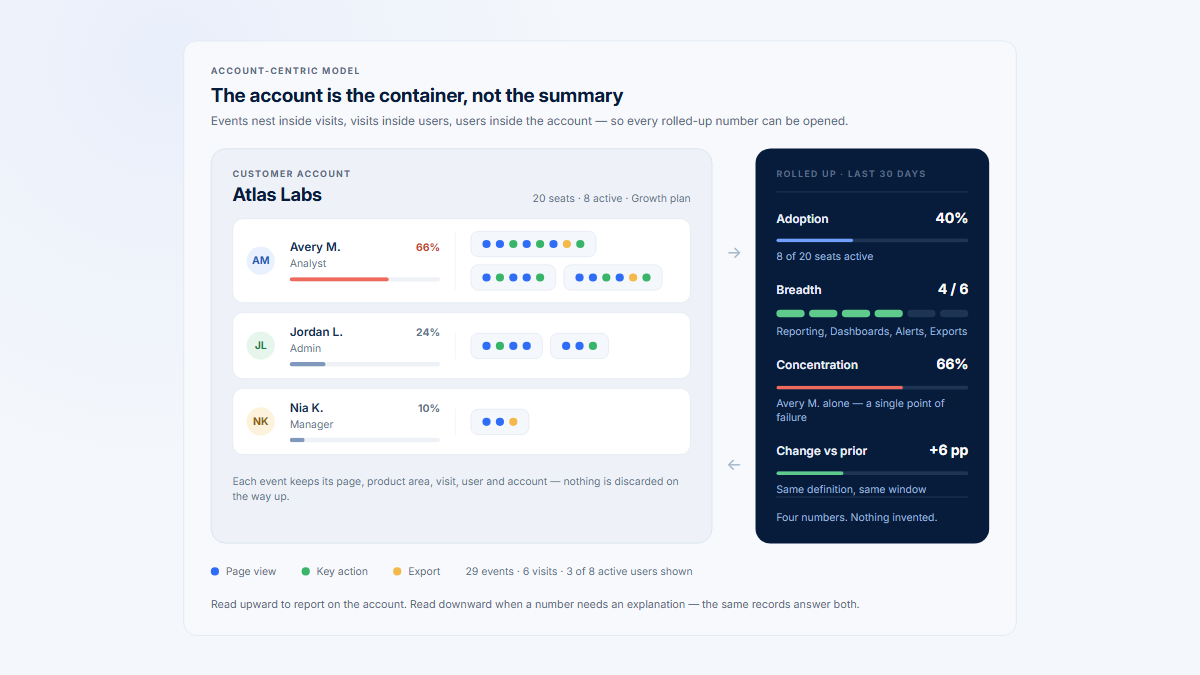
For B2B SaaS, a third layer matters: the customer company. Several people may use the same product under one commercial account. A useful account model has to connect company membership, users, workflows, repeated usage, adoption breadth, and sessions. GA4 and Matomo can cover portions of product analytics when carefully instrumented, and Plausible can measure selected product events, but none has a native B2B company-adoption model.
Primary data models
The most important difference is not the dashboard. It is what each system treats as a stable analytical object.
GA4: events first
GA4 represents page views, clicks, purchases, signups, and other interactions as events. Events can carry parameters; users can carry user properties; ecommerce events can carry item arrays. GA4 derives sessions and users from the event stream and supports an optional first-party User-ID supplied by the implementer. See Google’s User-ID guidance.
This model is flexible, but flexibility creates governance work. Two teams can install GA4 and obtain very different usefulness depending on event naming, ecommerce implementation, key-event definitions, campaign tagging, consent behavior, and identity setup.
Matomo: visitors, visits, and actions
Matomo’s reporting model exposes visitors, visits, actions, page views, events, goals, and ecommerce activity. Its Visitor Profile can show an individual recognized visitor’s recorded history, and an application can supply a User ID for authenticated activity.
This is a richer visitor-level model than Plausible’s, but it means the implementation must make explicit decisions about identifiers, cookies, retention, anonymization, consent, and access.
Plausible: aggregate trends without a persistent profile
Plausible documents an aggregate-first architecture. It does not set cookies, use local storage, or create a persistent identifier. It generates a daily identifier from a rotating salt, website domain, IP address, and User-Agent; the salt is rotated and deleted every 24 hours, while raw IP addresses and full User-Agent strings are not stored. A person returning on another day or device cannot be recognized as the same persistent profile by this mechanism. See Plausible’s data policy.
This limitation is also why Plausible can remain simple. It does not need to expose a complicated identity graph, merge controls, profile explorer, or cross-device lifecycle model.
Narrow scope can be an advantage
A founder who needs weekly answers to “How many people arrived, from where, and did they request a demo?” may gain nothing from a larger event and identity model. Conversely, a product team studying whether the same user or account adopts a workflow over several weeks cannot obtain that answer from a deliberately non-persistent daily visitor model. The feature list should follow the decision, not replace it.
Data model and privacy controls
| Data or control | Google Analytics 4 | Matomo | Plausible Analytics |
|---|---|---|---|
| Aggregate visitor model | Yes, with event, user, session, and aggregate reporting | Yes, with aggregate reports plus individual visitor and visit views | Yes; aggregate trends are the central model |
| Persistent identifiers | Client and device identifiers are normally used; identity behavior depends on setup and consent | Visitor identifiers can be persistent; behavior is configurable | No documented persistent visitor identifier |
| Cookies | First-party analytics cookies are normally used | First-party cookies are normally used; cookieless configuration is available | No analytics cookies in the standard documented model |
| User ID | Yes, when supplied by the application | Yes, when supplied by the application | No persistent User-ID model |
| Account ID | No native customer-account entity; a non-personal custom dimension and warehouse model can be constructed | No native customer-account entity; custom dimensions can support a custom model | No native persistent account entity |
| IP handling | For EU, UK, and Swiss traffic, Google documents discard before logging; elsewhere IP may be used transiently for spam detection, coarse location, and routing, with an additional Ads-linked qualification | Masking is configurable and defaults to two bytes; the operator remains responsible for surrounding web-server logs and complete anonymisation choices | IP is used transiently to derive location and a daily identifier, then not stored according to Plausible’s data policy |
| Custom properties | Event parameters, user properties, custom dimensions, and custom metrics | Custom dimensions, event fields, goals, and custom variables depending on configuration | Custom event properties on Business and higher hosted plans |
| URL parameters | The collected page location can contain query data; implementers must prevent personal or sensitive values from entering analytics | URLs and query parameters can be collected unless excluded or normalized | Query parameters are discarded except supported campaign and referral parameters |
| Raw-data access | BigQuery event export, with export limits and reporting-model differences | Direct SQL On-Premise; APIs and a paid Cloud Data Warehouse Connector add-on | Enterprise scheduled raw exports; direct ClickHouse data access in Community Edition; hosted dashboard/API exports are otherwise aggregated |
| Retention | Standard offers 2 or 14 months. Analytics 360 adds 26, 38, and 50 months only for eligible non-user, non-key-event data; user and key-event data remains limited to 2 or 14 months | Cloud Business documents 24 months of raw data and report retention indefinitely; On-Premise retention is operator-configured | Hosted retention varies by plan; Community Edition retention is controlled by the operator |
| Deletion | Data-deletion requests, user deletion, and property controls are available | Log deletion, report deletion, and privacy controls are configurable | Site or account data can be deleted; self-hosted deletion is the operator’s responsibility |
| Data residency | Google-operated architecture; regional collection settings do not turn GA4 into customer-hosted storage | Cloud primary data is documented as Frankfurt, Germany, with backups in Dublin, Ireland; On-Premise location is selected by the operator | Cloud visitor data is documented as remaining on EU-owned infrastructure; Community Edition location is selected by the operator |
| First-party hosting | No customer-hosted GA4 service | Yes with On-Premise | Yes with Community Edition |
| Self-hosting | No | Yes | Yes |
| Infrastructure responsibility | Google operates the service; the customer remains responsible for instrumentation, access, consent, governance, and deletion decisions | Matomo operates Cloud; the customer operates every infrastructure layer On-Premise | Plausible operates Cloud; the customer operates every infrastructure layer in Community Edition |
These are technical and operational distinctions, not legal scores. A cookie-free design, IP masking or anonymization controls, regional hosting, or self-hosting may affect a legal analysis, but none automatically determines whether a particular implementation requires consent or satisfies every applicable law.
Website traffic and acquisition
All three products can answer basic website questions: how many visits or visitors arrived, which pages were viewed, which sources and campaigns generated traffic, which devices and locations were represented, and which landing pages led to a goal or purchase. The difference is how far the analysis can continue.
GA4
GA4 separates user acquisition from traffic acquisition. This allows a team to ask both how a user was first acquired and how a particular session arrived. Default channel groups, campaign parameters, Google Ads links, Search Console links, and custom reporting make GA4 the deepest acquisition system of the three. See Google’s traffic-acquisition documentation.
That depth comes with terminology and configuration overhead. Users, active users, sessions, engaged sessions, key events, and attributed conversions are not interchangeable.
Matomo
Matomo has detailed referrer, campaign, search-engine, website, social-network, direct-entry, transition, and visitor reports. It also provides real-time and individual visit context.
For a team leaving Universal Analytics and wanting a conventional reporting structure, Matomo can feel more familiar than GA4. The dashboard still requires configuration discipline, especially when custom dimensions, ecommerce, goals, premium plugins, and On-Premise operations are involved.
Plausible
Plausible puts visitors, visits, page views, bounce rate, visit duration, top pages, sources, countries, devices, campaigns, goals, and related filters into one main dashboard. It includes automatic channel grouping, campaign analysis, scroll depth, and supported goal and revenue workflows. This is enough for many public sites. It is not a substitute for every report available in GA4 or Matomo—and does not try to be.
Why the totals will disagree
A migration should not assume that all three tools will produce identical visitor or session totals. Differences can result from:
- consent behavior;
- ad and tracker blocking;
- script loading;
- bot filtering;
- session definitions;
- time zones;
- identity rules;
- daily versus persistent visitor estimation;
- excluded internal traffic;
- cross-domain configuration;
- event validation;
- URL normalization.
A discrepancy is not automatically evidence that one system is broken. First compare definitions and collection conditions.
Campaigns and attribution
GA4 is the clear choice when attribution is closely connected to media buying and Google Ads. It supports Google Ads linking, imported key events, advertising audiences, campaign and traffic-source reporting, non-Google cost-data import, and data-driven attribution. Google’s current reporting attribution models are data-driven, paid-and-organic last click, and Google paid channels last click; older rule-based models were retired. See the current GA4 attribution documentation.
Matomo supports campaign parameters, conversion attribution, referrer reporting, and goals in its core product. Multi-Channel Conversion Attribution and Advertising Conversion Export are included in Matomo Cloud and available through premium On-Premise packaging. These capabilities make Matomo much more than a basic traffic counter, although its advertising ecosystem is not equivalent to Google’s.
Plausible reports sources, campaign parameters, channel groups, landing pages, goals, and—on the appropriate plan—revenue attributed to campaigns. This is useful for answering which source or campaign drove a conversion. It is not a persistent multi-touch identity or advertising-audience system.
Marketing and ecommerce comparison
| Capability | Google Analytics 4 | Matomo | Plausible Analytics |
|---|---|---|---|
| Source and medium | Detailed first-user and session source/medium dimensions | Referrer, campaign, website, search, social, and channel reports | Source, referrer, channel, and campaign reporting |
| Campaign parameters | UTM parameters, Google auto-tagging, and campaign dimensions | Native mtm_* campaign parameters plus supported UTM handling | UTM and supported referral/campaign parameters |
| Channel grouping | Default and configurable channel analysis | Channel and referrer reports | Automatic channel grouping |
| Advertising integrations | Native Google Ads linking, audiences, and conversion workflows | Premium Advertising Conversion Export; integrations vary | No comparable advertising-audience activation system |
| Ecommerce events | Detailed recommended ecommerce event and item schema | Core ecommerce tracking | Revenue attached to supported custom events or goals on Business |
| Checkout analysis | Purchase and checkout journey reports; funnel exploration | Ecommerce reports plus premium Funnels | Business funnels can model checkout steps |
| Product reports | Item, product, promotion, cart, checkout, and purchase reporting | Product, SKU, category, order, and revenue reports | Custom event/property and revenue analysis; not a complete product-merchandising report set |
| Attribution | Data-driven, paid-and-organic last click, and Google paid channels last click | Core goal/source attribution; premium multi-channel attribution | Source and campaign attribution, including revenue; no advanced multi-touch model |
| Audience creation | Persistent audiences for reporting and Google activation | Segments and visitor analysis; not equivalent to Google Ads audience activation | Segments, but no persistent cross-day audience identity |
| Conversion import | GA4 key events can participate in Google Ads conversion workflows | Advertising Conversion Export is a premium capability | No native Google Ads conversion-import workflow comparable to GA4 |
| Server-side collection | Measurement Protocol and related Google tooling | HTTP Tracking API and server-side SDK options | Events API |
| Dashboards | Standard reports, collections, explorations, and custom reports | Configurable dashboards, reports, widgets, and custom reports | Intentionally consolidated one-page dashboard |
| Scheduled reports | Up to 50 scheduled standard or custom email reports per property under current documentation | Scheduled email reports and custom alerts | Email and Slack reports on hosted plans |
Ecommerce
GA4 has the strongest ecommerce and advertising combination
GA4’s recommended ecommerce implementation covers product views, list views, selections, promotions, cart actions, checkout steps, purchases, refunds, item-level parameters, and purchase journeys. The value is not only the reports; it is the connection between those events, acquisition data, audiences, Google Ads, and BigQuery. See the official ecommerce schema.
The limitation is implementation quality. A partially implemented ecommerce schema can produce plausible-looking but incomplete reports. Item arrays, currency, value, transaction IDs, refunds, and duplicate-purchase prevention need validation.
Matomo includes core ecommerce reporting
Matomo’s core product supports ecommerce tracking and reports for orders, revenue, products, SKUs, categories, quantities, tax, shipping, and related measures. For deeper checkout-drop-off analysis, use Funnels, which is included in Cloud and premium On-Premise packaging. WooCommerce Analytics is another premium module in On-Premise packaging and is included in Cloud. This makes Matomo credible for ecommerce, especially when On-Premise deployment or replay is important.
Plausible provides focused revenue attribution
Plausible Business can associate revenue and currency with custom events, then report revenue by source, campaign, landing page, page, location, device, or another available dimension. Funnels and user journeys provide additional conversion context. See Plausible revenue tracking.
That is enough for questions such as “Which campaign generated paid orders?” It is not equivalent to GA4’s item, promotion, cart, merchandising, and advertising workflow. For a simple subscription purchase or a small product catalogue, the narrower model may suffice. For merchandising and paid-media optimization at scale, GA4 or a more complete ecommerce stack is usually stronger.
Events and conversions
GA4 events
Everything important in GA4 is represented as an event. Some events are collected automatically, some come from Enhanced Measurement, some follow Google’s recommended schemas, and others are custom. Important events can be marked as key events. That does not automatically create a Google Ads conversion: the accounts must be linked, auto-tagging enabled, and a separate Ads conversion created or imported through the appropriate workflow. Conversions created through Analytics default to secondary in Google Ads unless the advertiser changes that setting.
GA4 currently documents no limit on distinctly named web events, but event names, event parameters, user properties, ecommerce item parameters, and other collection or configuration objects have limits. Standard properties can mark up to 30 key events; Analytics 360 raises that limit to 50. The implementation must be designed rather than treated as an unrestricted event dump. See Google’s event collection limits and configuration limits.
Matomo events and goals
Matomo can collect event category, action, name, and numeric value, then use events or other conditions in goal reporting. Ecommerce conversions are also part of the core product. Its event model is more conventional than GA4’s all-event architecture because page views, visits, goals, and events remain visibly distinct concepts in reporting.
Plausible goals and custom events
Plausible can create page-based goals and receive custom events. Business plans add custom properties, which make events more useful for analysis. Events count toward the subscription’s measured monthly usage along with page views. For a public website, events such as Signup, Demo Request, Download, and Purchase may be enough. Sending every UI interaction into Plausible would work against its focused design.
Funnels, retention, and user journeys
Funnels answer whether a sequence is completed. Retention asks whether the same analytical subject returns or repeats behavior. Those are not the same question.
GA4
GA4 supports funnel explorations, path explorations, cohort exploration, user lifetime reporting, and user-stickiness measures. With an implemented User-ID, authenticated activity can be associated with an application-provided identifier. GA4 remains user-centric rather than customer-company-centric. A B2B account with ten users is not a native first-class object.
Matomo
Matomo offers Users Flow, Funnels, Cohorts, Visitor Profiles, segments, and transitions. These are included in Cloud or available through relevant On-Premise premium packaging. Matomo can investigate more detailed visitor journeys than Plausible. It still does not automatically calculate product adoption across a multi-user customer account.
Plausible
Plausible Business offers funnels for predefined step sequences and user journeys for paths around a conversion. These features are useful inside the current visit and aggregate analytical model. Plausible cannot provide conventional persistent-user retention cohorts when its identity design intentionally prevents recognizing the same person across days.
Identified users and company accounts
GA4 can identify a signed-in user
An application can provide a User-ID that does not contain prohibited personal data. GA4 can then use that identifier in identity and user-exploration reporting. A team can also send a non-personal account identifier as a custom dimension and model customer companies in BigQuery. That is a custom warehouse solution, not a native account-adoption product.
Matomo can identify a signed-in user
Matomo supports an application-supplied User ID and Visitor Profile. An operator can add a company identifier as a custom dimension and build custom reports or warehouse models. The organization must still define company membership, account activity, adoption breadth, user distribution, and account-level lifecycle logic.
Plausible does not create persistent user profiles
Plausible custom events and properties can carry contextual values, but its standard identity model does not create a persistent person who can be followed across days or devices. A property named company_id would not transform Plausible into a company-adoption system.
Account analytics requires more than an account field
A useful B2B account model generally needs to answer:
- Which users belong to each customer company?
- Which product areas did the company adopt?
- How many users adopted each workflow?
- Is activity broad or dependent on one user?
- Is usage increasing relative to the company’s own baseline?
- Which individual sessions explain a change?
- Is the company still onboarding, broadly adopted, softening, or inactive?
None of the three compared products provides that complete model automatically.
Session replay and heatmaps
Matomo is the only product in this comparison with native heatmaps and session recording. In Matomo Cloud, Heatmaps & Session Recording is included, subject to the plan’s allowances. In Matomo On-Premise, it is a premium capability or part of qualifying bundles. The individually listed entry price was approximately €219 per year at the verified snapshot, but Matomo also offers changing bundle structures. Consult the current Heatmaps & Session Recording listing.
GA4 does not include native session replay or heatmaps. Plausible does not include them either. A team choosing GA4 or Plausible must use a separate replay product when visual session evidence is required.
Replay expands the privacy and security surface. The team must decide which pages may be recorded, which fields and selectors must be masked, whether authenticated or sensitive areas should be excluded, who may access recordings, how long they are retained, how deletion requests apply, and whether consent or another legal basis is required. Replay is both an analytical capability and a governance responsibility.
Data export and APIs
GA4
The GA4 Data API returns processed reporting data. BigQuery export contains raw, unsampled client event data, but it is not a replica of modeled GA4 reporting: behavioral modeling and some data joined at query time are not exported, and the export uses device-based identity. Google currently documents a maximum of one million events per day for Standard daily batch export and 20 billion for Analytics 360. Streaming has no event-volume limit, but it is best effort, can contain gaps, and excludes new-user and new-session traffic-source data. BigQuery storage, streaming, and query costs are separate. See the BigQuery export limits and qualifications.
BigQuery is a major advantage when the organization has analysts or data engineers who can model the export. It is not a no-cost finished dashboard.
Matomo
Matomo provides an HTTP Analytics API and HTTP Tracking API. On-Premise operators can access the underlying SQL data. Matomo Cloud does not provide direct SQL access; its paid Data Warehouse Connector was listed from €5 per month at the verified snapshot, with export paths and final cost depending on the current plan. Direct On-Premise access gives flexibility, but also responsibility for schema changes, archive processing, database performance, and safe read patterns.
Plausible
Plausible provides an Events API for collection, a Stats API on qualifying hosted plans, CSV export, a Looker Studio connector, and scheduled raw event exports for Enterprise. Plausible Community Edition operators can access their ClickHouse data directly. Raw access does not make the underlying model more persistent.
Cookies, consent, and privacy controls
GA4
GA4 normally uses first-party cookies, including the _ga cookie, to distinguish clients. Consent Mode can change tag behavior based on consent signals and may support modeled reporting when configured conditions are met. It does not transfer the legal decision to Google; the site operator still determines and implements appropriate consent and disclosure behavior.
For traffic collected on or after June 15, 2026, Google documents that IP addresses from the EU, United Kingdom, and Switzerland are discarded before logging. Elsewhere, an IP address may be used transiently for spam detection, coarse location, and routing before it is discarded. Google also documents encrypted IP handling for certain Ads-linked traffic-quality checks. That describes Google’s architecture; it is not a universal conclusion about the legality of every GA4 deployment.
Matomo
Matomo normally uses first-party cookies but can be configured for cookieless tracking. Cookieless operation degrades unique-versus-returning visitor analysis and cross-visit attribution; Matomo documents that Cohorts and Multi-Channel Attribution can be empty without persistent recognition. It also provides IP masking, consent APIs, deletion controls, retention settings, and On-Premise operation. IP masking defaults to two bytes, but masking a value is not the same claim as fully anonymising the complete dataset. “Matomo can be configured without cookies” is accurate. “Matomo never requires consent” is not. The applicable result depends on configuration and jurisdiction.
Plausible
Plausible documents that it uses no cookies, local storage, or persistent identifiers. Its daily identifier cannot link a person across days, sites, or devices. It discards query parameters except supported campaign parameters and does not store raw IP addresses. Its architecture can materially simplify an organization’s consent analysis compared with persistent cookie-based tracking, but the organization must still assess its complete implementation, other scripts, local law, contracts, disclosures, and custom event data.
What self-hosting changes
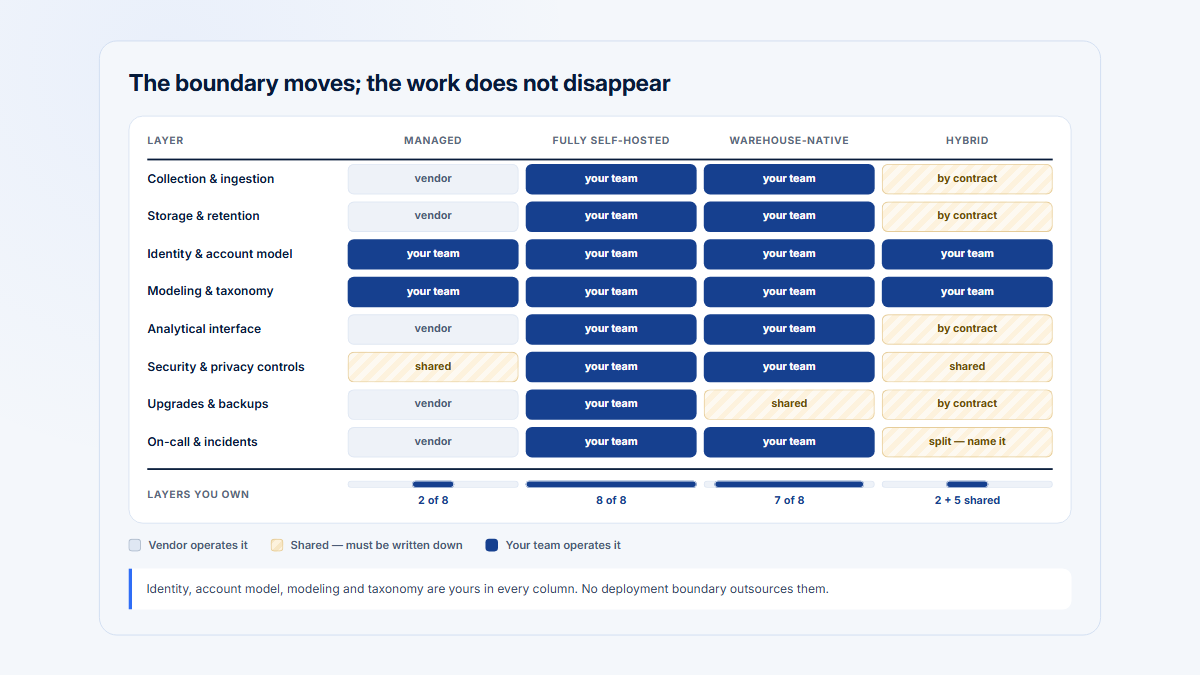
Self-hosting can change who operates the infrastructure, where data is stored, who has database access, how retention and deletion are configured, which subprocessors are involved, and which security controls are available. It does not eliminate privacy, security, consent, transparency, access-control, retention, or incident-response responsibilities.
Hosted versus self-hosted operation
GA4 is a managed Google service. A customer can change collection and property settings, but cannot install the GA4 service on its own database or infrastructure.
Matomo provides the broadest deployment choice in this comparison:
- Matomo Cloud: Matomo operates hosting, maintenance, updates, security monitoring, backups, and scaling. At the verified 50,000-hit tier, published allowances included 30 websites, 30 team members, 100 segments, 150 goals, and 30 custom dimensions, with 24 months of raw-data retention and reports retained indefinitely. Primary data was documented in Frankfurt and backups in Dublin.
- Matomo On-Premise Community: the organization installs the GPLv3-or-later core and operates the complete stack.
- Matomo On-Premise premium packaging: the organization still operates the stack while paying for premium plugins, support, or bundles.
Matomo’s core and tracker are generally licensed under GPLv3 or later, while premium plugins are distributed under the Matomo/InnoCraft EULA.
Plausible also provides two operating models:
- Plausible Cloud: continuously updated managed infrastructure, advanced bot filtering, backups, security, support, and hosted-plan features.
- Plausible Community Edition: an AGPLv3-or-later long-term release that the organization installs and operates; Plausible documents a twice-yearly long-term release cadence.
Plausible documents that Community Edition excludes hosted premium capabilities such as marketing funnels, user journeys, ecommerce revenue goals, SSO, and the Sites API. Its release cadence and bot filtering also differ from Cloud. The browser tracker is separately MIT-licensed.
Open source does not mean zero total cost
The license price can be zero while operating cost includes compute, storage, database administration, proxy infrastructure, backups, disaster recovery, monitoring, patches, upgrades, capacity planning, developer time, privacy configuration, incident response, support, and premium modules. The controlling question is not “Is the source available for free?” It is “Who performs and pays for the work required to operate it reliably?”
Deployment and operational responsibility
| Responsibility | GA4 hosted | Matomo Cloud | Matomo On-Premise | Plausible Cloud | Plausible Community Edition |
|---|---|---|---|---|---|
| Initial service installation | Matomo | Customer | Plausible | Customer | |
| Tracking configuration | Customer or implementation partner | Customer or partner | Customer or partner | Customer or partner | Customer or partner |
| Event and goal design | Customer | Customer | Customer | Customer | Customer |
| Hosting | Matomo | Customer | Plausible | Customer | |
| Database operation | Matomo | Customer | Plausible | Customer | |
| Backups | Google service operation | Matomo documents daily backups | Customer | Plausible | Customer |
| Security patches | Matomo | Customer | Plausible | Customer | |
| Scaling | Matomo | Customer | Plausible | Customer | |
| Consent configuration | Customer | Customer | Customer | Customer | Customer |
| Data-deletion policy | Customer decides and initiates; Google operates service controls | Customer decides; Matomo operates hosted controls | Customer decides and operates deletion | Customer decides; Plausible operates hosted controls | Customer decides and operates deletion |
| Product upgrades | Matomo | Customer | Plausible | Customer | |
| Monitoring | Matomo | Customer | Plausible | Customer | |
| Support | Google documentation/support tier | Included by plan | Community or purchased support | Included by plan | Community support |
| Data export setup | Customer | Customer, with Matomo service support where applicable | Customer | Customer | Customer |
| Infrastructure incident response | Google for service infrastructure | Matomo for service infrastructure | Customer | Plausible for service infrastructure | Customer |
| Legal and governance review | Customer | Customer | Customer | Customer | Customer |
Implementation effort
Plausible Cloud is the easiest default implementation
A basic Plausible installation requires adding the site, loading its script, validating traffic, and defining the few goals or custom events that matter. Complexity rises with custom properties, ecommerce events, funnels, server-side events, proxies, multiple sites, or governance rules, but the reporting model remains comparatively small.
GA4 is easy to start and difficult to finish well
A page-view-only GA4 tag is straightforward. A useful marketing implementation may require:
- Google Tag Manager governance;
- campaign standards;
- Enhanced Measurement review;
- recommended events and custom parameters;
- key-event definitions and separate Google Ads conversion configuration;
- ecommerce arrays;
- cross-domain measurement;
- User-ID;
- consent behavior;
- internal-traffic exclusion;
- Google Ads linking;
- BigQuery export;
- report customization and data-quality monitoring.
The gap between “installed” and “decision-ready” is substantial. Marking an event as a GA4 key event does not automatically make it a Google Ads conversion; the Ads conversion must be created or imported through the appropriate linked workflow.
Matomo Cloud has medium implementation complexity
Matomo Cloud removes infrastructure work, but the team still has to decide how to configure goals, events, ecommerce, campaigns, visitor identifiers, privacy settings, retention, replay, heatmaps, funnels, segments, and access.
Matomo On-Premise has the highest operational requirement
In addition to analytics configuration, On-Premise requires a reliable production service: database sizing, archive processing, cron jobs, backups, monitoring, upgrades, plugin compatibility, PHP and database maintenance, security hardening, and capacity planning.
Plausible Community Edition is simple analytically but not operationally free
Community Edition retains Plausible’s smaller analytical scope, but the operator becomes responsible for PostgreSQL, ClickHouse, application services, release management, backups, monitoring, security, and capacity.
Pricing and total cost
Prices below are a verified snapshot, not a permanent promise. Recheck the linked official pricing before procurement.
| Pricing criterion | GA4 Standard | Analytics 360 | Matomo Cloud Business | Matomo On-Premise | Plausible Starter | Plausible Business | Plausible Community Edition |
|---|---|---|---|---|---|---|---|
| Free hosted option | Yes | No | Trial only | Not hosted | Trial only | Trial only | Not hosted |
| Paid hosted entry | $0 | Contract-priced; base fee covers the first 25 million monthly billable events, followed by volume tiers | Approximately USD $26/month at 50,000 hits on the official pricing-for-AI reference; locale UI showed €22/month or €220/year | Not applicable | $9/month annual-billing equivalent at 10,000 monthly pageviews | $19/month annual-billing equivalent at 10,000 monthly pageviews | Not applicable |
| Billing unit | No published traffic-based subscription charge for Standard | Contract base fee and volume tiers based on monthly billable events | Monthly hits | License, support, modules, bundles, and operator infrastructure | Total monthly pageviews and custom events across included sites | Total monthly pageviews and custom events across included sites | Operator infrastructure |
| Traffic allowance | No paid pageview tier; product and export limits still apply | First 25 million monthly billable events covered by the base fee; higher volume uses contractual tiers | 50,000 hits at the entry tier | Community software documents unlimited hits, subject to operator capacity | 10,000 monthly pageviews/events at the displayed tier | 10,000 monthly pageviews/events at the displayed tier | No vendor traffic charge; operator capacity applies |
| Event allowance | Collection and configuration limits apply; BigQuery daily batch export has a Standard limit | Higher contractual limits; billable-event volume affects price | Events consume hits | Operator capacity | Custom events consume subscription volume | Custom events consume subscription volume | Operator capacity |
| Detailed-data retention | 2 or 14 months for eligible user and event data | User and key-event data remains limited to 2 or 14 months; 26, 38, and 50 months apply only to eligible non-user, non-key-event data | 24 months raw data on the verified Business plan; reports retained indefinitely | Operator-configured | 3 years | 5 years | Operator-configured |
| Premium plugins | Not applicable | Not applicable | Matomo capabilities are included according to plan allowances | Core is free; premium plugins or bundles cost extra | Not applicable | Not applicable | Cloud premium features are excluded |
| Replay and heatmaps | Not included | Not included | Included subject to plan allowances | Heatmaps & Session Recording €219/year or a qualifying bundle | Not included | Not included | Not included |
| Ecommerce packaging | Included in Standard feature set | Included | Core ecommerce included | Core ecommerce included; WooCommerce and advanced modules may cost extra | Goals/events but not hosted ecommerce-revenue package | Ecommerce revenue attribution included | Ecommerce revenue goals excluded from CE |
| Enterprise model | Not applicable | Custom contract | Custom Enterprise plan | Paid bundles, support, or custom arrangements | Not applicable | Upgrade path to Enterprise | Self-operated |
| Self-hosting license | None | None | None | Core and tracker GPLv3 or later; premium modules use a commercial EULA | None | None | AGPLv3 or later; tracker MIT |
| Self-hosting infrastructure responsibility | Not applicable | Not applicable | Not applicable | Entirely the operator’s responsibility | Not applicable | Not applicable | Entirely the operator’s responsibility |
| Official source | Google Analytics Help | Google Analytics 360 documentation and contract | Matomo pricing | Matomo pricing and licensing | Plausible pricing | Plausible pricing | Plausible self-hosting page and GitHub |
| Research verification date | August 6, 2026 | August 6, 2026 | August 6, 2026 | August 6, 2026 | August 6, 2026 | August 6, 2026 | August 6, 2026 |
Matomo Cloud entry-tier allowances
The verified 50,000-hit Cloud tier was approximately USD $26 per month in Matomo’s official machine-readable reference, while the locale pricing interface showed €22 per month or €220 per year. Its published allowances included 30 websites, 30 team members, 100 segments, 150 goals, and 30 custom dimensions, plus 1,500 heatmap pageviews and 150 session recordings per month. Raw data was retained for 24 months and processed reports indefinitely. These are packaging limits, not permanent product guarantees, and should be rechecked for the buyer’s locale.
Matomo On-Premise premium packaging needs careful reading
Matomo’s free Community software includes core analytics such as events, goals, ecommerce, campaigns, dashboards, segments, Visitor Profile, APIs, and scheduled reports. Advanced capabilities may be purchased individually or through On-Premise bundles. Current annual individual-plugin prices verified on August 6, 2026 include:
- Heatmaps & Session Recording: €219/year;
- A/B Testing: €219/year;
- Funnels: €199/year;
- Custom Reports: €219/year;
- Form Analytics: €149/year;
- Multi-Channel Conversion Attribution: €89/year;
- Cohorts: €89/year;
- Advertising Conversion Export: €169/year;
- SAML: €2,219/year.
The current pricing page also presents On-Premise bundles with user and hit limits. At the verified snapshot, Team was €275 per month or €2,750 per year, Business €1,450 per month or €14,500 per year, and Enterprise €3,400 per month or €34,000 per year; a VIP option was also presented. Do not treat the individual-plugin list as the only purchasing model. Reconcile live bundle and individual-plugin options before procurement. See the live Matomo pricing page; the separate USD reference was used only for the Cloud tier because its standalone-plugin figures were stale when checked.
- Team: 4 users and 5 million monthly hits; includes Funnels, Heatmaps & Session Recording, WooCommerce Analytics, Custom Reports, Users Flow, Media Analytics, Form Analytics, Search Engine Keywords Performance, and SEO Web Vitals.
- Business: 20 users and 30 million monthly hits; adds Cohorts, Multi-Channel Conversion Attribution, Advertising Conversion Export, Activity Log, Roll-Up Reporting, and White Label.
- Enterprise: 50 users and 100 million monthly hits; adds A/B Testing, SAML/LDAP SSO, and Crash Analytics.
- VIP: custom pricing for 50 or more users and more than 100 million monthly hits.
Plausible hosted plan snapshot
At 10,000 monthly pageviews, Plausible’s annual-billing-equivalent selector displayed Starter at $9 per month, Growth at $14, and Business at $19, with a 30-day trial and no permanent free hosted plan. Usage combines pageviews and custom events across the account’s included sites; a pageview goal does not consume a second event.
- Starter: 1 site and 3 years of retention.
- Growth: up to 3 sites and 3 team members, with the displayed plan retaining 3 years of data.
- Business: up to 10 sites and 10 team members, 5 years of retention, custom properties, a Stats API allowance of 600 requests per hour, Looker Studio, ecommerce revenue, funnels, user journeys, and Consolidated View.
- Enterprise: custom pricing for 10 or more sites, 10 or more team members, more than 600 Stats API requests per hour, and 5 or more years of retention, with Sites API access, SSO, a managed proxy, scheduled raw exports, and priority support.
GA4’s free price is not its total cost
Potential costs include analytics implementation, tag and consent management, data governance, specialist training, BigQuery storage and queries, transformations, dashboard development, quality assurance, and marketing operations.
Matomo’s zero license price is not its total cost
Potential costs include infrastructure, storage, backups, monitoring, upgrades, security work, premium plugins, support, bundles, and engineering and operations time.
Plausible’s smaller feature set can reduce operating cost
Plausible may reduce training, report administration, event-taxonomy sprawl, dashboard maintenance, identity governance, and routine reporting time. The trade-off is that a second product may be required for replay, retention, product analytics, advanced attribution, or authenticated account analysis.
The main total-cost drivers
Across all three products, model website traffic, event volume, sites, team members, retention, premium modules, warehouse usage, infrastructure, maintenance, consent and governance work, advertising integrations, analyst and developer time, and any additional products needed to cover missing capabilities.
Customer ratings and review themes
Use G2 as the single shared rating source. Do not average ratings from unrelated review sites.
Google Analytics
4.5/5 · approximately 6,851 reviews
G2 · verified
The sample is much larger than the Matomo and Plausible samples. Current review summaries repeatedly praise reporting depth, traffic and behavior insight, integrations, and the free product. Recurring criticisms include the GA4 learning curve, confusing navigation, report complexity, and difficulty turning a large feature set into a clear routine.
Important qualification
G2’s listing is named “Google Analytics” and may include experience with the product family rather than only the current GA4 interface. Do not describe all 6,851 reviews as GA4-only.
Matomo
4.2/5 · approximately 96 reviews
G2 · verified
Recurring positive themes include data control, self-hosting, customization, detailed reports, and operating outside Google’s ecosystem. Recurring trade-offs include setup and maintenance complexity, a larger interface, and cost or packaging considerations for Cloud and premium modules. The sample is meaningful but far smaller than Google Analytics’ sample, so small rating differences are not decisive.
Plausible Analytics
Low review volume
4.5/5 · approximately 4 reviews
G2 · verified
The available reviews praise its clean interface, easy setup, and focused reporting. Four reviews are not enough to establish a reliable recurring market-wide pattern or support a statistical comparison with thousands of Google Analytics reviews.
What the ratings do—and do not—tell you
Ratings reflect reviewer mix, expectations, review age, deployment model, company size, and the questions users hoped to answer. A simple tool may receive praise because it does less; a broad platform may receive lower ease-of-use feedback because it supports more workflows. Choose the required data model and operating model first, with ratings as context.
Current videos worth watching
The two click-to-load videos embedded earlier were selected as supplementary visual context. Official product documentation and pricing take precedence over both videos.
Matomo versus Plausible overview
- Title: Plausible vs Matomo Comparison Review: Privacy, Features & Pricing (2026)
- Channel: Daxon Creed
- Date and duration: February 6, 2026 · 3 minutes 44 seconds
- Classification: Independent comparison
- Disclosure: No sponsorship or affiliate links were disclosed in the reviewed description; official documentation controls factual claims.
GA4 interface walkthrough
- Title: (2026) Google Analytics 4 Tutorial for Beginners: How to Use GA4 & Important Data to Look at
- Channel: Mariah Magazine
- Date and duration: January 21, 2026 · 18 minutes 45 seconds
- Classification: Independent product walkthrough
- Disclosure: The creator promotes educational and SEO resources, and the description includes affiliate links. Official Google documentation controls factual claims.
Migration from GA4
A migration should begin with definitions, not a tracking-script swap.
1. Inventory the existing measurement system
Document properties and streams, key events, custom events and parameters, ecommerce events, audiences, Google Ads links, campaign conventions, cross-domain rules, User-ID, BigQuery exports, scheduled reports, dashboards, consent behavior, retention, and internal-traffic filters.
2. Separate historical import from future collection
Both Matomo and Plausible provide GA import paths, but an imported history does not mean the new product will reproduce GA4’s collection model forever. Imported reports and newly collected data can differ because the products define visitors, sessions, channels, events, and identity differently.
3. Map business questions before fields
Do not mechanically convert every GA4 event. Ask which acquisition decisions remain, which campaign dimensions and conversions affect budget, which ecommerce reports are reviewed, whether user retention, replay, or account-level SaaS adoption is required. Plausible may need far fewer events; Matomo may need a different visit and goal structure.
4. Run parallel collection
Run the old and new systems together for a defined validation period. Compare page coverage, attribution, campaign parameters, conversions, ecommerce totals, bot and internal traffic, consent behavior, geographic distribution, landing pages, and cross-domain journeys. Expect differences and investigate definitions before forcing parity.
5. Rebuild advertising workflows explicitly
Replacing GA4 with Matomo or Plausible does not automatically reproduce Google Ads audiences, GA4 conversion imports, remarketing lists, data-driven attribution, Ads optimization inputs, or linked cost reports. Matomo’s Advertising Conversion Export can cover selected workflows. Plausible can report campaign conversions and revenue but does not provide an equivalent advertising-audience system.
6. Preserve exports
Before changing or deleting properties, preserve BigQuery data, report exports, campaign definitions, event taxonomies, ecommerce schemas, audience definitions, dashboard logic, annotations, and implementation documentation.
7. Change the operating routine
A migration is not complete until the team knows which dashboard and metric definitions to use, who owns campaign tagging and conversion validation, who handles deletion and retention, who maintains self-hosted infrastructure, and when another product is needed for product or account analytics.
Illustrative B2B SaaS scenario
The following company and numbers are fictional. They illustrate analytical trade-offs and are not customer evidence.
The company
LedgerLane is a fictional B2B SaaS company selling financial-reporting workflow software. It has a public marketing website, paid Google and LinkedIn campaigns, content, demo and signup forms, a 14-day trial, an authenticated application, three to twenty users inside each customer company, a Reporting workflow important to retention, subscription upgrades, and a need to connect acquisition to eventual company-level adoption.
Paid or organic campaign
→ Landing page and content
→ Signup
→ Trial
→ First Reporting workflow
→ Repeated Reporting use
→ More users inside the company adopt Reporting
→ Paid subscription or expansionHow GA4 handles the scenario
Campaign traffic and landing pages: Strong. GA4 can report first-user and session acquisition, campaigns, channels, landing pages, engagement, key events, and Google Ads performance.
Signup and trial conversion: Strong when events such as sign_up, trial_started, or trial_activated are implemented, validated, and used in explorations. Marking a key event does not automatically create a Google Ads conversion.
Custom events and identified users: Strong with a governed taxonomy and User-ID after authentication.
Company membership and account adoption: Not native. LedgerLane can send a non-personal account_id custom dimension and model membership in BigQuery, but analysts must define meaningful Reporting events, deduplicate companies and users, model active accounts, calculate penetration, and build warehouse reports.
Repeated product use: Cohorts, user lifetime, paths, and BigQuery support user-level analysis. Company-level repeated use requires custom modeling.
Ecommerce or subscription events: GA4 can record purchases and subscriptions where the business maps them into an appropriate event model. Subscription lifecycle analytics may still require billing or warehouse data.
Raw-data export: Strong through BigQuery. The export is raw and unsampled, not the same as modeled GA4 reporting. Daily Standard export limits and separate warehouse costs apply; streaming export can have gaps and excludes some new-user and new-session traffic-source data.
Self-hosting and replay: Neither is available natively.
Practical result: GA4 is excellent for public acquisition and can extend into the authenticated product. LedgerLane can build an account model in BigQuery, but GA4 does not supply it as a ready product experience.
How Matomo handles the scenario
Campaign traffic and landing pages: Strong through campaign, referrer, landing-page, transition, goal, and visit reporting.
Signup, trial, and custom events: Strong through goals or events and Funnels where included.
Identified users: Supported through User ID and Visitor Profile.
Company membership and account adoption: Not native. A company identifier can be added as a custom dimension and used in custom reporting, APIs, or a separate warehouse. LedgerLane must define companies, membership, active users, workflow adoption, penetration, repeated usage, and account-health logic.
Repeated product use: Visitor Profiles, cohorts, segments, goals, and custom reports support user-level analysis. Company-level adoption remains custom.
Ecommerce and subscription events: Core ecommerce supports orders and revenue. Subscription lifecycle states may require custom events or billing data.
Raw-data export: Strongest in On-Premise through database access; APIs and Cloud warehouse options are also available.
Self-hosting and replay: Both are available, with replay included in Cloud or sold through premium On-Premise packaging.
Practical result: Matomo covers the broadest single-tool combination of web analytics and replay here. It still does not automatically turn multiple identified users into a first-class customer-company adoption model.
How Plausible handles the scenario
Campaign traffic and landing pages: Strong for focused public-site reporting. LedgerLane can see sources, UTMs, channels, landing pages, content, and conversions.
Signup and trial conversion: Straightforward as page goals or custom events and, on Business, funnel steps.
Custom events: Supported.
Identified users, company membership, and account adoption: Not supported as persistent models. A custom property can label an event, but Plausible will not build a persistent multi-user company or calculate adoption across weeks.
Repeated product use: Aggregate event trends are available. Persistent individual or company retention is outside the model.
Ecommerce or subscription events: Business supports revenue events and attribution. That can show which campaign drove subscription revenue but not the complete lifecycle of an identified account.
Raw-data export: Enterprise provides scheduled raw exports; Community Edition provides direct database control. The underlying data still follows Plausible’s non-persistent identity model.
Self-hosting and replay: Community Edition can be self-hosted but excludes hosted premium funnels, journeys, and ecommerce revenue goals. Replay is unavailable.
Practical result: Plausible is a strong public acquisition layer when LedgerLane values simplicity. It should not be stretched into the authenticated account-adoption layer.
Scenario comparison
| LedgerLane requirement | GA4 | Matomo | Plausible |
|---|---|---|---|
| Paid campaign acquisition | Best fit, especially for Google Ads | Strong reporting; less integrated with ad activation | Clear campaign reporting, narrower activation |
| Landing-page performance | Strong | Strong | Strong and simple |
| Signup conversion | Strong | Strong | Strong |
| Trial funnel | Strong | Strong with Funnels packaging | Business funnels |
| Custom product events | Strong | Strong | Supported, but use a focused set |
| Persistent identified users | Yes with User-ID | Yes with User ID | No |
| Native customer companies | No | No | No |
| Company membership | Custom dimension and warehouse model | Custom dimension/API/warehouse model | Not a persistent model |
| Account adoption | Custom warehouse work | Custom analytics work | Outside intended model |
| Repeated product use | User-level analysis and custom account model | Visitor/user analysis and custom account model | Aggregate trends, not persistent retention |
| Subscription revenue | Events and ecommerce model | Ecommerce and custom events | Business revenue goals |
| Raw export | BigQuery | API, direct database, or connector | Enterprise export or CE database |
| Self-hosting | No | Yes | Yes |
| Replay | Separate product required | Native capability | Separate product required |
Why none of the three is automatically complete
The missing object is the customer account. LedgerLane needs to know that five people belong to Acme Manufacturing, that three used Reporting this month, that usage expanded from one user to three, and that two sessions explain the change.
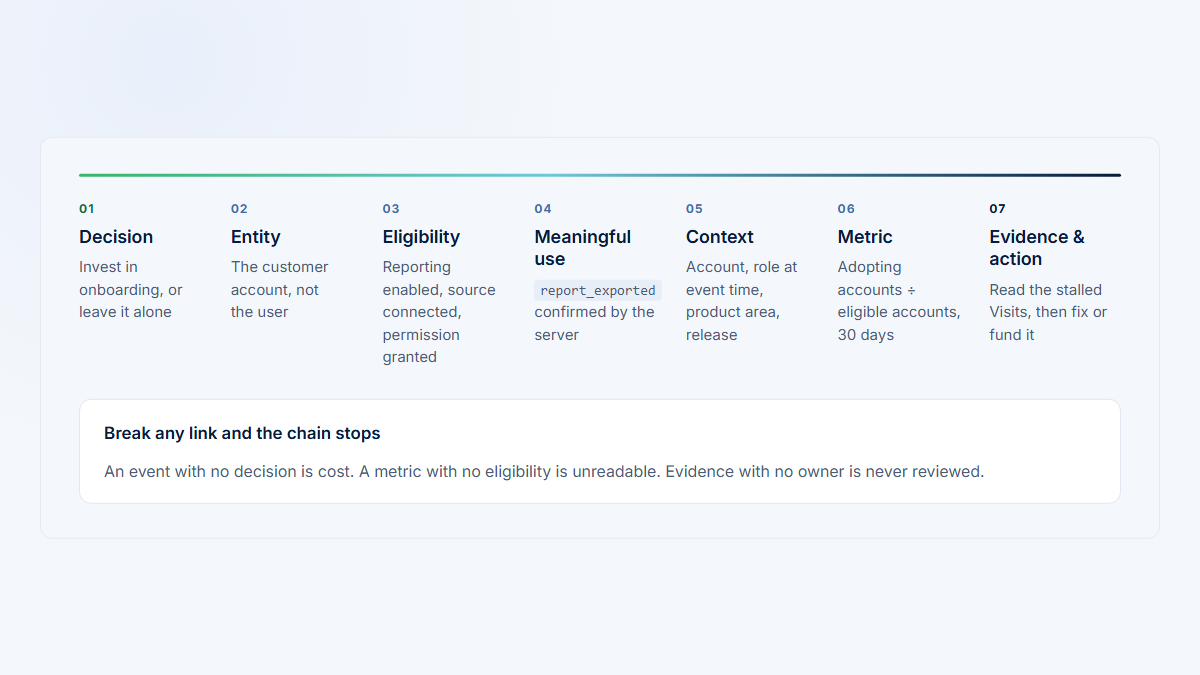
A visitor or User-ID is not enough. An account_id event property is not enough. A complete solution also needs membership, deduplication, company-level active periods, adoption definitions, user distribution, product structure, repeated-use logic, company segments, account context, and investigation paths into users and sessions.
GA4 and Matomo can supply raw material for a custom version of that model. Plausible intentionally does not retain the identity required for it. A dedicated B2B product or account analytics layer can shorten the distance from collection to an operational answer.
Using separate marketing and product tools
Using two analytics products is often more coherent than forcing one product to answer incompatible questions.
Public acquisition analytics
Use GA4, Matomo, or Plausible for traffic, sources, campaigns, landing pages, content, public-site conversions, ecommerce acquisition, and advertising workflows.
Authenticated product analytics
Use a product or account analytics tool for identified users, product areas, feature or workflow adoption, funnels after signup, retention, customer companies, adoption breadth, champion concentration, account-health signals, and session evidence.
The connection point is usually a stable, non-personal acquisition key or warehouse model linking a signup, user, or customer company to acquisition context. This architecture creates two collection paths, identity and consent coordination, more governance, cost, and reconciliation—but keeps each tool aligned with the questions it was built to answer.
Decision by scenario
| Scenario | Recommended starting point | Why | Important qualification |
|---|---|---|---|
| Small company website | Plausible | The focused dashboard, goals, campaigns, and simple pricing are often sufficient | Choose Matomo when deeper visitor reports, replay, or deployment control is required |
| Content publisher | Plausible for essential content and source reporting; Matomo for deeper analysis | Both support pages and acquisition at different levels of depth | Confirm the need for subscriber journeys, paywalls, replay, and custom reporting |
| Ecommerce store | GA4 when Google Ads and merchandising are central; Matomo when control and replay are central | GA4 has the strongest ecommerce-advertising combination; Matomo has broad ecommerce plus replay | Plausible Business can cover lightweight revenue attribution but not every merchandising workflow |
| Marketing team using Google Ads | GA4 | Native linking, audiences, conversion workflows, and attribution | Consent, event quality, Ads configuration, and conversion creation still require ownership |
| Public B2B SaaS website | GA4 for paid growth; Plausible for simplicity; Matomo for control and depth | The right choice depends on acquisition complexity | Add a separate post-signup product/account layer when authenticated adoption matters |
| Authenticated B2B SaaS product | Another product or account analytics layer | The customer company and multi-user adoption are the central objects | GA4 or Matomo may remain for marketing and selected events |
| Government or regulated organization | Evaluate Matomo, especially On-Premise | Deployment, storage, retention, and access can be controlled | Self-hosting is not a compliance guarantee; security, legal, and operational review remains necessary |
| Team requiring On-Premise deployment | Matomo or Plausible CE | Both can be self-hosted | Matomo is broader; Plausible CE is narrower and excludes several Cloud premium features |
| Agency managing many websites | Matomo for broad configurable reporting; Plausible Growth/Business for simple client dashboards | Both have multi-site use cases with different complexity | Verify live site, member, white-label, and traffic allowances |
| Founder wanting one simple dashboard | Plausible | It minimizes navigation and reporting overhead | Use GA4 when Ads or detailed ecommerce makes the extra complexity worthwhile |
| Organization requiring session replay | Matomo | It is the only compared product with native replay and heatmaps | Review capture rules, masking, consent, retention, and access |
| Product team needing account-level adoption | A dedicated B2B product/account analytics product | None has a native multi-user customer-company model | Keep one of the three for public-site acquisition if needed |
Final recommendation by organization type
Choose GA4 for a marketing-led organization
GA4 is the strongest default when the organization needs Google Ads, advertising audiences, detailed ecommerce, campaign cost and conversion workflows, web and app reporting, BigQuery, and analysts comfortable with a larger event model. Its free Standard tier is commercially significant, but implementation and governance are not free.
Choose Matomo for a control-led organization
Matomo is strongest when the organization needs broad web analytics, conventional visitor and visit reporting, events and goals, ecommerce, replay and heatmaps, Cloud or On-Premise choice, direct database access, configurable retention and privacy controls, and a path outside Google’s ecosystem. The organization must decide whether Matomo operates the service or whether it can own the infrastructure and premium-module lifecycle.
Choose Plausible for a simplicity-led organization
Plausible is strongest when the organization needs public-site traffic, pages and content, sources and campaigns, a small set of goals, Business funnels or revenue attribution where required, low training overhead, no persistent visitor profile, and a smaller analytics surface by design. Do not reject Plausible because it has fewer features; reject it only when a missing capability is required for an actual decision.
Use another product for account-centric SaaS analytics
When the important object is a customer company containing several users, choose a system that explicitly models that relationship. The public marketing tool can remain in place. The post-signup layer should own product structure, identified users, Companies, account adoption, user distribution, repeated usage, and session evidence.
Where Hymetry fits
Hymetry is not intended to replace GA4, Matomo, or Plausible for public-site traffic, acquisition reporting, campaign attribution, or advertising workflows.
Hymetry is account-centric product intelligence for B2B SaaS. It becomes relevant after signup, when identified Users belong to customer Companies and the team needs to understand how accounts adopt product areas, grouped pages, and workflows. It connects Pages, Companies, Users, and Visits so a team can move from an aggregate signal to affected accounts and people, then inspect session evidence.
GA4, Matomo, or Plausible for the public website
+
Hymetry for authenticated B2B product usageRelevant use cases include grouping dynamic SaaS URLs, measuring which Companies adopted a workflow, examining adoption breadth, seeing whether use is distributed across several Users or concentrated in one person, and reviewing Visits connected to a page, Company, User, or signal.
Hymetry is not a marketing-attribution platform; it does not have an advertising ecosystem comparable with Google; its ecosystem is smaller; it is newer; it does not have a mature independent customer-rating sample; and its focus is intentionally narrower than a general web analytics suite.
Continue with the product analytics tools comparison, the guides to B2B product analytics, product analytics instrumentation, self-hosted product analytics, product usage by company, grouping dynamic SaaS URLs, and page views, Visits, sessions, and engaged time. Product details are available for Hymetry Pages, Companies, Users, and Visits.
Frequently asked questions
Is Matomo better than Google Analytics?
Matomo is better when deployment control, direct data access, On-Premise hosting, visitor-level reports, and native replay matter more than Google Ads integration. GA4 is better when advertising audiences, Google Ads, detailed ecommerce, attribution, app measurement, and BigQuery are central. Neither is universally better.
Is Plausible better than GA4?
Plausible is better for teams that want a small, understandable, aggregate-first website dashboard without persistent visitor profiles. GA4 is better for sophisticated acquisition, advertising, ecommerce, user-level analysis, and raw-event warehouse export. Plausible’s simplicity is an advantage only when its narrower model still answers the required questions.
Is Matomo better than Plausible?
Matomo is better for detailed visitor journeys, ecommerce, funnels, cohorts, replay, heatmaps, custom reports, and broad analytics. Plausible is better when the organization values a smaller interface, simpler operation, and an aggregate-first model more than those capabilities.
Which product is easiest to use?
Plausible is normally the easiest for essential website traffic and conversion reporting. GA4 and Matomo provide more analytical depth but require more terminology, configuration, and reporting knowledge. Matomo On-Premise also requires infrastructure expertise.
Which has the best campaign analytics?
GA4 has the strongest campaign and advertising system, especially for teams using Google Ads. Matomo has substantial campaign and conversion reporting and can export conversions through premium functionality. Plausible provides clear campaign and conversion reporting without the same activation ecosystem.
Which is best for ecommerce?
GA4 is normally strongest for detailed ecommerce event schemas, product reports, checkout journeys, Google Ads, and BigQuery. Matomo is a strong alternative when ecommerce must be combined with deployment control or replay. Plausible Business is suitable for lighter revenue and funnel analysis.
Which products can be self-hosted?
Matomo On-Premise and Plausible Community Edition can be self-hosted. GA4 cannot. Matomo’s core and tracker are GPLv3 or later, with commercial premium modules under a separate EULA. Plausible Community Edition is AGPLv3 or later, with its tracker under the MIT license.
Does self-hosting guarantee privacy or compliance?
No. Self-hosting changes control over infrastructure, storage, access, retention, and subprocessors. The operator still has to configure collection, secure the service, manage consent where required, minimize data, process deletion requests, maintain patches, monitor incidents, and comply with applicable law.
Which products use cookies?
GA4 normally uses first-party analytics cookies. Matomo normally uses first-party cookies but can be configured for cookieless tracking. Plausible’s documented standard model uses no cookies or persistent identifiers. The legal consequence depends on the complete implementation and jurisdiction.
Which products provide raw-data export?
GA4 exports raw, unsampled events to BigQuery; this export is not the same as modeled GA4 reporting, and streaming export has documented gaps. Matomo On-Premise provides direct database access, while Cloud provides APIs and a paid Data Warehouse Connector add-on. Plausible Enterprise provides scheduled raw event exports, and Community Edition operators can access ClickHouse. Formats and identity models differ significantly.
Which supports session replay?
Matomo supports native session recording and heatmaps through Cloud or premium On-Premise packaging. GA4 and Plausible do not provide native replay.
Which is best for an authenticated SaaS application?
GA4 or Matomo can collect authenticated events and user identifiers, but neither has a native multi-user customer-company adoption model. Plausible deliberately avoids persistent identified-user tracking. Use a dedicated product or account analytics system when questions concern feature adoption, retention, customer Companies, user distribution, or account-level workflows.
Can Matomo replace product analytics?
Matomo can cover events, users, funnels, cohorts, visitor journeys, and replay, and may be enough for a relatively simple application. It does not automatically provide a B2B account-adoption model, so a team may still need custom dimensions, warehouse work, or a dedicated product/account analytics tool.
Can Plausible replace product analytics?
Plausible can measure selected product events and funnels, but its non-persistent visitor model is not designed for identified-user retention, lifecycle analysis, or customer-account adoption. It is strongest as public-site analytics or for intentionally aggregate product signals.
Can a company use two analytics tools?
Yes. A common architecture uses GA4, Matomo, or Plausible for the public website and a separate product analytics system after signup. The organization must coordinate identity, consent, governance, and data definitions across the stack.
Where does Hymetry fit?
Hymetry fits after signup in a B2B SaaS product with identified Users and customer Companies. It connects product areas and grouped Pages with Companies, Users, account adoption, user distribution, and Visits. It complements rather than replaces public-site acquisition analytics.
Disclosure
Hymetry publishes this comparison and is mentioned only where authenticated B2B product usage is relevant. Product capabilities, prices, ratings, licensing, deployment guidance, and videos were verified against linked sources and may change after publication.
The comparison does not claim hands-on testing of the three products against a shared dataset. Google, Matomo, Plausible, G2, YouTube, and the independent publishers cited here are not represented as endorsing this article.
Privacy, consent, data-protection, communications, employment-monitoring, and sector-specific requirements depend on implementation and jurisdiction. This article describes documented technical and operational characteristics and is not legal advice.
Methodology
This comparison is based on desk research completed and implementation-time verification performed on .
Source priority
Sources were evaluated in this order:
- official product documentation;
- official pricing pages;
- official event, ecommerce, attribution, export, API, retention, cookie, identity, privacy, deployment, and licensing documentation;
- official source repositories;
- G2 as a shared rating source;
- recent independent comparison articles;
- current videos and creator metadata.
Official documentation takes precedence when an independent review conflicts with current product information.
Evidence level
No claim of hands-on comparative testing is made. The article compares documented capabilities, architecture, packaging, prices, deployment responsibilities, customer-review signals, and independent commentary. A live product trial could reveal additional usability or implementation details that documentation alone cannot establish.
Interpretation rules
- “Included” means included in the cited plan or deployment model, not necessarily unlimited.
- “Self-hosted” means the organization can run the service itself; it does not mean operation is free or simple.
- “Raw export” means access to collected event or database records; it does not imply identical schemas, identity, or parity with modeled reports.
- “Cookie-free” describes a technical collection model, not a universal legal conclusion.
- “User” and “visitor” definitions differ between products.
- “Account analytics” means a native customer-company model, not merely storing an account identifier in a custom property.
- G2 ratings are displayed separately and are not averaged with other review sites.
- Plausible’s G2 score carries a prominent low-volume qualification.
Independent-review cross-check
Recent independent comparisons were used to challenge the provisional decision structure, not as primary authority. They broadly reinforce the distinction between GA4’s marketing ecosystem, Matomo’s breadth and deployment control, and Plausible’s intentionally smaller scope. Overly broad legal or consent claims were not adopted.
Sources
Google Analytics 4 official sources
- Google Analytics product and help center: https://support.google.com/analytics/
- Event collection limits: https://support.google.com/analytics/answer/9267744
- Configuration limits: https://support.google.com/analytics/answer/12229528
- Marking events as key events: https://support.google.com/analytics/answer/13128484
- Data retention: https://support.google.com/analytics/answer/7667196
- BigQuery export: https://support.google.com/analytics/answer/9823238
- BigQuery export limits and streaming qualifications: https://support.google.com/analytics/answer/9358801
- BigQuery and GA4 reporting differences: https://support.google.com/analytics/answer/13644080
- Behavioral-modeling exclusion from BigQuery: https://support.google.com/analytics/answer/11161109
- Google Analytics 360: https://support.google.com/analytics/answer/11202874
- Analytics 360 billing: https://support.google.com/marketingplatform/answer/9013858
- Traffic acquisition: https://support.google.com/analytics/answer/12923437
- Attribution models: https://support.google.com/analytics/answer/10596866
- Google Optimize sunset and third-party experimentation: https://support.google.com/analytics/answer/12979939
- Google Ads conversion workflow: https://support.google.com/google-ads/answer/10632359
- Google Ads linking: https://support.google.com/analytics/answer/9379420
- Ecommerce measurement: https://developers.google.com/analytics/devguides/collection/ga4/ecommerce
- User-ID: https://support.google.com/analytics/answer/9213390
- Consent Mode: https://support.google.com/analytics/answer/10000067
- Analytics cookies: https://developers.google.com/tag-platform/security/guides/cookies
- Regional collection and IP handling: https://support.google.com/analytics/answer/12017362
- IP handling outside the EU, United Kingdom, and Switzerland: https://support.google.com/analytics/answer/16871531
- June 2026 data-control update: https://support.google.com/analytics/answer/17016975
- Scheduled reports: https://support.google.com/analytics/answer/13722168
- Data deletion: https://support.google.com/analytics/answer/9940393
Matomo official sources
- Pricing and Cloud limits: https://matomo.org/pricing/
- Machine-readable pricing: https://matomo.org/pricingforai/
- Cloud data-processing agreement and backup location: https://matomo.org/matomo-cloud-dpa/
- Cloud Data Warehouse Connector: https://matomo.org/faq/cloud/data-warehouse-connector/
- Cloud Data Warehouse Connector pricing: https://matomo.org/faq/cloud/how-much-does-the-bigquery-export-for-matomo-cloud-cost/
- License explanation: https://matomo.org/faq/general/matomo-analytics-licences-for-core-tracker-and-plugins/
- Ecommerce analytics: https://matomo.org/guide/reports/ecommerce/
- Campaign tracking: https://matomo.org/faq/reports/what-is-campaign-tracking-and-why-it-is-important/
- User ID: https://matomo.org/faq/general/faq_168/
- Visitor Profile: https://matomo.org/guide/reports/visitors/visitor-profile/
- Heatmaps and Session Recording: https://plugins.matomo.org/HeatmapSessionRecording
- Funnels: https://plugins.matomo.org/Funnels
- A/B Testing: https://plugins.matomo.org/AbTesting
- Custom Reports: https://plugins.matomo.org/CustomReports
- Form Analytics: https://plugins.matomo.org/FormAnalytics
- Cohorts: https://plugins.matomo.org/Cohorts
- Multi-Channel Conversion Attribution: https://plugins.matomo.org/MultiChannelConversionAttribution
- Advertising Conversion Export: https://plugins.matomo.org/AdvertisingConversionExport
- SAML: https://plugins.matomo.org/LoginSaml
- Analytics API: https://developer.matomo.org/api-reference/reporting-api
- Tracking API: https://developer.matomo.org/api-reference/tracking-api
- Consent configuration: https://developer.matomo.org/guides/tracking-consent
- Cookieless tracking limitations: https://matomo.org/faq/general/faq_156/
- Privacy configuration and IP masking: https://matomo.org/faq/general/configure-privacy-settings-in-matomo/
- Database and raw data: https://developer.matomo.org/guides/database-schema
- Reporting API export example: https://matomo.org/faq/how-to/faq_24536/
Plausible official sources
- Product and pricing: https://plausible.io/
- Subscription plans: https://plausible.io/docs/subscription-plans
- Data policy: https://plausible.io/data-policy
- Metric definitions: https://plausible.io/docs/metrics-definitions
- Goals and conversions: https://plausible.io/docs/goal-conversions
- Custom events: https://plausible.io/docs/custom-event-goals
- Funnels: https://plausible.io/docs/funnel-analysis
- User journeys: https://plausible.io/docs/user-journeys
- Ecommerce revenue: https://plausible.io/docs/ecommerce-revenue-tracking
- Data access: https://plausible.io/docs/data-access
- Stats API: https://plausible.io/docs/stats-api
- Events API: https://plausible.io/docs/events-api
- Data export: https://plausible.io/docs/export-stats
- Data pipelines and integrations: https://plausible.io/docs/data-pipelines
- Self-hosted comparison: https://plausible.io/self-hosted-web-analytics
- Community Edition repository: https://github.com/plausible/analytics
Shared customer-rating sources
- Google Analytics on G2: https://www.g2.com/products/google-analytics/reviews
- Matomo on G2: https://www.g2.com/products/matomo-formerly-piwik/reviews
- Plausible Analytics on G2: https://www.g2.com/products/plausible-analytics/reviews
Independent reviews and comparisons
- Searchlab, “Google Analytics 4 vs Matomo,” March 17, 2026: https://searchlab.nl/en/compare/google-analytics-4-vs-matomo
- NarratIQ, “Plausible vs GA4 vs Matomo,” May 27, 2026: https://narratiq.fr/en/blog/plausible-vs-ga4-vs-matomo
- Ad Astra Marketing, “GA4 vs Matomo vs Plausible,” April 26, 2026: https://adastramarketing.website/en/2026/04/26/ga4-vs-matomo-vs-plausible-2026/
- Faurya, “Matomo vs Plausible,” July 2, 2026: https://www.faurya.com/blog/matomo-vs-plausible
- OpenPanel, “Self-Hosted Web Analytics,” updated April 28, 2026: https://openpanel.dev/articles/self-hosted-web-analytics
- Plausible’s vendor comparison with Matomo: https://plausible.io/vs-matomo
- Matomo’s vendor comparison with Plausible: https://matomo.org/plausible-vs-matomo/
Videos
- Daxon Creed, “Plausible vs Matomo Comparison Review: Privacy, Features & Pricing (2026),” February 6, 2026: https://www.youtube.com/watch?v=B7iP7MlppuY
- Mariah Magazine, “(2026) Google Analytics 4 Tutorial for Beginners: How to Use GA4 & Important Data to Look at,” January 21, 2026: https://www.youtube.com/watch?v=iT-cfaizksc