Quick comparison
The decisive split is marketing activation versus operating control. Both products cover traffic, campaigns, events, ecommerce, and important outcomes, but they assign data access and infrastructure responsibility differently.
For a lighter third option, see Google Analytics vs Matomo vs Plausible.
| Decision factor | Google Analytics 4 | Matomo |
|---|---|---|
| Primary job | Cross-platform marketing and behavior measurement | Website and app analytics with deployment choice |
| Campaigns | UTMs, auto-tagging, acquisition reports, and channel groups | mtm_ and UTM parameters with acquisition reports |
| Google Ads | Native Linking, reporting, conversions, and eligible audiences | Tagged traffic plus packaged Advertising Conversion Export; no equivalent audience loop |
| Attribution | Data-driven and two last-click models in attribution reports | Last non-direct in Core; more models through a premium module |
| Ecommerce | Recommended events and item arrays | Product, cart, order, revenue, and ecommerce reports |
| Funnels, cohorts, replay | Funnel and cohort Explorations; no documented integrated replay or heatmap workflow | Included in Cloud within allowances; paid On-Premise packaging varies |
| Raw data | Native event-level BigQuery export | Direct database/API On-Premise; APIs and paid warehouse connector in Cloud |
| Deployment | Google-hosted only | Matomo Cloud or customer-operated On-Premise |
| Free model | Standard Google Analytics property has no software subscription charge | On-Premise Community uses free, open-source Matomo Core; operations still cost money |
| Main trade-off | Strong Google integration without self-hosting | More control, with weaker native Google activation and possible operating work |
Operating model
Google ecosystem
GA4 is the stronger starting point when measurement feeds Google Ads conversions, eligible advertising audiences, campaign optimization, and Google-linked reporting.
Operating model
Managed Matomo
Matomo Cloud operates hosting, maintenance, automatic updates, security monitoring, and backups while the customer configures collection, access, and privacy controls.
Operating model
Customer-operated analytics
Matomo On-Premise gives the operator its database and infrastructure choices, plus responsibility for updates, backups, monitoring, capacity, recovery, and security.
Marketing integration, or control over the data
Google Analytics 4
Deepest marketing-ecosystem integration
Matomo Cloud
Between integration and control
Matomo On-Premise
Customer-controlled infrastructure
The three sit on one axis, not two sides. Moving right buys control over the data and costs you advertising integration and operational effort.
Campaigns, ecommerce, and reporting
Documented difference: GA4 has the tighter Google advertising loop. Matomo provides capable campaign and ecommerce reporting, but analytical segments do not replace advertising audiences and conversion export does not reproduce the complete GA4–Google Ads relationship.
| Capability | Google Analytics 4 | Matomo | Buyer implication |
|---|---|---|---|
| Campaign sources | UTMs, auto-tagging, referrers, and linked-platform data | mtm_ parameters and standard UTMs | Retain naming governance; validate report values |
| Channel grouping | Default, primary, and custom channel groups | Channels, referrers, campaigns, source, and medium | Management views will not map exactly |
| Advertising | Native Google Ads and Marketing Platform links | Campaign reports and packaged conversion export | GA4 is stronger for Google activation |
| Audiences | Audience builder and eligible linked-product export | Segments filter and compare reports | A segment is not an advertising audience |
| Attribution | Data-driven, paid-and-organic last click, and Google paid-channels last click | Last non-direct in Core; additional models via Multi-Channel Attribution | Results can differ with matching sales |
| Ecommerce | Recommended discovery, cart, checkout, purchase, refund, and promotion events | Product views, carts, orders, revenue, and reports | Map business outcomes, not event names |
| Important outcomes | Mark events as key events; create Google Ads conversions when needed | Configure Goals or ecommerce conversions | Rebuild the trigger and revenue rule |
| Scheduled reports | Supported sharing, export, and email workflows | Scheduled PDF, HTML, or CSV email reports | Templates and access behavior differ |
| Multi-site use | Account/property hierarchy; some governance is 360-specific | All Websites in Core; roll-ups and white label depend on packaging | Verify sites, users, roll-ups, and branding |
Data model and raw-data access
The tools can capture the same action without modeling it identically. “Raw access” also means different things: an exported GA4 event schema, a customer-operated Matomo database, or a paid Cloud connector are distinct data products.
Measurement model
GA4
- Events carry parameters; suitable events become key events.
- Registered custom dimensions use event, user, or item scope.
- User-ID connects identified signed-in behavior across sessions and devices.
- Ecommerce uses recommended events and item arrays.
Measurement model
Matomo
- Visits contain pageviews, events, downloads, searches, and ecommerce actions.
- Events use category, action, name, and optional value.
- Custom dimensions have visit or action scope.
- Goals, ecommerce, User-ID, and Visitor Profile supply outcome and visitor context.
Raw-data paths
Export, API, or database
- The standard Google Analytics daily BigQuery export is limited to one million events per day.
- Streaming avoids that count limit but is best-effort and can contain gaps.
- Matomo On-Premise provides database and API access.
- Matomo Cloud has APIs and an optional paid Data Warehouse Connector, not direct SQL.
Teams redesigning events, identity, and scopes should begin with a product analytics instrumentation plan instead of translating tags one by one.
Privacy, hosting, and operating responsibility
Documented difference: Matomo offers more deployment control. Operational consequence: On-Premise transfers infrastructure duties to the customer; it does not remove consent, privacy, security, governance, or legal obligations.
| Area | Google Analytics 4 | Matomo Cloud | Matomo On-Premise |
|---|---|---|---|
| Hosting | Google-hosted | Matomo-hosted | Customer or selected provider |
| Database/raw path | No direct database; BigQuery export | No direct SQL; APIs and paid connector | Customer database and APIs |
| Backups and recovery | Vendor-operated platform | Daily backups included | Customer responsibility |
| Updates and monitoring | Vendor responsibility | Automatic updates and vendor monitoring | Customer testing, rollout, monitoring, and response |
| Retention and deletion | Standard event-data options of 2 or 14 months; 360 adds 26, 38, and 50 months; deletion tools | Cloud Business lists 24 months of raw data and reports retained forever | Operator-configured policy and database lifecycle |
| Cookies | Commonly first-party; behavior changes with consent/tag configuration | Cookie or cookieless modes | Same controls, operated by customer |
| Consent | Consent mode changes tag behavior; it is not a consent banner | Consent APIs can integrate with a CMP | Customer implements and validates controls |
| Data location | No customer-selected On-Premise database | Matomo states Frankfurt, Germany | Customer selects infrastructure and location |
| Operating owner | Google operates infrastructure | Matomo operates infrastructure | Customer owns security, capacity, recovery, and incidents |
Technical configuration
Decide cookie behavior, consent signals, anonymization, filters, identifiers, custom fields, retention, and deletion. Test each consent state and deletion path.
Deployment architecture
Document hosting, database and warehouse locations, encryption, backups, recovery, access, monitoring, capacity, updates, and subprocessor boundaries.
Contracts and organization
Review processing terms, roles, data inventories, access approvals, incident handling, audit procedures, and ownership of recurring controls.
Applicable law
Assess lawful basis, notice, consent, transfers, sector rules, and regulator guidance with qualified counsel for the actual jurisdiction and use.
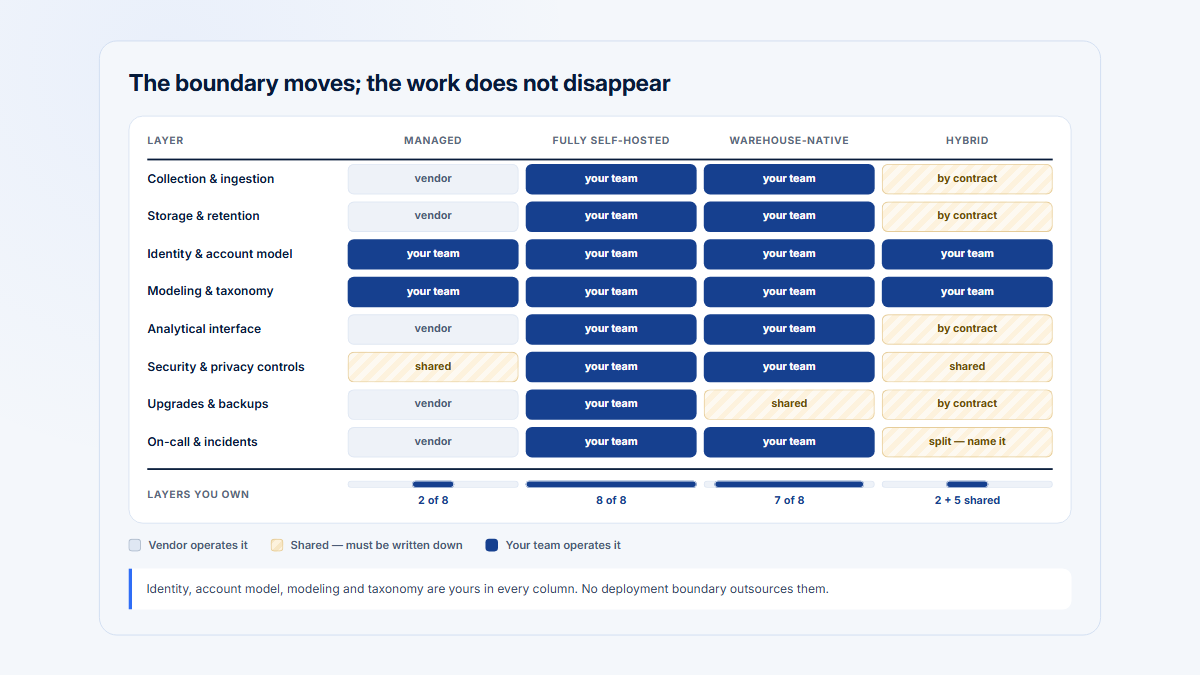
Two things never transfer to a vendor
GA4
Matomo Cloud
Matomo On-Premise
Collection configuration
Always yours
Always yours
Always yours
Legal basis and consent
Always yours
Always yours
Always yours
Application operation
Google operates it
Matomo operates it
You operate it
Database and storage
Google operates it
Matomo operates it
You operate it
Updates, backups, scaling
Google operates it
Matomo operates it
You operate it
Filled means your team carries it. Self-hosting transfers the infrastructure rows to you and nothing else — configuration and legal responsibility were always yours.
For database, maintenance, recovery, and staffing questions, use the fuller self-hosted product analytics checklist.
Migration from GA4 to Matomo
Editorial recommendation: treat migration as a measurement redesign, not a JavaScript replacement. Inventory decisions and KPIs, map concepts, dual-track, reconcile first-party outcomes, then decide whether GA4 remains for advertising.
| GA4 concept | Matomo target | Migration action | Parity caveat |
|---|---|---|---|
| Event | Event or another action type | Map names and parameters to category, action, name, value, dimensions, or dedicated calls | No automatic one-to-one taxonomy |
| Key event | Goal or ecommerce conversion | Recreate business rule, trigger, and revenue | Completion and attribution can differ |
| Google Ads conversion | Conversion export or retained GA4 conversion | Choose the advertising bridge | Export is not the full native integration |
| Custom dimension | Visit- or action-scoped dimension | Inventory scope, values, cardinality, and dependencies | Item scope has no direct equivalent |
| Ecommerce | Matomo ecommerce | Map products, carts, orders, revenue, tax, shipping, refunds, and IDs | Schemas and calculations differ |
| Audience | Segment | Recreate the analytical group | Does not become a Google Ads audience |
| Exploration/report | Report, premium module, or external analysis | Rebuild decision-critical views only | Packaging and visualizations differ |
| User-ID | Matomo User-ID | Preserve the authenticated identifier policy | Stitching and history differ |
| BigQuery export | Database/API or paid Cloud connector | Rewrite queries for Matomo tables | GA4 SQL is not reusable unchanged |
| Historical reports | Google Analytics Importer | Import supported aggregates while source access remains | Not raw-event parity; several reports cannot be reconstructed |
Migrate in stages, and decide at the end
1
Inventory and KPI mapping
List what is actually used, and which measures matter
2
Dual tracking
Run both in parallel on the same pages
Numbers will not match — separate session clocks
3
Validation
Reconcile a small KPI set and explain each gap
4
Rebuild reports
Recreate the reports people open, plus a raw-data review
5
Decide
Keep GA4 for advertising, or retire it
Retiring it is a choice, not the default
Do not retire the old property until a small set of agreed KPIs reconciles and every remaining difference has a stated cause. Many teams keep GA4 solely for advertising.
| Area | GA4 | Matomo | Risk | Validation |
|---|---|---|---|---|
| Acquisition | UTMs, auto-tagging, channel groups | UTMs/campaign reports | Split or missing values | Compare daily distributions |
| Users/sessions | Device IDs, User-ID, GA4 rules | Visitor IDs, User-ID, visits | Different boundaries | Compare trends and test journeys |
| Trial signup | sign_up key event | Goal | Timing or duplicates | Reconcile controlled signups |
| Purchase | purchase with items | Ecommerce order | Revenue or deduplication | Reconcile order IDs |
| Dimensions | Event, user, item scopes | Visit/action scopes | Changed meaning | Inspect known journeys |
| Reports/data | Reports, Explorations, BigQuery | Reports, modules, APIs/connector | Invalid copied logic | Validate owned dashboards |
Pricing and customer feedback
GA4 minimizes the entry software fee. Matomo makes traffic tiers, deployment operations, and premium On-Premise capabilities explicit cost decisions. Public prices and G2 figures below were verified August 11, 2026.
GA4 pricing
Google Analytics 4
No subscription charge
- Paid edition
- Analytics 360, custom sales quote
- Data costs
- BigQuery storage, queries, and streaming can be separate
- Operations
- Implementation, consent, modeling, and analytics labor remain
Matomo pricing
Matomo
US$26 monthly
- On-Premise Core
- Free software licence; infrastructure excluded
- Bundles
- Team, Business, and Enterprise
- Cloud warehouse
- Data Warehouse Connector is a paid add-on
| Item | Google Analytics 4 | Matomo | Caveat |
|---|---|---|---|
| Free option | Standard property without subscription charge | On-Premise Community with Matomo Core | Implementation and labor still cost money |
| Hosted price | Standard is free; 360 requires a quote | Cloud starts at US$26 monthly or US$260 annually for 50,000 hits | Traffic, billing, currency, and tax affect price |
| On-Premise | Not available | Core is GPLv3-or-later open source | Servers and operations are not free |
| Paid bundles | Not applicable | Monthly Team €275, Business €1,450, Enterprise €3,400 | Annual equivalents: €230, €1,209, and €2,834 per month |
| Premium modules | Standard/360 packaging, not plugins | Individual plugins; Team adds Funnels and Heatmaps & Session Recording, Business adds Cohorts and Multi-Channel Attribution, and Enterprise adds A/B Testing | Verified packaging; not every Matomo feature is part of Core |
| Warehouse | Native export with possible Cloud charges | Own export On-Premise; paid connector in Cloud | Include engineering and schema upkeep |
| Infrastructure | Hosted platform included | Cloud included; On-Premise customer-funded | Model monitoring, backups, upgrades, and support |
| G2 signal | 4.5/5 from 6,862 Google Analytics reviews | 4.2/5 from 96 Matomo reviews | Different sample sizes; not a benchmark |
Costs that can change the total
Model implementation, consent tooling, Analytics 360, BigQuery, Matomo Cloud hit volume, the Cloud warehouse connector, On-Premise infrastructure, database tuning, archiving, recovery, updates, security work, plugins, bundles, and support. Do not estimate a three-year total without traffic, staffing, data, and feature requirements.
Which should you choose?
Editorial recommendation: start with the organization’s non-negotiable requirement rather than a generic score. “Better starting point” is deliberately conditional.
| Scenario | Better starting point | Why | Validate |
|---|---|---|---|
| Content website | Depends | Control and simpler web reporting favor Matomo; Google marketing favors GA4 | Avoid unused complexity |
| Ecommerce using Google Ads | GA4 | Native Ads links, conversions, audiences, and ecommerce | Reconcile backend orders and revenue |
| Government or regulated | Shortlist Matomo | Cloud or On-Premise can offer more architectural control | Legal, security, and procurement duties remain |
| Hard On-Premise requirement | Matomo On-Premise | GA4 has no On-Premise edition | Operations, support, capacity, and recovery |
| Agency | Depends | GA4 offers familiarity; Matomo offers multi-site and packaged roll-up options | Sites, users, branding, and client access |
| Small business | Usually GA4; Cloud Matomo when control is worth the fee | Both avoid a large licence purchase | On-Premise technical capacity |
| B2B SaaS public site | GA4 or Matomo | Either measures acquisition, content, leads, and public checkout | Ads, governance, hosting, and raw data |
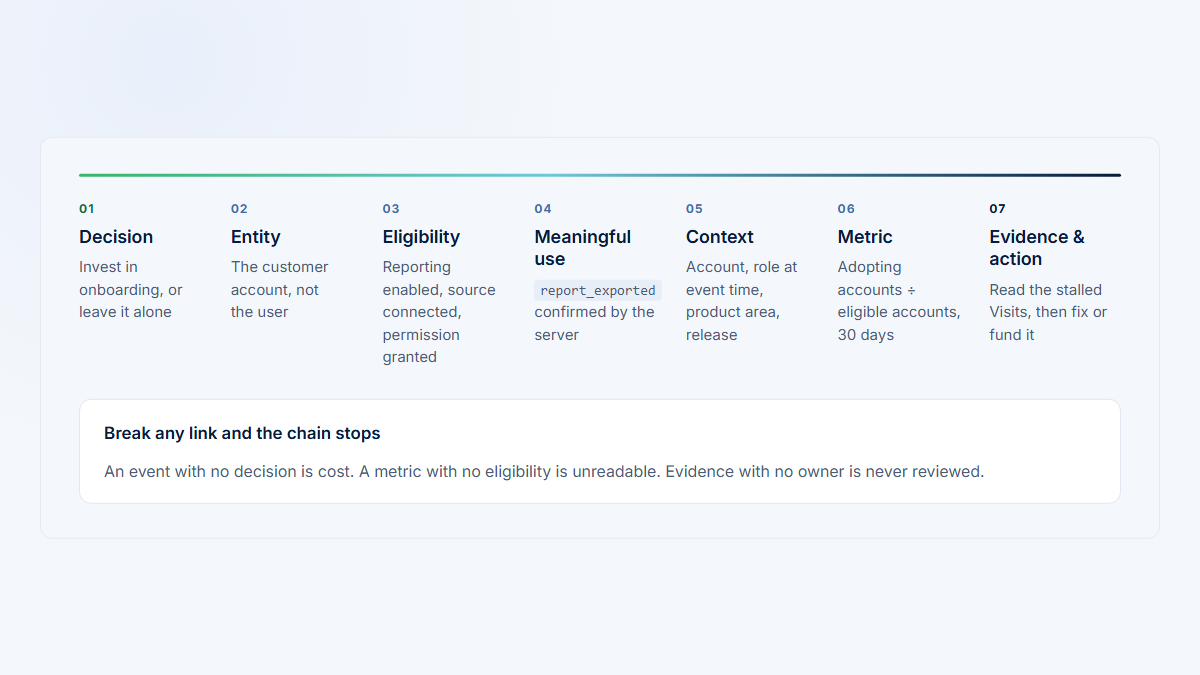
| Authenticated SaaS | Neither automatically | Signed-in events do not create account-adoption workflows | Evaluate account-centric analytics |
| Staged migration | Run both temporarily | Parallel evidence supports mapping and validation | Owners, acceptance criteria, authority, and end date |
A government site using Google Ads, an agency with an On-Premise mandate, or an ecommerce company with strict infrastructure rules can reasonably reach a different conclusion. The product analytics tools comparison covers a different category.
When neither is enough for authenticated B2B SaaS
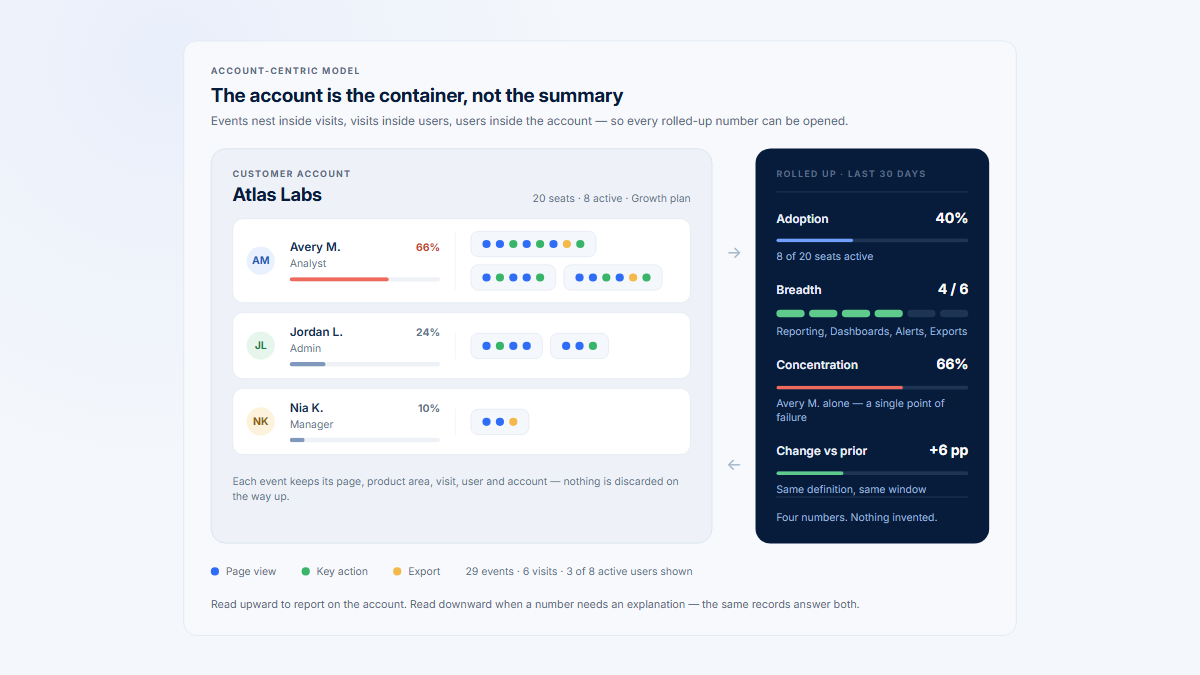
GA4 and Matomo can track identified users, custom events, product screens, and conversion paths. The gap appears when the customer is a company with several users and the question becomes: how broadly has this account adopted the product?
| B2B question | GA4 approach | Matomo approach | Remaining gap |
|---|---|---|---|
| Which companies adopted? | Model an account ID in reports or BigQuery | Use User-ID/custom dimensions and reports | No default account-adoption portfolio |
| What share of users adopted? | Join account, user, and feature events | Combine identifiers, dimensions, APIs, or warehouse | Requires account-level denominator and window |
| Is use concentrated? | Calculate distribution by account and user | Calculate from User-ID and account attributes | Champion concentration is not a primary workflow |
| Which sessions explain change? | Inspect events/users and another replay tool | Use profiles and packaged session recordings | Needs an account-to-user-to-session path |
| Layer | Suggested tool | Primary job | Boundary |
|---|---|---|---|
| Public website | GA4 or Matomo | Campaigns, content, public ecommerce, and conversion | Not multi-user account adoption by default |
| Authenticated B2B product | Hymetry | Pages, Companies, Users, adoption breadth, concentration, and linked Visits | Does not replace advertising analytics |
| Identity/governance | Instrumentation and data policy | Consistent IDs, structure, consent, masking, and ownership | Requires ongoing review with any vendor |
Read the guides to B2B product analytics and product usage by company, or inspect Hymetry’s Pages, Companies, Users, and Visits.
Sources
The questions below summarize common replacement decisions. Methodology, disclosures, and primary source groups follow them.
Frequently asked questions
Can Matomo fully replace GA4?
It can replace many website-analytics requirements, including campaigns, events, goals, ecommerce, segments, reports, and raw-data workflows. It does not exactly replace native Google Ads audiences, GA4 attribution, the GA4 BigQuery schema, or every Exploration. Define required decisions and acceptance criteria first.
Is Matomo free?
On-Premise Community with Matomo Core is free and open source. The operator still funds infrastructure, databases, backups, updates, security, monitoring, and staff. Matomo Cloud is paid, while advanced On-Premise modules may require plugins or bundles.
Which is better for ecommerce?
GA4 is usually stronger when ecommerce directly supports Google Ads and eligible audiences. Matomo is attractive when deployment choice and data control dominate. Both need validated instrumentation and reconciliation against the store, payment, or order database.
Which is better for Google Ads?
GA4 has the stronger native relationship through account linking, reports, eligible audience export, and Google Ads conversions created from key events. Matomo can track tagged traffic and export supported conversions, but does not recreate the complete loop.
Can historical GA4 data be imported into Matomo?
Yes, for supported aggregated reports and dimensions. The importer creates a new Matomo site, cannot merge into an existing site, and does not reconstruct raw visits/actions, Funnels, log data, segmentation, or every GA4 field and result.
Should both tools run during migration?
Usually. Parallel collection lets teams validate campaigns, identity, sessions, outcomes, ecommerce, reports, and exported data. Cover meaningful weekly, monthly, campaign, and purchase cycles, then end the overlap using predefined owners and acceptance criteria.
Which is better for authenticated SaaS analytics?
Neither is automatically sufficient for account-centric B2B adoption. Both collect signed-in events and identifiers, but company adoption, penetration across eligible users, champion concentration, and account-linked session investigation normally require additional modeling or an account-centric layer.
Methodology and evidence labels
Official Google, Google Cloud, and Matomo documentation supplied product, implementation, privacy, deployment, licensing, and pricing facts. G2 seller pages supplied only ratings and review counts. Videos were supplementary workflow context. Scenario recommendations are editorial inferences from documented requirements, not universal winners.
- Documented: supported by official documentation.
- Public price: displayed by the vendor on August 11, 2026.
- Customer-feedback signal: a G2 aggregate, not an objective benchmark.
- Editorial recommendation: a conditional interpretation.
- Not tested: no first-hand validation was performed.
Google Analytics and Google Cloud official sources
Google official documentation
- Key events, attribution, and campaign parameters
- Advertising, audiences, and User-ID
- Ecommerce, custom dimensions, and funnels
- BigQuery export, export schema and limits, export completeness, and BigQuery pricing
- Retention, thresholding, and data deletion
- Consent mode, data safeguards, and Analytics 360
Matomo official sources
Matomo official documentation
- Pricing and packaging and Core and plugin licences
- Campaign tracking, UTM support, and advertising conversion export
- Default attribution, multi-channel attribution, and ecommerce
- User-ID, custom dimensions, and raw data access
- Data Warehouse Connector, cookie and cookieless tracking, and privacy settings
- GA4 migration, importer setup, running the importer, and import limitations
Ratings, videos, and supplementary context
Review and media sources
- Google seller page on G2 and Matomo seller page on G2
- Goodish Show comparison — supplementary independent orientation
- Matomo importer video — official but explicitly out-of-date interface; use the current setup guide above