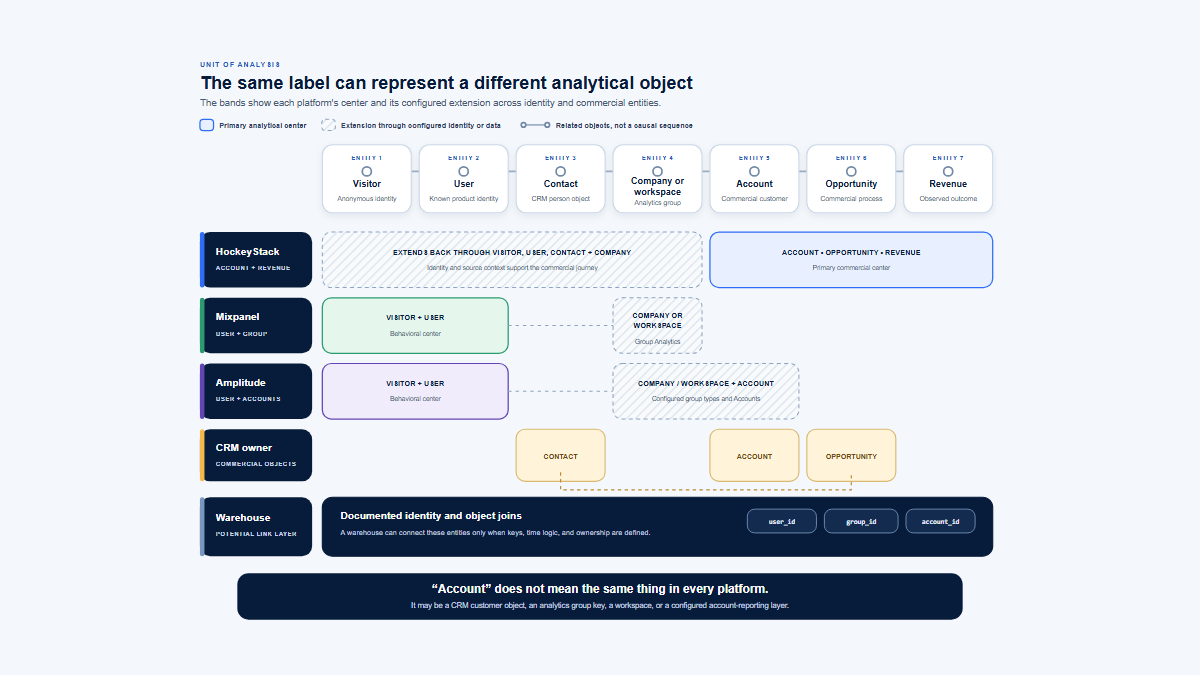
Quick comparison
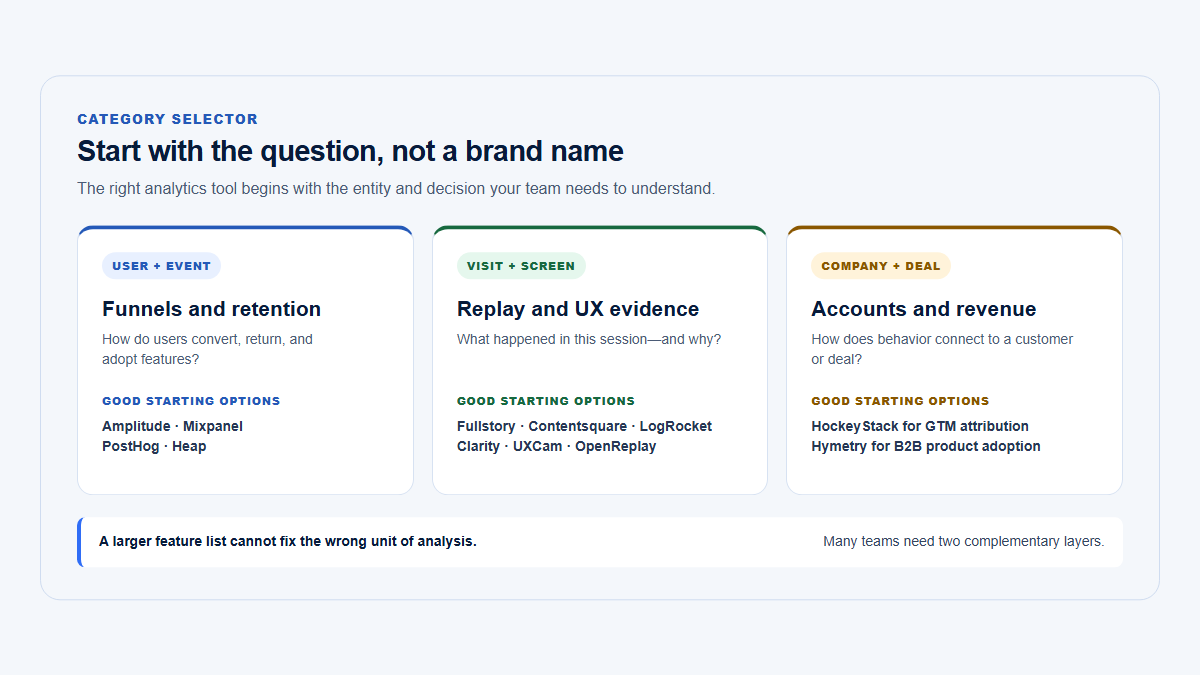
HockeyStack is the more direct B2B GTM choice; AIRIS is the more direct unified-profile and activation choice. Compare HockeyStack with behavioral analytics in HockeyStack vs Mixpanel vs Amplitude, or survey the broader market in product analytics tools.
Naming note: AIRIS, Appier Data Cloud, and Woopra
Appier acquired Woopra in October 2022 and launched AIRIS that December, combining AIXON prediction with Woopra analytics and visualization. AIRIS currently sits in Appier Data Cloud.
- AIRIS is not simply Woopra renamed. It combines product lines and capabilities under Appier's data-cloud offering.
- Woopra remains publicly accessible. Its site, login, trial, pricing, and documentation were live at verification.
- Do not assume tier parity. A capability documented for AIRIS or Woopra Enterprise is not necessarily included in every Woopra plan.
B2B revenue decisions, or unified data and activation
HockeyStack
B2B go-to-market and revenue
Both provide
Appier AIRIS
Unified customer data and activation
Which account will close Which individual to act on next
Both can build a segment. The real difference is which entity the segment describes — an account or a person — and what action it is designed to trigger.
Accounts, customer profiles, and identity
AIRIS is profile-first; HockeyStack is account-and-opportunity-first. Both depend on identifiers supplied by websites, products, CRMs, warehouses, and other source systems.
| Entity or evidence | HockeyStack | Appier AIRIS | What this means |
|---|---|---|---|
| Anonymous visitor | Tracks web activity and connects later identities. | Captures anonymous behavior into journey context. | Consent, cookies, and devices affect continuity. |
| Identified user | Person-level identity supports account journeys. | Known identity becomes a unified profile. | A stable first-party ID matters. |
| Lead or contact | CRM contacts join marketing and sales touches. | Contact fields enrich profiles and segments. | Field mapping governs reliability. |
| Company or account | Core Deduplicated B2B account. | Modeled through company attributes and integrations. | HockeyStack starts closer to account decisions. |
| Opportunity or deal | Core Pipeline and revenue entity. | Via integration | CRM completeness is decisive. |
| Customer profile | Person evidence organized for GTM analysis. | Core Unified attributes and behaviors. | AIRIS starts closer to person-level activation. |
| Product user | Product events contribute to account context. | Behavior enriches profile journeys and segments. | Instrumentation must identify meaningful use. |
| Subscription or revenue | Connected to account, opportunity, and reporting. | Available when billing data enters profiles. | Neither manufactures billing truth. |
| Campaign | Campaign touches feed attribution and ROI. | Campaign context feeds journeys and activation. | Naming and cost data require governance. |
| Sales activity | Calls, emails, meetings, and CRM events. | Available when ingested as profile events. | HockeyStack documents the B2B path more directly. |
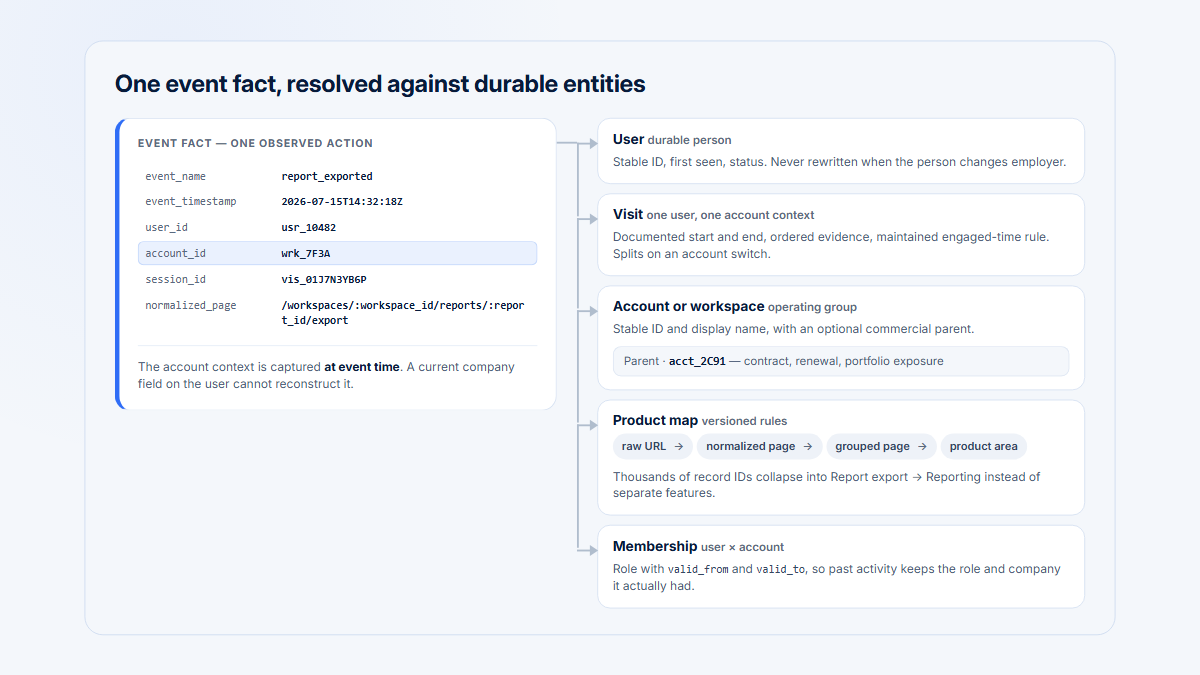
| Identity stitching | Connects anonymous, personal, and business identities. | Merges profiles around unique identifiers. | Merge rules can create false certainty. |
| Account matching | Domains and CRM evidence support deduplication. | Requires an organization-specific company model. | Subsidiaries and shared domains need rules. |
| Warehouse data | Can join GTM and account evidence. | Can enrich unified profiles and audiences. | Validate direction, latency, and transformations. |
| Event-time context | Preserves sequence across buyer journeys. | Preserves sequence across customer journeys. | Late and duplicate events affect analysis. |
Identity quality is an implementation property, not a badge. Test real anonymous-to-known joins, domains, devices, CRM records, duplicates, and merge/split corrections before trusting either journey view.
Attribution, journeys, pipeline, and revenue
HockeyStack has the more native B2B opportunity, pipeline, and revenue workflow. AIRIS can analyze customer journeys and attribution, but commercial reporting depends more heavily on the opportunity and revenue data supplied to it.
| Workflow | HockeyStack | Appier AIRIS | Editorial interpretation |
|---|---|---|---|
| Multi-touch attribution | Core Multiple documented models. | Available Journey attribution. | HockeyStack starts with the B2B revenue question. |
| Account-based attribution | Core Account and opportunity context. | Via integration Company modeling required. | Test real account hierarchies and duplicate domains. |
| Campaign ROI | Strong Spend, pipeline, and revenue. | Available With cost and outcome data. | Neither fixes missing spend or revenue inputs. |
| Buyer journey | Core People, accounts, touches, deals. | Strong Person-level journey context. | The entity boundary differs. |
| Sales journey | Strong CRM activity and progression. | Available When sales events are ingested. | HockeyStack offers the more direct template. |
| Pipeline analysis | Core Stage and opportunity analysis. | Via integration | AIRIS needs a governed commercial model. |
| Revenue reporting | Core GTM reporting. | Via integration | Billing and CRM remain source systems. |
| Product-event analysis | Available A GTM signal. | Strong Behavioral context. | AIRIS starts closer to customer behavior. |
| Funnels | Strong Buyer and GTM funnels. | Strong Customer journey funnels. | Validate the counting entity and reset rules. |
| Customer segments | Available GTM entities. | Core Rich profile filters. | AIRIS has the broader activation-oriented surface. |
| Predictive audiences | Limited Scoring is GTM-oriented. | Core Predictive customer audiences. | Prediction targets different downstream decisions. |
| Activation | Strong Workflows and GTM destinations. | Core Triggers and audience destinations. | Test exact destinations, latency, and write-back. |
| Dashboards and natural-language analysis | Strong GTM reporting and AI analysis. | Strong Data intelligence and AI. | Ask each system the same governed question. |
Can one replace the other?
| Question | Short answer | Main compromise |
|---|---|---|
| Can HockeyStack replace AIRIS? | Sometimes for B2B GTM attribution and account workflows. | Narrower unified-profile, prediction, and customer-activation scope. |
| Can AIRIS replace HockeyStack? | Sometimes when customer journeys and audiences dominate. | More modeling for native account, opportunity, and pipeline decisions. |
| Should an organization use both? | Only with deliberate entity and workflow ownership. | Duplicate identities, attribution, segments, destinations, and governance. |
Segmentation, prediction, and activation
AIRIS has the broader customer-segmentation and activation orientation. HockeyStack concentrates segmentation, intent, and workflow actions on B2B people, accounts, and revenue teams.
A shared start, then two different destinations
Shared first two stages
HockeyStack continues
AIRIS continues
The question is not whether a platform can create a segment. It is which entity, which prediction and which downstream action that segment exists to support.
HockeyStack documents account and intent scoring plus workflow destinations such as CRM actions, webhooks, and ad audiences. AIRIS combines profile attributes, behavior, predictive audiences, lifecycle segments, triggers, audience synchronization, and Appier campaign orchestration. Both require destination permissions, suppression logic, refresh expectations, and measurement after activation.
Product data, integrations, and implementation
The best implementation is the one with governed source ownership. HockeyStack typically centers CRM, marketing, sales, and account evidence. AIRIS typically centers identity, behavioral events, profile enrichment, and audience destinations.
| Area | HockeyStack | Appier AIRIS |
|---|---|---|
| CRM | Central source for accounts, contacts, opportunities, and activity. | Enriches profiles, journeys, and segments. |
| Advertising platforms | Spend, campaign context, attribution, and workflow destinations. | Audience activation and campaign feedback. |
| Marketing automation | Campaign and lifecycle evidence for GTM analysis. | Profile enrichment and campaign activation. |
| Website tracking | Anonymous and known buyer activity. | Anonymous and known customer behavior. |
| Product-event tracking | Used as an account and GTM signal. | Used for profiles, journeys, segments, and triggers. |
| Data warehouse | Documented Snowflake, BigQuery, Amazon S3, and other analytics/data-warehouse paths. | Data-cloud ingestion and enrichment paths; validate specifics. |
| Customer support | Useful context when integrated; not the primary workflow. | Support events can enrich customer profiles. |
| Billing and subscription data | Connects accounts to realized commercial outcomes. | Enriches value, lifecycle, and customer segments. |
| Identity configuration | Personal and business IDs plus CRM joins. | Unique IDs, profiles, and merge rules. |
| Account matching | Explicit B2B deduplication and domain logic. | Organization-specific attributes and relationships. |
| Data export | Validate destinations, granularity, and contract terms. | Validate destinations, granularity, and contract terms. |
| APIs and custom paths | Available for specialized sources and workflow actions. | Available for specialized sources and destinations. |
| Likely operational owner | RevOps, marketing ops, analytics, or GTM engineering. | Data, lifecycle, growth, or enterprise marketing operations. |
| Implementation complexity | Highest around CRM quality, identity, attribution, and account rules. | Highest around profiles, identity, events, prediction, and activation governance. |
Integration counts are directional packaging statements, not equal-depth guarantees. Appier markets AIRIS ingestion from more than 113 platforms, while Woopra packaging lists 30-plus integrations. Verify each source, field, direction, latency, backfill, limit, authentication method, and write-back.
Product usage is an input, not automatically an account-adoption model
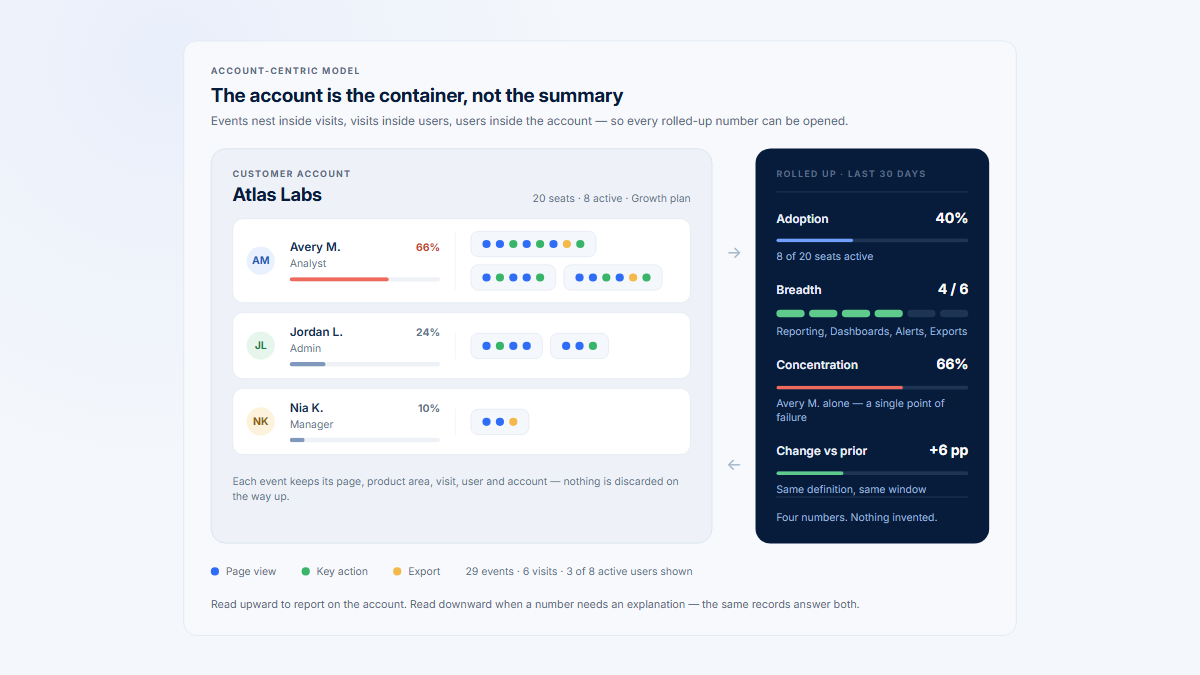
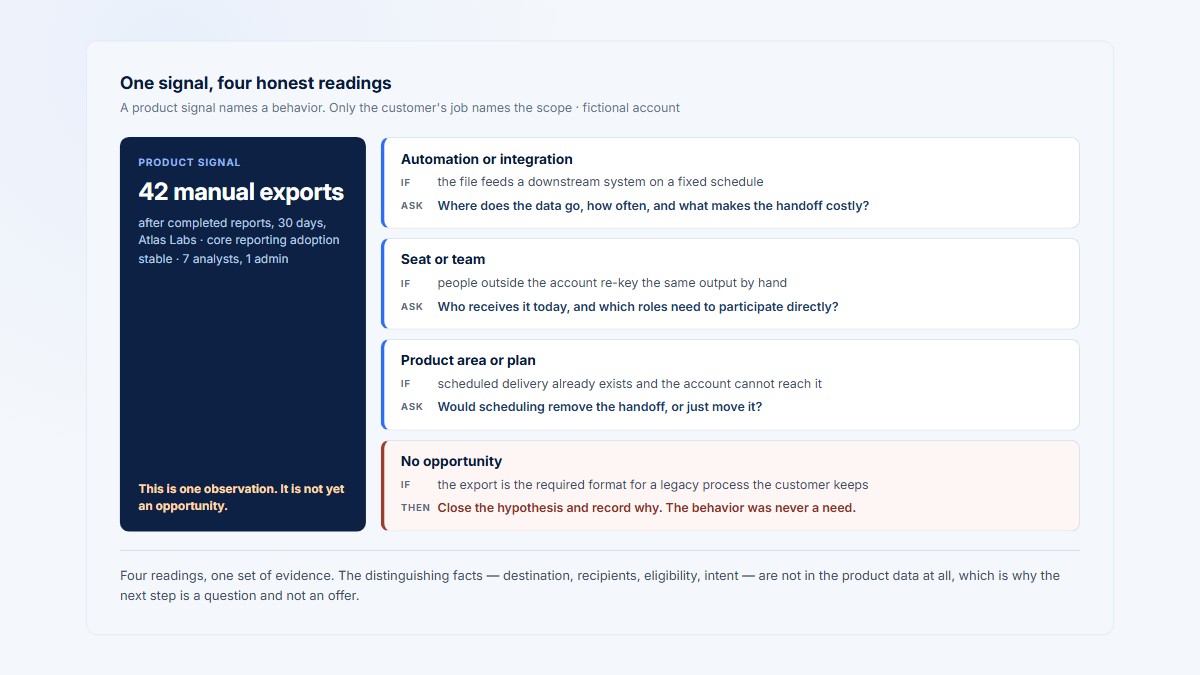
A product event says that something happened. It does not by itself show whether enough roles at an account adopted the right workflows, whether activity depends on one champion, or whether usage aligns with the purchased plan. Start with a governed B2B product analytics model.
For account decisions, join meaningful actions to companies, users, roles, product areas, and time. The product usage by company guide shows how to separate account breadth from raw event volume.
Fictional B2B customer-journey scenario
Fictional scenario: Northstar Cloud sells a sales-assisted SaaS product. A prospect first visits anonymously, becomes a contact, joins an account and opportunity, activates in the product, and later contributes to revenue. The table shows where each platform begins and which evidence still lives elsewhere.
| Decision step | HockeyStack | Appier AIRIS | Additional system or evidence required |
|---|---|---|---|
| Identify visitor | Connects web behavior to known people and businesses. | Connects anonymous behavior to a known profile. | Consent, first-party ID, and form or login event. |
| Unify contact profile | Combines GTM touches around a person. | Combines attributes and behavior into a profile. | CRM, support, and identity rules. |
| Match account | Native account and domain matching. | Requires a supplied company relationship. | CRM account, hierarchy, and duplicate policy. |
| Attribute campaign | Applies B2B attribution models to pipeline/revenue. | Analyzes channels and journeys around the profile. | Spend, campaign taxonomy, and outcome definition. |
| Analyze sales touches | Includes CRM calls, emails, and meetings. | Uses sales events when ingested. | Activity completeness and ownership. |
| Track product activation | Adds activation as account journey evidence. | Adds activation to the profile and journey. | Instrumentation and activation definition. |
| Measure account adoption | Can analyze product events around an account. | Can segment profiles and company attributes. | Seats, roles, product areas, and breadth model. |
| Predict or segment customers | Account and intent scoring for GTM. | Predictive and behavioral customer audiences. | Outcome labels, evaluation, and bias controls. |
| Activate an audience | Routes segments into GTM destinations. | Triggers and synchronizes campaign audiences. | Consent, suppression, destination, and holdout. |
| Connect pipeline and revenue | Native commercial reporting orientation. | Requires opportunity, billing, or revenue inputs. | CRM and finance source of truth. |
Six identity transitions, each with its own source
1
Visitor
2
Contact
3
Account
4
Opportunity
5
Product user
6
Revenue
HockeyStack emphasis
AIRIS emphasis
Each transition needs its own source evidence
A useful implementation ties every identity and commercial transition to the system that actually recorded it, rather than expecting one analytics platform to manufacture the complete truth.
Pricing and customer feedback
HockeyStack now publishes a $1,250-per-month Self-Serve plan; its broader plans and AIRIS remain sales-led. The related Woopra Pro tier starts at $999 per month and offers a 30-day trial.
Pricing and ratings
Official commercial model
HockeyStack pricing
$1,250/month
- Included scale
- 5 team members; 20,000 tracked users/month
- Support
- Ticket-based asynchronous support; no dedicated CSM
Official commercial model
Appier AIRIS pricing
Custom pricing
- Billing basis
- Quote-specific for AIRIS
- Validate
- Profiles, events, seats, retention, predictions, integrations, and activation
G2 product snapshot
HockeyStack reviews
G2 product snapshot
Appier AIRIS reviews
| Field | HockeyStack | Appier AIRIS |
|---|---|---|
| Free plan or trial | No permanent free plan; Self-Serve has a 14-day card-required trial. | AIRIS: none published; Woopra Pro: 30-day trial. |
| Public/custom starting model | Self-Serve $1,250/month; broader plans custom. | AIRIS custom; Woopra Pro from $999/month. |
| Billing unit | Self-Serve fixed monthly; broader contracts vary. | AIRIS quote-specific; Woopra Pro begins at 5 million events/month. |
| Integration limits | Validate sources, direction, backfill, and write-back. | Validate included connectors, destinations, and activation volume. |
| Report/user limits | Self-Serve: 5 team members and 20,000 tracked users/month. | Woopra Pro lists 50 seats; AIRIS is custom. |
| Retention | Validate contracted event and source retention. | Woopra Pro: 24 months; Enterprise/AIRIS customized. |
| Implementation services | Self-Serve is self-implemented with async support and no dedicated CSM. | Validate profile design, migrations, activation, and support. |
| Enterprise model | Broader custom contracts; startup pricing advertised. | Contact sales; Woopra labels Enterprise an Agentic CDP. |
| Customer rating | 4.5/5 on G2. | 4.4/5 on G2. |
| Review count | 81 reviews. | 207 reviews. |
| Verification date | ||
| Official pricing source | HockeyStack Self-Serve and custom pricing | Woopra and AIRIS pricing context |
| Official product source | HockeyStack platform overview | Appier AIRIS product page |
The Woopra Pro figures describe a public plan related to the AIRIS product family, not a public AIRIS enterprise quote. Compare contracts on the same data, retention, seats, source history, implementation, destinations, and support assumptions.
Recurring customer-review themes
| Product | Rating and review count | Common praise | Common criticism |
|---|---|---|---|
| HockeyStack | 4.5/5 from 81 reviews. | Attribution visibility, account journeys, reporting, and support. | Learning curve, setup, report complexity, data confidence, and cost. |
| Appier AIRIS | 4.4/5 from 207 reviews. | Journey analysis, profiles, segmentation, usability, and support. | Setup, advanced-report learning, customization, performance, and pricing. |
These are recurring observations across self-selected reviews, not universal customer experiences or a statistical sentiment study. Ratings, sample sizes, use cases, review age, and product packaging differ.
Which one fits your scenario?
The operating decision matters more than feature-count overlap. Start with the system that owns the entity and action; add companion tools only where the evidence or workflow genuinely crosses boundaries.
| Scenario | Recommended starting product | Companion tool if needed | Reason | Main caveat |
|---|---|---|---|---|
| B2B demand generation | HockeyStack | CRM and ad platforms | Connects touches to accounts, pipeline, and revenue. | Attribution remains model-dependent. |
| RevOps | HockeyStack | CRM, warehouse, and billing | Account and opportunity entities match the workflow. | CRM quality governs the output. |
| Enterprise marketing | Depends on operating model | CRM plus campaign systems | Choose GTM revenue analysis or profile activation. | Large organizations may need deliberate coexistence. |
| Ecommerce or consumer marketing | Appier AIRIS | Commerce and campaign platforms | Unified profiles, prediction, segments, and activation. | Validate regional consent and channel coverage. |
| PLG SaaS with sales-assisted conversion | HockeyStack, conditionally | Product analytics or Hymetry | Connects product signals to accounts and opportunity outcomes. | Needs an explicit account-adoption model. |
| Audience activation | Appier AIRIS | Campaign destinations | Profiles and predictions lead into audience actions. | Test suppression, latency, and incrementality. |
| Product-usage analysis | Appier AIRIS, conditionally | Specialist product analytics or Hymetry | Behavioral journeys and profiles are closer to the task. | Neither automatically answers account-adoption questions. |
| Established warehouse | Depends on the downstream decision | Warehouse and transformation layer | Keep governed facts upstream and select the operating surface. | Validate bidirectional movement and semantic duplication. |
Where Hymetry fits
Hymetry is relevant after signup when authenticated B2B product evidence must become an account-level adoption decision. It complements the compared products; it does not replace a CRM, attribution platform, activation layer, CDP, or revenue-intelligence system.
| Need | Where Hymetry contributes | Relationship to compared products |
|---|---|---|
| Workflow adoption | Groups Pages into meaningful product areas and measures company use. | Adds account-adoption interpretation to raw product events. |
| Breadth and champion dependency | Connects Companies with Users, participation, and concentration. | Supplies post-signup evidence for GTM or customer-data workflows. |
| Evidence behind usage change | Visits expose sessions behind an aggregate signal. | Supports investigation without claiming motive or causality. |
| Customer-success decisions | Surfaces account adoption, momentum, risk, and evidence for review. | Can inform a customer-success workflow; it is not the CSM system. |
Related guidance
- Find expansion opportunities from product usage.
- Review product usage before a renewal meeting.
- Build peer baselines for B2B SaaS accounts.
- Analyze product usage by company.
Hymetry is newer, with a smaller ecosystem, fewer integrations, and no mature independent review score. It does not provide a broad activation or GTM operating platform, and this comparison assumes no unconfirmed integrations, customers, outcomes, pricing, or capabilities.
FAQ, methodology, and sources
This is a category and workflow decision, not a universal winner. The questions below preserve the practical boundaries between the products.
Is Appier AIRIS the same as Woopra?
No. AIRIS combines Appier's AIXON predictive capabilities with Woopra analytics and visualization and sits in Appier Data Cloud. Woopra remains a public product surface, but AIRIS capabilities should not be assumed in every Woopra tier.
Is HockeyStack a CDP?
HockeyStack has a data foundation that unifies GTM evidence, but its primary operating orientation is B2B revenue-data intelligence, attribution, accounts, opportunities, pipeline, and GTM workflows rather than broad customer-data activation.
Can HockeyStack replace AIRIS?
Sometimes, when B2B attribution, account journeys, pipeline, and revenue are the central jobs. It is a weaker substitute for broad unified customer profiles, predictive audiences, and omnichannel activation.
Which is better for B2B attribution?
HockeyStack is usually the clearer starting point because its documented model centers accounts, sales touches, opportunities, pipeline, and revenue. Validate identity, CRM completeness, cost data, lookback windows, and model assumptions.
Which is better for customer segmentation and activation?
Appier AIRIS is usually the clearer starting point because its orientation centers unified profiles, behavior, prediction, segments, triggers, and audience destinations. Test the exact connectors, latency, consent, and suppression workflow.
Should an organization use both?
Possibly, if HockeyStack owns B2B account-to-revenue analysis while AIRIS owns customer-profile-to-audience activation. Define canonical IDs, attribution ownership, segment ownership, data movement, consent, and duplicate costs first.
Where does Hymetry fit?
Hymetry adds account-centric authenticated product adoption: product areas, companies, users, adoption breadth, user penetration, usage concentration, and visit evidence. It complements rather than replaces the compared platforms.
Methodology and evidence limits
- Research verification date: August 13, 2026.
- Evidence level: documentation and independent reviews.
- Source hierarchy: official product and naming pages; official documentation; official pricing; G2; independent editorial media; canonical Hymetry product context.
- Capability labels: editorial assessments, not vendor certifications.
- Hands-on status: no hands-on test was performed for this edition.
- No stronger neutral, current head-to-head demonstration was identified. Vendor-authored competitor pages were not treated as neutral evidence.
Names, pricing, packages, ratings, review counts, integrations, limits, and media availability can change. Verify contract terms and operational fit during procurement.
Publisher disclosure: Hymetry develops account-centric B2B product intelligence. Hymetry has no affiliate relationship with HockeyStack, Appier, Woopra, G2, GTMnow, or YouTube.
Sources
Official HockeyStack product, data model, and attribution sources
- HockeyStack GTM Intelligence
- HockeyStack platform overview
- HockeyStack Atlas data foundation
- Anonymous, personal, and business identity connections
- HockeyStack account deduplication
- HockeyStack attribution models
- HockeyStack advanced attribution models
- Lift analysis and multi-touch attribution
- HockeyStack funnels
- HockeyStack account scoring
- HockeyStack intent scoring
- HockeyStack marketing blueprints
Official HockeyStack integration and workflow sources
Official Appier AIRIS and Woopra product and naming sources
- Appier Data Cloud and current AIRIS positioning
- Appier AIRIS product page
- AIRIS and AIQUA product context
- Appier AIRIS launch announcement
- Woopra product site
- Woopra documentation
- Woopra unique identifiers and profile merging
- Woopra custom actions and visitor data
- Woopra Journeys
- Woopra attribution
- Woopra segmentation filters
- Woopra triggers
- Woopra integrations
- Woopra product capabilities
Official pricing and independent customer-review sources
- HockeyStack pricing
- HockeyStack Self-Serve offer
- Woopra and AIRIS pricing context
- HockeyStack product reviews on G2
- HockeyStack seller snapshot on G2
- Appier AIRIS reviews on G2
G2 counts are dynamic and may be cached or temporarily blocked to automated clients. The dated visible snapshots were checked in browser-rendered surfaces.
Editorial and video material
- GTMnow interview episode page
- GTMnow HockeyStack interview on YouTube
- Appier paid-ads webinar page
- Appier Woopra webinar on YouTube
The GTMnow item is independent operator media with a vendor executive guest. The Appier item is vendor-produced. Neither is treated as a neutral head-to-head test.