Key differences
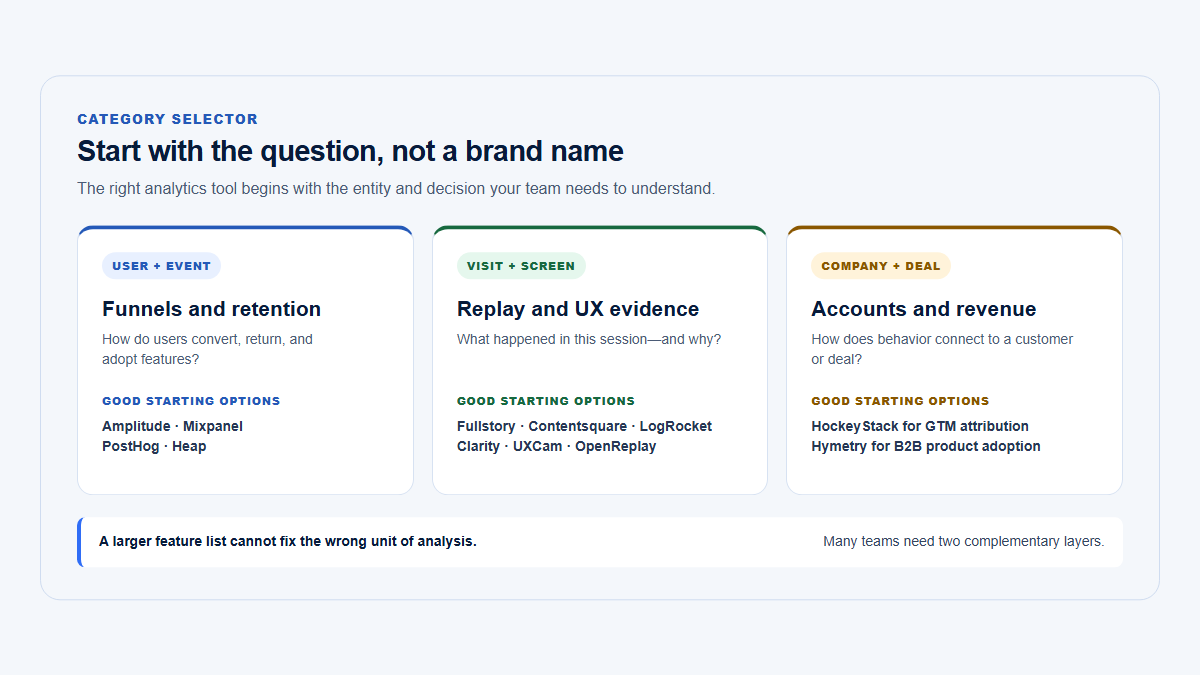
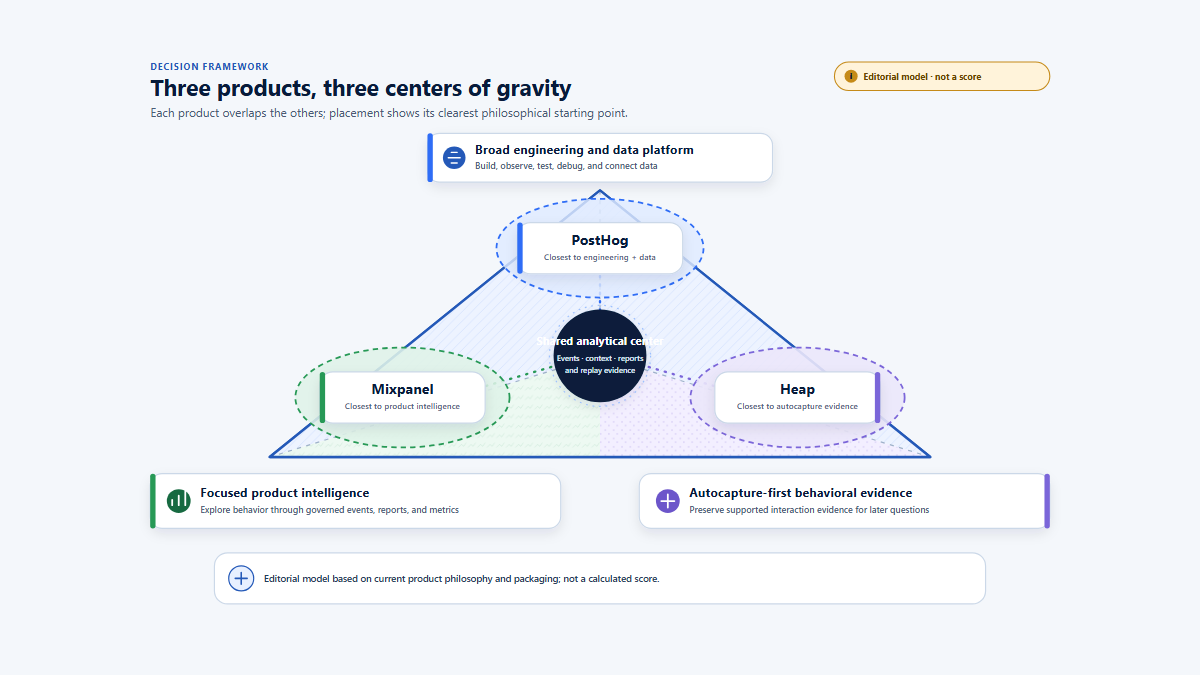
Mixpanel and Heap now overlap, but their operating models remain distinct. Mixpanel rewards deliberate semantic events; Heap makes Smart Capture and retrospective definition a core workflow.
| Criterion | Mixpanel | Heap by Contentsquare |
|---|---|---|
| Primary strength | Governed behavioral analysis | Broad interaction evidence |
| Collection model | Explicit events plus web autocapture | Smart Capture plus custom and server events |
| Historical flexibility | Reinterpret data already captured and retained | Stronger Define UI events after collection |
| Core analytics | Stronger Advanced funnels, retention, cohorts, and Flows | Strong funnels and Journeys over captured behavior |
| B2B accounts | Group Analytics add-on on Growth or Enterprise | Account-Based Analytics on Pro or Enterprise |
| Replay and heatmaps | Replay allowances by plan; web heatmaps require replay | Package dependent Experience Analytics extension or bundle |
| Experiments and flags | Native capabilities with Enterprise/add-on packaging | Analyze exposures; no native flag delivery assumed |
| Billing unit | Events, replay, and add-ons | Sessions, contract package, and extensions |
| Main limitation | Quality depends on deliberate instrumentation | Definitions depend on retained evidence and UI stability |
Decision by scenario
| Scenario | Start with | Why | Important limitation |
|---|---|---|---|
| Small product team with clear activation events | Mixpanel | Focused reports around a small semantic model | Someone must own event QA |
| Autocapture-first discovery | Heap | Broad evidence supports later UI questions | Definitions still need curation |
| Mature analytics team | Mixpanel | Advanced funnels, retention, cohorts, and governed metrics | Volume and add-ons affect cost |
| B2B SaaS with several users per company | Evaluate both | Both support paid account or group analysis | Attach active company context at event time |
| UX team already using Contentsquare | Heap | Product analytics fits the wider experience workflow | Confirm module packaging |
| Experiment and feature-flag workflow | Mixpanel | Native options exist alongside analysis | Advanced capabilities are package dependent |
| Self-hosting or strict infrastructure ownership | Neither | Both are managed platforms | Consider a self-hostable category |
A team can split responsibilities—for example, official activation metrics in Mixpanel and broad experience evidence in Contentsquare—without sending every event to both systems. Define one source of truth for each KPI.
Instrumentation, historical analysis, and reliability
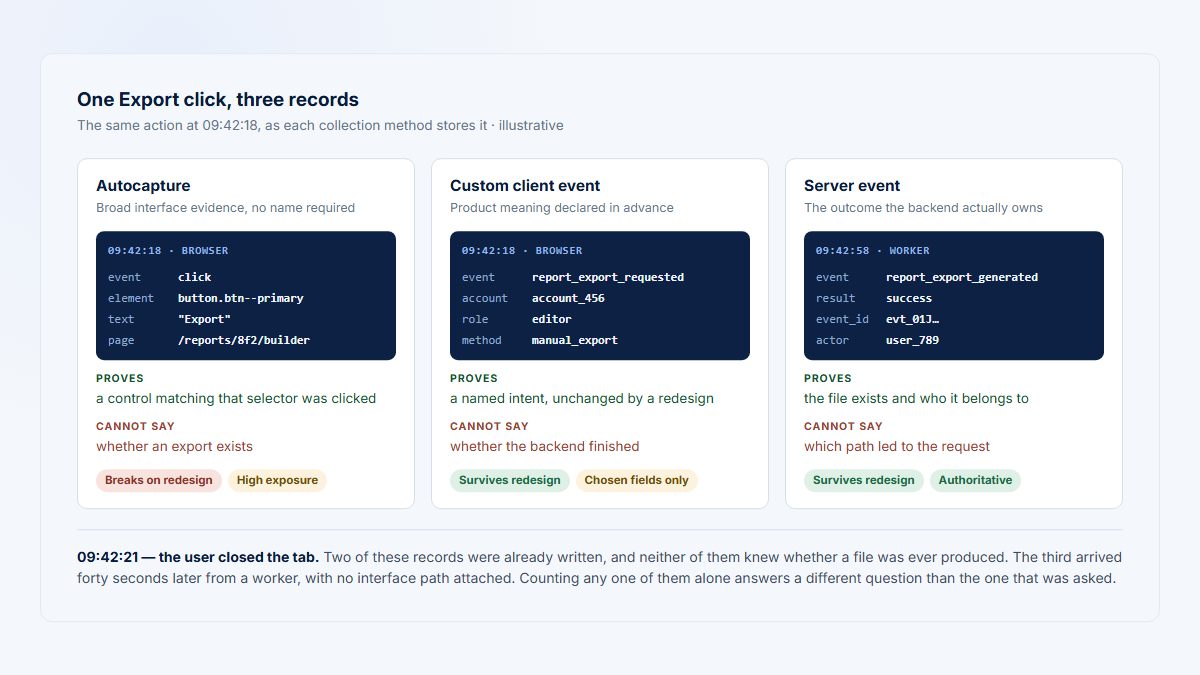
Mixpanel is better when stable business meaning should be designed early; Heap is better when the team must preserve more interface evidence before it knows every question.
| Question | Mixpanel | Heap by Contentsquare | Buyer implication |
|---|---|---|---|
| What is captured? | Explicit client/server events plus supported web autocapture | Broad UI interaction evidence plus custom/server events | Choose the evidence volume you can govern |
| When is meaning defined? | Usually before collection; custom events can reinterpret retained data | Often after collection through reusable definitions | Work moves earlier or later, not away |
| Historical flexibility | Limited to events and properties already retained | Core strength for retained Smart Capture evidence | Neither recovers missing backend facts |
| Business outcomes | Use explicit server events | Use Track APIs or other explicit server events | A click proves an attempt, not success |
| After a UI change | Semantic events can remain stable | Selector-based definitions may need repair or versioning | Use stable product-owned attributes |
| Governance burden | More event design before launch | More definition curation after capture | Assign an owner either way |
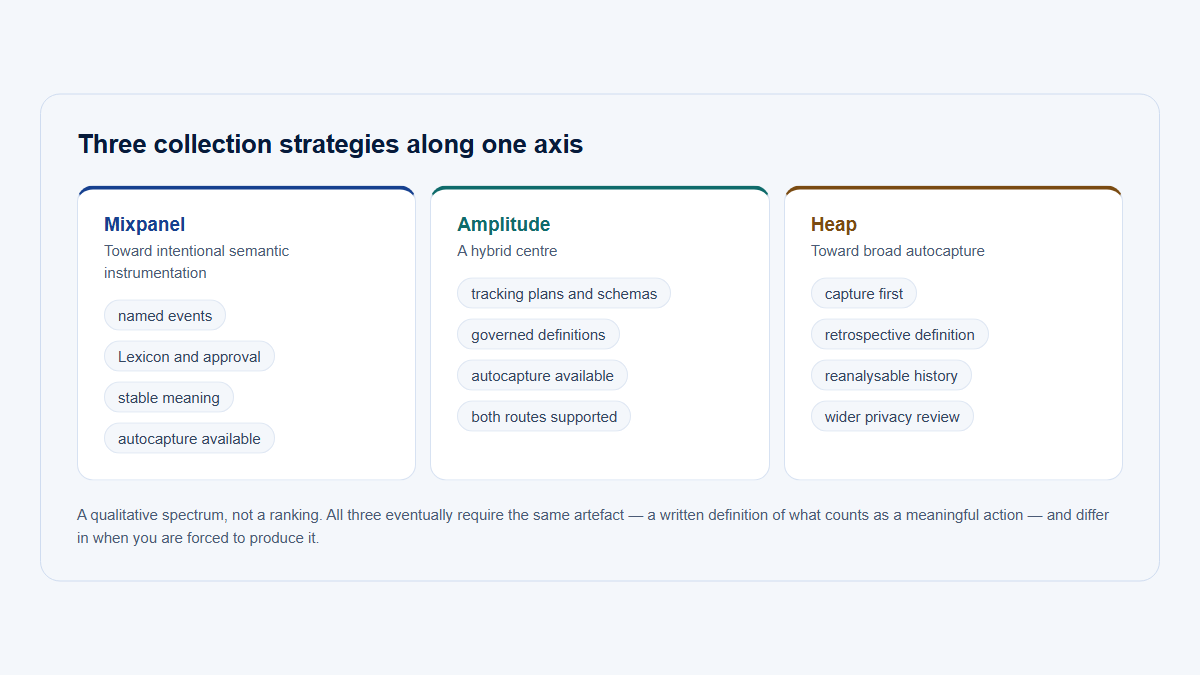
Both sit between the extremes, at different points
Planned semantic events
Decide the meaning first
Where these two actually sit
Autocapture-first
Decide the meaning later
Semantic stability up front Historical flexibility up front
Neither product occupies a pole. Both eventually require the same thing — a written definition of what counts as a meaningful action — and differ only in when you are forced to write it down.
For implementation detail, see autocapture vs custom events and the product analytics instrumentation plan.
Analytics, B2B accounts, and session evidence
Mixpanel has the edge for advanced governed analysis. Heap remains strong when a new funnel or journey can be defined from historical interaction evidence.
| Capability | Mixpanel | Heap by Contentsquare | Decision |
|---|---|---|---|
| Funnels | Advanced ordering, exclusions, repeated steps, windows, and counting modes | User, Session, and eligible Account funnels | Mixpanel stronger |
| Retention and cohorts | Reusable governed definitions and behavioral cohorts | Retention and segments over captured or defined events | Mixpanel for standardization; Heap for historical flexibility |
| Paths | Flows with exclusions, windows, and held properties | Journeys with branching behavior | Similar goal, different evidence model |
| B2B accounts | Event-time group keys and group profiles | Configured Account identity and properties | Higher tier/add-on in both |
| Replay | Plan-specific allowances linked to analytics | Experience Analytics integration, extension, or bundle | Confirm allowance and retention |
| Experiments and flags | Native analysis and current Enterprise/add-on capabilities | Analyze external exposure context | Mixpanel if native workflow matters |
| Warehouse and export | APIs, exports, Warehouse Connectors, and paid Data Pipelines | APIs plus Data Connect on Enterprise and optionally Pro | Verify with vendor |
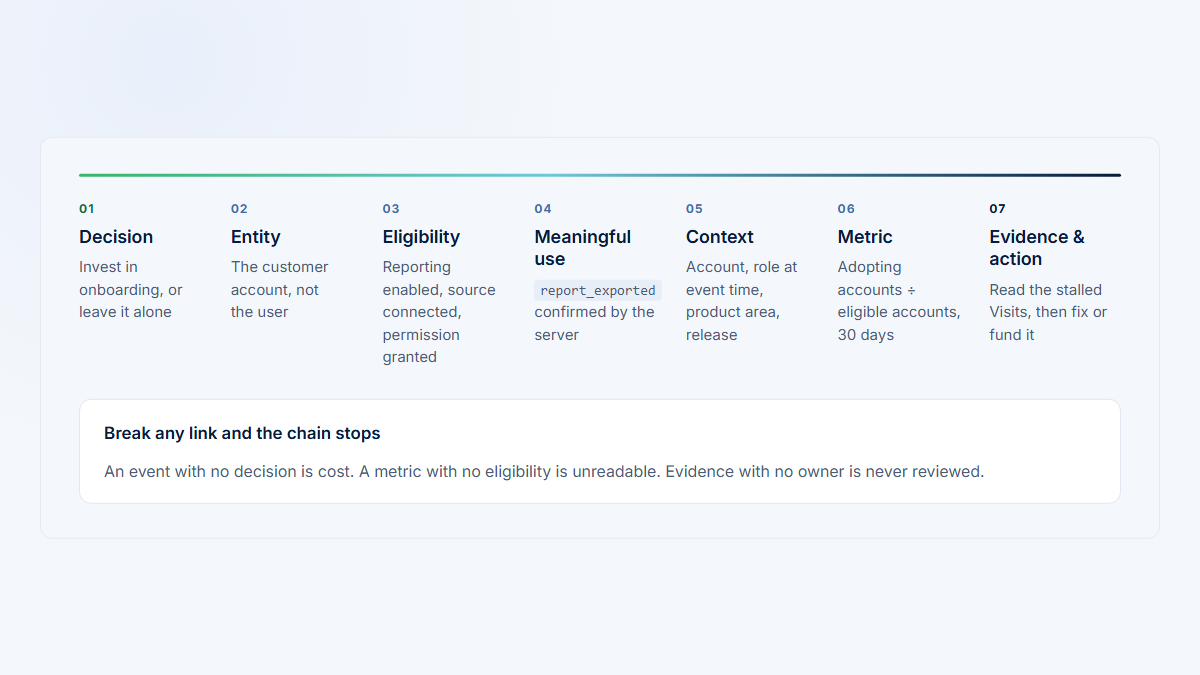
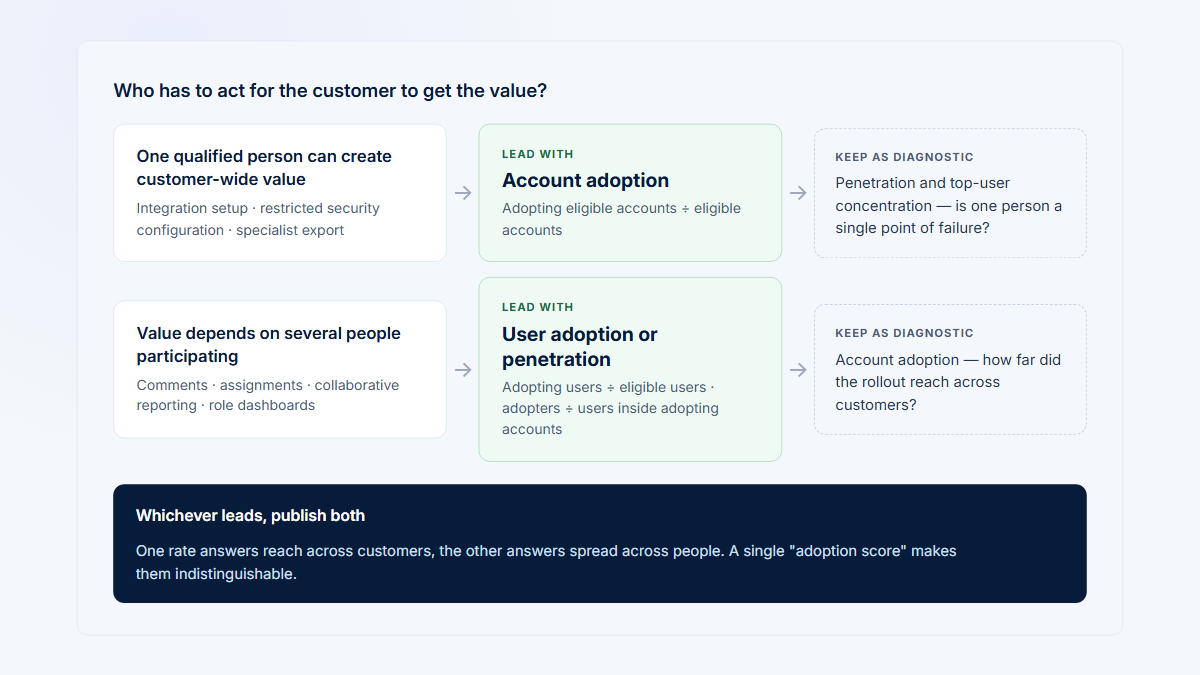
For B2B SaaS, neither product is account-aware by magic. Put the active company_id or workspace key on relevant events, especially when one user can switch companies. Mixpanel documents that missing group keys cannot be reconstructed reliably on already-ingested events; Heap account mapping also needs event-time context when a mutable user property would blur history. (Mixpanel Group Analytics; Heap Account Health Analysis)
Pricing and customer ratings
The free allowances use different units, and paid cost depends on adjacent modules. Compare your own events per session, replay needs, history, account analytics, and export requirements.
Mixpanel pricing
Mixpanel
1M events
- Replay
- 10,000 free monthly replays
- Billing
- Events, replay, and add-ons
- Groups
- Paid add-on on Growth/Enterprise
- Paid price
- Published usage detail plus quote-based Enterprise
Heap pricing
Heap by Contentsquare
10K sessions
- History
- Seven months on Free
- Billing
- Sessions, package, and extensions
- Accounts
- Pro or Enterprise
- Paid price
- Quote required
| Cost driver | Mixpanel | Heap by Contentsquare |
|---|---|---|
| Primary unit | Events | Sessions |
| Replay | Allowance by plan | Experience Analytics extension or bundle |
| Account analytics | Group Analytics charge/add-on | Pro or Enterprise packaging |
| Warehouse/export | Data Pipelines and connector packaging | Data Connect on Enterprise and optionally Pro |
| Paid transparency | Some public usage detail | Quote required |
Detailed pricing notes
At verification, Mixpanel's Growth model included the first 1 million monthly events and documented a per-additional-event example; Enterprise, replay, Group Analytics, Data Pipelines, experiments, feature flags, and optional MTU pricing can change the total. Contentsquare published Product Analytics session ranges, but paid pricing remained quote-based. Its service schedule also documented treatment for server-side events and high event density.
- Do not combine the separate Contentsquare Experience Analytics free allowance with Product Analytics Free.
- Mixpanel cost tends to rise with events, replay, groups, pipelines, experiments, flags, and enterprise commitments.
- Heap cost tends to rise with sessions, event density, history, experience extensions, accounts, Data Connect, and wider platform packaging.
- Implementation, identity design, taxonomy maintenance, privacy review, QA, migration, and training are operating costs in both systems.
See the Mixpanel pricing documentation and Contentsquare Product Analytics service schedule.
A 0.1-point rating difference is not a meaningful winner. Use recurring themes to plan a proof of concept, not as evidence of objective accuracy or return on investment.
Which should you choose?
| Choice | Choose it when | Implementation caveat |
|---|---|---|
| Mixpanel | You want stable events, advanced analysis, and governed metrics | Start with a small event set and attach user and company context consistently |
| Heap | You repeatedly need answers about interactions nobody named before release | Curate definitions, version them through UI changes, and retain explicit backend outcomes |
| Use both temporarily | You are migrating or running a controlled evaluation | Define one KPI owner, one identity contract, and an end date |
Whichever product you choose, define stable user identity, active company context, authoritative backend outcomes, privacy rules, retention, release QA, and one source of truth for every business metric. A team that governs neither model will eventually distrust both.
Where Hymetry fits
Hymetry is narrower account-centric product intelligence for B2B SaaS, not a replacement for the full analytics breadth of Mixpanel or Heap.
| Decision | Consider Hymetry when | Choose Mixpanel or Heap when | Hymetry's current limitations |
|---|---|---|---|
| Primary job | Company-level usage is the default view | Broad event, funnel, cohort, or autocapture analysis is primary | Less analytical breadth |
| B2B workflow | You need Companies, Users, Visits, adoption breadth, and concentration together | You can build the account workflow from general analytics primitives | Fewer integrations and a smaller ecosystem |
| Session evidence | Customer teams start from an account signal and inspect relevant Visits | You need deeper general-purpose replay or experience tooling | No equivalent large-scale autocapture proposition |
See Hymetry's Pages, Companies, Users, and Visits for the narrower account-centric model.
Frequently asked questions
Can Mixpanel analyze events retroactively?
Yes, when the underlying event, property, or autocaptured interaction was already collected and remains within retention. Custom events and saved metrics can reinterpret existing data, but they cannot recover a missing interaction, backend result, property, or group key.
Can Heap replace custom events?
No. Heap can replace some pre-planned UI instrumentation with retrospective definitions. Custom and server events remain necessary for stable business meaning, backend-only outcomes, asynchronous completion, and reliable company context.
Which supports B2B account analytics?
Both do on eligible paid packages. Mixpanel uses group keys and group profiles; Heap uses configured Account identity and properties. Both require reliable event-time company context, and neither automatically provides a complete customer-success workflow.
What happens after a UI redesign?
Explicit business events can remain stable if their meaning is unchanged. Autocapture-based definitions may need new selectors or versions. Historical evidence remains usable only when it was retained and old and new interface versions can be distinguished.
Which has the better free plan?
The units differ. At the verification date, Mixpanel Free offered up to 1 million monthly events and 10,000 monthly replays. Contentsquare Product Analytics Free offered up to 10,000 monthly sessions and seven months of data access. Model your own events per session and module needs.
Is Heap still a separate product?
Heap was acquired by Contentsquare, and current capabilities are presented through Contentsquare Product Analytics. The Heap name remains relevant in buyer searches, reviews, legacy documentation, and existing accounts. Verify current packaging through Contentsquare.
Sources
Disclosure: Hymetry publishes this comparison and appears only where its narrower B2B account model is relevant. Product capabilities, prices, ratings, ownership, packaging, and videos were verified on August 9, 2026 and may change.
Methodology and evidence limits
Official product, implementation, pricing, and legal documentation were prioritized. G2 was used as the common customer-rating source, and recurring review themes were treated as evaluation prompts rather than objective performance evidence. Vendor comparison pages were used only for stated positioning.
No authenticated Mixpanel or Heap account was created and no hands-on implementation was performed. The article does not claim benchmark results. Package-dependent information retains its uncertainty, and the original verification date was not changed during this editorial restructure.
Full source directory
Mixpanel official sources
- Pricing and pricing documentation
- Free plan and data history
- Autocapture and choosing a tracking method
- Custom events and Lexicon and governance
- Funnels, advanced funnels, retention, and Flows
- Group Analytics
- Session replay and heatmaps
- Experiments and feature flags
- Export methods, Data Pipelines, and Warehouse Connectors
Heap and Contentsquare official sources
- Contentsquare Product Analytics and Heap at Contentsquare
- Heap acquisition announcement
- Pricing, free-plan announcement, and Product Analytics service schedule
- Autocaptured data and Heap with React
- Client-side and server-side tracking
- Funnel analysis, Journeys, and Account Health Analysis
- Replay locations and Experience Analytics extension setup
- Data history and Data Connect
- Product Analytics Android SDK