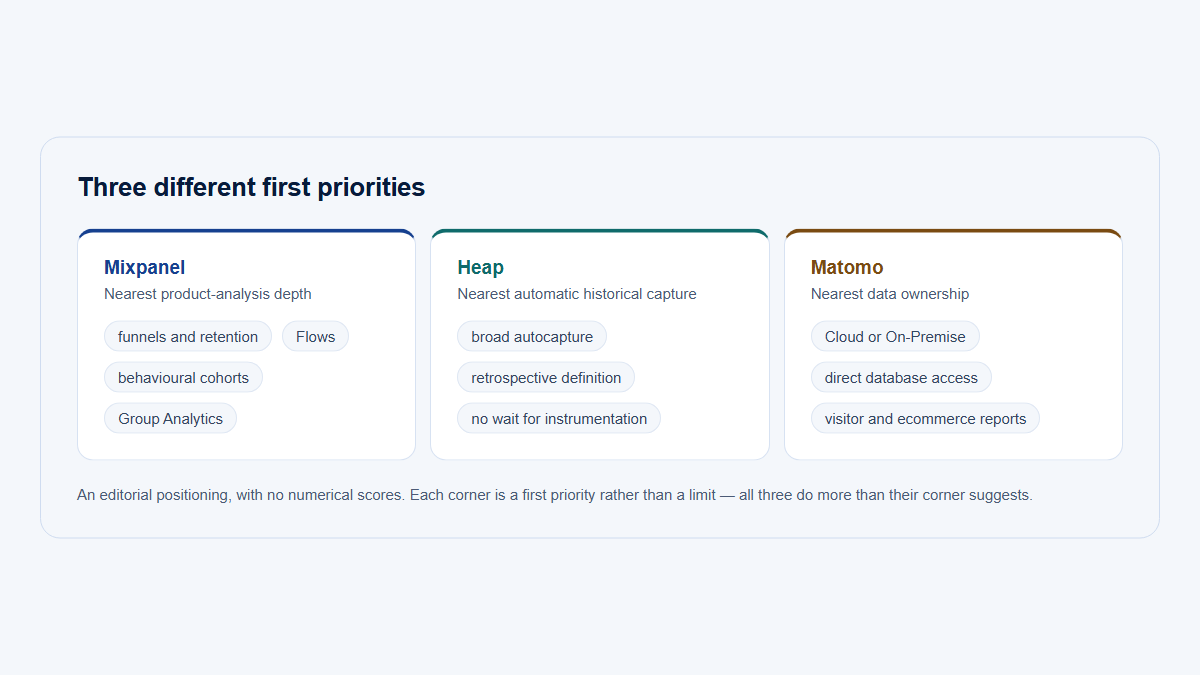
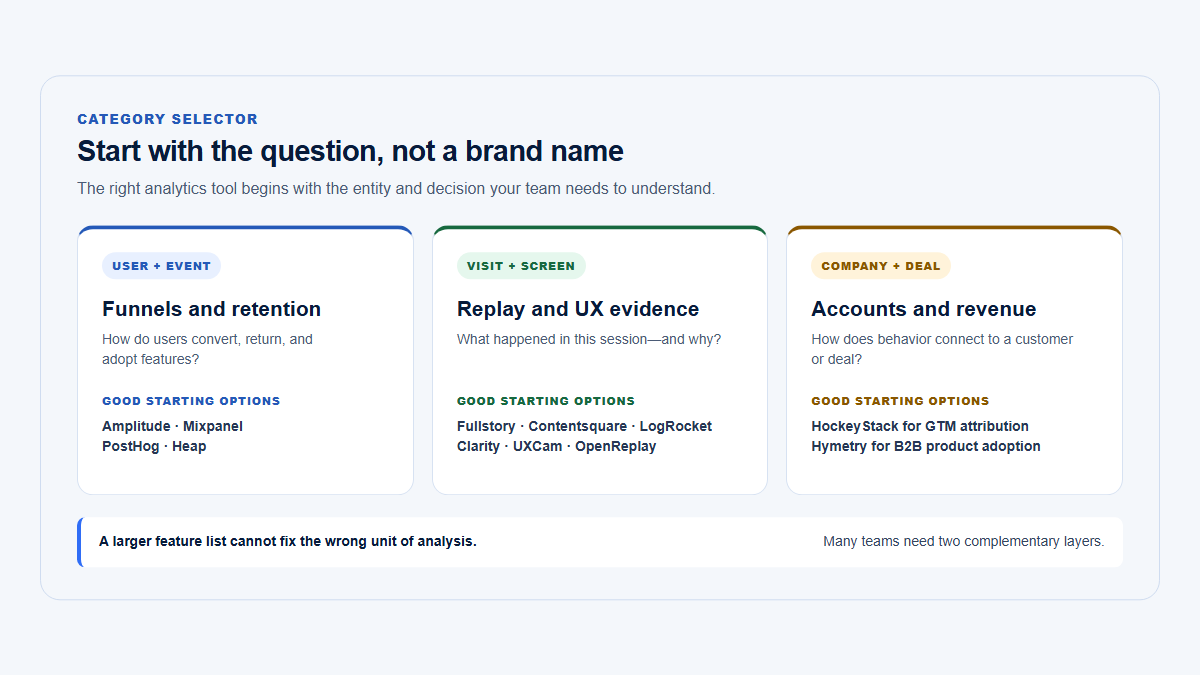
Looking for a wider market comparison? Read Mixpanel vs Heap vs Matomo or explore the product analytics tools comparison.
Quick comparison
The practical dividing line is not whether either platform can track an event; it is which workflows feel native after the data arrives.
| Criterion | Mixpanel | Matomo |
|---|---|---|
| Primary job | Analyze behavioral events from identified and anonymous users across web and mobile products. | Analyze visitors, acquisition, campaigns, goals, ecommerce, and website behavior with Cloud or On-Premise deployment. |
| Website and ecommerce | Campaign, attribution, cart, and purchase analysis are available in an event-first model. | Stronger website workflow Dedicated acquisition, campaign, goal, and ecommerce reports. |
| Funnels, retention, and cohorts | Native product workflow Funnels, retention reports, and behavioral cohorts are central. | Funnels and Cohorts are included in Cloud and available in paid On-Premise packaging; returning-visitor reports remain part of Core. |
| Identified users and companies | User profiles and identity merging; paid Group Analytics adds account, company, device, or other group keys. | User ID and Visitor Profiles connect known activity; company context needs governed dimensions and segments rather than a first-class group layer. |
| Session replay | Web, iOS, Android, React Native, and Electron support connected to product analysis. | Heatmaps & Session Recording focuses on website sessions; Matomo mobile tracking does not make it native-app replay. |
| Experiments and flags | Enterprise add-ons for Feature Flags and Experiments. | A/B Testing supports browser, server-side, mobile, and desktop experiments; it is not a general-purpose feature-flag service. |
| Raw data and warehouse | UI/CSV exports, Query API, paid Data Pipelines, and warehouse connectors; no direct access to the managed datastore. | Cloud APIs and export processes; On-Premise provides direct database control and the associated operating responsibility. |
| Hosting | No On-Premise platform A tracking proxy does not self-host Mixpanel analytics. | Cloud or On-Premise The self-hosted edition is a genuine customer-operated application. |
| Pricing model | Free includes 1M monthly events and 10K replays; Growth adds event overage and 20K replays; advanced capabilities can be add-ons. | Cloud starts at $26 monthly for 50K hits; On-Premise Core has no license fee, but infrastructure, support, and premium modules add cost. |
| Customer signal and main limit | 4.5/5 from 1,371 G2 reviews. Cost and governance can become harder as events, replay, groups, and teams grow. | 4.2/5 from 96 G2 reviews. Deep product behavior often needs more modeling and paid modules. |
Packaging matters: “Supported” does not mean included everywhere. Mixpanel groups, pipelines, flags, and experiments may require add-ons or Enterprise; Matomo Cloud includes a broad set, while free On-Premise Core excludes premium modules. Both stretch outside their core workflow, so verify the current Mixpanel plans and Matomo plans before buying.
Website analytics versus product analytics
Matomo is usually the more natural website system, while Mixpanel is usually the more natural authenticated-product system.
| Workflow | Mixpanel | Matomo | What the difference means |
|---|---|---|---|
| Visitors | Anonymous and identified users through distinct IDs and event properties. | A website-oriented visitor and visit model with acquisition and visit history. | Mixpanel starts with behavior; Matomo starts with the visit and traffic source. |
| Campaigns | Campaign reporting and multi-touch attribution in paid workflows. | Campaigns, referrers, channels, and acquisition reports are core concepts. | Matomo needs less translation for marketing reporting. |
| Ecommerce | Product views, carts, checkout, and purchases modeled as events and properties. | Dedicated reports for orders, products, revenue, taxes, shipping, coupons, and sources. | Mixpanel is flexible for journeys; Matomo is more prescriptive for website commerce. |
| Custom events | A foundational model across web, mobile, and server sources. | Supported through trackers, SDKs, and Events reports. | Both support events; Mixpanel builds more exploration around them. |
| Identified users | Profiles, identity merging, user properties, and cross-device behavior. | User ID can connect authenticated visits and devices. | Both follow known users, but Mixpanel makes identity more central analytically. |
| Funnels | Native and closely connected to segmentation, cohorts, and experiments. | Cloud or paid On-Premise | Matomo answers funnel questions, but packaging and workflow differ. |
| Retention | Dedicated retention reports and behavioral cohorts. | Returning-visitor reports plus Cohorts in Cloud and paid On-Premise packaging. | Mixpanel is usually more direct for recurring product behavior. |
| Account groups | Paid Group Analytics for companies, workspaces, subscriptions, or another group key. | Custom dimensions and segments; no equivalent first-class group layer. | B2B account analysis needs less custom modeling in Mixpanel if the add-on is acceptable. |
| Replay | Replays linked to events, users, funnels, and supported web/native SDKs. | Heatmaps and recordings focus on website sessions and page behavior. | Mixpanel has broader product/native orientation; Matomo is strong for website UX review. |
| Experiments | Feature Flags deliver variants; Experiments evaluates exposure and outcomes. | A/B Testing can run in browsers, servers, mobile, or desktop apps. | Mixpanel combines flag delivery and analysis; Matomo does not offer the same general-purpose flag layer. |
Website and campaign analysis, or identified product behaviour
Matomo
Website, campaign and ecommerce analysis
Overlapping capabilities
Mixpanel
Identified product behaviour
Before and around acquisition After identification
The overlap is genuine, so both will demo credibly. The decision follows which side of signup your team's recurring questions live on.
Choose by workflow, not a generic feature checklist: marketing may own acquisition, while product and growth own authenticated activation and retention. The B2B product analytics guide explains the account context.
Identity, companies, and behavioral analysis
Mixpanel has the clearer path from an identified user to a behavioral cohort or account group; Matomo can identify users but remains more visitor- and website-oriented.
- Mixpanel: user profiles plus the paid Group Analytics add-on for a company, workspace, subscription, device, or other group key. It is not a CRM or customer-success system.
- Matomo: User ID and Visitor Profiles across visits and devices. Custom dimensions and segments can represent business attributes, but the public documentation shows no equivalent first-class account layer.
| Signal or workflow | Mixpanel | Matomo | Recommended owner |
|---|---|---|---|
| Campaign | Store campaign properties and attribute later product events. | Use campaign, referrer, channel, landing-page, and conversion reports. | Marketing |
| Signup | Start an activation funnel with a signup event. | Track a goal or funnel step and preserve campaign context. | Growth |
| Identified user | Identify the user, attach profile properties, and merge behavior as configured. | Set a User ID to connect authenticated visits and devices. | Product analytics |
| Company identity | Add a company or workspace key through Group Analytics. | Use a governed organization dimension or property. | Data and product operations |
| Activation | Build a funnel and segment by source, role, plan, or company. | Use Goals and Funnels, subject to deployment packaging. | Product growth |
| Reporting adoption | Compare Reporting events by user and company. | Track events and segment by user or organization attributes. | Product |
| Returning users | Use retention reports and behavioral cohorts. | Use returning-visitor reports and Cohorts where included. | Product and marketing |
| Replay | Review product sessions tied to events, funnels, users, and supported native apps. | Review website recordings around landing, signup, and checkout flows. | UX research |
| Experiment | Deliver variants with Feature Flags and evaluate with Experiments. | Use A/B Testing for browser, server-side, or SDK-based experiments. | Growth and engineering |
| Raw-data export | Use exports, Query API, Data Pipelines, or warehouse connectors by plan. | Use APIs, Cloud exports, or direct database access On-Premise. | Data engineering |
Clearline Ops is fictional. Its handoff must preserve campaign context, a stable user ID, company association, and activation criteria. See the instrumentation plan, company analysis, and account versus user adoption.
Four stages, and what the handoff has to carry
1
Public website
2
Signup and identity handoff
3
Authenticated product
4
Company adoption analysis
Matomo measures
Mixpanel measures
The handoff
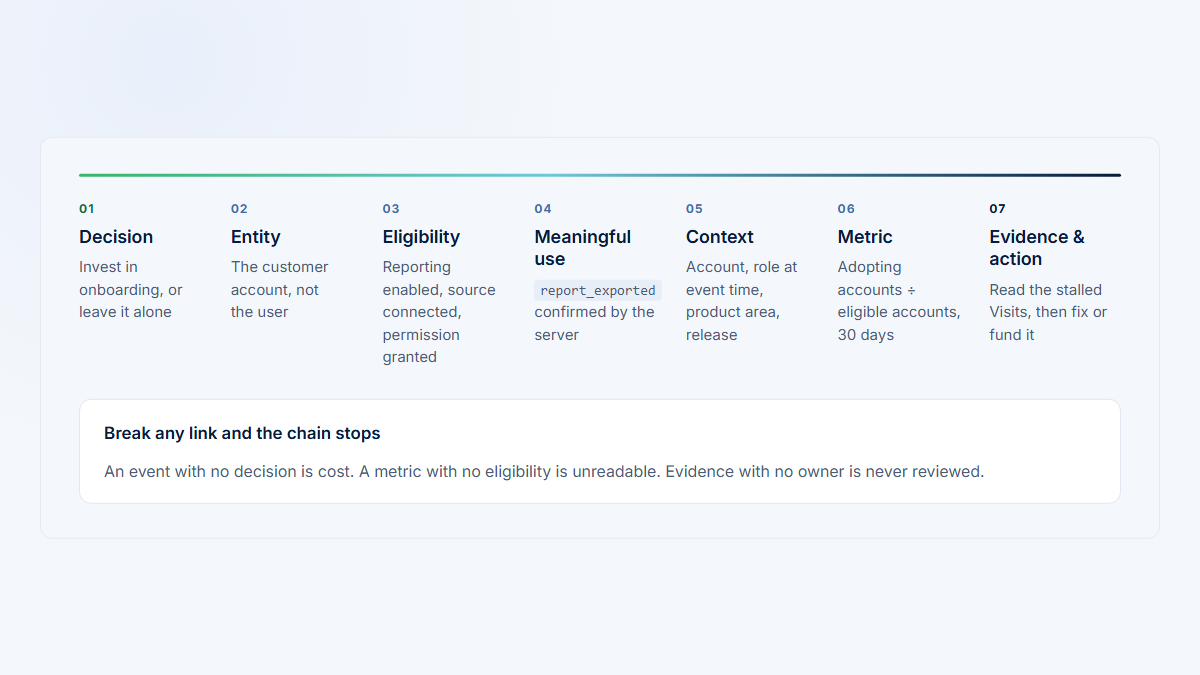
The handoff has to carry four things across signup: campaign parameters, consent state, a permitted anonymous identifier and a stable post-authentication user ID. Company analysis at stage 4 then needs account identity, adoption breadth, user participation and activity concentration — none of which stage 3 gives you on its own.
Replay, experiments, and data access
Mixpanel offers the broader product-analysis combination of replay, native-app support, flags, and experiments; Matomo combines website replay and A/B Testing with stronger On-Premise data control.
Session replay
Mixpanel Session Replay supports web, iOS, Android, React Native, and Electron. Free has 10,000 monthly replays; Growth and Enterprise have 20,000. Default retention is 30 days; an Enterprise paid add-on allows 7–360 days.
Web recording masks text and inputs and blocks images and video by default, but teams must test privacy settings. Matomo Heatmaps & Session Recording is website-only. Its mobile SDKs track apps but do not record native-app sessions.
Experiments and feature flags
Mixpanel separates delivery from evaluation: Feature Flags rolls out variants, while Experiments evaluates exposures. Both were separately priced Enterprise add-ons.
Matomo A/B Testing supports browser, server-side, mobile, and desktop experiments. It is not a general-purpose feature-management service equivalent to Mixpanel Feature Flags.
Exports, APIs, and warehouses
Mixpanel offers UI, CSV, and report exports; a Growth/Enterprise Query API; paid Data Pipelines; and warehouse connectors. None provides direct access to its internal database.
Both Matomo editions have reporting APIs. Cloud offers a warehouse connector and raw export but no direct MySQL access. On-Premise gives direct database control plus responsibility for performance, security, backups, and upgrades.
Product workflow videos
No independent comparison video was embedded because the reviewed material did not add sufficiently current, decision-relevant evidence.
Hosting, privacy, and operating responsibility
Matomo gives buyers a genuine On-Premise choice; Mixpanel and Matomo Cloud reduce infrastructure work but do not remove the customer’s responsibility for capture, consent, retention, and governance.
| Responsibility | Mixpanel SaaS | Matomo Cloud | Matomo On-Premise |
|---|---|---|---|
| Deployment | Vendor-managed SaaS. | Vendor-managed Cloud. | Customer-managed application and infrastructure. |
| On-Premise | Not available for the analytics platform; a tracking proxy is still a proxy. | Not applicable. | Supported and central to the edition. |
| Database | Mixpanel operates the datastore; customers use exports, APIs, pipelines, and connectors. | Matomo operates the database; customers use the UI, APIs, connector, and export process. | The customer controls and operates the database. |
| Backups | Vendor platform operations; customers define their own export and continuity needs. | Managed backups are part of Cloud operations. | The customer designs, tests, monitors, and restores backups. |
| Updates | Applied by Mixpanel. | Applied by Matomo. | Planned and applied by the customer or hosting provider. |
| Infrastructure security | Vendor operates infrastructure; customer controls implementation, access, and governance. | Vendor operates Cloud; customer controls tracking and account configuration. | Customer owns server, network, database, secrets, patching, monitoring, and incidents. |
| Retention | Product and plan settings; replay has separate rules. | Plan and configuration determine raw-data retention and report availability. | Customer configures retention and provides storage and deletion processes. |
| Deletion | Documented controls, APIs, and support processes as applicable. | Matomo privacy and administration tools. | Customer operates application- and infrastructure-level deletion. |
| Cookies | SDK and implementation choices determine identifier and cookie behavior. | Cookie-based or cookieless configurations are available. | Cookie-based or cookieless configurations are available. |
| Consent | Customer integrates the appropriate consent or opt-out flow. | Customer configures consent behavior and surrounding systems. | Customer configures consent and operates the surrounding system. |
| Replay masking | Defaults reduce capture, but implementation must be tested. | Website recording masking must be configured and verified. | Customer configures, verifies, and maintains recording privacy rules. |
| Support | Plan-dependent vendor support; internal teams own instrumentation and governance. | Cloud includes vendor operations and plan-dependent support. | Community support unless paid support or a commercial bundle is purchased. |
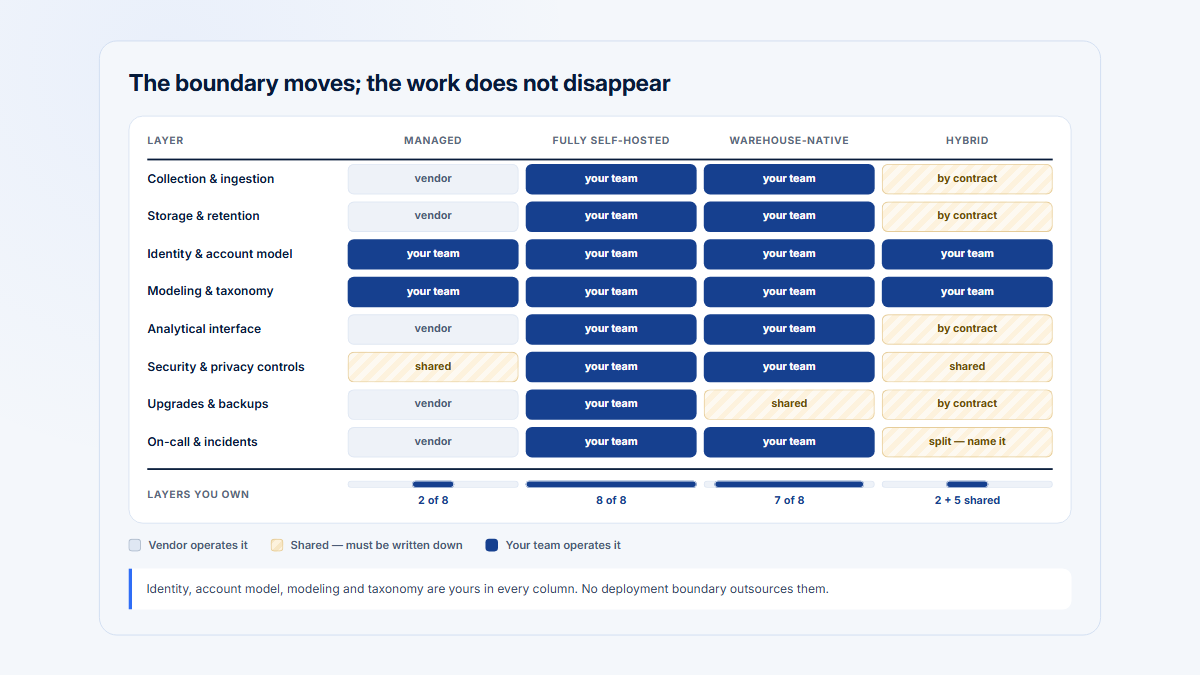
Three operating models, one constant
Mixpanel
Matomo Cloud
Matomo On-Premise
Event design and identity
Yours
Yours
Yours
Consent, masking, access
Yours
Yours
Yours
Retention and deletion requests
Your policy, vendor executes
Your policy, vendor executes
Your policy, you execute
Application and infrastructure
Vendor, plus managed data services
Vendor
You or your hosting provider
Backups, updates, monitoring, capacity
Vendor
Vendor
Yours, including support escalation
Filled means your team carries it. The first three rows are filled in every column — event design, consent and retention policy never transfer to a vendor, whichever model you choose.
See Mixpanel privacy controls, Matomo consent configuration, and the guide to self-hosted product analytics.
Pricing and customer feedback
Mixpanel’s cost follows behavioral volume and optional capabilities; Matomo’s cost follows hits in Cloud or infrastructure, operations, support, and premium modules On-Premise.
Mixpanel pricing
Mixpanel
- Free replay
- 10K monthly
- Growth replay
- 20K monthly included
- Growth overage
- $0.28 per 1K events after 1M
- Enterprise
- Quoted; add-ons can apply
Matomo pricing
Matomo
- Cloud trial
- 21 days
- On-Premise Core
- No software license fee
- Raw data
- 24 months in the entry Cloud plan
- Bundles
- €275 / €1,450 / €3,400 monthly
| Product or deployment | Free allowance or Core | Hosted or bundle starting model | Billing unit | Add-ons or modules | Main cost drivers | G2 rating | Official source |
|---|---|---|---|---|---|---|---|
| Mixpanel Free, Growth, Enterprise | Free: 1M events and 10K replays monthly. | Growth: first 1M events free, then $0.28 per 1K at entry; Enterprise quoted. | Events, replay, contract. | Groups, pipelines, flags, experiments, extra replay, support. | Volume, replay, add-ons, governance. | 4.5/5, 1,371 reviews | Pricing · billing guide |
| Matomo Cloud Business | 21-day trial; no permanent free plan. | $26 monthly for 50K hits; annual billing and volume affect the total. | Hits. | Funnels, Cohorts, Custom Reports, replay, and A/B Testing included within quotas. | Hits, quotas, retention, support. | 4.2/5, 96 reviews | Pricing |
| Matomo On-Premise Community | GPL v3-or-later Core; no license-level user or hit cap. | Customer hosted. | Infrastructure, not a Core meter. | Several reporting, replay, and experiment modules are premium. | Infrastructure, backups, upgrades, security, expertise, support. | 4.2/5, 96 reviews | Licences |
| Matomo On-Premise bundles | Core remains free. | Monthly: Team €275, Business €1,450, Enterprise €3,400. | Tier, users, hits, infrastructure. | Team adds Funnels and replay; Business Cohorts; Enterprise A/B Testing and more modules. | Tier, usage, support, operations. | 4.2/5, 96 reviews | On-Premise pricing |
Detailed pricing notes
- Mixpanel Growth includes 1M monthly events. The entry billing example charges $0.00028 per extra event, plus 20% for Data Pipelines or 40% for Group Analytics on applicable extra data; other contracts differ.
- Entry Matomo Cloud includes 30 sites and members, 100 segments, 150 goals, 30 dimensions, 24 months of raw data, and retained reports.
- Monthly On-Premise bundles allow 4 users/5M hits, 20/30M, or 50/100M by tier; annual equivalents are lower.
- Recheck tax, currency, billing cycle, quotas, implementation, and module packaging.
What “free” actually means
Mixpanel’s free tier is a vendor-hosted allowance: the customer avoids platform operations but must stay within event, replay, report, and feature limits.
Matomo On-Premise Core is free software: the customer avoids a Core license fee but owns database capacity, storage, backups, upgrades, security, monitoring, support, and staff time.
| Product | Rating and review count | Common praise | Common criticism |
|---|---|---|---|
| Mixpanel | 4.5/5 from 1,371 reviews | Self-serve analysis, funnels, boards, segmentation. | Learning curve, taxonomy work, cost as usage grows. |
| Matomo | 4.2/5 from 96 reviews | Data control, website reporting, unsampled data, deployment choice. | Self-hosted operations, advanced analysis, premium modules. |
The review counts are materially different. Treat ratings as a directional customer-feedback signal, not a statistically normalized benchmark.
Which should you choose?
The best choice follows the surface being measured, the identity model, and the operating constraint—not the longest feature list.
| Scenario | Recommended approach | Why | Watch for |
|---|---|---|---|
| Marketing website | Matomo | Acquisition, campaign, landing-page, visitor, goal, and conversion workflows. | Campaign taxonomy, consent, bots, internal traffic, cookies, retention. |
| Ecommerce website | Usually Matomo | Dedicated reports connect products, orders, revenue, coupons, and acquisition. | A product-led team may add Mixpanel for behavioral journeys and experiments. |
| B2B SaaS public site | Matomo for the public site | Marketing needs campaign, content, signup, and attribution before authentication. | Preserve campaign context when a visitor becomes a known user. |
| Authenticated SaaS app | Usually Mixpanel | Event exploration, funnels, retention, cohorts, users, replay, experiments. | Govern event taxonomy, identity, autocapture, and volume. |
| Product-growth team | Mixpanel | Activation, retention, cohorts, replay, flags, and experiment analysis are integrated. | Reverify add-on and Enterprise packaging. |
| On-Premise requirement | Matomo On-Premise | Genuine self-hosted analytics and direct database control. | Budget infrastructure, backups, updates, security, monitoring, and support. |
| Customer-success behavior | Mixpanel groups or an account-centric layer | Company groups can show adoption and behavior by account. | Group Analytics is not a full customer-success platform. |
| Website plus product analysis | Matomo and Mixpanel with explicit ownership | Each platform owns the workflow closest to its center. | Avoid duplicate capture, mismatched identity, conflicting definitions, and uncontrolled cost. |
| Question | Short answer | Rebuild or loss |
|---|---|---|
| Can Mixpanel replace Matomo? | Sometimes, if an event-first managed platform can own website measurement. | Rebuild acquisition, goals, ecommerce, consent, and reports; lose On-Premise and direct database ownership. |
| Can Matomo replace Mixpanel? | Sometimes for website-first organizations and simpler app analytics. | Rebuild events, funnels, cohorts, company modeling, and experiments; premium modules may be required. |
| Should a company use both? | Often, when public marketing and the authenticated product are distinct systems. | Assign metric ownership, preserve campaign and identity handoffs, prevent duplication, and plan historical access. |
Compact coexistence architecture
Matomo
  public website · campaigns · acquisition · goals · ecommerce

Mixpanel
  authenticated product · funnels · retention · groups · replay · experiments
This separation works only when ownership is explicit. A “signup” should not have three incompatible definitions across marketing, product, and finance dashboards.
Migration checklist
- Inventory dependencies: list decisions, reports, alerts, experiments, and exports.
- Map the model: document pages, events, identities, goals, funnels, campaigns, consent, and replay.
- Validate in parallel: compare trends during a controlled overlap; sessions, bots, identity, time zones, and attribution can change totals.
- Preserve history: export required data and reports because dashboards rarely transfer directly.
- Retire duplicates: remove old tracking and replay only after owners validate the new workflow.
Editorial inference: replacement and migration recommendations synthesize documented product models; they are not vendor guarantees.
Where Hymetry fits
Hymetry is narrower than either platform’s broadest category: it does not replace Matomo for public-site analytics and does not match Mixpanel’s general behavioral-analysis depth.
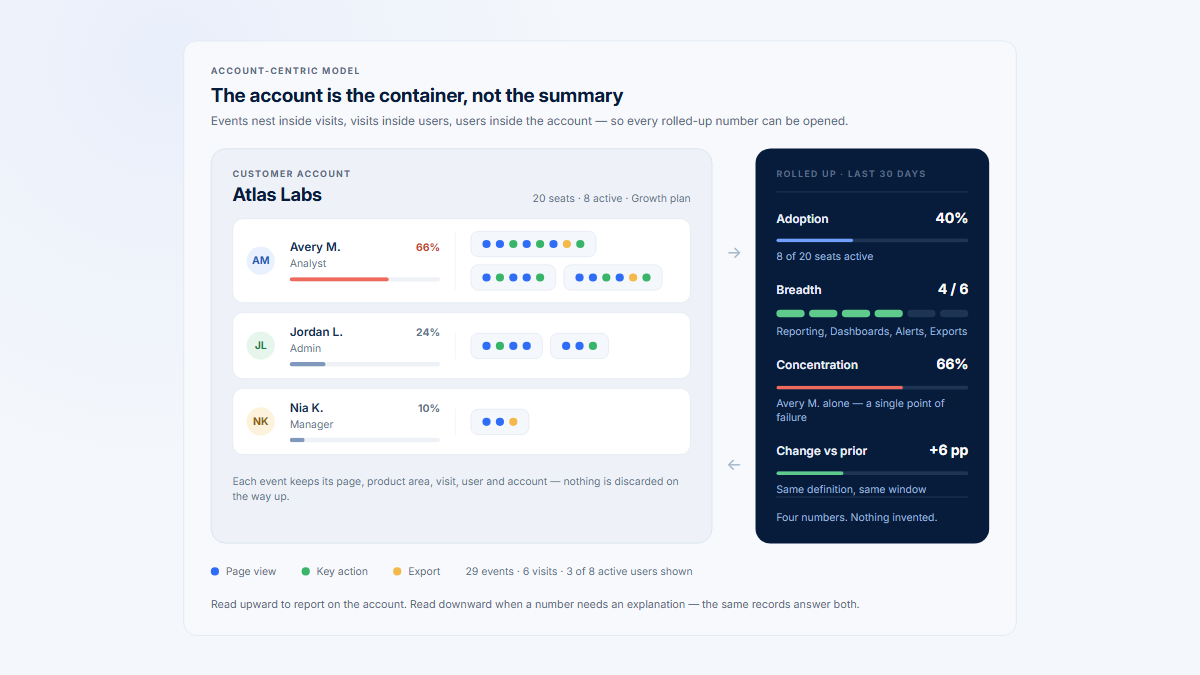
Hymetry connects B2B product areas, grouped Pages, Companies, Users, account adoption, user penetration, concentration, and Visits as session evidence.
Matomo for public-site analytics
+
Hymetry for authenticated B2B account usage
That stack is relevant when Matomo owns campaigns and website conversion while Hymetry explains which customer accounts adopt product areas, whether usage is broad or concentrated, which users participate, and which Visits provide evidence.
- Hymetry is not positioned as anonymous marketing-site analytics.
- It does not provide Mixpanel’s full general-purpose event-analysis, feature-flag, or experimentation breadth.
- It is not a full CRM or customer-success workflow platform.
- Account, risk, friction, and expansion signals require human review and are not guaranteed outcomes.
For the wider category, see product analytics tools. For implementation concepts, read B2B product analytics, product usage by company, and account versus user adoption.
FAQ, methodology, and sources
This comparison is a source-backed fit analysis, not a laboratory benchmark or a legal compliance assessment.
Can Mixpanel replace Matomo?
Yes, if an event-first managed platform can own website measurement and On-Premise is unnecessary. Acquisition, goals, ecommerce, consent, and reporting history still require a deliberate migration.
Can Matomo replace Mixpanel?
Sometimes for website-first teams or simpler app analytics. The fit weakens when deep retention, first-class account groups, native-app replay, feature flags, or integrated experiment analysis are central.
Which is better for product analytics?
Mixpanel is usually stronger because funnels, retention, behavioral cohorts, profiles, replay, groups, and experiments are central. Matomo supports events, User ID, funnels, cohorts, and mobile SDKs but typically needs more modeling.
Which is better for website analytics?
Matomo is usually more natural for acquisition, campaigns, goals, ecommerce, visitor reports, and Cloud or On-Premise choice. Mixpanel handles web analytics, but its deeper advantage is product behavior.
Which product can be self-hosted?
Matomo On-Premise. Mixpanel has no self-hosted analytics platform; a tracking proxy does not move its application and datastore into the customer’s infrastructure.
Should a SaaS company use both?
Yes, when Matomo owns public-site acquisition and conversion while Mixpanel owns authenticated activation, retention, replay, and experiments. Coordinate identity, campaign context, consent, definitions, and duplicate collection.
Where does Hymetry fit?
Hymetry connects B2B Pages, Companies, Users, account adoption, participation, concentration, and Visits. It can complement Matomo for authenticated account usage without replacing Matomo’s public-site analytics or Mixpanel’s broader analysis.
Sources
Official vendor sources support product claims; G2 supplies only ratings and review themes. The visible FAQ feeds FAQ structured data.
Methodology and evidence limits
- Verified: Product, pricing, licensing, ratings, and videos on August 11, 2026.
- Sources: Official documentation and pricing first; G2 only for ratings and review themes.
- Evidence: Documented details are facts; fit, replacement, architecture, and migration guidance are editorial inferences.
- Testing: No undocumented implementation, benchmark, or controlled product test is claimed.
- Pricing: Snapshots exclude tax, discounts, implementation, infrastructure, and labor.
- Limits: Ratings are not normalized, and privacy discussion is not legal advice.
Full source directory
Mixpanel official documentation
- Mixpanel product overview
- Mixpanel pricing
- Mixpanel billing guide
- Group Analytics
- Session Replay
- Session Replay privacy controls
- Feature Flags
- Experiments
- JavaScript SDK and autocapture
- Mixpanel SDKs
- Export methods
- Data Pipelines
- Warehouse Connectors
- Protecting user data
Matomo official documentation
- Matomo product features
- Goals and conversions
- Ecommerce reports
- Funnels guide
- Funnels plugin
- Cohorts plugin
- Custom Reports plugin
- Heatmaps & Session Recording
- A/B Testing
- Tracking clients and mobile SDKs
- A/B Testing developer guide
- Raw data and warehouse export
- Exporting data to other tools
- Tracking consent
- Privacy settings
- Data retention
- Installation and maintenance
- Cloud and On-Premise pricing
- Matomo licences
- Core, tracker, and plugin licence FAQ
Customer reviews and videos
- Mixpanel reviews on G2
- Matomo reviews on G2
- G2 comparison page
- Official Mixpanel demonstration
- Official Matomo dashboard workflow
- Matomo official video library
No independent editorial source supported product claims. Both videos are official vendor workflows, not independent comparisons.