Quick comparison
The old shorthand that Amplitude is only for logged-in product behavior and GA4 is only for pageviews is no longer useful. GA4 has an event model, User-ID, funnels, paths, cohorts, and BigQuery export. Amplitude now offers substantial web, campaign, attribution, ecommerce, and marketing-analysis workflows.
| Question | Short answer | What would be lost or rebuilt |
|---|---|---|
| Can Amplitude replace GA4? | Sometimes, particularly when Google Ads and standard ecommerce reporting are not central. | You may need to rebuild familiar acquisition reports, channel governance, Google advertising workflows, ecommerce conventions, and campaign-cost processes. |
| Can GA4 replace Amplitude? | Sometimes, for a simpler product or a data team prepared to build the missing layer. | You may need to rebuild reusable retention and behavioral analysis, native replay, feature flags, experimentation, guides, and first-class account modeling. BigQuery export alone does not create a usable product-analytics system. |
| Should a SaaS company use both? | Often, when public acquisition and authenticated product adoption serve different operating teams. | You must define metric ownership, shared identifiers, canonical events, attribution semantics, and warehouse reconciliation before trusting cross-platform numbers. |
| Can Amplitude cover marketing analysis? | Yes, for many web, campaign, attribution, and ecommerce questions. | Standard Google Ads workflows, familiar channel reporting, and Google-centered media operations may still need GA4 or a rebuilt process. |
| Can GA4 cover product analysis? | Yes, when its event model and Explorations are enough for the team's recurring questions. | Native replay, account analytics, flags, experiments, guides, and reusable product-decision workflows would require adjacent products or custom work. |
| Does a warehouse make them equivalent? | No. It can reconcile data without recreating either product's operating experience. | The warehouse can own commercial truth, but analysts still need defined event, identity, attribution, session, and metric-ownership rules. |
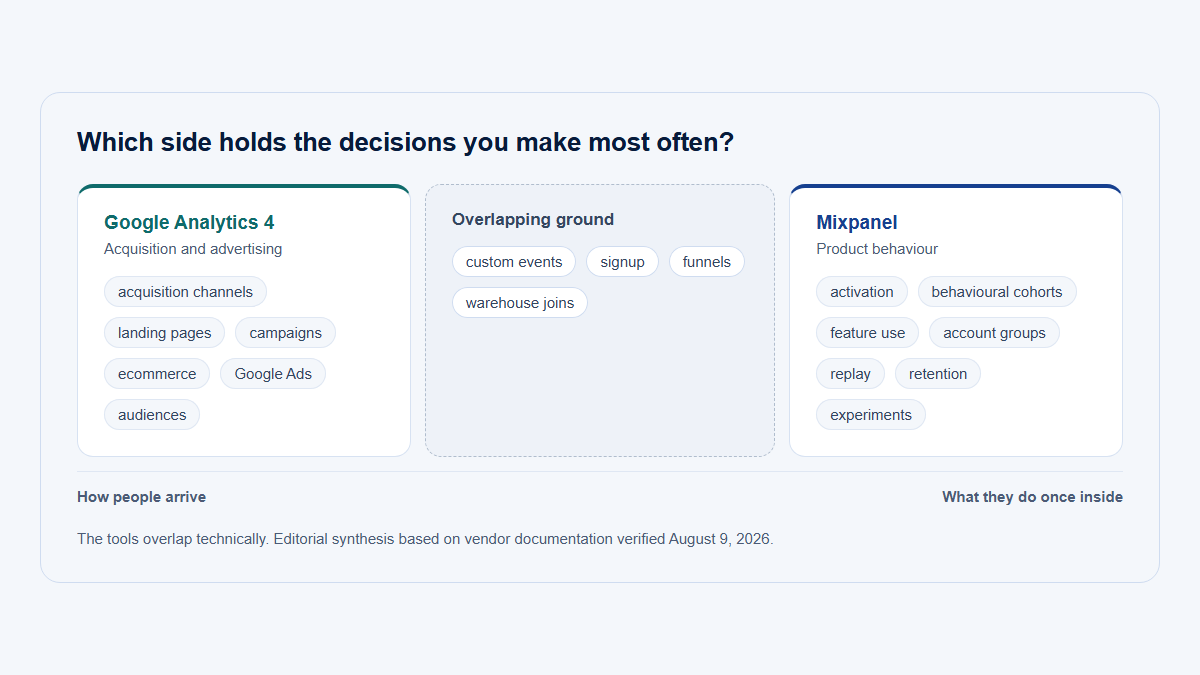
The overlap is real; the strongest workflows sit at opposite ends
Google Analytics 4
Acquisition and advertising
Both do this
Amplitude
Product intelligence
Decisions before signup Decisions after identification
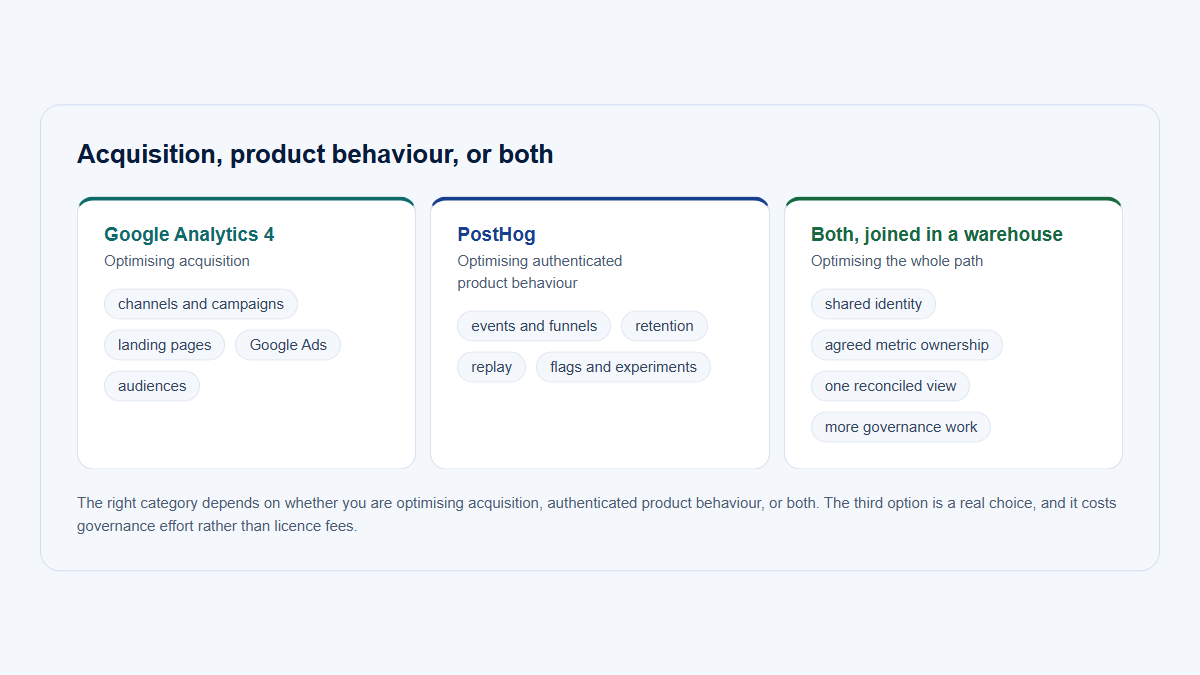
The tools overlap technically. The buying decision depends on which side holds the decisions your team makes most often.
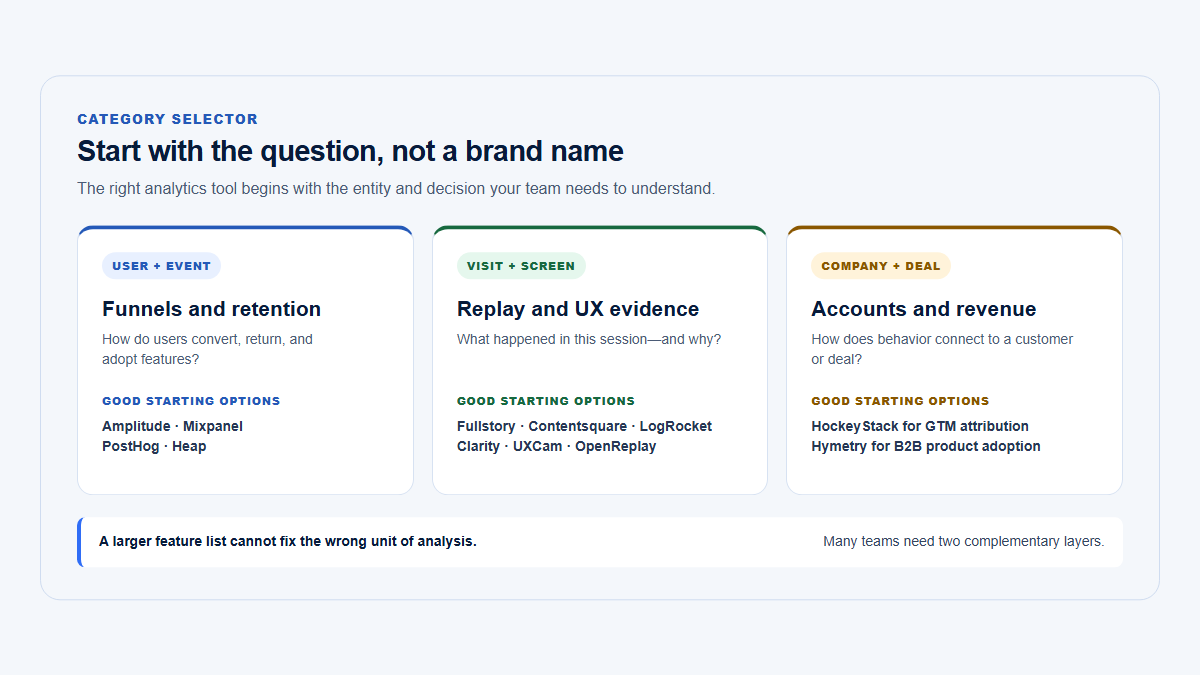
For the broader landscape, compare the options in Hymetry's product analytics tools guide.
Product analytics and user behavior
Amplitude remains deeper and faster for repeated product-behavior analysis, but GA4 is capable of much more than pageview reporting when it is instrumented as an event system.
| Capability | Amplitude | Google Analytics 4 | What this means |
|---|---|---|---|
| Product events and identified users | Event-first analysis with device and user identity, reusable behavioral properties, cohorts, and governed definitions. | Event-first collection with anonymous identifiers, optional User-ID, user properties, and event parameters. | Both can measure product events. Identity continuity and event quality matter more than the category label. |
| Funnels and retention | Flexible funnels and retention analyses designed for recurring product questions and reusable behavioral cohorts. | Open and closed Funnel Explorations, Cohort Exploration, user-lifetime analysis, and segments. | GA4 can answer funnel and retention questions, but Amplitude usually makes repeated analysis more accessible to product teams. |
| Behavioral cohorts and journeys | Behavioral cohorts, segmentation, journey and path analysis, and direct reuse across charts and activation. | User, session, and event segments plus path, cohort, overlap, and user explorations. | Both can investigate sequences; Amplitude's workflow is more tightly centered on behavioral reuse. |
| Account or group analysis | Higher tier The Accounts package adds account-level reporting, bucketing, and group-level experimentation. | Not native Model a company with event parameters, custom dimensions, or BigQuery. | GA4 can store company context, but teams must define membership, aggregation, and multi-account rules themselves. |
| Public traffic and landing pages | Web Analytics captures pageviews, sessions, clicks, traffic, conversions, channels, campaigns, and landing-page performance. | Pages and Screens, Landing Page, User Acquisition, and Traffic Acquisition reports are core workflows. | GA4 remains more familiar for conventional website reporting, but Amplitude has meaningful overlap. |
| Campaigns and attribution | UTM and referrer channel classification, multi-touch attribution, campaign analysis, and ROAS through connected advertising or warehouse data. | First-user and session acquisition, UTM and auto-tagging support, Advertising workspace, data-driven attribution, key-event attribution paths, and attribution-model comparison. | GA4 has the stronger standardized advertising ecosystem; Amplitude better connects acquisition to later product behavior. |
| Ecommerce | Ecommerce dashboards and behavioral analysis can connect product discovery, conversion, repeat use, and revenue. | Recommended ecommerce events and monetization reports cover item views, cart, checkout, purchase, revenue, and product performance. | GA4 is the safer default for standard ecommerce reporting; Amplitude can add deeper behavioral context. |
| Advertising audiences | Behavioral cohorts can sync to destinations through Activation and supported integrations. | Audiences and key events connect directly to Google Ads, Display & Video 360, and Search Ads 360 subject to eligibility and configuration. | GA4 is stronger when the analytics audience becomes a Google media audience. |
| Replay and experimentation | Native replay, heatmaps, feature flags, feature experiments, web experiments, guides, and surveys. | No native GA4 replay. Firebase A/B Testing and Remote Config are adjacent options; other teams use third-party tools. | Amplitude is more complete when analysis must lead immediately to product or experience changes. |
Funnels, cohorts, paths, replay, and attribution show association and sequence, not causal lift. Treat them as evidence for hypotheses. Reserve causal claims for a valid experiment with stable assignment, measured exposure, adequate power, and pre-specified success metrics.
A reliable comparison also depends on a shared event vocabulary. See B2B product analytics and the product analytics instrumentation plan.
Acquisition, campaigns, and ecommerce
GA4 still has the clearer starting advantage for public acquisition, ecommerce, and paid-media operations, while Amplitude now offers enough marketing depth to be a serious alternative or complement.
GA4 advantage
Established acquisition workflows
GA4 provides User Acquisition and Traffic Acquisition reports, UTM and Google auto-tagging support, session attribution, key-event attribution paths, ecommerce reporting, and direct Google advertising integrations. It is the natural starting point when the next decision concerns channel performance, a Google Ads audience, a purchase journey, or media allocation.
Amplitude overlap
Marketing depth is real
Amplitude Web Analytics covers pageviews, sessions, clicks, traffic, conversions, channels, and campaigns. Current marketing workflows also include UTM and referrer classification, multi-touch attribution, ROAS through supported advertising or warehouse data, replay, heatmaps, web experimentation, guides, and surveys.
Practical boundary
Match the next decision
Choose GA4 when marketing operations need standard channel, advertising, and ecommerce conventions. Choose Amplitude when campaign quality must be judged by later activation, feature adoption, retention, or experiment outcomes rather than by signup volume alone.
An analytical handoff, not a vendor integration
1
Campaign
2
Public website
3
Signup
4
Identified user
5
Customer company
6
Product adoption
GA4 strongest
Amplitude strongest
Shared boundary
Warehouse only
Identity begins anonymously, becomes a known user at signup, gains company context inside a B2B product, and is reconciled with commercial outcomes in the warehouse.
Preserve campaign context deliberately after signup. Capture first-touch and current-session UTM or referrer values before authentication, retain a stable link to the anonymous visitor, and decide whether each analysis uses first-touch, signup-touch, or current-session attribution. Do not combine those meanings under one generic “source” label.
Identity, accounts, and data architecture
The decisive architecture question is whether anonymous, signed-in, company, and campaign identity can survive the full journey without one metric taking on several incompatible meanings.
| Architecture question | Amplitude | Google Analytics 4 | Implementation note |
|---|---|---|---|
| Anonymous visitor | Uses a device identifier before a user ID is known. Anonymous history can be associated with an identified user when identity is implemented correctly. | Uses browser or app identifiers such as client_id or user_pseudo_id before a supplied User-ID is available. | Preserve the vendor-specific anonymous identifier through signup and test the transition. |
| Identified user | A stable user ID supports cross-session and cross-device analysis. | User-ID connects behavior across sessions and devices when the organization supplies a stable identifier. | Use a stable, non-PII internal identifier. Do not use email addresses as analytics IDs. |
| Company or group | Higher tier The Accounts package supports account-level analysis, group bucketing, and group experimentation. | Store a company ID as an event parameter or custom definition, then aggregate it in Explorations, reports, or BigQuery. | A custom company dimension does not automatically create account adoption, penetration, or account-health analysis. |
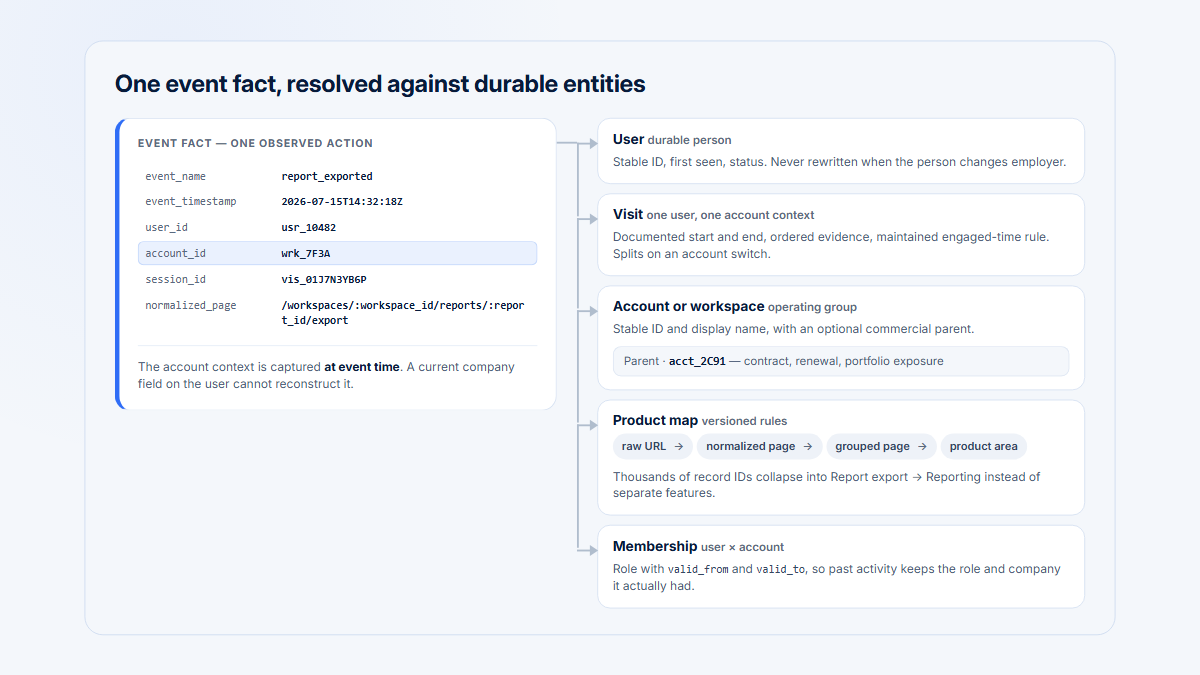
| Multi-account users | Send the relevant group or account context on each event and define how a user switching accounts should be analyzed. | Prefer event-scoped company context when one person can act in several accounts; a single user-scoped value can overwrite membership meaning. | Membership belongs to the event or product context, not necessarily to the person forever. |
| Campaign properties after signup | Campaign and attribution properties can connect to later product behavior when identity and persistence are implemented deliberately. | First-user and session traffic-source dimensions remain available, while custom persistence may be needed for a signup-specific source. | Decide which attribution scope owns each metric before building dashboards. |
| BigQuery or warehouse | Supports warehouse imports, exports, APIs, and destinations, with availability depending on plan and integration. | Provides direct BigQuery export. Standard daily batch export is limited to 1 million events; Analytics 360 allows up to 20 billion. Streaming has no stated event-volume limit, but is best-effort, can contain gaps, omits some new-user and new-session traffic-source data, and adds cloud cost. | Export is the beginning of a model, not a finished product-analytics system. |
| Raw export | Export APIs and supported destinations provide event-level access subject to product and plan details. | BigQuery provides event-level export with nested event, user, item, device, and traffic-source fields. | Document schema versioning, late-arriving data, deduplication, and transformation ownership. |
| Retention and deletion | Retention depends on plan and data type. Current pricing lists one year of analytics data access on Free, two years on Plus, and unlimited access on Growth and Enterprise. The newer replay overview documents one-month base raw-replay retention; expanded Growth and Enterprise replay packages advertise three-to-twelve-month options. Privacy APIs support deletion workflows. | User-level and key-event data have two- or fourteen-month choices in both Standard and 360. Analytics 360 adds 26-, 38-, and 50-month choices only for other eligible event data. These settings affect Explorations and funnel reports, not standard aggregated reports. Data-deletion requests are available. | Retention and deletion settings are technical controls, not legal conclusions. |
| Implementation responsibility | Taxonomy, identity, groups, campaign persistence, consent, governance, and QA remain customer responsibilities. | Tagging, ecommerce events, User-ID, custom definitions, consent, channel governance, BigQuery, and QA remain customer responsibilities. | Neither platform removes the need for a maintained measurement plan. |
A standard GA4 property supports 25 user-scoped, 50 event-scoped, and 10 item-scoped custom dimensions, plus 50 custom metrics and 5 calculated metrics. Treating every B2B concept as a new user-scoped dimension can therefore become limiting. More importantly, a stored company ID still needs definitions for active companies, account adoption, user penetration, membership changes, and users acting across several accounts.
Fictional B2B SaaS example: Veridian Cloud
Fictional scenario: Veridian Cloud runs paid campaigns, a public marketing site, signup and free trial, an authenticated multi-user product, onboarding, a Reporting feature, a product experiment, replay, a warehouse, and customer-success reviews.
| Signal or metric | Amplitude | Google Analytics 4 | Best owner of the metric |
|---|---|---|---|
| Campaign source | Captures UTMs and referrers, classifies channels, and can connect source to later behavior. | Captures UTMs, referrers, auto-tagging data, and first-user or session acquisition. | GA4 for acquisition reporting. |
| Signup | Track one canonical signup event and connect it to prior anonymous behavior. | Track the same canonical signup event or key event. | Shared event contract; warehouse reconciles duplicates and billing records. |
| Identified user | Set a stable user ID after authentication and validate anonymous-history association. | Set the same stable User-ID while preserving the anonymous identifier. | Authentication and identity service. |
| Company identity | Attach the customer company through the Accounts or group model. | Send company ID as event-scoped context and register only the dimensions needed in the interface. | Amplitude or the warehouse account model. |
| Activation | Define a governed sequence such as workspace created, teammate invited, and first report produced. | Build the same sequence with events, Funnel Exploration, or BigQuery. | Amplitude for product operations; warehouse for audited reporting. |
| Reporting adoption | Analyze use by user cohort and customer group, then compare repeat behavior. | Analyze a report_viewed or report_created event in Explorations or BigQuery. | Amplitude. |
| User penetration | Use account context plus a governed denominator for users active or eligible inside adopting companies. | Build distinct-user and company denominators in BigQuery or another modeled layer. | Account analytics model or warehouse. |
| Returning use | Use retention and behavioral cohorts for users and, where packaged, groups. | Use Cohort Exploration, return events, or BigQuery. | Amplitude for product decisions. |
| Replay | Open sessions connected to the relevant event, funnel, or user. | No native replay; pass context to a separate replay tool if one is used. | Amplitude or the selected replay product. |
| Experiment | Use feature or web experiments with assignment, exposure, and behavioral outcomes. | Use Firebase A/B Testing and Remote Config where appropriate, or a separate experiment platform. | Experiment platform; Amplitude when it runs the test. |
| Warehouse join | Export behavioral data and join it to subscription, account, and revenue records. | Export GA4 events directly to BigQuery and join to the same business tables. | Warehouse. |
The warehouse should resolve commercial truth such as subscription status and invoiced revenue, while the analytical products retain ownership of the behavioral questions they answer best.
One event contract, two products, separate session clocks
Before authentication
Join and contract
Consumers
A shared internal user ID helps, but campaign continuity and company reporting need server-side persistence and a governed warehouse model. Each product keeps its own session clock, so session counts will not match.
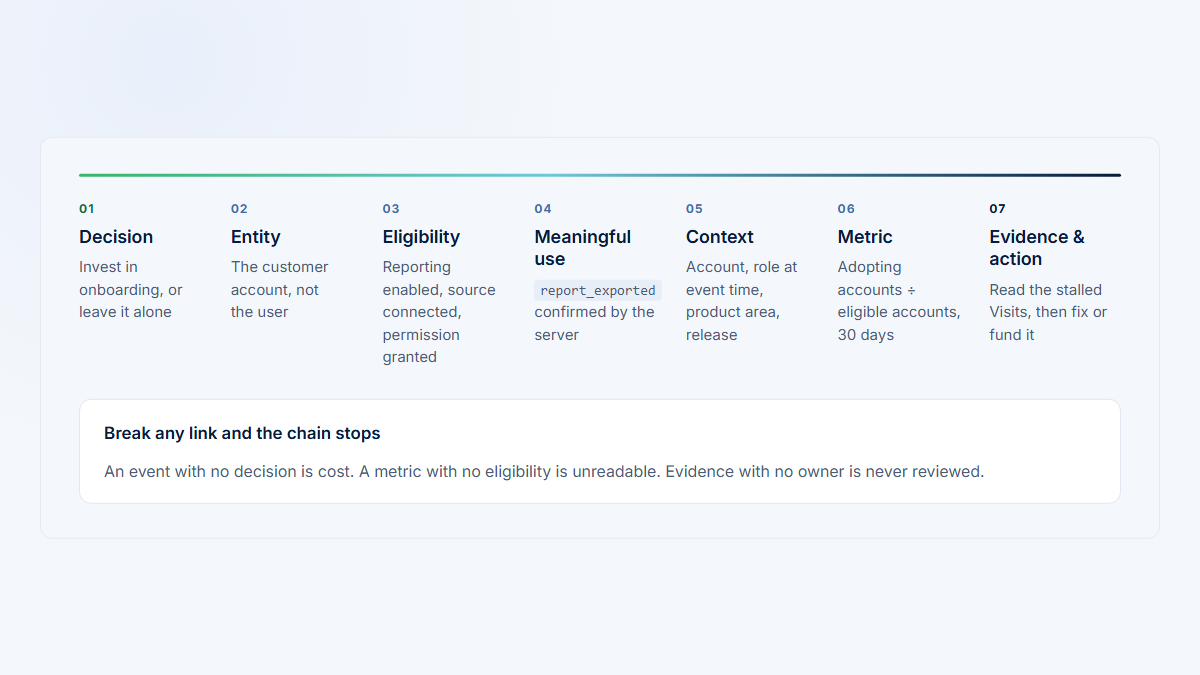
Metric ownership when using both
| Metric | Primary owner | Rule |
|---|---|---|
| Public website pageviews | GA4 | Use GA4's page and acquisition semantics for the public site. Authenticated product screens can be analyzed separately in Amplitude. |
| Signups | Canonical dual-sent event; warehouse reconciliation | Use one event definition and deduplicate against the application or billing record. |
| Activation | Amplitude | Define activation as a governed behavioral sequence, not a generic conversion flag. |
| Campaign attribution | GA4 | State whether the report uses first-user, session, key-event, or another attribution scope. |
| Company adoption | Amplitude or warehouse account model | Aggregate by company ID and preserve the active account on every relevant event. |
| Retention | Amplitude | Use a defined return event and population; do not equate every return session with retained product value. |
| Experiment results | Experiment platform or Amplitude | Use assignment and exposure data for causal analysis; use the warehouse for downstream revenue or contract outcomes. |
Rules that prevent contradictory metrics
| Risk | Required rule |
|---|---|
| Anonymous IDs | Retain each vendor's anonymous identifier until identification and test the signup transition. |
| User-ID | Use the same stable internal identifier and the same semantic definition in both products. |
| Company ID | Send the active company on every relevant authenticated event, especially for multi-account users. |
| UTM persistence | Preserve first-touch, signup-touch, and current-session values separately. |
| Duplicated events | Use one event schema and one intended firing path per destination; add server or client deduplication where needed. |
| Different session definitions | Document each platform's timeout and counting behavior. Do not expect session totals to match exactly. |
| Warehouse joins | Preserve stable user, company, event, transaction, and timestamp fields so behavioral and commercial data can be reconciled. |
For the account model behind these rules, see product usage by company, account versus user adoption, and the instrumentation plan.
Replay, experiments, and product action
Amplitude is the clearer choice when analysis must lead directly to replay, experimentation, feature rollout, guides, surveys, or audience activation.
| Action layer | Amplitude | Google Analytics 4 | Decision note |
|---|---|---|---|
| Session replay | Included Native replay connected to behavioral events and supported web or mobile implementations. | Not native | GA4 requires a separate replay product and identity bridge. |
| Heatmaps and page diagnosis | Native heatmaps and related web-analysis tools. | Not native | GA4 event data can identify a drop-off, but not visually replay it. |
| Feature flags | Native Feature Management and feature-flag workflows. | Firebase Remote Config is an adjacent Google product rather than a native GA4 feature-management workspace. | Keep the distinction clear in architecture and procurement. |
| Product and web experiments | Native Feature Experimentation and Web Experimentation; advanced packages vary by plan. | Firebase A/B Testing can use Analytics data with Remote Config or messaging; Google Optimize was discontinued on September 30, 2023. | Amplitude offers the more integrated product-to-experiment loop. |
| Guides and surveys | Native in-product Guides and Surveys with plan-dependent allowances. | Not native | A separate engagement or survey product is required with GA4. |
| Audience activation | Behavioral cohorts can sync to supported destinations through Activation. | Particularly strong for exporting audiences and key events into Google advertising products. | Amplitude emphasizes behavior-driven cohorts; GA4 emphasizes the Google media ecosystem. |
| Causal interpretation | Use experiment assignment, exposure, guardrails, and outcome metrics. | The same requirement applies to Firebase or third-party experiments. | Observational funnels, replay, and attribution do not prove causal lift. |
For the analytical handoff behind this workflow, read session replay versus product analytics.
Pricing and customer feedback
GA4 has the lower license-cost floor; Amplitude bundles more product-action capability, but event volume and paid packages can materially change the bill.
Amplitude pricing
Amplitude
2M events
- Free replay
- Verify with vendor Headline says 10K/month; comparison table says 1K/month
- Plus
- Starts at $0 for the first 2M monthly events
- Growth
- Custom event pricing; 20,000 monthly replays
- Enterprise
- Custom event pricing; 50,000 monthly replays
- Analytics retention
- 1 year Free; 2 years Plus; unlimited Growth/Enterprise
- Expanded packages
- Growth/Enterprise percentage of platform plan
GA4 pricing
Google Analytics 4
No license
- Replay
- Not native
- Experiments
- Adjacent Firebase or third-party product
- Analytics 360
- Contract-priced base allowance plus event tiers
- BigQuery
- Separate storage, streaming, and query costs
- Implementation
- Tagging, consent, identity, QA, modeling, and governance
| Product | Free allowance | Paid model and billing unit | Important cost drivers | Independent rating | Verified official links |
|---|---|---|---|---|---|
| Amplitude | Free forever with 2 million events per month, unlimited seats, basic product analytics, one-time cohort syncs, and limited experiments, guides, and surveys. Verify replay allowance The headline plan card says 10,000 monthly replays, while the same page's feature comparison says 1,000. | Plus starts at $0 for the first 2 million monthly events and scales with event volume. Growth and Enterprise use custom event-based pricing. | Event volume; expanded replay; Accounts; Feature Experiment; Web Experiment; Guides and Surveys; Activation; security and governance. Growth and Enterprise expanded packages are priced as a percentage of the platform plan. | 4.5/5 · 2,974 reviews G2, verified August 11, 2026. | Pricing · G2 reviews |
| Google Analytics 4 | Standard Google Analytics is offered without a product-license charge. There is no included native replay or GA4 experimentation allowance because those are not native GA4 products. | Analytics 360 is a contract-priced enterprise subscription with a fixed base fee covering the first 25 million monthly events and tiered per-event fees above that allowance; public documentation does not publish universal dollar rates. | Implementation, tag management, consent configuration, QA, custom modeling, BigQuery storage and queries, BI work, external replay or experimentation products, and paid-media spend. Standard daily BigQuery batch export has a one-million-event limit. | 4.5/5 · 6,862 reviews G2, verified August 11, 2026. | Overview · Analytics 360 · G2 reviews |
The Google Analytics G2 listing covers the broader Google Analytics product and can include experiences spanning the transition to GA4. Treat it as directional customer evidence rather than a pure GA4-only benchmark. Review counts change continuously, so this is a dated snapshot rather than a permanent total.
Amplitude plan and add-on caveats.
“Full platform” does not mean unlimited advanced usage on every plan. Free and Plus include limited access to several products; Accounts, unlimited or expanded experimentation, expanded replay, Guides and Surveys, and Activation packages are primarily Growth or Enterprise options.
On August 11, 2026, Amplitude's headline Free card advertised 10,000 monthly replays while its same-page feature table listed 1,000. Treat the allowance as unresolved and verify the live calculator or contract. Also verify included limits, retention, and terms for the intended event volume.
Why GA4 is not automatically zero-cost.
The standard product may have no license charge, but a dependable implementation can still require tag management, engineering, consent configuration, ecommerce instrumentation, identity work, governance, QA, BigQuery, BI modeling, external replay or experimentation tools, and ongoing analytical maintenance. Google advertising media spend is separate from analytics-product cost.
| Product | Common praise | Common criticism | What the reviews suggest |
|---|---|---|---|
| Amplitude | Intuitive self-service analysis, accessible charts, strong funnels and cohorts, and useful behavioral visibility. | A learning curve for advanced workflows, governance and implementation complexity, and pricing concerns as usage scales. | It works best when teams maintain a clean taxonomy and have regular product-analysis questions, not when it is treated as a passive dashboard. |
| Google Analytics | Broad website and app tracking, traffic-source and campaign insight, conversion reporting, and the surrounding Google ecosystem. | A steep learning curve, an interface and reporting model many reviewers find complex, and continuing confusion around the GA4 event model and migration. | Its breadth is valuable, but teams should budget for configuration, training, and report governance. |
These are recurring themes visible in G2 summaries and individual reviews, not the output of a quantitative review-coding study. Do not let the shared 4.5 rating decide the product recommendation.
Which should you choose?
Start with the platform whose primary unit of decision matches the team, and add the second only when the next measurement layer is genuinely important.
| Scenario | Recommended starting product | Use both? | Reason | Main caveat |
|---|---|---|---|---|
| Public content website | GA4 | Usually no | Acquisition, landing pages, channels, content engagement, and search or advertising integrations are the main jobs. | Tagging, consent, channel definitions, and content-grouping quality still require work. |
| Ecommerce | GA4 | Sometimes | GA4 has recommended ecommerce events, monetization reports, purchase journeys, and advertising integrations. | Reporting is only as reliable as the item, cart, checkout, transaction, refund, and currency implementation. |
| B2B SaaS marketing site | GA4 | Often, once the product matters | GA4 can own campaign and website acquisition while Amplitude evaluates whether acquired users activate and retain. | Persist campaign context through signup and define one canonical signup event. |
| Authenticated SaaS product | Amplitude | Often, when there is a public acquisition funnel | Funnels, retention, cohorts, journeys, replay, and experimentation are central product workflows. | Event volume, identity, governance, and advanced product packaging affect cost and quality. |
| Product-growth team | Amplitude | Often | Behavioral cohorts, experiments, replay, and activation can share one analytical model. | Observational charts must not be presented as proof of experimental lift. |
| Team using Google Ads heavily | GA4 | Sometimes | GA4 has direct Google Ads reporting, audience, and key-event workflows. | Use Amplitude only when downstream product behavior materially changes campaign decisions. |
| B2B customer-success team | Amplitude Accounts | Sometimes | Account groups can connect product behavior to customer companies and support account-level review. | Accounts is paid packaging, and the team must model multi-user and multi-account identity correctly. |
| Organization deciding between one or both | Start with the dominant operating job | Yes, when acquisition and product adoption have different owners | A split stack can let each product own the decisions it handles best. | Without a metric-ownership contract, two platforms create duplicated events and conflicting dashboards. |
Choose GA4 when the next decision is about a campaign, channel, advert, or ecommerce journey. Choose Amplitude when the next decision depends on retention, behavioral cohorts, account adoption, replay, or an experiment. Use both when those decisions belong to different operating systems—and assign one owner to every metric before launch.
Related published comparisons: PostHog vs Google Analytics and Mixpanel vs Google Analytics.
Where Hymetry fits
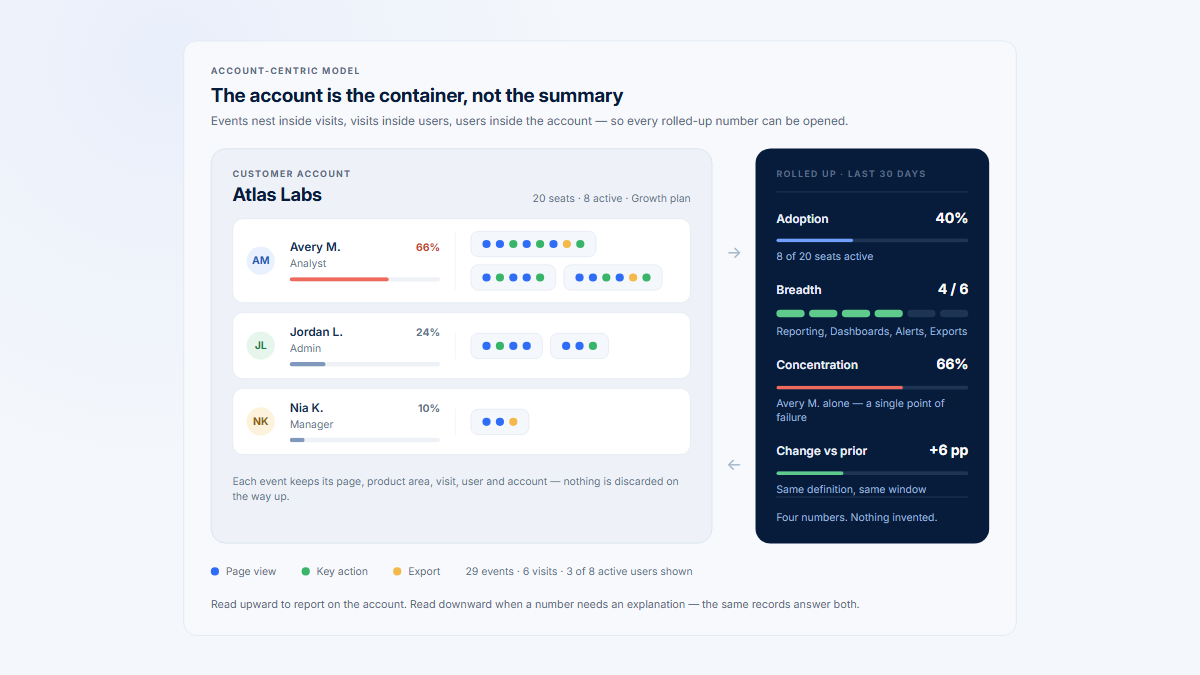
Hymetry is not a third general-purpose replacement; it is a narrower account-centric layer for authenticated B2B SaaS usage.
| Analytical job | GA4 | Amplitude | Hymetry |
|---|---|---|---|
| Public acquisition, campaigns, advertising, and ecommerce | Core strength | Capable and increasingly broad | Not intended to replace GA4 for these jobs |
| Identified product behavior | Capable through events and Explorations | Broad product-analytics platform | Narrower B2B product-usage focus |
| Company and account adoption | Requires custom context and modeling | Available through Accounts packaging | Companies are part of the core product model |
| Product structure | Pages, screens, content groups, events, and custom definitions | Event and feature taxonomies | Product areas, grouped pages or features, and normalized pages |
| Account adoption and breadth | Custom warehouse or reporting model | Can be modeled through groups and behavioral analysis | Explicit focus on which pages and product areas each company adopts |
| User penetration and usage concentration | Custom account model | Can be modeled with account and user data | Explicitly connects active users, penetration, and concentration to Companies |
| Session evidence | Requires a separate replay product | Native Session Replay | Visits connect session evidence to Pages, Companies, and Users |
| Experimentation and activation breadth | Adjacent Firebase and advertising products | Broad experiments, flags, guides, surveys, and activation | Less analytical and experimentation breadth than Amplitude |
A possible measurement stack—not a claim of a native integration—is GA4 for acquisition plus Hymetry for authenticated B2B account usage. Hymetry is newer, has a smaller ecosystem and fewer integrations, has no mature independent rating, and offers less analytical and experimentation breadth than Amplitude. Its narrower value is connecting product areas, grouped pages, Companies, Users, account adoption, user penetration, usage concentration, and Visits.
Explore Hymetry's Pages, Companies, Users, and Visits.
Frequently asked questions
Can Amplitude replace Google Analytics?
Amplitude can replace GA4 for some organizations, particularly when behavioral product analysis and conversion optimization matter more than standard Google advertising and ecommerce workflows. Expect to rebuild or rethink conventional acquisition reports, campaign governance, and Google ecosystem integrations.
Can GA4 replace Amplitude?
GA4 can replace Amplitude for a simpler product or for a data team willing to build more analysis in Explorations and BigQuery. Native replay, feature management, integrated experiments, reusable account analysis, and some self-service product workflows would need separate tools or custom modeling.
Should a SaaS company use both?
Using both is reasonable when GA4 owns public acquisition and Amplitude owns authenticated product behavior. The stack works only when the team defines shared identifiers, canonical events, attribution scopes, company context, session differences, and metric ownership.
Which is better for product analytics?
Amplitude is generally the stronger choice for repeated product-behavior work involving funnels, retention, behavioral cohorts, journeys, replay, experiments, feature flags, and product decision-making. GA4 can perform meaningful product analysis, but it is less complete as a product-action workspace.
Which is better for acquisition and ecommerce?
GA4 is generally the stronger starting point for acquisition reports, campaign attribution, Google Ads audiences, ecommerce events, monetization reports, and the wider Google marketing ecosystem. Amplitude becomes more compelling when acquisition quality must be connected to later activation and retention.
Which supports B2B account analytics?
Amplitude supports account and group analysis through its Accounts package. GA4 can carry a company ID but requires custom aggregation and warehouse logic for account adoption, multi-user behavior, penetration, and multi-account users. Hymetry addresses a narrower version of this problem as its central B2B model.
Where does Hymetry fit?
Hymetry focuses on authenticated B2B account usage across product areas, grouped pages, Companies, Users, and Visits. It is not intended to replace GA4 for campaigns or ecommerce and has less analytical and experimentation breadth than Amplitude.
Sources
Methodology and evidence limits
| Methodology item | Approach |
|---|---|
| Research date | August 11, 2026, including final pre-publication verification. |
| Hands-on testing | Not performed. No claim in this article relies on an authenticated production tenant. |
| Capability evidence | Official product pages, feature pages, technical documentation, and official demonstrations. |
| Pricing evidence | Official Amplitude, Google Analytics, Analytics 360, and BigQuery pages. |
| Ratings and review themes | G2 product pages and review summaries. Counts fluctuate and themes are directional. |
| Editorial judgment | Scenario-based synthesis of each product's operating model, overlap, packaging, and implementation burden. |
| Privacy and legal scope | No legal conclusion is made. Consent, cookie, data-transfer, retention, and privacy obligations depend on implementation and jurisdiction. |
| Replacement test | A product was considered a replacement only when the missing workflows could reasonably be omitted or rebuilt—not merely because both products accept events. |
| Causality | Observational analytics and replay were distinguished from randomized experimentation. |
Official Amplitude product and technical documentation
Official Google Analytics and Firebase documentation
- Google Analytics overview
- Google Analytics feature list
- About Analytics sessions
- User-ID for cross-platform analysis
- Google Analytics custom dimensions and metrics limits
- Funnel Exploration
- Path Exploration
- Build segments in Explorations
- URL builders and custom campaigns
- Traffic Acquisition report
- Purchase journey report
- Ecommerce dimensions and metrics
- BigQuery Export limits and behavior
- BigQuery Export schema
- Google Analytics data retention
- Data-deletion requests
- Analytics 360 property information
- Google Analytics Standard and Analytics 360 limits
- Analytics 360 billing model
- Google Analytics 360 overview
- Google Analytics 360 features
- Google Optimize sunset
- Run an A/B test with Google Analytics data
- Key-event attribution models and paths
- Firebase A/B Testing
- Create Remote Config experiments
- Firebase Remote Config
Pricing, customer reviews, and video material
Official pricing and cloud-cost sources
Independent customer reviews
Official demonstration and video material
Hymetry product context and independent editorial material
Hymetry product context
Independent editorial material reviewed for triangulation
These sources provide practitioner perspective; they are not the source of truth for current pricing, plan limits, or capability claims.