Key differences
| Criterion | Mixpanel | Google Analytics 4 |
|---|---|---|
| Primary strength | Product behavior, activation, and retention | Acquisition, campaigns, ecommerce, and advertising |
| Core unit | Events, identified users, sessions, optional paid groups | Events, users, sessions, channels, campaigns, items, audiences |
| Funnels and retention | Stronger product workflow | Explorations and custom reports; more configuration |
| B2B accounts | Paid Group Analytics | Not native Model with dimensions/BigQuery |
| Replay and heatmaps | Native on supported web/mobile SDKs | Not native |
| Campaigns and ads | UTMs, attribution, and integrations | Stronger Google ecosystem |
| Warehouse | Connectors, exports, and paid Data Pipelines | Native BigQuery event export |
| Free model | 1M monthly events and 10K replays | No GA4 Standard license charge; limits and cloud costs apply |
| Main limitation | Event volume and add-ons raise cost | No native replay/company entity; product analysis needs setup |
Which side holds the decisions you make most often?
Google Analytics 4
Acquisition and advertising
Overlapping ground
Mixpanel
Product behaviour
How people arrive What they do once inside
The tools overlap technically. Editorial synthesis based on vendor documentation verified August 9, 2026.
Decision by scenario
| Scenario | Start with | Why | Important limitation |
|---|---|---|---|
| Public marketing site | GA4 | Channels, landing pages, campaigns, and audiences | Consent and data quality still need governance |
| Authenticated SaaS product | Mixpanel | Funnels, retention, cohorts, and profiles | Instrument stable user identity |
| Full marketing-to-product journey | Both | Each owns a different part of the lifecycle | Persist attribution and reconcile identities |
| B2B company adoption | Mixpanel or another account tool | Paid groups are closer to the entity | GA4 needs custom/warehouse modeling |
| Ecommerce and Google Ads | GA4 | Recommended ecommerce schema and ad ecosystem | Billing remains authoritative for revenue |
| Replay-led investigation | Mixpanel | Native replay linked to reports and profiles | Confirm SDK, masking, volume, and retention |
| Self-hosting required | Neither | Both are managed services | Choose another category |
Marketing acquisition and product analytics
GA4 is designed around acquisition and marketing dimensions; Mixpanel is designed around repeated behavior in a digital product.
| Question | Mixpanel | GA4 | Decision |
|---|---|---|---|
| Where did visitors come from? | UTMs and attribution properties | User/traffic acquisition, channels, campaigns | GA4 stronger |
| Which feature drives activation? | Insights, Funnels, Retention, cohorts, and Flows | Events and explorations with more setup | Mixpanel stronger |
| How do users return? | Purpose-built retention and frequency workflows | Cohorts, lifecycle, and custom analysis | Mixpanel for product retention |
| Which campaign drove revenue? | Campaign properties and paid attribution | Attribution, ecommerce, Ads links, and audiences | GA4 for marketing; billing for authoritative revenue |
| What did one user do? | User profile joined to event history and replay | User-ID, properties, Explorer, and reporting identity | Mixpanel is more product-profile oriented |
| Can a company be the entity? | Yes with paid Group Analytics | Not first class | Use event-time company IDs and a modeled layer |
GA4 before identification, Mixpanel after
1
Campaign
2
Website
3
Signup
4
User identity
5
Customer company
6
Adoption
7
Retention
GA4 emphasis
Mixpanel emphasis
Shared ownership
External systems
GA4 is usually strongest before and around acquisition; Mixpanel is usually strongest after identification. Company and revenue stages are shared or owned outside both.
Identity, B2B accounts, and warehouse data
A shared user ID helps connect anonymous acquisition to authenticated behavior, but it does not solve attribution persistence, company identity, consent, or revenue truth.
| Layer | Mixpanel | GA4 | Governed requirement |
|---|---|---|---|
| Anonymous identity | Anonymous distinct ID | Client or app-instance ID | Test the authentication merge |
| Known user | Identify and user profile | User-ID and reporting identity | Use an internal key, not email |
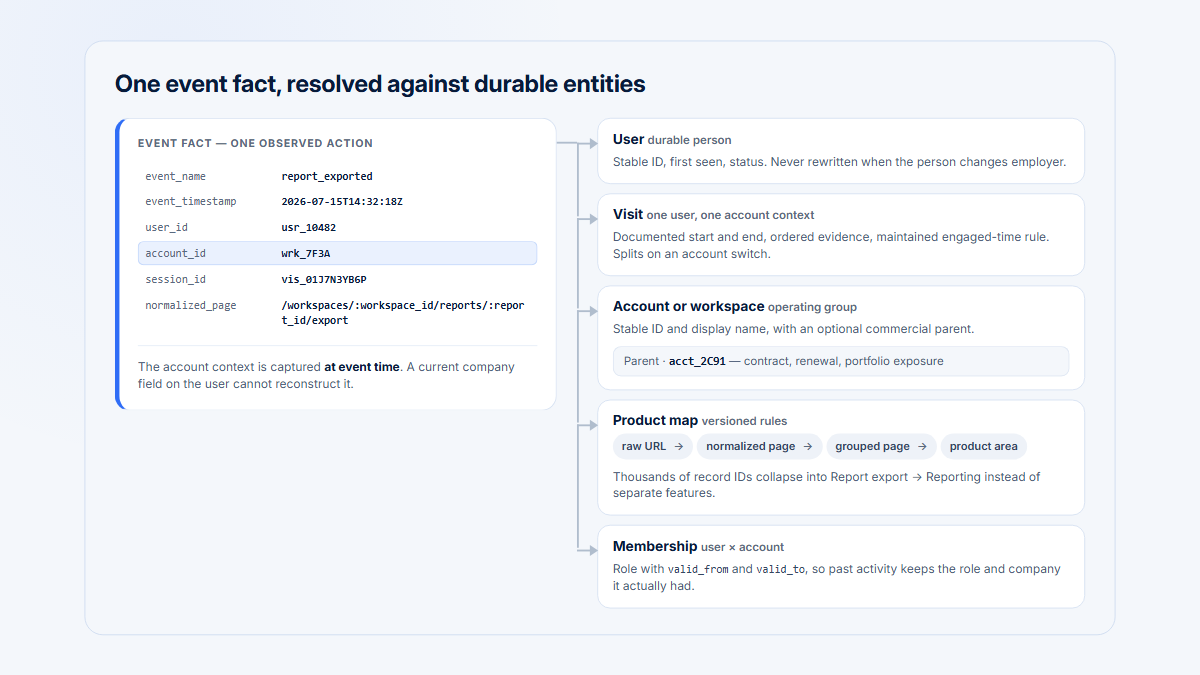
| Company | Paid group key and profiles | Custom dimension or BigQuery model | Attach active company at event time |
| Campaign continuity | Persist UTMs as event/user properties | Native campaign dimensions and scopes | Persist important acquisition fields server-side |
| Raw data | Exports, connectors, paid pipelines | Native BigQuery export with edition limits | Reconcile browser, server, billing, and consent |
| Authoritative revenue | Send confirmed server events or join billing | Recommended ecommerce events plus billing reconciliation | Keep billing or finance authoritative |
Two anonymous identities, one join, one governed model
Anonymous, separately
Join after authentication
Reconciliation
A shared internal user ID helps, but campaign continuity and company reporting require server-side persistence and a governed warehouse model.
GA4 Standard daily BigQuery export is limited to 1 million events; Analytics 360 supports much higher limits. Streaming is best effort and may contain gaps. Mixpanel warehouse connectors and outbound Data Pipelines depend on the paid architecture. Verify current limits and model cloud storage and query cost. (GA4 BigQuery export; Mixpanel Warehouse Connectors)
Implementation, privacy, and session evidence
Both require a governed event plan. GA4 adds campaign scope, consent, ecommerce, and advertising policy. Mixpanel adds identity merges, event-volume control, group keys, replay masking, and add-on decisions.
- Define which tool owns acquisition, signup, activation, retention, and revenue.
- Deduplicate browser and server outcomes.
- Exclude internal users, bots, and noisy automatic events.
- Test consent and deletion across all destinations.
- Document first-user, session, user, event, and company scopes.
GA4 has no native replay. Mixpanel can open recordings from reports and profiles across supported SDKs, but allowance, retention, masking, and sampling affect usefulness. Use an analytical signal to select relevant sessions rather than browsing recordings randomly. (Mixpanel Session Replay; Google Consent Mode)
Pricing and customer ratings
Mixpanel has an event-based license and add-ons. GA4 Standard has no license charge, but BigQuery, consent, implementation, analysis, and governance create operating cost.
Mixpanel pricing
Mixpanel
1M events
- Replay
- 10,000 monthly recordings
- Billing
- Events plus add-ons
- Groups
- Paid add-on
- Paid price
- Published entry rate and custom Enterprise
GA4 pricing
Google Analytics 4
No license
- Replay
- Not native
- Billing
- Limits plus implementation/cloud cost
- 360
- Custom contract
- BigQuery
- Separate cloud charges
| Cost driver | Mixpanel | GA4 |
|---|---|---|
| Primary unit | Events | No Standard event fee; product limits apply |
| Replay | Allowance, volume, and retention | Separate replay tool required |
| Accounts | Group Analytics add-on | Custom/warehouse model |
| Warehouse | Connectors and paid Data Pipelines | BigQuery storage, streaming, and query cost |
| Enterprise | Custom quote; optional MTU model documented | Analytics 360 custom contract |
Detailed pricing notes
Mixpanel’s billing documentation gave a base overage example after the included events and described Group Analytics and Data Pipelines percentages against additional-data charges. Replay, experiments, flags, retention, warehouse, and support can add cost. GA4 operating cost includes Tag Manager and data-layer work, consent, custom ecommerce, BigQuery, BI, reconciliation, training, and governance. Analytics 360 has custom pricing.
See Mixpanel billing, GA4/360 limits, and BigQuery pricing.
The identical score covers different jobs and customer populations. Do not treat it as a head-to-head winner.
Which should you choose?
| Choice | Choose it when | Implementation caveat |
|---|---|---|
| Mixpanel | Identified product behavior and retention are primary | Govern events, identity, volume, groups, and replay |
| GA4 | Acquisition, campaigns, ecommerce, and advertising are primary | Govern scopes, consent, BigQuery, and revenue reconciliation |
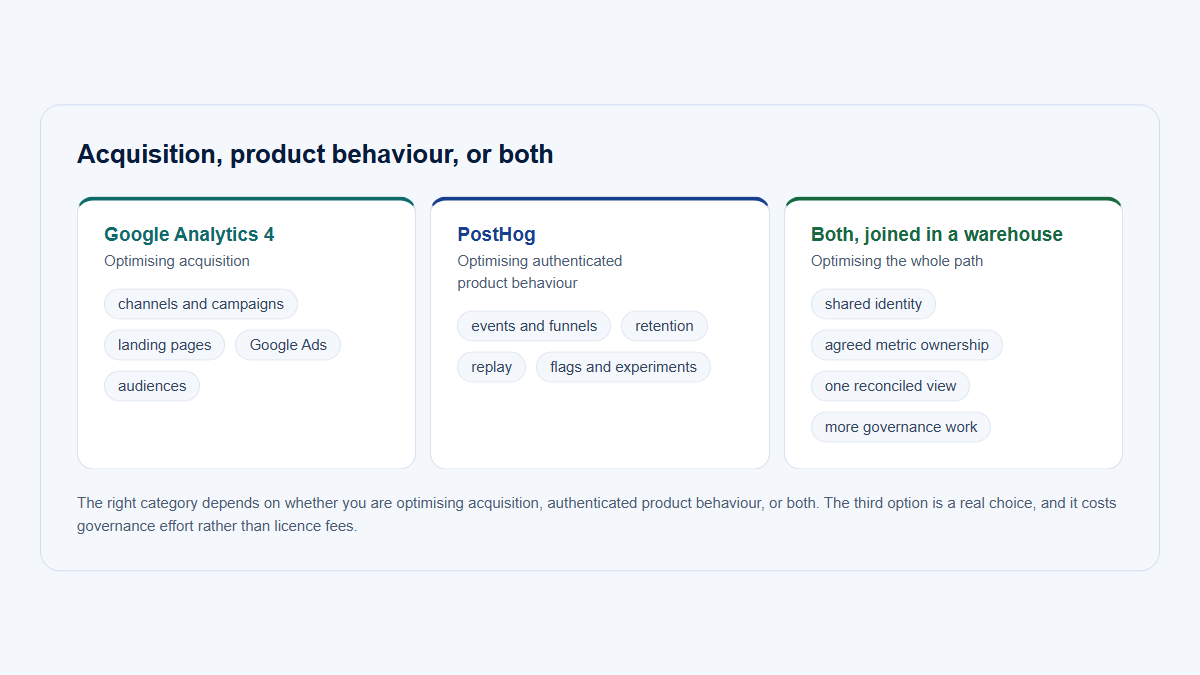
| Both | You need the full marketing-to-product journey | Define the signup handoff and one owner per metric |
Where Hymetry fits
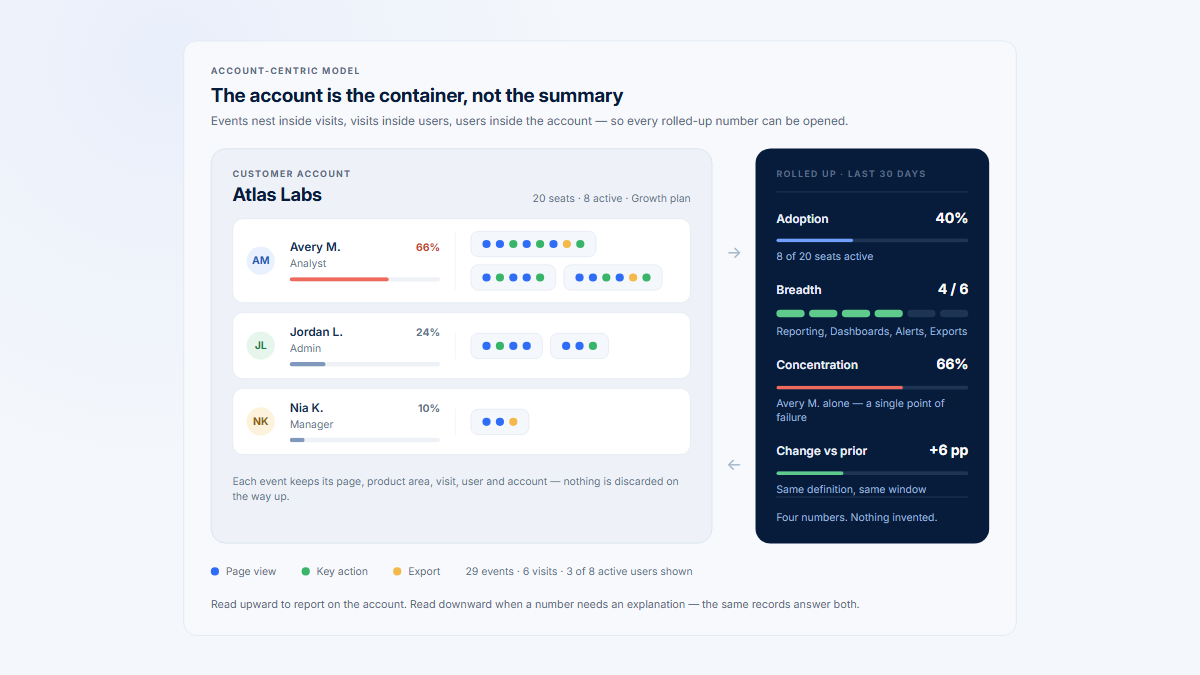
Hymetry is narrower account-centric product intelligence for B2B SaaS. It is relevant when the commercial customer is a Company and customer teams need product evidence by account.
| Decision | Consider Hymetry when | Choose Mixpanel or GA4 when | Hymetry’s limitations |
|---|---|---|---|
| Primary job | Company-level adoption is the default view | Product analysis or marketing acquisition is primary | Less analytical breadth |
| B2B workflow | Companies, Users, Visits, breadth, and concentration belong together | You can build account context from general primitives | Smaller ecosystem and fewer integrations |
| Evidence | Customer teams inspect Visits behind account signals | You need broader analytics, ads, or replay | Not an attribution or advertising platform |
Explore Hymetry’s Pages, Companies, Users, and Visits. See also product usage by company.
Frequently asked questions
Can Mixpanel replace GA4?
It can cover page views, sessions, events, UTMs, funnels, and some attribution, but it is not a complete substitute for GA4’s acquisition reports, ecommerce conventions, audiences, Google Ads connections, and broader marketing ecosystem.
Can GA4 replace Mixpanel?
GA4 can model custom events, funnels, cohorts, and paths, but it lacks Mixpanel’s first-class group entity and native replay and is less product-workflow oriented. Sophisticated product analysis often needs more configuration or BigQuery.
Which is better for B2B account analytics?
Mixpanel is closer because paid Group Analytics provides a company-like entity. GA4 needs custom company dimensions and usually BigQuery. Both require event-time company context and separate definitions for account adoption and user penetration.
Does Mixpanel export to BigQuery?
Mixpanel provides raw exports, warehouse connectors, and paid Data Pipelines depending on the architecture. GA4 has a native BigQuery event export with edition limits and separate cloud costs. Compare latency, schema, completeness, and contract terms.
Which is cheaper?
GA4 Standard has no license charge, while Mixpanel includes 1 million monthly events. GA4 still incurs implementation, consent, BigQuery, BI, and governance cost; Mixpanel can add event, replay, groups, pipelines, experiment, and support cost.
How should a company use both?
Let GA4 own public acquisition and campaign reporting, and Mixpanel own authenticated product behavior. Persist campaign data through signup, use an internal user key, attach company context at event time, and reconcile revenue to billing.
Sources
Disclosure: Hymetry publishes this comparison and appears only where its narrower B2B account model is relevant. Product capabilities, prices, ratings, limits, and videos were verified on August 9, 2026 and may change.
Methodology and evidence limits
Official product, reporting, pricing, export, privacy, and configuration documentation were prioritized. G2 provided the common rating source. Independent agency material supplied category framing only.
No authenticated production tenant or controlled implementation was used. Package- and limit-dependent information retains its uncertainty.
Full source directory
Mixpanel official sources
- Pricing and billing
- Reports, Insights, advanced Funnels, Retention, and Flows
- Group Analytics, user profiles, Session Replay, and heatmaps
- Experiments, Feature Flags, Data Pipelines, and Warehouse Connectors
- Traffic attribution, Autocapture, and API/export overview
- Privacy guidance and retention/deletion
Google Analytics official sources
- Analytics overview, Standard/360 limits, and configuration limits
- Events, enhanced measurement, User-ID, and custom definitions
- Funnel exploration, Path exploration, User acquisition, and Traffic acquisition
- Channel groups, Attribution, Audiences, and Google Ads linking
- Ecommerce, Campaign Data Import, and data freshness
- BigQuery export, BigQuery schema, Measurement Protocol, and Data API
- Data retention, cross-domain measurement, Consent Mode, privacy and identifiers, and 2026 data-control update
Ratings and context
Additional preserved references
These references supported the original detailed article and remain available for claim verification and further reading.