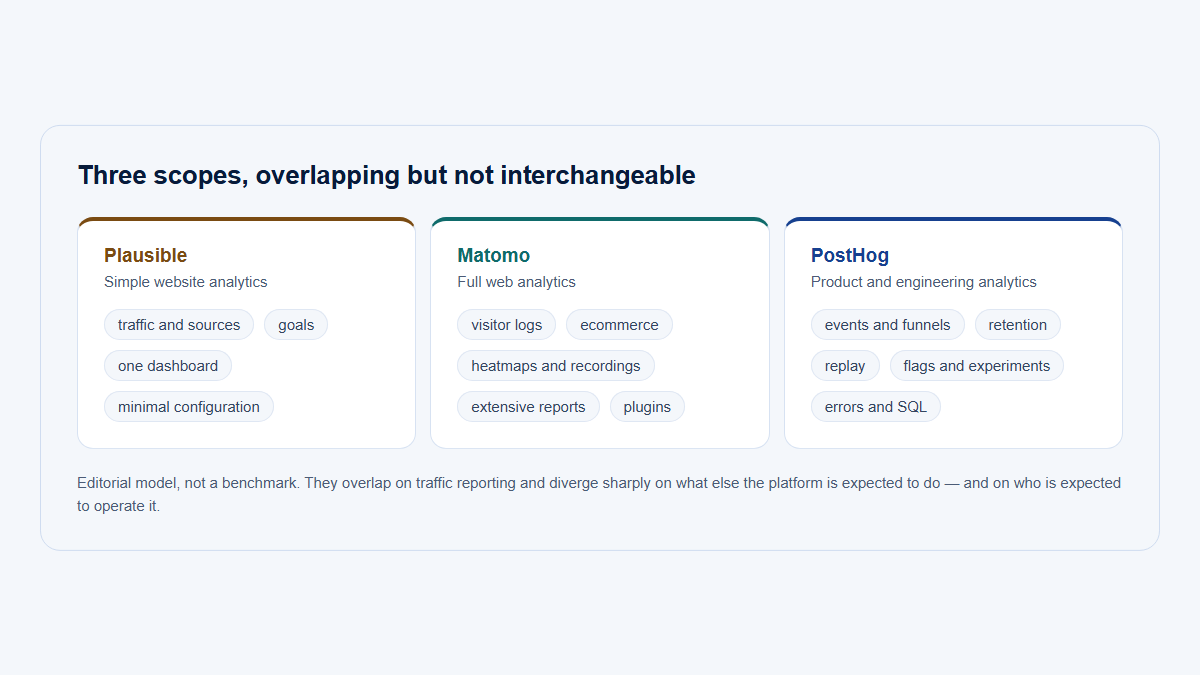
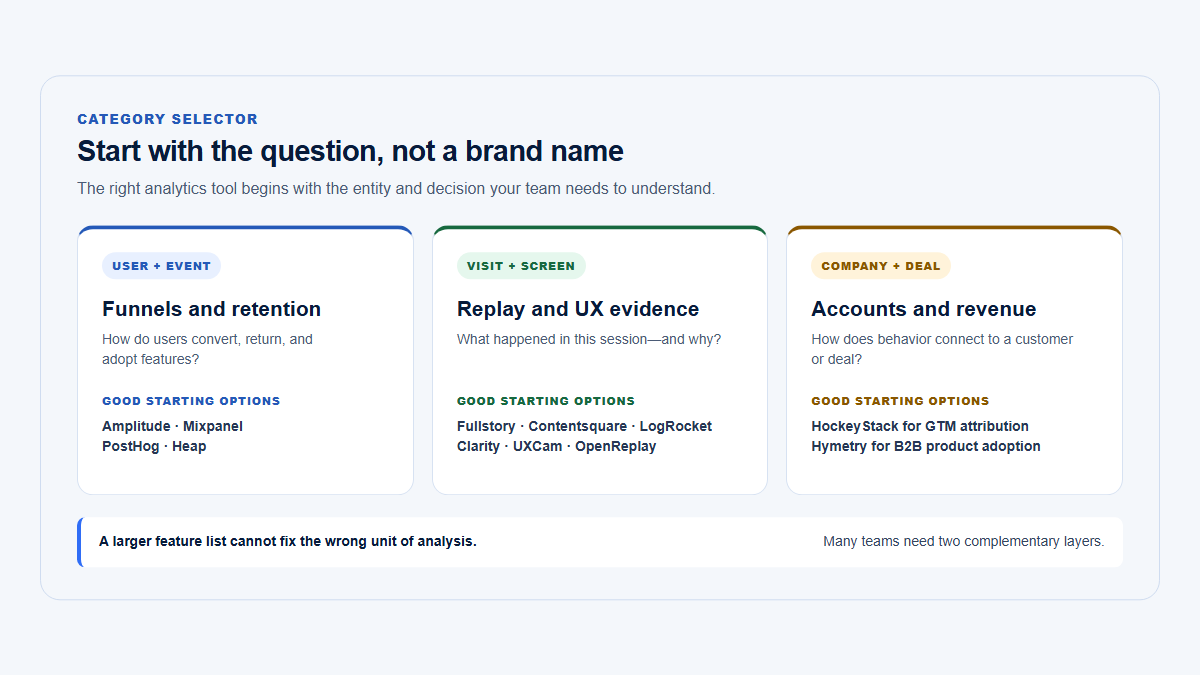
Key differences
| Criterion | PostHog | Google Analytics 4 |
|---|---|---|
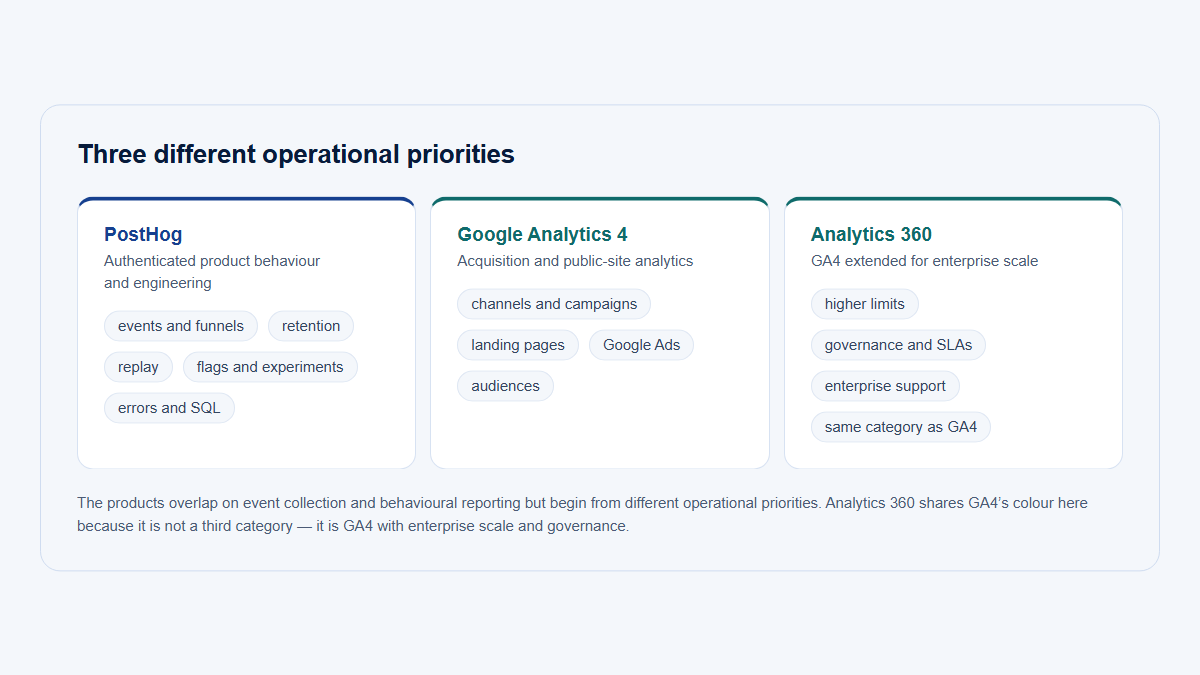
| Primary job | Authenticated product and engineering analytics | Public acquisition and marketing analytics |
| Funnels and retention | Product-centered with reusable cohorts | Explorations and reports for configured events |
| Campaigns and attribution | UTM and web-analytics support | Stronger native ecosystem |
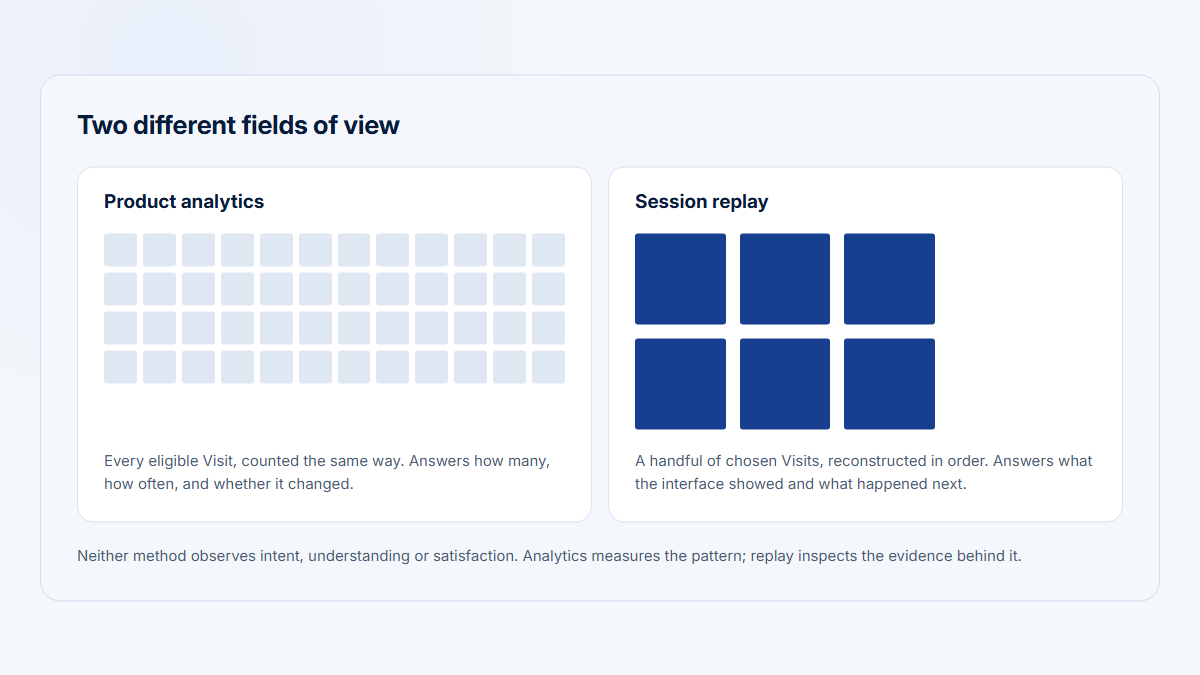
| Replay | Native web and mobile product | Not native |
| Flags and experiments | Native usage-metered products | Use Firebase or another product |
| B2B companies | Paid Group Analytics | Custom company parameters; external modeling for first-class accounts |
| Raw data | Exports, pipelines, SQL/HogQL, and warehouse connections | Native BigQuery export |
| Self-hosting | Unsupported MIT-licensed hobby path | No self-hosted edition |
| License model | Free allowances then product-specific meters | Standard service has no software-license charge |
Acquisition, product behaviour, or both
Google Analytics 4
Optimising acquisition
PostHog
Optimising authenticated product behaviour
Both, joined in a warehouse
Optimising the whole path
The right category depends on whether you are optimising acquisition, authenticated product behaviour, or both. The third option is a real choice, and it costs governance effort rather than licence fees.
Decision by scenario
| Scenario | Start with | Why | Important limitation |
|---|---|---|---|
| Content website | GA4 | Channels, landing pages, and content reporting | A simpler web-analytics category may be enough |
| Ecommerce store | GA4 | Recommended ecommerce model and advertising workflows | Add product/replay tooling only when justified |
| Authenticated SaaS app | PostHog | Identity, product events, replay, flags, and experiments | Govern capture volume and product meters |
| Google Ads-heavy company | GA4 | Native conversion, audience, and campaign integration | Advertising spend remains separate |
| Engineering-led startup | PostHog | Several technical workflows can share one SDK and context | Broad platform introduces complexity |
| B2B SaaS journey | Use both | GA4 before signup; PostHog after signup | Define metric ownership and identity boundaries |
| BigQuery-standardized data team | GA4, then assess PostHog | Native raw export is a natural marketing-data path | Warehouse modeling and queries still cost money |
| Self-hosting required | PostHog or another category | Only self-managed path here | PostHog labels it unsupported hobby deployment |
Acquisition, product behavior, and ecommerce
GA4 starts with traffic acquisition and scopes; PostHog starts with product events, persons, groups, and connected engineering actions.
| Question | PostHog | GA4 | Decision implication |
|---|---|---|---|
| Where did visitors come from? | Web analytics and UTM segmentation | User and Traffic acquisition, channel groupings, and attribution | GA4 is the more natural owner |
| What did users do after signup? | Funnels, retention, paths, cohorts, replay, and feature context | Events and Explorations can answer configured questions | PostHog is the more natural product workspace |
| How did a checkout perform? | Flexible custom events and replay | Recommended ecommerce events, items, and monetization workflows | GA4 is stronger for standard ecommerce reporting |
| Why did a user fail? | Replay, errors, properties, and feedback | No native replay; use external evidence | PostHog supplies richer qualitative context |
| Can a release be controlled? | Flags and experiments | Use Firebase Remote Config/A/B Testing or a specialist tool | Do not treat GA4 as a delivery system |
GA4 can measure product events, and PostHog can measure public web traffic. The recommendation reflects workflow fit, not an absolute technical boundary. If the business needs both, do not mirror every event blindly: preserve one stable internal user ID after authentication, persist permitted campaign context at signup, and send each platform the events needed for its owned decisions.
Identity, B2B accounts, and data architecture
Keep each tool’s anonymous identifier intact until authentication. At signup, attach the same stable internal user_id and, for B2B products, a stable company_id. Do not use email as the analytical identifier. The application database or warehouse should remain the authoritative identity map.
| Layer | Recommended owner | Control |
|---|---|---|
| Anonymous acquisition | GA4 | Consent-aware source, medium, campaign, and landing context |
| Authenticated behavior | PostHog | Stable user ID and authoritative product outcomes |
| Company context | Application/warehouse; copied to PostHog | Attach company ID at event time |
| Revenue and contracts | Billing system/warehouse | Do not infer authoritative revenue from browser events |
| Cross-system reporting | Warehouse | Document joins, scopes, time zones, filters, and late data |
Share the semantic IDs, keep each anonymous identity
Anonymous, and separate by design
Connected at signup
Reconciled
Share stable semantic identifiers while preserving each analytics system's supported anonymous identity. Trying to force one identity across both produces two broken systems instead of one.
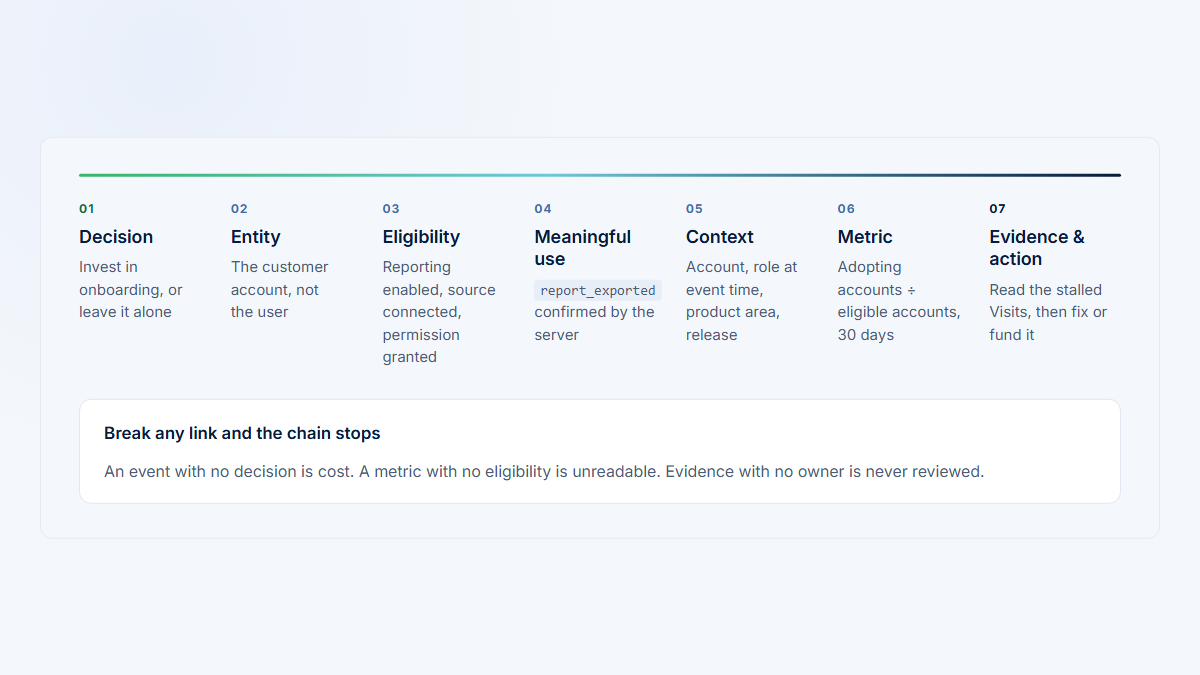
PostHog’s paid Group Analytics can analyze configured company groups across insights, flags, and experiments. GA4 can carry a company ID as a custom parameter or dimension, but first-class company profiles, cross-user account funnels, adoption breadth, and user concentration need explicit external modeling. Read account vs user adoption before defining an account KPI.
Replay, experiments, privacy, and deployment
PostHog provides native web and mobile replay, flags, experiments, surveys, and error tracking. GA4 does not include replay or a general-purpose product-release system; Google’s adjacent Firebase products can cover Remote Config, A/B Testing, and Crashlytics for eligible applications.
Both require consent, minimization, access, deletion, and retention decisions. Replay increases the privacy burden: mask sensitive content, exclude protected pages, validate mobile behavior, sample deliberately, and test deletion. Self-hosting PostHog does not remove these duties; it transfers infrastructure, upgrades, backups, security, monitoring, and incident response to the operator. GA4 cannot be self-hosted.
Pricing and customer ratings
Pricing and rating data below was verified August 9, 2026. GA4 Standard’s lack of a license charge does not make implementation, consent, BigQuery, BI, replay, experimentation, or specialist labor free.
PostHog pricing
PostHog
1M events
- Replay
- 5,000 web and 2,500 mobile recordings
- Flags
- 1M requests
- Groups
- Paid add-on from a published identified-event rate
- Other meters
- Surveys, errors, warehouse, pipelines, AI, and more
GA4 pricing
Google Analytics 4
$0 license
- BigQuery
- Storage, query, and eligible streaming charges apply
- Daily batch export
- Standard property limit documented at 1M events/day
- Replay and flags
- Not included natively
- Analytics 360
- Custom quote; no supported public fixed price
Detailed pricing cautions
PostHog’s calculator separated anonymous and identified events and exposed product-specific meters for groups, replay, flags, surveys, exceptions, warehouse rows, and pipelines. Rates are progressive and may change. GA4 Standard has no per-event software-license fee, but implementation, Tag Manager, consent, server collection, BigQuery, modeling, external tools, and analytics labor are real cost. Build total-stack scenarios rather than comparing $0 with one PostHog rate.
The matching rounded score does not make the products interchangeable. GA4 has a much larger and more diverse review population; themes guide a pilot but cannot establish accuracy or return on investment.
Which should you choose?
| Choice | Choose it when | Implementation caveat |
|---|---|---|
| PostHog | Authenticated product behavior and engineering actions are primary | Control identity, capture volume, privacy, and many meters |
| GA4 | Acquisition, campaigns, ecommerce, or Google Ads are primary | Scopes, consent, tags, and attribution require specialist governance |
| Use both | The SaaS journey spans public acquisition and authenticated usage | Separate ownership; join deliberately in the warehouse |
One practical responsibility model: signup is the boundary
1
Campaigns
2
Public website
3
Signup
4
Authenticated product
5
Retention
6
Reconciliation
Measured primarily in GA4
Measured primarily in PostHog
The signup boundary
Joined in the warehouse
GA4 before signup, PostHog after, and the warehouse joining approved identity and outcome data. It is one workable division of responsibility, not the only one — but decide it explicitly rather than by default.
Where Hymetry fits
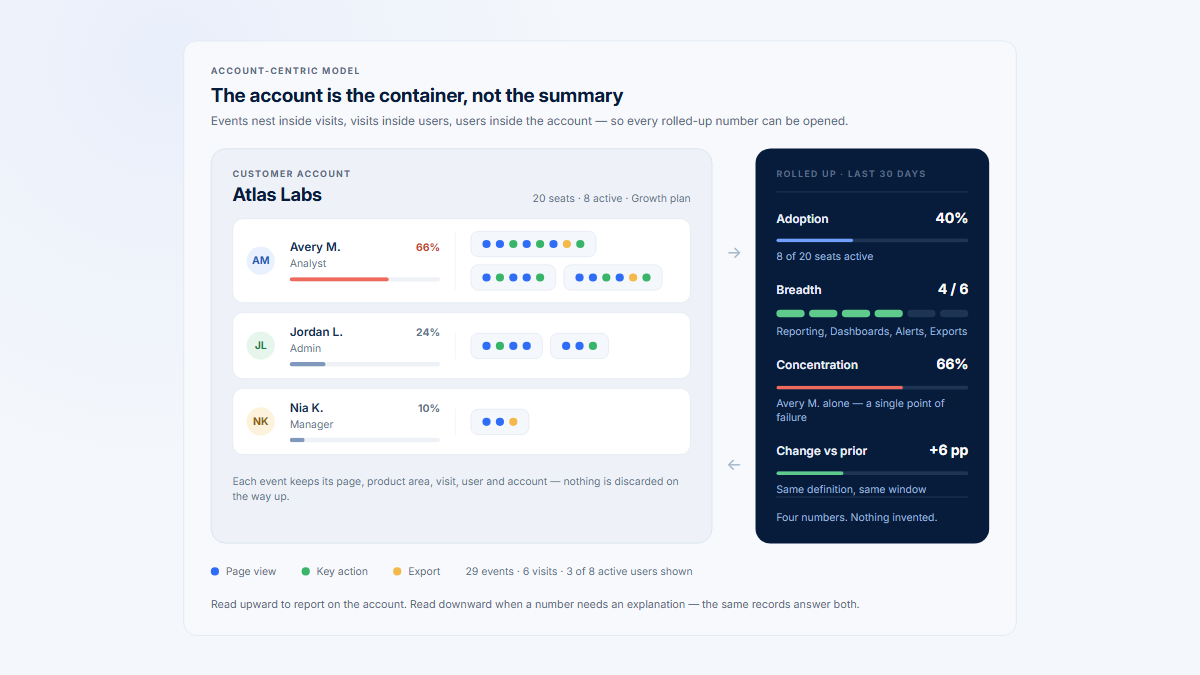
Hymetry is narrower account-centric product intelligence for B2B SaaS. It becomes relevant after signup when Companies—not visitors or isolated users—are the primary unit and teams need adoption breadth, user concentration, product-area usage, and Visits in one investigation path.
| Decision | Consider Hymetry when | Choose PostHog or GA4 when | Hymetry’s limitation |
|---|---|---|---|
| Primary question | Which companies adopted, and how broadly? | General product behavior or acquisition is primary | Narrower analytical scope |
| Evidence path | Company → users → product areas → Visits | You need flexible events, replay, ads, or campaigns | Fewer integrations |
| Engineering suite | Not central to the purchase | Flags, experiments, errors, surveys, or data pipelines matter | No comparable broad engineering platform |
Explore Companies, Users, Pages, and Visits.
Frequently asked questions
Can PostHog replace Google Analytics?
Yes when product behavior is central and the company does not depend on GA4’s advertising, acquisition, or ecommerce workflows. Many SaaS companies should retain GA4 on the public site and avoid forcing PostHog to own every marketing report.
Can GA4 replace PostHog?
GA4 can cover a limited, stable product event program. It does not include native replay, general-purpose feature flags, product experiments, surveys, error tracking, or first-class group analytics, so a full PostHog replacement usually needs adjacent products.
Should a SaaS company use both?
Often. Let GA4 own public acquisition and advertising, PostHog own authenticated product behavior, and the warehouse or billing system own authoritative revenue. Share stable semantic identifiers without expecting every report to match exactly.
Which supports session replay?
PostHog supports native web and mobile replay under separate allowances and rates. GA4 does not include native replay. Whichever replay tool is used, configure masking, exclusions, sampling, consent, retention, and deletion deliberately.
Which supports B2B company analytics?
PostHog offers paid Group Analytics for configured groups across insights, flags, and experiments. GA4 can carry company IDs as custom data, but first-class account profiles, adoption breadth, and cross-user workflows need external modeling.
Which is cheaper?
GA4 Standard has no software-license charge; PostHog has free allowances and product-specific usage rates. The cheaper complete system depends on PostHog meters versus GA4 implementation, consent, BigQuery, BI, replay, experimentation, and specialist labor.
Sources
Disclosure: Hymetry publishes this comparison and appears only where its narrower B2B account model is relevant. Product claims, prices, ratings, limits, and video metadata were verified August 9, 2026 and may change.
Methodology and evidence limits
Official PostHog, Google Analytics, Google developer, Firebase, and BigQuery documentation was prioritized. G2 supplied the common rating source. Independent and vendor videos were used only for workflow orientation with their commercial context disclosed.
No authenticated tenant or performance test was used. Analytics 360 has no supported public fixed price in this article, and PostHog rates are point-in-time references.
Full source directory
PostHog official sources
- Pricing, Product Analytics, and Web Analytics
- Group Analytics, Session Replay, Feature Flags, and Experiments
- Data Warehouse, CDP and destinations, and self-hosting guidance
Google and Firebase official sources
- GA4 reports, acquisition reports, and attribution
- Ecommerce events, BigQuery export, and BigQuery pricing
- Firebase Remote Config, A/B Testing, and Crashlytics
Ratings and video context
Additional preserved references
These references supported the original detailed article and remain available for claim verification and further reading.
- UTM segmentation
- Measurement Protocol
- cross-domain measurement
- Product analytics insights
- Funnel Exploration
- Identifying users
- GA4 event model
- User-ID and reporting identity
- Privacy and data collection
- Session-replay collection controls
- Consent and data safeguards
- Consent Mode concepts
- Access and data restrictions
- Data retention
- PostHog documentation and product index
- Marketing analytics
- Heatmaps
- Surveys
- Error tracking
- Batch exports
- Custom dimensions and metrics
- Google Ads linking
- Google Analytics audiences in Google Ads
- Data-deletion requests
- Admin API user-deletion method
- Google Analytics Standard and Analytics 360 limits
- Analytics 360 overview
- PostHog reviews on G2
- Vision Labs practitioner comparison
- Product usage by company
- self-hosted product analytics