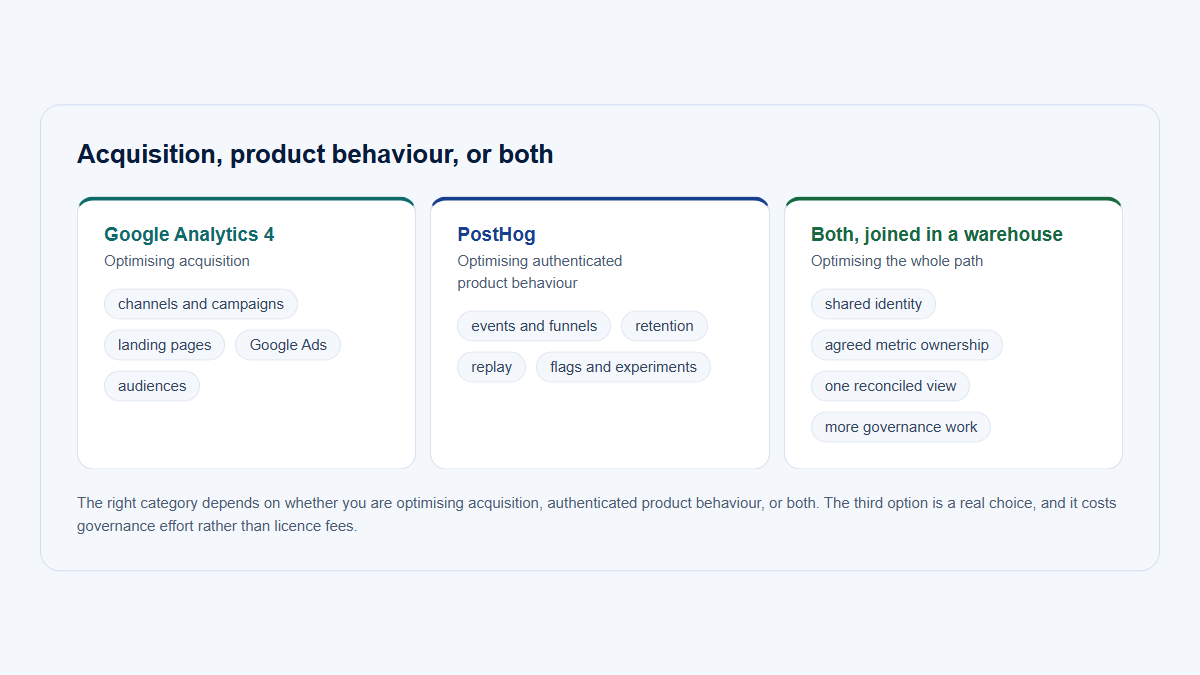
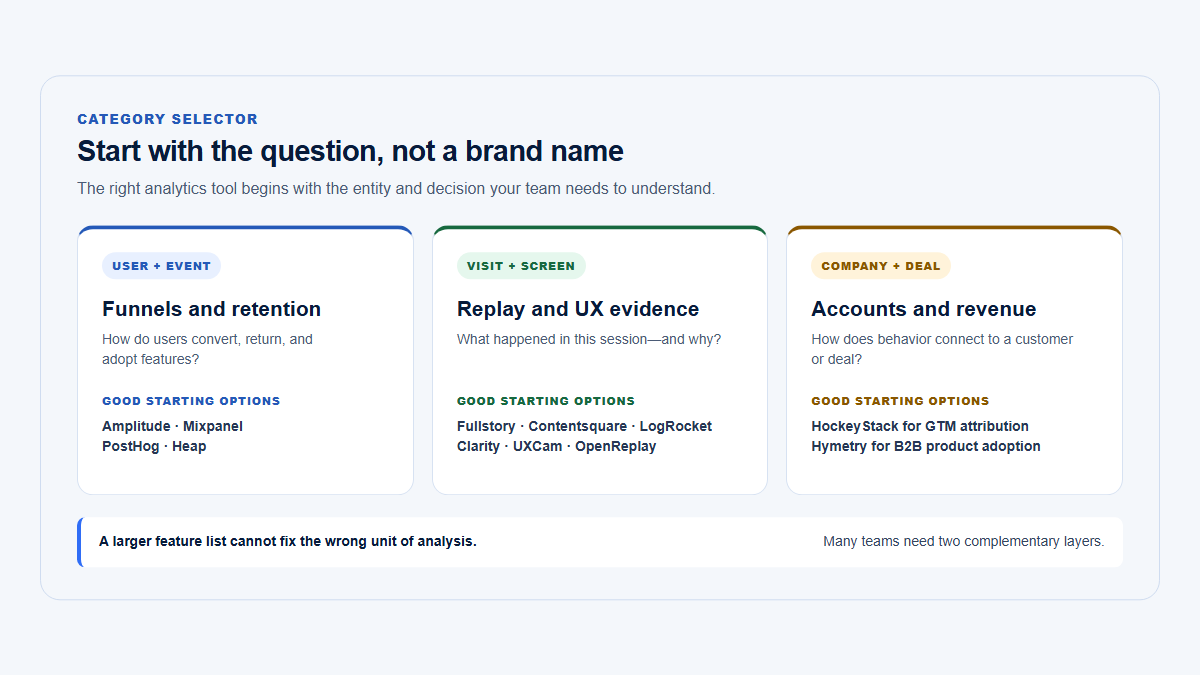
Choose PostHog if
Choose PostHog when the central questions concern what signed-in users do inside a product: which workflow they completed, whether they returned, where a funnel failed, what happened during a session, which experiment changed behavior, or whether a feature should be rolled out further.
It is the strongest choice of these three for an engineering-led product team that wants product analytics, replay, feature flags, experiments, surveys, web analytics, and related developer tooling in one platform. Its breadth is also its main trade-off: implementation, event governance, identity design, permissions, and usage-based costs require more active management than a narrow website-analytics product. (PostHog)
Choose Matomo if
Choose Matomo when website analytics is the primary job and you need more depth than a minimal traffic dashboard. Matomo is suited to campaign analysis, goals, ecommerce, visitor reports, segmentation, custom reports, heatmaps, recordings, funnels, and other traditional web-analytics workflows.
It offers both managed Cloud and a mature On-Premise path. Cloud bundles hosting and advanced functionality, while On-Premise lets the organization operate the analytics stack and choose between the free Community edition and paid feature bundles. The trade-off is that Matomo’s deepest capabilities, administration, and self-hosted operations are more involved than Plausible’s. (Analytics Platform - Matomo)
Choose Plausible if
Choose Plausible when the main questions are: How many people visited? Where did they come from? Which pages did they view? Which goals or campaign conversions occurred? Which simple funnel steps were completed?
Plausible deliberately avoids becoming a person-profile product. Its hosted model does not use cookies, local storage, or persistent cross-day identifiers by default. It supports page views, custom events, campaigns, goals, revenue, segments, funnels, and aggregate user journeys, but not session replay, feature flags, experimentation, product-retention analysis, or persistent account profiles. That narrowness reduces both analytical and operational complexity. (Plausible Analytics)
Use separate tools if
Use separate tools when the marketing website and authenticated application answer different questions.
A public website may need aggregate acquisition, campaign, content, and signup reporting. The application may need identified users, account membership, feature adoption, repeated use, replay, and customer-success investigation. Plausible or Matomo can serve the first model while PostHog—or an account-centric B2B product tool—serves the second.
This separation can make data minimization clearer: anonymous or aggregate website data does not need to be transformed into a permanent user profile merely because the authenticated product needs identity.
At-a-glance comparison
| Capability | PostHog | Matomo | Plausible |
|---|---|---|---|
| Primary category | Product and engineering analytics platform | Comprehensive web analytics platform | Aggregate, privacy-focused web analytics |
| Best for | Authenticated products, engineering workflows, behavior analysis, replay, flags, and experiments | Full website, campaign, ecommerce, visitor, and self-hosted analytics | Straightforward traffic, content, campaign, goal, and simple funnel reporting |
| Primary analytical unit | Events, people, sessions, and optional groups | Visits, visitors, actions, page views, events, and ecommerce actions | Page views, custom events, sessions, and daily visitor estimates |
| Aggregate visitor analytics | Yes, through Web Analytics and event reports | Yes; a core use case | Yes; the primary use case |
| Identified users | Yes; anonymous activity can be linked to identified person profiles | Optional User ID and visitor-profile workflows | No persistent identified user profile in the default model |
| Account or group analysis | Yes in Cloud through the paid Group Analytics add-on | No first-class B2B account object; can be approximated with custom dimensions, segments, and implementation conventions | No persistent account or group model |
| Custom events | Yes | Yes | Yes |
| Autocapture | Broad web autocapture plus explicit events | Automatic page, link, download, and content tracking; product interactions normally require explicit setup | Automatic page views plus optional engagement scripts; custom product actions require explicit events |
| Funnels | Yes | Included in Cloud and current Team-or-higher On-Premise bundles | Included in the hosted Business plan |
| Retention | Native product-retention reports | Cohort and visitor-history capabilities, but less product-native than PostHog | No persistent cross-day person-retention model |
| Cohorts | Yes | Included in Cloud; current Business-or-higher On-Premise bundles | No persistent behavioral cohorts |
| Session replay | Yes, web and mobile offerings | Included in Cloud and current Team-or-higher On-Premise bundles | No |
| Heatmaps | Yes within the wider behavioral toolkit | Included with Heatmaps & Session Recording | No |
| Experiments | Yes; integrated with feature flags | A/B Testing is available in Cloud and in the current Enterprise On-Premise bundle | No |
| Feature flags | Yes | No native feature-flag delivery platform | No |
| Surveys | Yes | No general-purpose native product-survey platform; Form Analytics is a different function | No |
| Ecommerce | Flexible event and revenue tracking | Mature ecommerce reports and campaign attribution | Revenue attribution on the hosted Business plan |
| Campaign analytics | UTM, referrer, web analytics, and custom event analysis | Extensive acquisition, campaign, channel, goal, and ecommerce reporting | Simple source, referrer, UTM, goal, and revenue reporting |
| Raw data | APIs, exports, data warehouse integrations, and query tools | APIs and direct database access when self-hosted | Stats API on Business, scheduled raw exports on Enterprise, and database access in Community Edition |
| API | Yes | Yes | Yes, with plan-dependent hosted limits |
| Self-hosting | Open-source hobby deployment available; PostHog recommends Cloud for most production use and the OSS deployment has feature and support limitations | Mature On-Premise edition with free core and paid commercial bundles | Community Edition available; operator manages its application and data stack |
| Hosted cloud | US Cloud in Virginia and EU Cloud in Frankfurt | Matomo Cloud, with current hosted data location documented as Frankfurt | Hosted EU service |
| Mobile support | Dedicated mobile SDKs and mobile replay offering | Mobile-app tracking is possible within the Matomo analytics model | Events API can receive mobile or server-side events, but Plausible is not a dedicated mobile product-analytics suite |
| Free or community edition | Cloud free allowances plus open-source deployment | Free On-Premise Community edition | No permanent hosted free plan; Community Edition is self-hosted |
| Pricing model | Usage by analytics events, replay recordings, flag requests, survey responses, and optional packages | Cloud scales by hits; On-Premise combines free core, commercial bundles, and infrastructure costs | Hosted plans scale by page views plus custom events; Community Edition has operator-funded infrastructure |
| G2 rating | 4.5/5 · 1,054 reviews | 4.2/5 · 96 reviews | 4.5/5 · 4 reviews |
| Main strength | Connects analysis, replay, experimentation, flags, and engineering workflows | Deep web analytics with meaningful deployment choice | Clarity, data minimization, and a deliberately constrained analytical model |
| Main limitation | Breadth, governance, and usage pricing create complexity | Full configuration and self-hosted operation can be demanding | Not designed for persistent users, account adoption, replay, flags, or advanced product behavior |
Feature scope, current packaging, deployment guidance, and ratings were verified on . PostHog’s Cloud and self-hosted feature sets are not identical. Matomo’s current On-Premise packaging uses commercial bundles in addition to the free Community edition. Plausible’s hosted and Community editions should not be assumed to have permanent feature parity. (PostHog)
Why PostHog, Matomo, and Plausible are compared
All three appear in searches for Google Analytics alternatives, open-source analytics, privacy-focused analytics, and self-hosted analytics. That makes the comparison useful, but it also creates a category trap.
They overlap on page views, traffic sources, campaigns, custom events, dashboards, APIs, hosted services, and some form of self-hosting. They differ most sharply in what happens after a visitor becomes a known product user:
- PostHog can create a persistent person profile, connect events over time, associate users with groups, inspect sessions, and run product experiments.
- Matomo can identify users and provide detailed visitor histories, but its native model remains centered on websites, visits, actions, campaigns, goals, and ecommerce.
- Plausible intentionally avoids persistent cross-day person profiles in its standard model and emphasizes aggregate website measurement.
The correct question is therefore not “Which tool has the longest feature list?” It is “What entity must our analytics explain: a page, a visit, a user, a customer account, or an engineering change?”
Product analytics versus web analytics
Web analytics starts with acquisition and site behavior. It asks which sources brought visitors, what content they viewed, whether they converted, what devices or countries they used, and how campaigns or ecommerce revenue performed.
Product analytics starts with behavior inside an application. It asks which users activated, which feature they adopted, whether they repeated an action, where an onboarding funnel failed, how a cohort retained, or whether an experiment improved a product outcome.
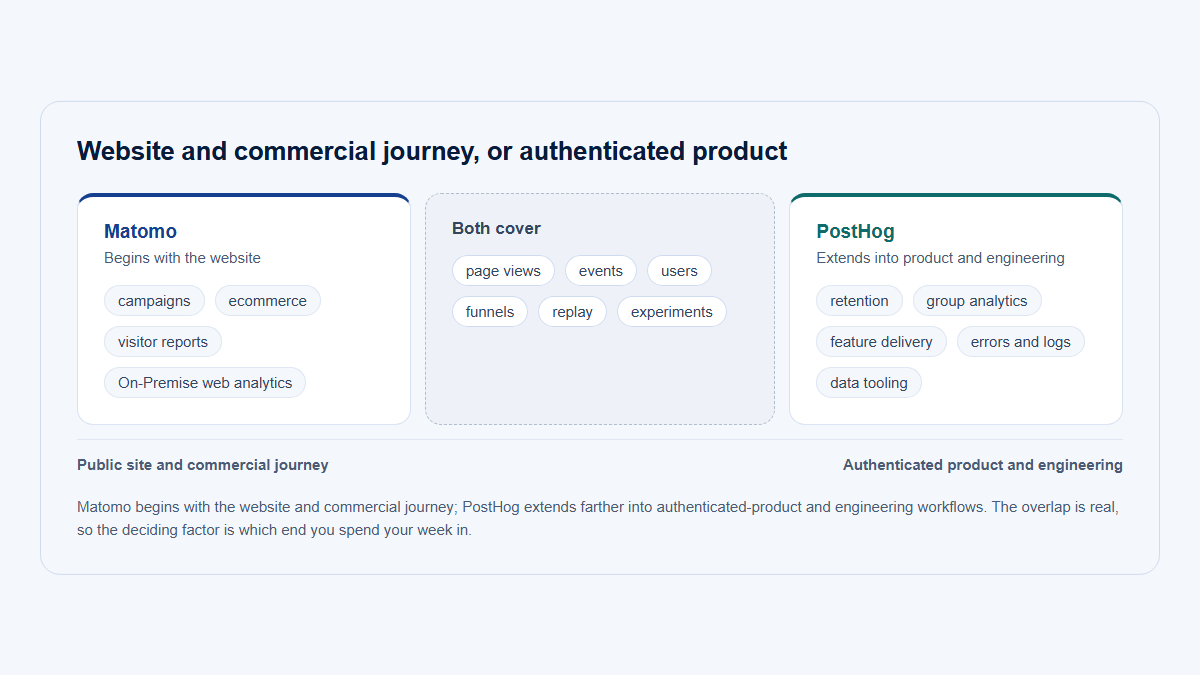
PostHog spans both categories but is structurally closer to product analytics and engineering operations. Its current suite includes Product Analytics, Web Analytics, Session Replay, Feature Flags, Experiments, Surveys, data tools, and additional developer-facing products. (PostHog)
Matomo is structurally a web analytics platform. It can record custom events, User IDs, ecommerce, forms, funnels, heatmaps, recordings, cohorts, and experiments, but its language and reporting model begin with websites, visits, visitor actions, goals, and campaigns.
Plausible is a narrower web analytics system. It has expanded beyond a page-view counter—Business currently includes funnels and user journeys—but those journeys remain aggregate paths inside a site, not permanent user dossiers. (Plausible Analytics)
For a broader product-category view, see Hymetry’s product analytics tools comparison.
Aggregate visitors, identified users, and accounts
The most important difference among these tools is not the dashboard design. It is identity.
Plausible: daily visitor estimation without a persistent profile
Plausible’s hosted model does not place a persistent analytics identifier in cookies or local storage. To estimate unique visitors, it generates a daily identifier from a rotating salt, site domain, IP address, and user agent. The salt is rotated and deleted every 24 hours, and raw IP addresses and user agents are not stored. This allows same-day counting without creating a cross-day visitor profile. (Plausible Analytics)
This is useful when the goal is aggregate traffic measurement. It also means Plausible cannot natively answer questions such as:
- Did this same person use Reporting every week for three months?
- Which users inside Acme Corporation adopted a feature?
- Is an account’s activity dependent on one champion?
- Which individual session explains a long-term retention change?
Avoid calling this automatically or universally “anonymous.” Legal classification depends on the data processed, implementation, purpose, and jurisdiction.
Matomo: visitor histories and optional User ID
Matomo commonly uses first-party cookies to distinguish visits and visitors, although a cookieless configuration is possible. Its documentation notes that disabling cookies changes the available continuity and accuracy. Matomo can also accept an application-provided User ID, which makes cross-device or cross-visit analysis possible. That identifier can still be personal data even when it is pseudonymous. (Analytics Platform - Matomo)
Matomo therefore supports substantially more individual-level analysis than Plausible. In our review of the current Matomo documentation, we found no first-class B2B group entity equivalent to PostHog Group Analytics. A company can be approximated through custom dimensions, segments, or implementation conventions, but the team must design that model.
PostHog: anonymous events, identified people, and optional groups
PostHog can record anonymous events and later connect activity to a person when the implementation calls identification methods. Identified events and person properties support persistent behavioral analysis. Group Analytics can associate events with entities such as companies, organizations, or workspaces, but it is a paid Cloud add-on and is not part of the limited open-source hobby deployment described by PostHog. (PostHog)
That makes PostHog the strongest of these three for questions about long-term user behavior or company-level product activity, provided the team instruments identity correctly.
For a deeper account-level framework, read B2B product analytics and how to measure product usage by company.
Privacy and data-model comparison
| Topic | PostHog | Matomo | Plausible |
|---|---|---|---|
| Cookies and browser storage | SDK behavior depends on configuration; browser persistence can be used for anonymous and identified continuity | First-party cookies are the common default; cookieless configuration is possible with analytical trade-offs | No cookies, local storage, or persistent browser identifier in the default hosted tracker |
| Personal identifiers | Can collect application User IDs, emails, properties, device identifiers, and other configured data | Can collect User ID, visitor IDs, custom dimensions, ecommerce data, and configured properties | Default model avoids a persistent person identifier; custom properties and URLs still require careful data minimization |
| User profiles | Persistent person profiles are a central capability when enabled | Visitor profiles and optional User ID are supported | No persistent cross-day user profile in the intended hosted model |
| Account context | Group Analytics can model companies, organizations, or workspaces in Cloud | No first-class account entity; approximate with custom dimensions and segments | No persistent account profile |
| IP handling | Configurable; PostHog documents IP-capture controls and region-specific defaults | IP anonymization and privacy settings are configurable | IP contributes transiently to the daily identifier; raw IP is not stored according to Plausible’s data policy |
| URL collection | Page URLs and properties can reveal sensitive values unless sanitized | URLs, site search, events, forms, and replay can expose sensitive values unless configured safely | Host and path are collected; query parameters are generally excluded except supported campaign data, but custom URLs still need review |
| Custom properties | Broad event, person, group, and session properties | Events, dimensions, User ID, ecommerce, and other configurable properties | Custom properties on qualifying hosted plans; documentation says not to send personally identifiable information |
| Retention | Plan- and product-dependent; current Cloud plans differ in retention | Matomo Cloud currently defines raw-data retention by plan; On-Premise operators configure and enforce their own policy | Hosted retention varies by plan; Community operators define and enforce retention |
| Deletion | Product and account deletion controls exist; operator owns execution in self-hosted environments | Cloud and On-Premise include deletion and retention controls, with operator responsibility On-Premise | Hosted account controls and Community database operation determine deletion workflows |
| Data residency | US Cloud in Virginia and EU Cloud in Frankfurt; self-host location is chosen by the operator | Current Cloud data location is documented as Frankfurt; On-Premise location is operator-selected | Hosted processing and storage are documented in the EU; Community location is operator-selected |
| Self-hosted control | Greater infrastructure and storage control, but limited OSS deployment and feature differences must be accepted | Strong control through the mature On-Premise edition | Strong control through Community Edition, with hosted-feature differences |
| Infrastructure responsibility | Vendor in Cloud; customer for the OSS deployment | Vendor in Cloud; customer On-Premise | Vendor in hosted service; customer in Community Edition |
| Consent considerations | Depends on identifiers, replay, properties, purpose, configuration, and jurisdiction | Depends on cookies, User ID, replay, forms, configuration, purpose, and jurisdiction | Cookie-free collection reduces one consent trigger, but does not remove every legal, transparency, minimization, or contractual obligation |
| Access control | Organization, project, and plan-dependent access controls; infrastructure access is customer-controlled when self-hosted | User and role administration; advanced identity options depend on current package | Site and team access controls; enterprise identity features are plan-dependent |
PostHog documents Cloud privacy controls and an EU region, Matomo documents cookie, consent, and User ID configuration, and Plausible documents the processing behind its daily identifier. None of those documents eliminates the need to assess the actual implementation and applicable law. (PostHog)
Events and page views
All three tools can count page views and receive custom events, but “event support” does not make their analytical models equivalent.
PostHog
PostHog is event-first. Teams can use autocapture to discover common browser interactions and add explicit events for business-critical actions such as:
account_createdreport_createdreport_exportedteammate_invitedintegration_connected
Explicit events are still important. Autocaptured clicks can reveal that an element was used, but a stable domain event communicates what happened in product language and is less vulnerable to interface changes.
Matomo
Matomo automatically handles common web-analytics actions such as page views, downloads, and outbound links. It also accepts custom events, goals, ecommerce activity, dimensions, and content tracking.
That is enough to measure many product interactions, but the implementation still needs an event taxonomy. Recording a click does not automatically define activation, adoption, retention, or account health.
Plausible
Plausible automatically captures page views and can enable optional measurements such as outbound-link clicks, file downloads, form submissions, scroll depth, and 404 pages. Custom events can represent signup, purchase, demo request, or feature use.
Every custom event contributes to hosted usage totals, and an event remains aggregate unless the implementation deliberately sends properties. Plausible’s documentation warns against sending personally identifiable information in custom properties. (Plausible Analytics)
For implementation guidance, see autocapture versus custom events.
Funnels, retention, and behavioral analysis
A funnel tells you how many observed entities moved through ordered steps. The meaning of “entity” matters.
PostHog funnels and retention
PostHog can build funnels from product events, break them down by person or group properties, inspect drop-offs, create cohorts, and connect results to recordings. Retention reports can ask whether people who completed one event returned to complete another over subsequent periods.
This is the most product-native model of the three.
Matomo funnels and cohorts
Matomo supports funnels in Cloud and in current qualifying On-Premise bundles. It also provides goals, segments, visitor profiles, Users Flow, and cohort capabilities in qualifying packages.
This works well for website and ecommerce journeys. Product teams can also model application workflows, but they must define events, dimensions, User IDs, and interpretation carefully. Matomo does not automatically become account-centric merely because a company value is stored in a custom dimension.
Plausible funnels and user journeys
Plausible’s current hosted Business plan includes funnels and user journeys. These are valuable additions for website conversion analysis: landing page to signup, article to newsletter registration, or product page to purchase.
They should not be confused with persistent user retention. Plausible deliberately cannot connect the same individual across days using a durable behavioral profile, so it cannot provide PostHog-style long-term person retention or account adoption. (Plausible Analytics)
Replay and qualitative evidence
Session replay can explain behavior that a metric cannot. A funnel shows that completion fell; a replay may reveal a confusing control, unexpected validation loop, visual defect, or slow response.
PostHog and Matomo both offer replay. Plausible does not.
PostHog replay
PostHog integrates recordings with event filters, users, cohorts, funnels, errors, and product investigation. Current Cloud pricing includes a monthly free allowance and usage-based charges beyond it. Web and mobile replay are priced separately. (PostHog)
This integration is valuable for authenticated product teams because a metric can lead directly to session evidence.
Matomo replay
Matomo combines heatmaps and session recording in Cloud and in its current Team-or-higher On-Premise bundle. It fits teams that want qualitative evidence inside a comprehensive web-analytics system.
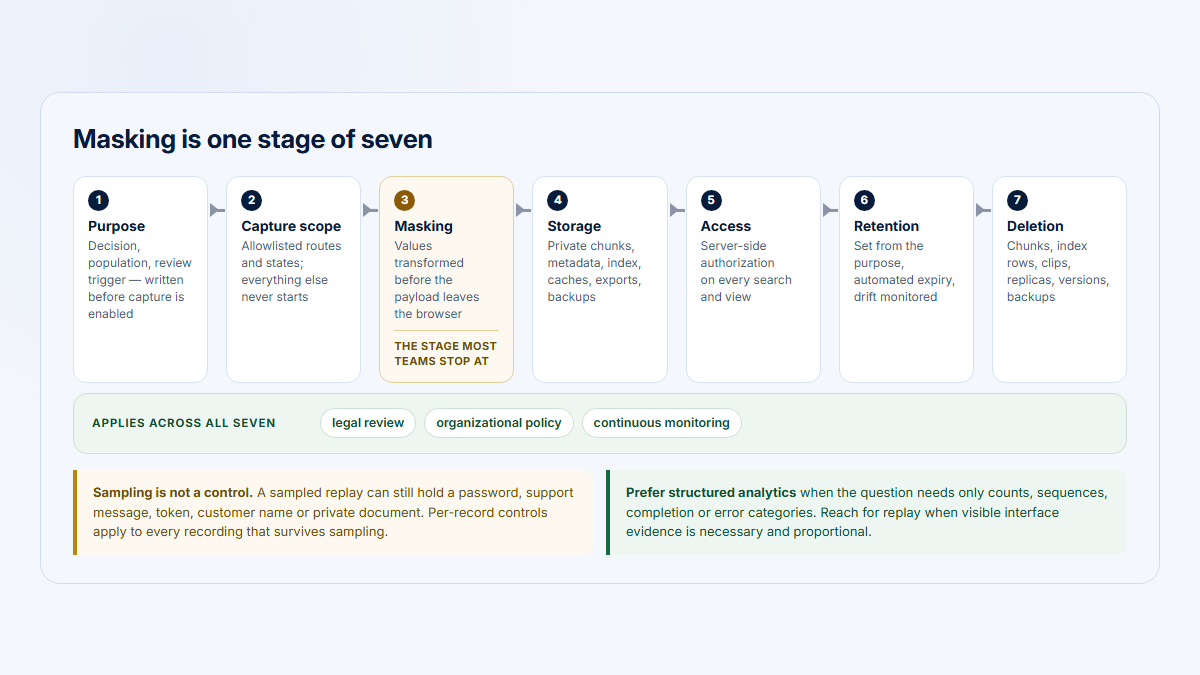
Replay expands the privacy review. Forms, text, URLs, user identity, account data, and sensitive routes need masking, exclusion, or capture controls.
Plausible
Plausible has no native replay or heatmaps. That is consistent with its aggregate data model. A team that needs replay must add another product and evaluate the combined capture, consent, storage, retention, and access model.
Before recording production sessions, use the session replay privacy checklist. Teams operating their own stack should also review the self-hosted session replay guide.
Feature flags and experimentation
PostHog is the only product in this comparison that combines feature-flag delivery with native product experiments.
A product team can:
- Define a flag.
- Target users or cohorts.
- Roll a change out gradually.
- Measure an experiment against product events.
- Inspect affected sessions.
- Continue, stop, or expand the release.
Feature Flags have their own usage allowance and pricing. Experiments use the flag infrastructure and the broader analytics model. (PostHog)
Matomo offers A/B Testing as part of Cloud and the current Enterprise On-Premise bundle. It is useful for website and conversion experiments, but Matomo is not a general feature-flag delivery platform.
Plausible does not include experiments or feature flags. Teams can analyze an externally run test by sending properties or separate events, but assignment, rollout, exposure logging, and statistical analysis must live elsewhere.
Choose PostHog when controlled product rollout is part of the analytics requirement. Do not choose it merely because feature flags appear in the feature list if the team already has a mature flagging platform and only needs aggregate website traffic.
Website acquisition and ecommerce
Matomo has the strongest traditional web-analytics depth of these three.
It supports campaign tracking, channels, goals, ecommerce orders, products, revenue, visitor reports, custom dimensions, site search, and a broad set of configurable reports. Organizations moving from an established web-analytics suite will usually find more familiar reporting concepts here.
Plausible provides a simpler acquisition model: sources, referrers, UTM parameters, landing pages, goals, revenue, custom events, funnels, and journeys. Its Business plan includes ecommerce revenue attribution. This is often enough for a company website, publisher, subscription business, or focused ecommerce dashboard. (Plausible Analytics)
PostHog includes web analytics, campaign properties, revenue tracking, and flexible event analysis. It can connect acquisition to downstream product behavior more naturally than Plausible. Its trade-off is that teams may need to construct reports that Matomo already expresses in established web-analytics language.
The decision is therefore:
- Choose Matomo for the deepest ready-made website and ecommerce analysis.
- Choose Plausible for an intentionally concise acquisition and conversion view.
- Choose PostHog when acquisition must connect to identified activation, retention, replay, or experiments.
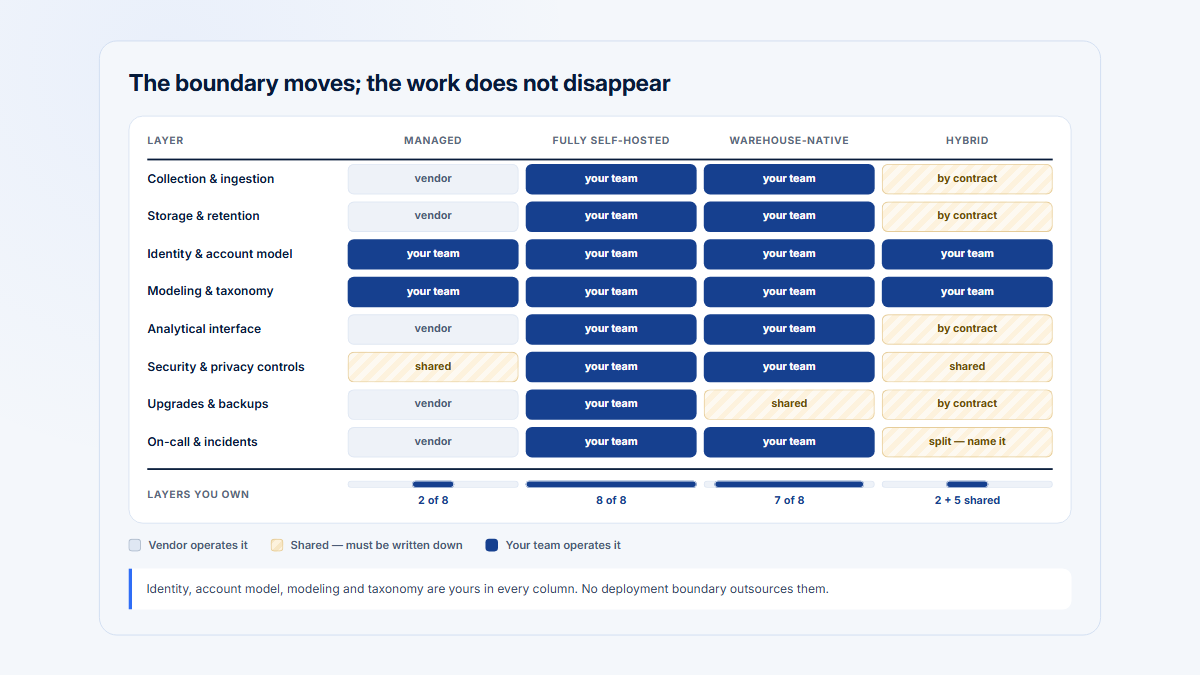
Self-hosting does not remove operational responsibility
“Can be self-hosted” is not the same as “recommended for production self-hosting,” “feature-equivalent to Cloud,” or “free to operate.”
License cost is only one part of total cost. A self-hosted deployment also requires application operation, database capacity, backups, upgrades, monitoring, incident response, deletion workflows, access control, and staff time.
PostHog
PostHog explicitly recommends Cloud for most users. Its open-source documentation describes a limited hobby deployment for unusual requirements and smaller workloads, without the complete Cloud feature set, commercial support, or vendor-managed recovery. Group Analytics is among the capabilities excluded from the limited OSS deployment. (PostHog)
Do not describe PostHog self-hosting as a drop-in, feature-complete alternative to PostHog Cloud.
Matomo
Matomo has the most mature self-hosted web-analytics model in this comparison. The Community edition provides the core platform under the GPL, while current commercial bundles add advanced modules and support.
Maturity does not make it maintenance-free. The customer operates the web application, database, scheduled archiving, backups, patches, monitoring, scaling, and recovery.
Plausible
Plausible Community Edition is a genuine open-source, self-hosted option. The application is AGPL-licensed and its tracker is MIT-licensed. The current deployment uses containers and customer-managed PostgreSQL and ClickHouse services.
Community Edition does not guarantee hosted-feature parity. The operator owns upgrades, backups, monitoring, capacity, deletion, security, and incident response. (Plausible Analytics)
For a fuller operating model, read the guide to self-hosted product analytics.
Self-hosting responsibility table
| Responsibility | PostHog open-source deployment | Matomo On-Premise | Plausible Community Edition |
|---|---|---|---|
| Installation | Customer deploys and configures the supported hobby stack | Customer installs and configures the application, web server, PHP environment, database, and archiving | Customer deploys and configures the containerized application and data services |
| Upgrades | Customer plans, tests, and performs upgrades | Customer plans, tests, and performs core and plugin upgrades | Customer plans, tests, and performs Community Edition upgrades |
| Database | Customer operates the supported analytics data stack | Customer operates MySQL or MariaDB and archiving | Customer operates PostgreSQL and ClickHouse |
| Object storage | Customer manages any recording, export, or deployment storage used by the architecture | Not a universal core requirement; any introduced file or object storage is customer-managed | Not normally a core requirement; any introduced object storage is customer-managed |
| Backups | Customer defines, tests, and restores backups | Customer backs up database, configuration, and relevant files | Customer backs up both databases, configuration, and relevant files |
| Security patches | Customer patches host, containers, dependencies, and application | Customer patches operating system, web stack, database, application, and plugins | Customer patches host, containers, databases, and application |
| Monitoring | Customer monitors ingestion, queues, storage, errors, and availability | Customer monitors application, archiving, database, disk, and availability | Customer monitors application, PostgreSQL, ClickHouse, jobs, disk, and availability |
| Scaling | Limited OSS production guidance; Cloud is the stated recommendation for most use | Customer sizes database and archiving around hit volume and reporting demand | Customer sizes application and databases around page-view and event volume |
| Deletion and retention | Customer implements and verifies policy execution | Customer configures and verifies retention and deletion | Customer implements and verifies database retention and deletion |
| Incident response | Customer investigates and restores service and data | Customer investigates and restores service and data | Customer investigates and restores service and data |
| Support | Community resources; no equivalent to managed Cloud support or recovery | Community support for free core; paid support within commercial packages | Community support rather than hosted-service support |
| Cost predictability | No software invoice for the OSS core, but infrastructure and staff demand can vary substantially | Core license can be zero; commercial bundles, traffic, hardware, and staff create total cost | No Community license fee for the application, but databases, storage, backups, and staff create total cost |
Managed Cloud moves much of this infrastructure work to the vendor. It does not transfer the customer’s responsibility to select lawful purposes, configure collection, minimize data, control access, define retention, and answer data-subject or contractual requirements.
Privacy and data minimization
Three statements should be avoided:
- “Cookie-free means no consent or legal obligation is ever possible.”
- “Self-hosting guarantees privacy.”
- “A tool is GDPR compliant by default.”
Cookies are one technical mechanism. Privacy analysis also depends on what data is collected, whether it can relate to an individual, the purpose, legal basis, transparency, retention, recipients, transfers, access controls, replay capture, custom properties, and jurisdiction.
PostHog considerations
PostHog can collect rich behavioral and identity data. That is useful for product analysis and increases the need for deliberate configuration:
- Decide when a visitor should remain anonymous.
- Identify users only where the product purpose justifies it.
- Avoid sending unnecessary personal data in event, person, or group properties.
- Mask replay fields and exclude sensitive routes.
- Configure IP handling and regional storage.
- Set retention and deletion policies.
- Restrict access to replay and person-level views.
Matomo considerations
Matomo can be configured with or without cookies, with optional User ID, and with varying degrees of individual behavior and replay.
A cookieless Matomo implementation may reduce browser storage and consent requirements in some contexts, but it can also change visitor continuity and accuracy. Adding User ID, ecommerce details, form analysis, custom dimensions, or replay changes the data model and may change the legal analysis. Matomo’s own documentation treats consent as configuration- and context-dependent. (Analytics Platform - Matomo)
Plausible considerations
Plausible minimizes collection by avoiding persistent identifiers and raw IP storage in its hosted default. That is materially different from building long-lived person profiles.
Implementation still matters. A path such as /customers/[email protected]/invoices can leak personal data into any analytics platform. A custom property containing an email address defeats the intended minimization model. Campaign parameters, server-side events, proxying, data exports, retention, and contractual context still require review.
A better privacy question is not “Does it use cookies?” but:
What data is collected, for what purpose, for how long, with what continuity, under whose control, and who can inspect it?
The following third-party video reinforces that cookieless and privacy-first are related but not interchangeable ideas. The video is sponsored and is not legal advice. (MeasureU)
Data ownership and export
“Data ownership” should be translated into concrete capabilities:
- Can the organization export aggregate reports?
- Can it export events?
- Can it access the underlying database?
- Are schemas documented?
- Can retention and deletion be enforced?
- Can data be moved before a contract ends?
- What happens to replay files?
- Are exports available on the current plan?
- Does a self-hosted edition contain the capabilities the team uses in Cloud?
PostHog
PostHog supports APIs, event export, query tools, data pipelines, and data warehouse workflows. Its migration documentation also covers importing historical data from other systems. Export and query costs, retention, Cloud region, and feature-specific constraints should be evaluated against the intended volume. (PostHog)
Matomo
Matomo provides reporting APIs and, in On-Premise deployments, direct control over the database. This is the strongest raw operational control of the three for a conventional web-analytics implementation, but database access also makes schema knowledge, backup safety, upgrades, and query performance the operator’s problem.
Plausible
Plausible Business includes a Stats API with current rate limits. Enterprise adds scheduled raw event exports. Community Edition operators control their databases directly. Teams should not assume the Starter plan includes the same export surface as Enterprise. (Plausible Analytics)
Implementation effort
The easiest product to install is not always the easiest system to use correctly.
Plausible implementation
For a basic website, Plausible is usually the lowest-effort option:
- Add the script.
- Confirm page views.
- Define goals or custom events.
- Add campaign conventions.
- Configure shared access and reports.
Complexity increases when the site needs ecommerce revenue, custom properties, funnels, server-side events, proxying, or warehouse exports.
Matomo implementation
Matomo typically requires more choices:
- Cloud or On-Premise.
- Cookie or cookieless mode.
- Consent-manager behavior.
- Campaign naming.
- Goals and ecommerce.
- User ID and custom dimensions.
- Heatmap, replay, form, or funnel configuration.
- On-Premise archiving and operations.
The benefit is a deeper ready-made reporting model.
PostHog implementation
PostHog can begin with a snippet and autocapture, but obtaining trustworthy product insight requires a deliberate plan:
- Define users, anonymous visitors, and groups.
- Decide when identification occurs.
- Create stable business events.
- Standardize event and property names.
- Define activation, adoption, and retention.
- Configure replay masking and sampling.
- Establish feature-flag and experiment governance.
- Set cost controls for event volume, recordings, and flag requests.
Use a documented product analytics instrumentation plan before expanding collection.
Performance and script considerations
A small analytics script can reduce download, parse, and execution cost, but script size alone does not describe total impact.
Plausible says its current tracking script is 2.5 KB gzipped. Treat that as a vendor measurement for the current standard script. Optional scripts, custom events, proxying, tag managers, and consent products can change the complete page cost. (Plausible Analytics)
Matomo and PostHog support broader data capture. Their impact depends on enabled products, script configuration, autocapture, replay, sampling, network conditions, and application behavior. Replay is especially different from counting a page view because it must observe and transmit a representation of the session.
Do not publish an unsupported “X times faster” comparison. Instead, advise teams to test their own production-like pages using:
- Browser performance traces
- Lighthouse or equivalent lab tests
- WebPageTest
- Network request inspection
- Real-user Core Web Vitals
- Replay sampling comparisons
- Low-end mobile devices
An asynchronously loaded script is not automatically cost-free.
Pricing and total cost
Pricing is difficult to compare because the billing units differ:
- PostHog bills separate products with separate usage allowances.
- Matomo Cloud primarily scales by hits, while On-Premise combines license packages and operator cost.
- Plausible hosted plans count page views plus custom events.
One PostHog event is not equivalent to one Matomo hit or one Plausible page view. A page load can create several product events, and a replay recording has a different cost profile from a traffic event.
Current pricing and hosting models
| Product and hosting | Hosted entry plan | Free or community option | Billing unit and current allowance | Premium modules and product costs | Session replay | Self-hosted infrastructure cost | Enterprise option | Official source | Verified |
|---|---|---|---|---|---|---|---|---|---|
| PostHog Cloud | Free plan, followed by usage-based billing | Current monthly free allowances include 1 million analytics events, 5,000 web replay recordings, 2,500 mobile recordings, 1 million flag requests, and 1,500 survey responses | The first 1 million base analytics events are free each month. Identified events also use the person-profile meter, whose first 1 million events are free. Initial paid rates are about $0.00005 per anonymous event and $0.000248 per identified event | Group Analytics currently starts around $0.000071 per identified event. Enabling it makes all identified events in that project billable for Group Analytics, including events without a group property. Feature Flags start around $0.0001 per request after the free allowance. Surveys start around $0.10 per response after their allowance. Platform packages and enterprise terms add support and governance features | First 5,000 web recordings free monthly; the next tier currently starts at $0.005 per recording. The first 2,500 mobile recordings are free monthly; the next tier starts at $0.010 per recording | Not applicable to Cloud | Boost at $250 per month, Scale at $750 per month, and custom Enterprise terms | https://posthog.com/pricing | August 4, 2026 |
| PostHog open-source deployment | Not hosted | Open-source hobby deployment with feature limitations. Most of the repository is MIT-licensed, the ee/ directory uses PostHog’s Enterprise License, and PostHog publishes a FOSS-only mirror |
No vendor event invoice for the OSS core | Does not include the complete Cloud feature and support model; Group Analytics is among documented exclusions | Limited to what the supported OSS deployment provides and the operator can run | Variable compute, database, storage, backup, monitoring, upgrade, and staff cost | PostHog directs most production users to Cloud rather than an equivalent self-hosted enterprise package | https://posthog.com/docs/self-host and https://posthog.com/docs/self-host/open-source/disclaimer | August 4, 2026 |
| Matomo Cloud Business | At 50,000 monthly hits, currently about US$26 per month when paid annually, or about US$29 month-to-month | Trial, but not a permanent Cloud Community plan | Hits; price scales with monthly volume | Cloud currently includes hosting, maintenance, updates, security monitoring, backups, and the advanced Matomo feature set. At the cited tier, current limits include 30 websites, 30 users, 100 segments, 150 goals, 30 custom dimensions, and 24 months of raw-data retention | Included | Not applicable to Cloud | Custom Matomo Cloud Enterprise | https://matomo.org/pricing/ and https://matomo.org/pricingforai/ | August 4, 2026 |
| Matomo On-Premise Community | Not hosted | Free core, currently described with unlimited users and hits | No core software fee; traffic still determines infrastructure requirements | Advanced commercial modules and support are not all part of the Community core | Not included in the free core bundle | Variable server, database, archiving, backup, monitoring, upgrade, and staff cost | Commercial On-Premise bundles and custom services | https://matomo.org/pricing/ | August 4, 2026 |
| Matomo On-Premise Team | Not hosted | No | Current package: up to 4 users and 5 million hits | Approximately €275 month-to-month or €230 monthly equivalent when annual. Current bundle includes Custom Reports, Funnels, Users Flow, Media Analytics, Heatmaps & Session Recording, Form Analytics, Search Engine Keywords, WooCommerce Analytics, SEO Web Vitals, and email support | Included | Additional to the license | Upgrade to Business, Enterprise, or VIP | https://matomo.org/pricing/ | August 4, 2026 |
| Matomo On-Premise Business | Not hosted | No | Current package: up to 20 users and 30 million hits | Approximately €1,450 month-to-month or €1,209 monthly equivalent when annual. Adds Cohorts, Multi-Channel Attribution, Activity Log, Roll-Up Reporting, Advertising Conversion Export, and White Label to the Team bundle | Included | Additional to the license | Upgrade to Enterprise or VIP | https://matomo.org/pricing/ | August 4, 2026 |
| Matomo On-Premise Enterprise | Not hosted | No | Current package: up to 50 users and 100 million hits | Approximately €3,400 month-to-month or €2,834 monthly equivalent when annual. Adds A/B Testing, SAML/LDAP, Crash Analytics, onboarding, and customer-success services to the Business bundle | Included | Additional to the license | VIP/custom terms | https://matomo.org/pricing/ | August 4, 2026 |
| Plausible hosted | Starter currently begins at US$9 per month equivalent on annual billing for up to 10,000 monthly page views, one site, and three years of retention | 30-day trial; no permanent hosted free plan | Total page views plus custom events across included sites | At 10,000 monthly page views on annual billing, Growth begins at US$14 per month equivalent for up to three sites and three team members. Business begins at US$19 per month equivalent for up to 10 sites and 10 team members, includes five years of retention, and adds custom properties, Stats API access, ecommerce revenue, funnels, user journeys, and other advanced hosted features | Not available | Not applicable to hosted service | Custom Enterprise with SSO, Sites API, managed proxy, scheduled raw exports, and longer retention | https://plausible.io/ | August 4, 2026 |
| Plausible Community Edition | Not hosted | AGPL-licensed application; MIT-licensed tracker | No hosted subscription invoice | Hosted and Community features should not be assumed to remain identical | Not available | Variable application, PostgreSQL, ClickHouse, storage, backup, monitoring, upgrade, and staff cost | Enterprise hosted capabilities are not automatically part of Community Edition | https://github.com/plausible/community-edition and https://github.com/plausible/analytics | August 4, 2026 |
Current PostHog rates and allowances are usage-tiered and can change by product. Matomo’s prices differ between Cloud and current On-Premise bundles. Plausible’s displayed entry prices are annual-billing equivalents and scale with usage. These values reflect the August 4, 2026 verification date; confirm current terms before procurement. (PostHog)
How to compare total cost
Model at least these inputs:
- Monthly page views
- Total custom events
- Percentage of events attached to person profiles
- Number of company or group events
- Replay sampling rate
- Web versus mobile recordings
- Feature-flag request volume
- Number of sites and team members
- Required retention
- Required support and SSO
- Matomo commercial modules or bundle
- Database, storage, backup, and monitoring cost
- Engineering and on-call time
- Migration and event-governance work
A small hosted subscription may cost less than one hour of monthly infrastructure work. Conversely, an organization with existing operations staff, strict deployment requirements, and predictable high volume may rationally choose On-Premise.
Do not label self-hosting “free” without immediately stating that zero license cost is not zero operating cost.
Customer ratings and review themes
Ratings are useful for finding recurring questions, not for selecting a category.
| Product | Current G2 rating | Verification | Sample warning |
|---|---|---|---|
| PostHog | 4.5/5 · 1,054 reviews | G2 · verified | Large enough to inspect recurring themes, though reviewer mix and product versions still vary |
| Matomo | 4.2/5 · 96 reviews | G2 · verified | Moderate sample; substantially smaller than PostHog’s |
| Plausible | 4.5/5 · 4 reviews | G2 · verified | Very low volume. Do not generalize a strong market conclusion from four reviews |
The three star ratings are not directly comparable because review volume differs by more than two orders of magnitude. (G2)
PostHog review themes
Across the G2 sample and current external review, positive themes include:
- Consolidating analytics, replay, flags, and experiments
- Generous entry allowances
- Developer-oriented implementation
- Ability to move from aggregate behavior to individual sessions
- Strong product-analysis breadth
Concerns surfaced by reviews and the operational documentation include:
- A learning curve created by the large product surface
- Event and dashboard governance
- Documentation gaps around advanced workflows
- Usage-cost forecasting
- More complexity than a team needing only website traffic requires
Matomo review themes
Across the G2 sample and current external review, positive themes include:
- Data and deployment control
- A familiar, detailed web-analytics model
- Mature self-hosting
- Campaign, goal, ecommerce, and visitor-report depth
- Avoiding dependence on a large advertising platform
Concerns surfaced by reviews and the operational documentation include:
- Administrative and infrastructure work On-Premise
- Dense interface and reporting concepts
- Performance tuning for larger self-hosted installations
- Advanced-feature packaging and total bundle cost
- Configuration required to achieve the intended privacy posture
Plausible review themes
The four-review G2 sample includes praise for:
- A clear dashboard
- Fast setup
- Straightforward traffic reporting
- A small and understandable scope
The sample is too small to support a confident list of recurring negatives. The product’s documented limitations are a more reliable guide: it is not designed for persistent user profiles, retention cohorts, replay, feature flags, or advanced product analytics.
External review context
Two current external reviews of PostHog and Matomo were published by Work-Management.org on July 20, 2026. Work-Management.org states that it uses affiliate links and may earn commissions. Its reviews are supplementary third-party editorial sources, not product documentation.
Faurya also publishes a Matomo-versus-Plausible page. It is vendor-promotional content generated with EarlySEO, and its publication date could not be verified, so it is included only as a source of questions to check against official packaging, license, and data-model documentation.
Use external reviews to identify questions to verify, not as the sole authority for pricing or legal claims. (Work-Management.org)
Migrating from Google Analytics
A migration should begin by deciding whether the goal is to reproduce a traditional web-analytics model or replace it with a different measurement system.
Migrating to Matomo
Matomo is the closest conceptual continuation of traditional web analytics among these three. It has an official Google Analytics importer for historical reports and supports Cloud and On-Premise migration workflows. The importer creates Matomo properties for imported data, and the implementation still needs current tracking, goals, ecommerce, custom dimensions, and consent behavior to be validated. (Analytics Platform - Matomo)
Choose this path when historical website reporting, campaigns, goals, ecommerce, and familiar visitor analysis matter.
Migrating to Plausible
Plausible can import historical GA4 statistics. Its documentation recommends running Plausible and Google Analytics in parallel for at least two to four weeks before removing GA, warns that counting methods will not match exactly, and explains that goals may need to be recreated.
Imported data is more limited than Plausible-native data. Treat it as a historical reference rather than a perfectly continuous event-level dataset. (Plausible Analytics)
Choose this path when the migration is an opportunity to reduce measurement to the traffic and conversion questions the team actually uses.
Migrating to PostHog
PostHog documents a Google Analytics migration path through BigQuery and event-schema conversion. It also supports linking Google Analytics as a data source, currently marked alpha.
A useful PostHog migration usually involves more than importing history. The team should redesign events, identification, product properties, groups, activation, retention, replay, and experiment measurement around the authenticated product. (PostHog)
Choose this path when leaving GA is part of adopting a product-analytics model rather than recreating the same website reports.
Migration rules for all three
- Run systems in parallel before removing the previous tracker.
- Annotate the transition date.
- Expect differences in visitors, sessions, bounce, attribution, and conversions.
- Do not splice two unique-visitor series together as though the definitions were identical.
- Recreate and test goals.
- Audit URLs and properties for sensitive data.
- Export historical data before retention windows close.
- Keep the old interface read-only until stakeholders have validated the new reports.
Worked scenario: a fictional B2B SaaS
Consider MeridianOps, a fictional B2B SaaS company.
MeridianOps has:
- A public marketing website
- Campaign landing pages
- A signup flow
- An authenticated application
- Several users in each customer company
- A Reporting workflow
- A need for session replay
- A need to understand acquisition and account adoption
- A preference for deployment control
- Customer-success managers asking which accounts adopted Reporting and whether use is concentrated in one person
This example is fictional and contains no customer evidence.
How each platform would handle MeridianOps
| Question | PostHog | Matomo | Plausible |
|---|---|---|---|
| Public page views | Web Analytics and page-view events | Native web analytics and page reports | Core use case |
| Campaigns | UTM and referrer properties; custom analysis may be needed | Strong campaign, channel, goal, and ecommerce reporting | Clear UTM, source, landing-page, and goal reporting |
| Signup conversion | Event funnel from landing page to signup and activation | Goal or funnel from campaign visit to signup | Page-view or custom-event funnel on Business |
| Identified product users | Identify each signed-in user and connect behavior over time | Send User ID and product events | Not a persistent person-profile use case |
| Company membership | Send the customer company as a group; Group Analytics is a paid Cloud add-on | Represent company through a custom dimension or other convention | No persistent company profile |
| Reporting adoption | Track report_viewed, report_created, and report_exported; analyze people, groups, funnels, and cohorts |
Track custom events and build goals, segments, funnels, or reports | Count aggregate custom events and simple funnels |
| Repeated use | Native retention by person or group | Possible through User ID, visitor history, cohorts, and custom analysis | Cannot reliably recognize the same person across days by design |
| Session evidence | Filter recordings by Reporting events, user, company group, experiment, or error | Record qualifying sessions and inspect them in the web-analytics context | No native replay |
| Self-hosted deployment | Available as a limited hobby deployment, but Cloud is PostHog’s stated production recommendation | Mature On-Premise option with free core and commercial bundles | Community Edition available, with customer-operated databases |
| Customer-success questions | Can answer many account questions when group identity and events are designed well | Can approximate account reporting, but it is not a first-class B2B account model | Cannot answer account adoption or champion-concentration questions |
What PostHog would do well
PostHog is the strongest one-platform option for MeridianOps. It can connect the campaign visit, signup, identified product user, company group, Reporting events, retention, replay, feature flags, and experiments.
The trade-offs are:
- Group Analytics adds cost.
- Marketing reports may require more construction than Matomo.
- Event and identity governance matter.
- Rich replay and person data require strong privacy controls.
- PostHog’s open-source deployment is not the equivalent of managed Cloud for production use.
What Matomo would do well
Matomo is strongest on the public website. It can provide detailed campaign, acquisition, signup, ecommerce, visitor, and content reporting. It can also track User IDs and Reporting events inside the application.
The difficulty appears at the customer-account layer. MeridianOps must design company dimensions and custom reports, and it still lacks a native company entity with several users and account-adoption semantics.
Matomo remains the best fit when mature self-hosted web analytics and website reporting are more important than first-class B2B account behavior.
What Plausible would do well
Plausible would give MeridianOps a clear public-site dashboard, campaign attribution, signup goals, simple funnels, and aggregate Reporting-event counts.
It cannot answer:
- Which company adopted Reporting?
- Which users inside that company used it?
- Is activity concentrated in one champion?
- Did the same person return weekly?
- Which session explains the problem?
That is not a failure to deliver on Plausible’s purpose. Those questions require a different data model.
A practical MeridianOps stack
Three defensible architectures are:
PostHog across website and product Best when one event, identity, replay, flag, and experiment platform is worth the implementation complexity.
Matomo for the website plus PostHog or an account-centric product tool for the application Best when comprehensive acquisition reporting and mature web self-hosting must coexist with product behavior.
Plausible for the website plus PostHog or an account-centric product tool for the application Best when the public site needs a small aggregate model and the product needs identified behavior.
The third option often creates the clearest privacy boundary: aggregate website measurement remains aggregate, while product identity begins after authentication.
When to use different tools for marketing and product
A two-tool stack is reasonable when it reflects two genuinely different jobs rather than organizational duplication.
Use different tools when:
- The website should not create persistent visitor profiles.
- The product needs authenticated identities.
- Marketing works with campaigns, content, and acquisition.
- Product works with activation, adoption, retention, replay, and experiments.
- Customer success works with companies and users.
- The data-retention policy differs before and after authentication.
- Replay is allowed in the product but not on public or sensitive pages.
- The preferred self-hosting model differs by surface.
Common combinations include:
- Plausible + PostHog: aggregate public-site analytics plus broad product and engineering analytics.
- Matomo + PostHog: comprehensive marketing analytics plus product behavior, flags, and experimentation.
- Plausible or Matomo + Hymetry: public-site analytics plus account-centric B2B product usage and session evidence.
Avoid sending every event to every tool. Document ownership:
- Which system owns acquisition?
- Which owns the canonical signup conversion?
- Which owns product events?
- Which owns user and company identity?
- Which owns replay?
- Which owns experiments?
- Which metrics may differ by definition?
Decision by scenario
| Scenario | Recommended choice | Reason |
|---|---|---|
| Simple company website | Plausible | Clear traffic, sources, pages, goals, and low analytical overhead |
| Content publisher | Plausible for focused content reporting; Matomo when deeper segmentation, campaigns, or custom reporting are required | Choice depends on whether simplicity or report depth is more important |
| Ecommerce site | Matomo for the deepest ready-made ecommerce analysis; Plausible Business for a concise revenue dashboard; PostHog when product behavior and experiments dominate | Ecommerce requirements vary from campaign reporting to product experimentation |
| B2B SaaS marketing website | Plausible or Matomo | Plausible for aggregate simplicity; Matomo for comprehensive campaign and visitor reporting |
| Authenticated SaaS application | PostHog | Identified users, product events, funnels, retention, replay, and experiments |
| Engineering-led product team | PostHog | Feature flags, experiments, replay, analytics, and developer workflows |
| Organization requiring self-hosted web analytics | Matomo On-Premise | Most mature and complete self-hosted web-analytics model in this comparison |
| Team requiring session replay | PostHog for product replay; Matomo for website replay | Plausible has no replay |
| Team requiring feature flags | PostHog | Only native feature-flag platform in the comparison |
| Company that wants no individual behavioral profiles | Plausible | Its intended model avoids persistent cross-day person profiles |
| Customer-success team needing account usage | PostHog with Group Analytics, or a narrower account-centric B2B product such as Hymetry | Matomo requires custom modeling; Plausible has no account profile |
Final recommendations
There is no global winner.
Choose PostHog when the analytical object is a product user, session, cohort, company group, feature flag, or experiment. It provides the broadest product and engineering platform and requires the most event, identity, privacy, and cost governance.
Choose Matomo when the analytical object is a website visit, campaign, goal, ecommerce journey, or detailed visitor report. It provides the strongest combination of comprehensive web analytics and mature deployment control.
Choose Plausible when the analytical object is an aggregate website audience. It is the best fit when the team values a concise model more than persistent identity, behavioral depth, replay, or experimentation.
Choose separate tools when the website and product should not share the same identity model. This is often the soundest architecture rather than an admission that one product “lost.”
Where Hymetry fits
Hymetry is relevant when the difficult analytical problem begins after signup.
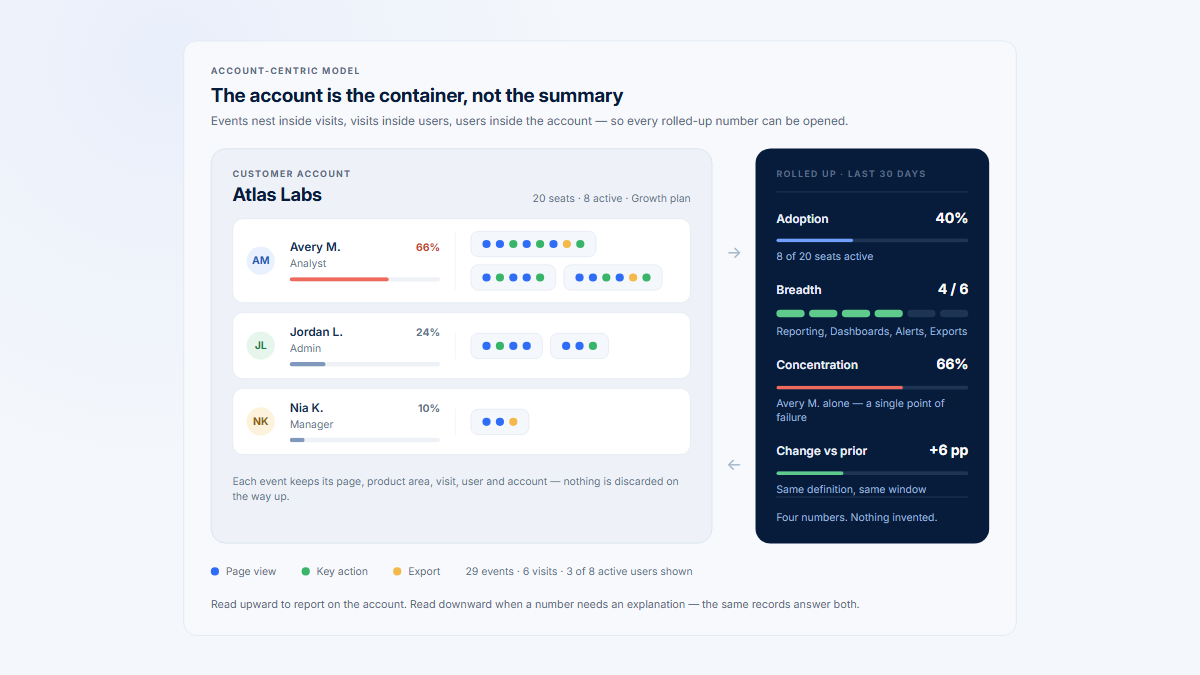
It is account-centric product intelligence for B2B SaaS. It connects product usage across companies, users, pages, and sessions so teams can understand account adoption, identify friction or concentration, find accounts or users that need attention, and inspect the session evidence behind a signal.
Hymetry organizes investigation around:
- Pages: normalized URLs, grouped pages, product areas, adoption, engagement, and flows
- Companies: account adoption, adoption breadth, active users, user concentration, and directional account signals
- Users: individual momentum, pages used, company context, and users behind an account pattern
- Visits: session-level evidence and replay connected to pages, companies, and users
That positioning makes Hymetry closer to PostHog than to Plausible in one specific sense: both analyze authenticated product use and connect quantitative signals to session evidence.
The difference is scope:
- PostHog is a broad product and engineering platform with product analytics, web analytics, replay, feature flags, experiments, surveys, and additional developer products.
- Hymetry is narrower and organized around B2B account usage: product areas, grouped pages, Companies, Users, account adoption, user concentration, and Visits.
- Matomo and Plausible are primarily public-site web analytics products.
- Hymetry is not primarily a public-site acquisition or campaign-analytics product.
Hymetry is not a replacement for:
- Marketing attribution
- A comprehensive public-site web analytics suite
- Feature-flag delivery
- Advanced experimentation
- A CRM or full customer-success workflow system
Its current trade-offs include:
- A smaller ecosystem
- A newer product
- Fewer integrations
- Less category breadth than PostHog
- No claim to replace marketing acquisition analytics
- No advanced feature-flag or experimentation platform
Teams can consider Hymetry when they need to answer questions such as:
- Which customer companies adopted Reporting?
- Is account activity broad or dependent on one user?
- Which grouped pages or product areas remain unused?
- Which users are gaining or losing momentum?
- Which Visit provides evidence for the change?
Creating a workspace does not immediately produce useful insight. Correct identity, product structure, integration, and a baseline period are required.
FAQ
Is PostHog an alternative to Matomo?
Yes, but only when the requirement overlaps. Both can track websites, page views, campaigns, events, funnels, users, and sessions. PostHog is better suited to authenticated product behavior, retention, replay, flags, and experiments. Matomo is better suited to comprehensive traditional web analytics, ecommerce, campaigns, visitor reports, and mature On-Premise operation.
A team replacing Matomo with PostHog should expect to redesign some reports rather than receive a direct replica.
Is PostHog an alternative to Plausible?
PostHog can cover the essential traffic and custom-event questions Plausible covers, but the products have different philosophies.
PostHog creates a broader behavioral and engineering system. Plausible deliberately minimizes identity and analytical breadth. Use PostHog when the additional behavior, replay, flags, and experiments are needed. Use Plausible when adding those layers would create unnecessary complexity or data collection.
Is Matomo better than Plausible?
Matomo is more capable for comprehensive web analytics. Plausible is simpler and more constrained.
Matomo is the better choice for advanced segmentation, visitor reports, ecommerce, heatmaps, replay, custom reports, and a mature On-Premise platform. Plausible is the better choice when a small aggregate dashboard is the goal. “Better” depends on whether analytical breadth is useful or burdensome.
Which is easiest to use?
Plausible is generally the easiest for a straightforward website because its dashboard and data model are intentionally narrow.
Matomo requires more reporting and configuration decisions. PostHog requires the most product-event, identity, and governance decisions when used fully. A complex requirement can still make a broad platform easier overall than integrating several smaller products.
Which supports session replay?
PostHog and Matomo support session replay. PostHog connects replay to product users, events, funnels, cohorts, errors, and experiments. Matomo combines replay with its website analytics and heatmap capabilities.
Plausible does not provide native replay.
Which supports funnels and retention?
All three can support funnels in current qualifying offerings:
- PostHog has native event funnels and product retention.
- Matomo has funnels in Cloud and current qualifying On-Premise packages, plus cohorts in qualifying packages.
- Plausible Business has website funnels and user journeys.
Only PostHog provides the most direct persistent person-level product-retention model of the three. Plausible does not persist a visitor identity across days by design.
Which can be self-hosted?
All three have a self-hosted path, but the paths are not equivalent.
- PostHog offers a limited open-source hobby deployment and recommends Cloud for most production use.
- Matomo provides a mature On-Premise platform with free core and commercial bundles.
- Plausible provides Community Edition, with the operator managing its application and databases.
Evaluate feature parity, support, scale, licenses, upgrades, and total operating cost—not merely whether a repository exists.
Does self-hosting guarantee privacy?
No.
Self-hosting gives the organization more control over infrastructure, storage location, access, retention, and code. Privacy still depends on what is collected, why it is collected, identifiers, replay configuration, access controls, security, deletion, transparency, and legal context.
A poorly configured self-hosted system can collect more sensitive data than a carefully configured managed service.
Which is best for a public website?
Choose Plausible for concise aggregate website analytics.
Choose Matomo for comprehensive campaigns, ecommerce, visitor reports, segmentation, heatmaps, replay, or mature self-hosting.
Choose PostHog when the website journey must connect directly to identified product activation, retention, replay, or experiments.
Which is best for a SaaS application?
PostHog is the strongest general choice of these three because it is designed around product events, identified users, retention, replay, feature flags, and experiments.
A B2B SaaS team that needs account adoption and customer-success investigation should also evaluate whether PostHog’s optional group model or a narrower account-centric product better matches its questions.
Can Matomo track product events?
Yes. Matomo can accept custom events, User IDs, goals, dimensions, and ecommerce activity.
Tracking product events does not automatically provide a first-class product-retention or B2B account model. The team must design event semantics, identity, company representation, cohorts, and reports.
Can Plausible track custom events?
Yes. Plausible can track custom-event goals and properties on qualifying plans.
Custom events count toward hosted usage, and properties should not contain personally identifiable information. Plausible still does not create a persistent user or company profile from those events.
Which is best for B2B account analytics?
PostHog can model companies through Group Analytics and connect groups to product events, users, funnels, cohorts, and replay.
Matomo can approximate company analysis using custom dimensions and segments. Plausible does not provide persistent account profiles.
A team whose primary problem is account adoption, multi-user concentration, company health signals, and session evidence should also consider an account-centric B2B product such as Hymetry.
Where does Hymetry fit?
Hymetry is for authenticated B2B SaaS products where companies contain several users and the team needs to connect grouped pages or product areas to account adoption, users, and Visits.
It is closer to PostHog’s product-analysis side than to Plausible’s aggregate website model, but it is narrower than PostHog’s broad engineering platform. It is not intended to replace Matomo or Plausible for public-site acquisition reporting, and it is not a feature-flag or advanced experimentation platform.
Publisher disclosure
Hymetry publishes this comparison and is itself an analytics product. Hymetry may benefit when readers conclude that public-site analytics and account-centric B2B product analytics are different problems.
The comparison does not claim hands-on testing of every current product, package, deployment, or scale condition. Feature, license, deployment, pricing, review, and privacy statements are based on official documentation and the external sources listed below, verified on .
PostHog, Matomo, Plausible, G2, YouTube, and the external publishers cited here are not represented as endorsing this article.
Privacy, consent, data-protection, employment-monitoring, communications, and sector-specific requirements depend on implementation and jurisdiction. This article is not legal advice.
Methodology
This comparison used the following hierarchy:
- Current official product and documentation pages
- Current official pricing
- Official licensing and self-hosting documentation
- Official identity, event, privacy, replay, experiment, retention, export, migration, and deployment documentation
- G2 as the common rating source
- Current external reviews and walkthroughs as supplementary context
- Hymetry’s canonical product context for Hymetry-specific claims
The evaluation compared:
- Product category and intended analytical object
- Aggregate visitors
- Persistent users
- Company or group context
- Events and autocapture
- Funnels, retention, and cohorts
- Replay and heatmaps
- Feature flags and experiments
- Campaign and ecommerce reporting
- Hosted and self-hosted deployment
- Data minimization and identity
- Export and data access
- Implementation effort
- Script and replay performance considerations
- Subscription price and total operating cost
- Review volume and recurring themes
No ranking was calculated from feature count or star rating. Products were evaluated against use cases because a narrow, intentional model can be preferable to a broader platform.
Pricing, packages, review totals, video metadata, licenses, and deployment recommendations can change. Reverify them before relying on this article for procurement.
Sources
PostHog official sources
- Product and pricing: https://posthog.com/pricing
- Main documentation: https://posthog.com/docs
- Identity and person profiles: https://posthog.com/docs/product-analytics/identify
- Group Analytics documentation: https://posthog.com/docs/product-analytics/group-analytics
- Self-hosting overview: https://posthog.com/docs/self-host
- Open-source deployment disclaimer: https://posthog.com/docs/self-host/open-source/disclaimer
- Privacy documentation: https://posthog.com/docs/privacy
- Data-collection controls: https://posthog.com/docs/privacy/data-collection
- Data import and export: https://posthog.com/docs/getting-started/data-import-export
- Historical migration overview: https://posthog.com/docs/migrate
- Google Analytics migration: https://posthog.com/docs/migrate/google-analytics
- Google Analytics data source: https://posthog.com/docs/cdp/sources/google-analytics
- Source repository: https://github.com/PostHog/posthog
- Enterprise-directory license: https://github.com/PostHog/posthog/blob/master/ee/LICENSE
- FOSS-only mirror: https://github.com/PostHog/posthog-foss
Matomo official sources
- Pricing: https://matomo.org/pricing/
- Machine-readable pricing reference: https://matomo.org/pricingforai/
- Main documentation: https://matomo.org/guides/
- Privacy guidance: https://matomo.org/privacy/
- Consent-management guidance: https://matomo.org/guide/tracking-data/consent-managers/
- Cookieless tracking guidance: https://matomo.org/faq/general/faq_156/
- User ID privacy considerations: https://matomo.org/faq/reports/user-id-privacy-considerations/
- IP address anonymization: https://matomo.org/faq/general/how-does-ip-address-anonymisation-work-in-matomo/
- Google Analytics migration and importer: https://matomo.org/faq/how-to/faq_102/
- Marketplace and premium features: https://plugins.matomo.org/
- Source repository: https://github.com/matomo-org/matomo
Plausible official sources
- Hosted product and pricing: https://plausible.io/
- Documentation: https://plausible.io/docs
- Data policy: https://plausible.io/data-policy
- Custom-event goals: https://plausible.io/docs/custom-event-goals
- Custom properties: https://plausible.io/docs/custom-props/introduction
- Funnel analysis: https://plausible.io/docs/funnel-analysis
- User journeys: https://plausible.io/docs/user-journeys
- Ecommerce revenue: https://plausible.io/docs/ecommerce-revenue-tracking
- Stats API: https://plausible.io/docs/stats-api
- Events API: https://plausible.io/docs/events-api
- Google Analytics import: https://plausible.io/docs/google-analytics-import
- Community Edition repository: https://github.com/plausible/community-edition
- Application repository and license: https://github.com/plausible/analytics
Customer ratings
- PostHog on G2: https://www.g2.com/products/posthog/reviews
- PostHog G2 seller profile used for the current 1,054-review count: https://www.g2.com/sellers/posthog
- Matomo on G2: https://www.g2.com/products/matomo-formerly-piwik/reviews
- Matomo G2 seller profile used for the current review count: https://www.g2.com/sellers/matomo-analytics
- Plausible on G2: https://www.g2.com/products/plausible-analytics/reviews
- Plausible G2 seller profile used for the current review count: https://www.g2.com/sellers/plausible-analytics
Third-party reviews and sponsored comparisons
- PostHog review, Work-Management.org, July 20, 2026: https://work-management.org/analytics/posthog-review/
- Matomo review, Work-Management.org, July 20, 2026: https://work-management.org/analytics/matomo-review/
- Work-Management.org affiliate disclosure: https://work-management.org/privacy/
- Matomo vs Plausible, Faurya; publication date not verified: https://www.faurya.com/blog/matomo-vs-plausible
- Cookieless vs Privacy-First comparison and sponsorship disclosure, MeasureU, June 17, 2026: https://measureu.com/cookieless-privacy-first/
Videos
- PostHog official walkthrough: https://www.youtube.com/watch?v=1FZji2L-LmM
- MeasureU privacy-analytics comparison: https://www.youtube.com/watch?v=0jHLhJPKaFU