Key differences
PostHog can replace Matomo when product behavior is the main job, while Matomo can replace PostHog only when a team does not need PostHog’s wider product-engineering workflows.
| Decision | Short answer or first steps | What would be lost or the critical guardrail |
|---|---|---|
| Can PostHog replace Matomo? | Often, when an authenticated SaaS product is the center and website or campaign needs are moderate | Matomo’s purpose-built campaign, ecommerce, acquisition, and visitor reporting; mature On-Premise packaging; and premium-plugin workflows already in use |
| Can Matomo replace PostHog? | Sometimes, when custom events, funnels, replay, and A/B testing are sufficient | First-class group analytics, feature flags, flag-backed experiments, surveys, integrated errors and logs, warehouse, and broader product-engineering workflows |
| Should a company use both? | Yes, when the public website and authenticated product are distinct analytical surfaces | Manage two data models, consent and privacy configuration, identity handoff, costs, ownership, and possible duplicate capture |
| Replace Matomo with PostHog | Inventory goals, campaigns, ecommerce reports, User IDs, dimensions, retention needs, and exports before rebuilding events and insights | Do not decommission Matomo until attribution, conversions, ecommerce totals, deletion, and historical exports validate |
| Replace PostHog with Matomo | Inventory events, persons, groups, insights, flags, experiments, surveys, errors, logs, replay, and warehouse dependencies | Assign another owner or tool for every engineering workflow Matomo will not replace |
| Run both | Assign Matomo to the public site and PostHog to the authenticated product; carry approved UTM values and stable identifiers through signup | Use one replay recorder per surface unless research justifies duplication; align consent, deletion, and retention rules |
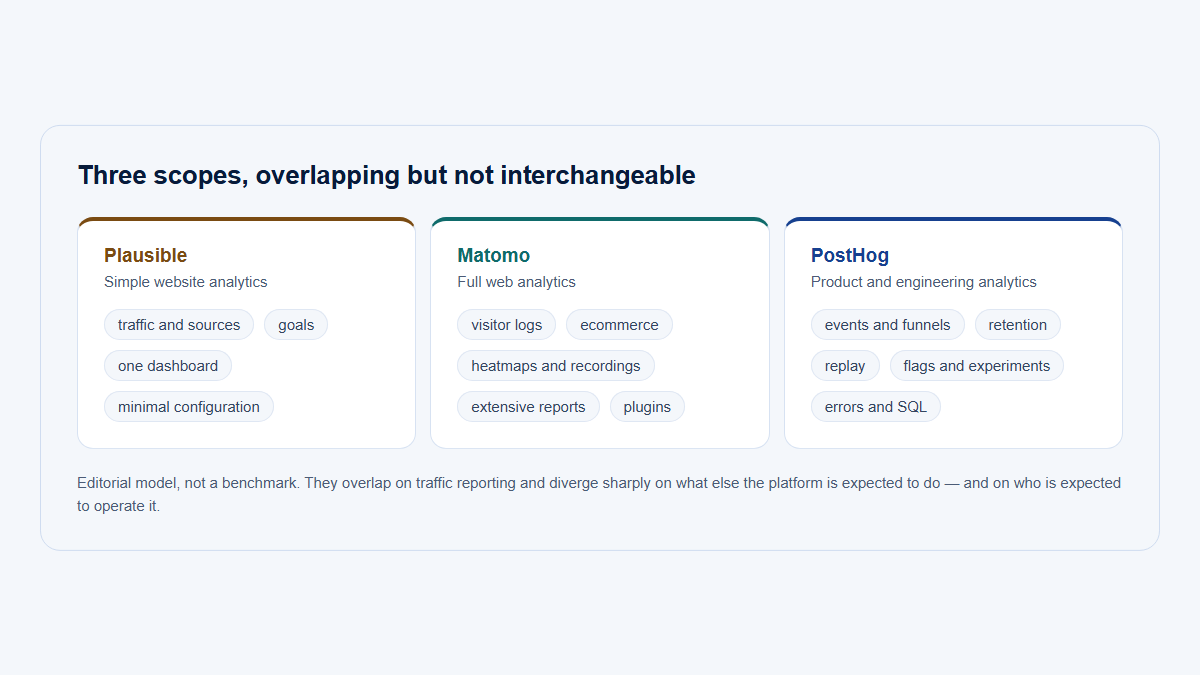
The decision is less about the longest feature list than the primary workflow. PostHog starts with understanding and changing a product; Matomo starts with understanding digital properties, acquisition, visitors, goals, and commerce.
For a broader overview that also includes Plausible, see PostHog vs Matomo vs Plausible. This direct comparison goes deeper into replacement, identity, self-hosting responsibility, authenticated-product workflows, and coexistence.
Website analytics versus product analytics
Matomo provides the more complete website and campaign workflow, while PostHog makes behavioral product analysis easier to connect to product changes.
| Workflow | PostHog | Matomo | What it means |
|---|---|---|---|
| Page views and visitors | Web Analytics reports visitors, views, sessions, bounce rate, top pages, referrers, and sources | Mature visitor, acquisition, content, behavior, goal, and segmentation reports | Both can measure a public website; Matomo provides the more website-native reporting model |
| Campaigns | UTM and referrer reporting; marketing analytics adds costs, conversion goals, and ad-source data but is labeled beta | Campaign reports connect visits, engagement, goals, ecommerce revenue, and ROI | Marketing teams with complex campaign reporting are likely to reach useful answers faster in Matomo |
| Ecommerce | Track orders and product behavior through custom events or an ecommerce integration | Dedicated tracking for orders, products, quantities, revenue, tax, shipping, discounts, average order value, conversion, and abandoned carts | Matomo requires less custom analytical modeling for a conventional ecommerce operation |
| Custom events | Core to the product-analytics model and reusable across funnels, retention, cohorts, replay, experiments, and other products | Supported for websites, applications, SDKs, server tracking, dimensions, segments, and reports | Both support event analytics; PostHog connects events to more product-engineering workflows |
| Product funnels | Native multi-step funnels with behavioral filters and product context | Funnels are available through a premium capability or relevant bundle | Product teams can begin with funnels more directly in PostHog |
| Retention | Native retention analysis based on events and identified people or groups | Cohort and retention analysis is available through the premium Cohorts capability | Matomo can perform retention analysis, but packaging matters |
| User profiles | Person profiles connect properties, activity, replay, errors, surveys, and other product data | User ID and Visitor Profiles connect known activity across sessions | Both support known users, but PostHog’s person model is more tightly integrated with its wider suite |
| Company or group context | Native group types can represent companies, teams, or other entities in insights, flags, and experiments | Company context generally needs custom dimensions, segments, Custom Reports, or an external model | B2B account analysis is a more explicit PostHog workflow |
| Replay | Replay connects to people, events, insights, errors, and product investigations | Replay connects to visitor behavior, pages, goals, segments, and website analysis | Both are useful, but their surrounding investigation models differ |
| Experiment or flag workflows | The native workflow joins PostHog flags to rollout and measurement; external flag systems can provide assignments through exposure events | A/B Testing supports website, server, and campaign experiments and can be integrated into apps; Matomo’s mobile SDKs do not provide native A/B Testing | Choose based on whether the team is testing content or managing product delivery |
PostHog Web Analytics covers common website metrics, and its newer marketing workflow expands campaign analysis. Matomo remains more purpose-built for campaigns and ecommerce, while its official app-analytics guidance confirms that it is not limited to page views.
Website and commercial journey, or authenticated product
Matomo
Begins with the website
Both cover
PostHog
Extends into product and engineering
Public site and commercial journey Authenticated product and engineering
Matomo begins with the website and commercial journey; PostHog extends farther into authenticated-product and engineering workflows. The overlap is real, so the deciding factor is which end you spend your week in.
Identity, events, and account context
Both products can identify users and capture custom events, but PostHog provides the clearer first-class model for companies and other groups.
| Identity requirement | PostHog | Matomo |
|---|---|---|
| Anonymous-to-identified continuity | Anonymous activity can connect to an identified person, subject to the project’s identity configuration | User ID can connect known visits, with behavior and attribution depending on when the ID is supplied |
| User profile | Person profiles combine properties and behavioral history across PostHog products | Visitor Profiles and User ID reports provide cross-session context for known users |
| Custom events and properties | Events and properties are the main reusable analytical model | Events, custom dimensions, custom variables, and segments support custom behavior analysis |
| Company or account identity | Group types model companies, teams, organizations, or another shared entity | Commonly modeled with a company identifier in a custom dimension, then analyzed through segments or reports |
| Account funnels and retention | Group analytics can run funnels, retention, trends, and other insights at group level | Possible through custom modeling and premium reporting, but not exposed as the same first-class account workflow |
| Account-targeted rollout | Flags and experiments can use group context | A/B Testing is available, but an equivalent managed company-level feature-flag workflow was not found in the official materials reviewed |
| Commercial packaging | Group analytics is a paid add-on and affects billing for identified events once enabled | Custom dimensions are available, while Custom Reports and some advanced analysis depend on packaging |
| Modeling burden | Lower when both user_id and company_id, or another group key, are available | Higher when the team needs account adoption, penetration, breadth, or champion-concentration metrics |
PostHog explicitly treats groups as companies, teams, and similar entities and lets them participate in analytics, flags, and experiments. Matomo can hold a company identifier and segment or report on it, but that is not the same as a dedicated account-adoption model.
This is a scoped comparison of the official capabilities reviewed on August 11, 2026, not a claim that account analysis is impossible in Matomo.
Product-building and replay capabilities
PostHog covers more of the workflow from observing behavior to changing and debugging the product; Matomo’s adjacent capabilities remain strongest in digital analytics and optimization.
| Capability | PostHog | Matomo | Decision impact |
|---|---|---|---|
| Session replay | Web and mobile replay connected to events, persons, insights, flags, and errors | Website replay through Heatmaps and Session Recording, with segmentation and privacy controls | PostHog is usually stronger for authenticated-product investigations; Matomo is strong for website and visitor analysis |
| Heatmaps | Click, movement, scroll, rage-click, and related overlays through the toolbar; the direct in-app viewer is labeled beta | Click, move, and scroll heatmaps within Heatmaps and Session Recording | Both cover website heatmaps; verify current packaging and browser or SDK support |
| Feature flags | Boolean, multivariate, and remote-configuration flags with release conditions | No comparable first-class feature-flag release service was found in the official portfolio reviewed | A team managing progressive product rollouts will usually prefer PostHog |
| Experiments | The native workflow is flag-backed and can use event or warehouse metrics; external flag assignments are supported through exposure events | A/B Testing supports browser, server, and campaign experiments and can be integrated into mobile or desktop apps, without native mobile-SDK A/B Testing | Both can test changes, but PostHog joins its native experimentation workflow directly to release control |
| Surveys | Native surveys can target users and feed qualitative responses into product analysis | No directly comparable native survey product was found in the official portfolio reviewed | Matomo users may need a separate feedback tool |
| Error diagnosis | Error Tracking groups exceptions and can connect them to people and replays | Crash Analytics captures browser errors automatically and supports manually reported server errors | PostHog provides the more integrated product-engineering diagnosis path |
| Application logs | Logs can be ingested, searched, and related to engineering work | Log Analytics imports web-server logs for analytics; this is not the same as a general application-log investigation product | Do not treat similarly named log features as interchangeable |
| Warehouse and pipelines | Managed warehouse sources, SQL access, batch exports, realtime destinations, transformations, and related tooling | HTTP APIs are available; On-Premise permits direct database access, while Cloud offers a paid warehouse connector | Both can move data, but the operational model and managed tooling differ |
| Native mobile support | Product analytics and session replay support documented mobile SDK workflows | App analytics supports Android and iOS tracking, but native mobile heatmaps and session recording are not supported in the cited matrix | Verify the exact SDK and capability rather than extrapolate from web support |
| Public-site analytics | Fully capable of measuring public sites and common acquisition paths | A primary product use case | PostHog is not app-only, and Matomo is not page-view-only |
The largest gap is not replay or event collection; both products cover those fundamentals. It is the surrounding workflow: PostHog connects evidence to flags, experiments, errors, logs, surveys, and data tools, while Matomo connects it to acquisition, campaigns, goals, content, ecommerce, and an established web-analytics model.
PostHog feature-flag workflow
Matomo On-Premise installation overview
No current neutral direct-comparison video met the evidence and relevance threshold for this article, so two official workflow videos were selected instead.
Self-hosting, privacy, and operations
Matomo provides the more established On-Premise product, while PostHog’s current self-hosting guidance explicitly describes an unsupported hobby deployment.
Self-hosting responsibility
| Responsibility | PostHog self-hosted | Matomo On-Premise |
|---|---|---|
| Software availability | A Docker Compose hobby deployment is available. Repository content outside the ee directory is MIT-licensed; enterprise content has separate terms | Core, tracker, and most free plugins are GPLv3; premium plugins use the InnoCraft EULA |
| Official deployment model | Officially unsupported and described as a hobby deployment; PostHog Cloud is the supported path | Established Community On-Premise edition with documentation, premium plugins, bundles, and paid support |
| Database | Multi-service architecture centered on PostgreSQL and analytical infrastructure such as ClickHouse, plus queues, cache, and storage services | PHP application using MySQL or MariaDB behind a supported web server |
| Storage | Customer provisions, sizes, secures, and monitors analytical and replay storage | Customer manages database, filesystem, archive data, and recording storage |
| Backups | Customer creates and tests backups, particularly before upgrades | Customer backs up database and configuration or filesystem state and tests restoration |
| Upgrades | Customer follows current images at its own risk; tagged production releases and migration guarantees are not provided like a supported distribution | Customer schedules core and plugin updates and maintains the PHP, database, web-server, and operating-system stack |
| Monitoring | Customer monitors ingestion, queues, databases, disks, replay storage, application health, and failures | Customer monitors tracking, archiving, database growth, scheduled tasks, web serving, storage, and plugin health |
| Security | Customer owns patching, network exposure, credentials, TLS, secrets, access, dependency risk, and incident response | Customer owns operating-system, PHP, database, web-server, plugin, TLS, access, and incident-response security |
| Deletion | Customer operates deletion workflows and ensures backups, exports, and downstream systems follow policy | Matomo provides retention and deletion controls, but the customer configures and operates them across its environment and backups |
| Support and parity | No commercial or instance-specific support or guarantees; reproducible open-source issues can go to GitHub. Self-hosting lacks listed Cloud and advanced capabilities and platform packages | Community forum for free core plus commercial support and bundles; advanced capabilities depend on plugins or packaging |
| Total operating responsibility | Very high: the team accepts a complex, unsupported deployment and scaling risk | High: the team runs an established product model but still owns infrastructure, maintenance, security, backups, upgrades, and capacity |
PostHog warns that the deployment is unsupported, the operator assumes scaling and upgrade risk, and the hobby edition lacks listed Cloud and advanced capabilities. Its current guide calls for an Ubuntu VM equivalent to 4 vCPU, 16 GB RAM, more than 30 GB storage, and a custom-domain A record.
Matomo documents a conventional On-Premise stack and maintenance process, but the customer still owns the operational work.
Privacy is four separate questions
| Layer | Question to answer | PostHog and Matomo implication |
|---|---|---|
| Technical configuration | What identifiers, event properties, URLs, form values, recordings, cookies, and retention periods are captured? | Both provide configuration and privacy controls, but defaults and advanced features such as replay require deliberate review |
| Deployment control | Who selects the hosting environment, storage location, network, backups, and access boundaries? | Cloud delegates more infrastructure work; self-hosting gives direct control while transferring more responsibility |
| Organizational responsibility | Who manages access, change control, patching, incident response, deletion requests, exports, vendors, and staff practices? | The customer remains responsible in every deployment model |
| Legal requirements | What lawful basis, consent, notice, retention, transfer, employment, and sector-specific obligations apply? | These depend on implementation and jurisdiction; neither product guarantees compliance |
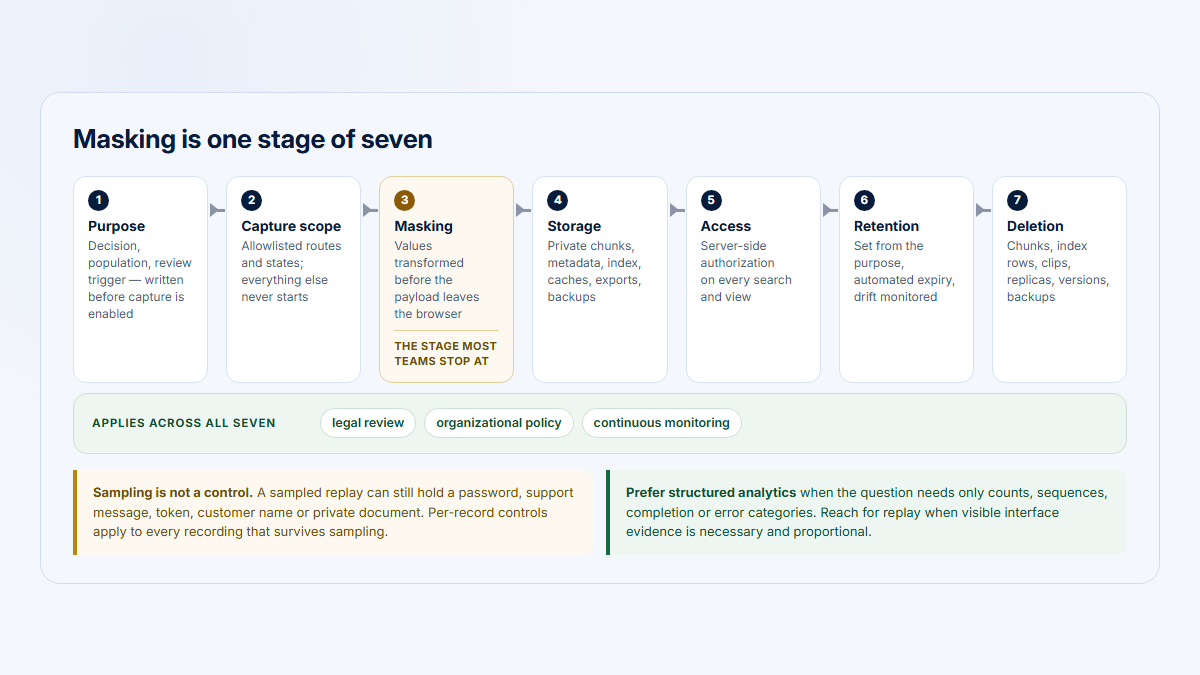
PostHog documents collection, storage, cookieless, consent, and deletion choices. Matomo documents consent and client-side replay masking, and says Heatmaps and Session Recordings require prior consent where ePrivacy rules apply and sit outside consent-exempt analytics configurations. Treat these as configuration tools and guidance, not compliance certifications.
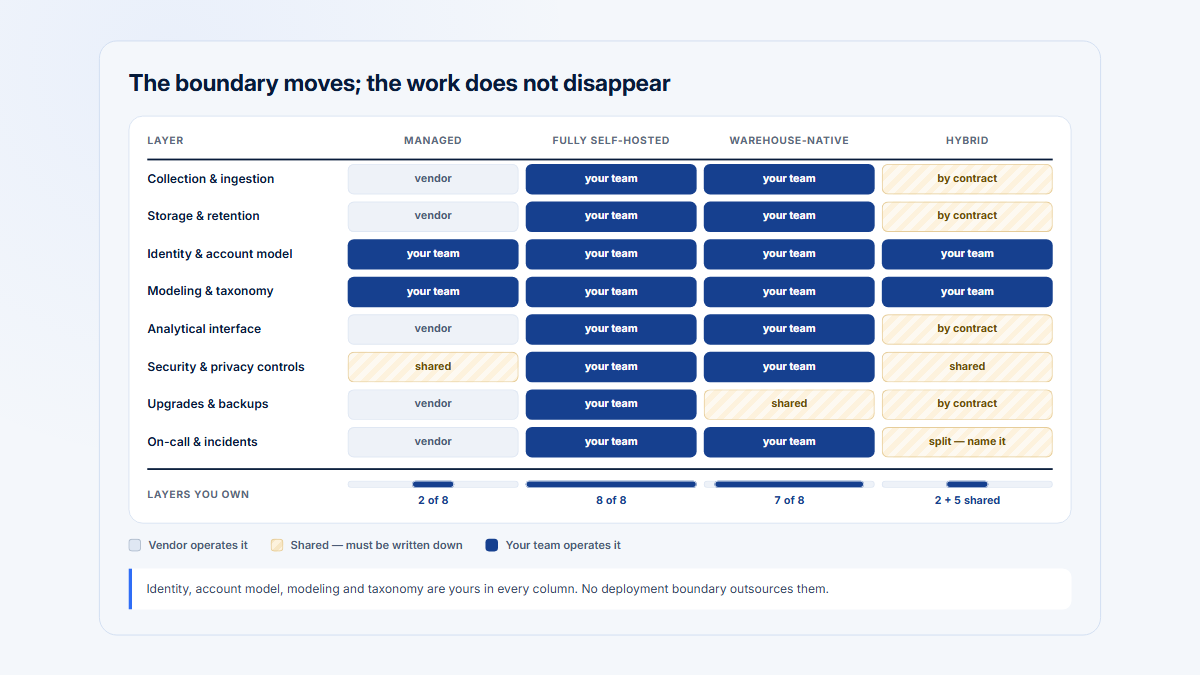
Four deployment options, and who carries each layer
PostHog Cloud
PostHog self-hosted
Matomo Cloud
Matomo On-Premise
Analytics configuration
Yours
Yours
Yours
Yours
Legal basis and consent
Yours
Yours
Yours
Yours
Application and database
Vendor
Yours, and unsupported
Vendor
Yours, with an established support model
Scaling, backups, upgrades
Vendor
Yours, at analytics-scale volume
Vendor
Yours
Colour marks the vendor, not the deployment — teal is PostHog, blue is Matomo, as in the other figures on this page. Filled means your team carries it. The top two rows are filled everywhere: vendor-managed does not mean legally guaranteed. PostHog self-hosting is documented as unsupported, which makes it a materially different commitment from Matomo On-Premise.
Pricing and customer ratings
PostHog is primarily usage-priced across separate products, while Matomo combines hit-based Cloud pricing with a free On-Premise core and paid modules or bundles.
PostHog pricing
PostHog
$0 entry
- Free entry
- 1M analytics events, 5K web replays, 1M flag requests, 100K exceptions, 1,500 survey responses, 1M warehouse rows, and other product allowances
- Hosted entry
- Free and PAYG both start at $0; PAYG adds six projects, seven-year retention, and email support before billable use
- Billing units
- Events, recordings, requests, exceptions, responses, rows, triggers, exports, log volume, and credits
- Major drivers
- Identified events, replay, flags, errors, logs, warehouse, destinations, surveys, add-ons, support, and retention
Matomo pricing
Matomo
€22/month
- Free entry
- On-Premise Community core with unlimited users and hits; infrastructure and advanced plugins are separate
- Hosted entry
- 21-day Cloud trial with no card; no permanent hosted free tier
- Billing units
- Monthly hits in Cloud; plugins, bundles, users, traffic, infrastructure, and support On-Premise
- Major drivers
- Hits, websites, users, modules, bundle level, server capacity, storage, administration, and support
PostHog pricing details
- Product Analytics includes 1 million events per month free. The first published paid tiers begin at $0.00005 per anonymous event and $0.000248 per identified event.
- Web Analytics uses Product Analytics event billing rather than a separate page-view subscription.
- Session Replay includes 5,000 web recordings per month free; the first paid web-replay tier is $0.005 per recording. Mobile replay has a separate allowance and rate.
- Feature Flags include 1 million requests per month free, then begin at $0.0001 per request. Experiments are billed through feature-flag usage.
- Error Tracking includes 100,000 exceptions per month free, then begins at $0.00037 per exception. Surveys include 1,500 responses, then begin at $0.10 per response.
- Managed Warehouse includes 1 million rows per month and free historical syncs, then begins at $0.000015 per row. Batch exports and realtime destinations have their own meters.
- Logs include 10 GB per month free, then begin at $0.25 per GB with 14-day retention. Thirty-day retention adds a published per-GB charge.
- Group analytics starts at $0.000071 per identified event. Once enabled, group billing applies to the project’s identified events, not only events queried in a group report.
- Free allowances reset monthly. The Free plan has one project and one-year retention; PAYG has six projects, seven-year retention, and email support. Packages and contracts can add cost.
Matomo pricing and plugin details
- Matomo defines a hit broadly: page views, events, downloads, outlinks, site search, content tracking, crashes, and other tracking requests can contribute.
- The current Cloud Business entry is €22 per month excluding tax for 50,000 monthly hits. Displayed currency and higher traffic tiers can vary by locale and billing choice.
- The official Cloud trial lasts 21 days and requires no credit card. Cloud includes managed hosting, maintenance, updates, security monitoring, backups, and support.
- The checked Business Cloud plan listed up to 30 websites, 30 team members, 24 months of raw-data retention, and report-data retention forever. Enterprise allowances are custom.
- The free On-Premise Community edition does not make every Matomo capability free. Premium plugins and predefined bundles remain separately licensed.
- Monthly On-Premise bundles were Team at €275 for up to four users and five million hits, Business at €1,450 for up to twenty users and thirty million hits, and Enterprise at €3,400 for up to fifty users and one hundred million hits.
- Exact annual charges were €2,750 for Team, €14,500 for Business, and €34,000 for Enterprise, excluding tax. Those prices require an annual commitment. Premium plugins can also be bought separately, and legacy customers may have different packaging.
- Team includes Custom Reports, Funnels, Users Flow, Media Analytics, Heatmaps and Session Recording, Form Analytics, Search Engine Keywords, WooCommerce, and SEO Web Vitals.
- Higher bundles add capabilities including Cohorts, attribution, Activity Log, Roll-Up Reporting, advertising conversion export, White Label, A/B Testing, SAML or LDAP, Crash Analytics, onboarding, and higher support levels.
- On-Premise infrastructure, database capacity, storage, backups, monitoring, upgrades, security work, and staff time remain additional costs even when core software is free.
The review volumes differ substantially, so the 0.3-point gap is not a controlled product benchmark. Review themes are directional summaries, not a substitute for evaluating each product with your data model and deployment constraints.
Which should you choose?
The correct choice follows the analytical surface and operating model rather than company size alone.
| Scenario | Recommended approach | Why |
|---|---|---|
| Content website | Matomo | Website, acquisition, content, visitor, campaign, and goal reporting are its center of gravity |
| Ecommerce | Matomo | Dedicated order, product, revenue, cart, conversion, campaign, and attribution reports reduce custom modeling |
| B2B SaaS public site | Matomo, or Matomo plus a product tool | Matomo can own acquisition and signup attribution while the authenticated product uses a different behavioral model |
| Authenticated SaaS product | PostHog | Native funnels, retention, people, groups, replay, flags, experiments, surveys, errors, and engineering context |
| Engineering-led startup | PostHog | One implementation can cover analytics, replay, delivery experiments, error diagnosis, and initial data workflows |
| Established On-Premise analytics required | Matomo | Its On-Premise edition, plugins, deployment documentation, and paid support are more mature |
| Team needing flags and errors | PostHog | These are first-class connected products rather than separately assembled analytics capabilities |
| Customer-success team | PostHog for broad product behavior; consider Hymetry when account adoption and evidence-linked visits are the primary job | The choice depends on broad product-engineering needs versus a narrower B2B account-centric investigation workflow |
| Organization considering one or both | Use one when one surface dominates; use both when public-site and authenticated-product ownership are genuinely separate | Two tools are justified only when roles, identities, privacy rules, replay boundaries, and source-of-truth metrics are explicit |
Fictional B2B SaaS example
Consider a fictional SaaS company with a public website, paid campaigns, a signup flow, several users per customer company, a Reporting area, a feature-flag rollout, replay, a warehouse, and customer-success reviews.
| Workflow | PostHog | Matomo | Recommended owner |
|---|---|---|---|
| Campaign measurement | Can attribute signup and downstream events; marketing workflow is still beta | Mature campaign, acquisition, goal, and ecommerce-style attribution | Marketing in Matomo |
| Signup | Capture signup as a product event and connect the new person | Track signup as a goal or event and retain campaign context | Shared definition owned by Growth |
| User identification | Identify the person and preserve product behavior across sessions | Supply User ID and use Visitor Profiles and segments | Product analytics owner |
| Company identification | Attach the person and events to a company group | Store company ID as a custom dimension and build segments or reports | Product or data team; PostHog is the more direct model |
| Reporting adoption | Measure events and funnels for users and company groups | Measure events and custom reports, with premium funnels where required | Product team |
| User penetration | Calculate which users inside adopting companies use Reporting | Requires a custom company-and-user model or external analysis | Product or customer success; consider Hymetry when this is a recurring primary metric |
| Replay | Review authenticated sessions linked to product events, users, and errors | Review public-site or relevant web sessions linked to visitor and goal context | UX or product; use one recorder per surface |
| Experiment | Roll out with a feature flag and measure the experiment in the same system | Run an A/B test, but without the same feature-flag release workflow | Product engineering in PostHog |
| Error diagnosis | Connect exceptions, logs, users, events, and replay | Use Crash Analytics for browser errors and manually reported server errors | Engineering |
| Self-hosting | Possible as an unsupported hobby deployment with high operating responsibility | Established On-Premise option with free core, paid modules, and support paths | Infrastructure and security |
| Warehouse export | Use managed sources, SQL, transformations, batch exports, or realtime destinations | Use the HTTP API, direct On-Premise database access, or the paid Cloud warehouse connector | Data team |
A practical split is Matomo on the public website and PostHog in the authenticated product, with approved campaign values and stable identity fields passed through signup. This works only when the team prevents duplicate replay, documents metric ownership, and can fulfill deletion and retention requirements across both systems.
Four layers, each needing an explicit owner
1
Campaigns
2
Public website
3
Signup handoff
4
Authenticated product
5
Engineering workflows
6
Company adoption
Matomo measures
PostHog measures
The signup handoff
Hymetry can supply
A two-tool stack works when the public website, the signup handoff, the authenticated product and the account-adoption layer each have a named owner. The handoff at step 3 — passing approved campaign values and stable user and company IDs into the product — is the one that is usually nobody's job.
| Choice | Choose it when | Implementation caveat |
|---|---|---|
| PostHog | The authenticated product and connected engineering workflows are primary | Control identity, capture volume, privacy, many usage meters, and unsupported self-hosting risk |
| Matomo | Website, campaigns, ecommerce, or established On-Premise operation is primary | Advanced modules, infrastructure, and account-centric modeling affect total effort |
| Use both | The public website and authenticated product are genuinely separate surfaces | Define ownership, identity handoff, replay boundaries, consent, deletion, retention, and metric sources |
Where Hymetry fits
Hymetry is not primarily a public-site analytics platform; it focuses on authenticated B2B account usage and the evidence behind adoption signals.
| Question | Hymetry’s role |
|---|---|
| Primary job | Account-centric product intelligence for B2B SaaS |
| Product structure | Organizes behavior into product areas, grouped pages or features, and normalized underlying pages |
| Company context | Connects product usage to Companies and supports investigation of account adoption and adoption breadth |
| User context | Shows which Users drive, broaden, soften, or concentrate usage inside an account |
| B2B metrics | Supports account adoption, user penetration, usage concentration, engaged time, and related product-usage views |
| Session evidence | Uses Visits as the session-level evidence layer so teams can move from an aggregate signal to the relevant recording |
| Where it complements Matomo | Matomo can own public-site analytics while Hymetry owns authenticated B2B account usage |
| Where it may replace part of PostHog | When account adoption, product-area usage, user penetration, company investigation, and replay are primary, and flags, experiments, surveys, errors, logs, and the wider engineering suite are not needed |
| Important limitations | Hymetry is not a campaign or ecommerce analytics platform, feature-flag service, experimentation platform, application-log system, error tracker, CRM, support desk, or full customer-success workflow product |
Hymetry connects Pages, Companies, Users, and Visits so a team can investigate which accounts adopted a workflow, how broadly people inside those accounts use it, whether usage depends on one champion, and which sessions support the conclusion.
Stable user and company identity, appropriate instrumentation, privacy configuration, and enough behavioral history are still required.
Frequently asked questions
Can PostHog replace Matomo?
Yes, when product analytics and engineering workflows are more important than Matomo’s dedicated campaign, ecommerce, visitor, and On-Premise capabilities. Rebuild and validate acquisition, conversion, ecommerce, privacy, retention, and export workflows before removing Matomo.
Can Matomo replace PostHog?
It can replace the analytics portion for teams satisfied with events, identified users, funnels, cohorts, replay, heatmaps, and A/B testing. It does not directly replace PostHog’s combined feature flags, flag-backed experimentation, surveys, errors, logs, group workflows, and broader product-engineering platform.
Which is better for product analytics?
PostHog is generally the better fit for authenticated-product analytics because its events, persons, groups, funnels, retention, replay, flags, experiments, surveys, errors, and data tools work together. Matomo can perform product and app analytics, but advanced workflows may require premium modules and more custom modeling.
Which is better for website analytics?
Matomo is generally stronger for comprehensive website, campaign, visitor, goal, content, and ecommerce reporting. PostHog is credible for public-site analytics when a team prefers to keep website and product behavior in the same engineering-led platform.
Which can be self-hosted?
Both can be deployed by the customer, but the operational meaning differs. PostHog describes self-hosting as an unsupported hobby deployment that lacks listed Cloud and advanced capabilities. Matomo offers an established On-Premise Community edition, premium plugins, bundles, documentation, and commercial support.
Should a SaaS company use both?
It can make sense to use Matomo for the public website and PostHog for the authenticated application. Define the signup handoff, identity model, source-of-truth metrics, replay boundaries, retention, consent, deletion, and ownership before running both.
Where does Hymetry fit?
Hymetry fits when a B2B SaaS team primarily needs account-centric analysis across product areas, Companies, Users, adoption, user penetration, usage concentration, and Visits. It can complement Matomo or replace part of a broader product-analytics stack, but it does not provide PostHog’s flags, experiments, errors, logs, or full engineering suite.
Sources
Disclosure: Hymetry publishes this comparison and competes in part of the product-analytics market. Product capabilities, prices, ratings, review counts, licensing, deployment guidance, and video metadata were verified on August 11, 2026 and may change.
Methodology and evidence limits
| Area | Method and evidence level |
|---|---|
| Product capabilities | Official documentation and official product pages; high evidence |
| Pricing and packaging | Live official pricing pages checked August 11, 2026; high evidence but time-sensitive |
| Licensing and deployment | Official documentation, repositories, license files, and maintenance guidance; high evidence |
| Ratings | G2 seller pages and aggregate review counts; medium evidence and time-sensitive |
| Review themes | Directional synthesis of recurring feedback, not statistical sentiment analysis; medium evidence |
| Comparative recommendations | Editorial synthesis based on documented workflows and operating responsibility |
| Hands-on testing | None; no performance benchmark, implementation trial, support interaction, or production migration was performed |
| Absence claims | Scoped to official product materials reviewed on August 11, 2026; they do not prove that a custom implementation or third-party extension is impossible |
Pricing, packaging, ratings, video availability, licensing, and deployment guidance can change. Reverify them before materially updating this page.
Full source directory
PostHog official sources
- Product documentation and pricing
- Web Analytics and marketing analytics
- User identification and group analytics
- Session Replay and heatmaps
- Feature flags, experiments, and external flag-system assignments
- Self-hosting guidance, self-hosted limitations, support policy, repository, and license
- Data collection and privacy, data storage, and GDPR guidance
- PostHog seller page on G2 and official feature-flags video
Matomo official sources
- Product features and pricing
- Campaign reports and ecommerce tracking
- Product and app analytics and User ID
- Funnels, Cohorts, and Heatmaps and Session Recording
- Replay data masking and A/B Testing
- Crash Analytics and mobile feature support
- Cloud warehouse connector and data export options
- On-Premise requirements, licensing, and maintenance guidance
- Consent guidance, Matomo seller page on G2, and official installation video
Hymetry sources
- Hymetry product positioning supplied in the publication brief and verified against the current local product pages.
- Hymetry Pages, Companies, Users, and Visits
- Self-hosted product analytics, product analytics instrumentation plan, and session replay privacy checklist
- Hymetry open-source repository and Hymetry demo project