Key differences
PostHog is organized around the product-development lifecycle; LogRocket is organized around evidence from the user’s frontend experience. Both now cover analytics, replay, surveys, errors, performance context, and AI-assisted investigation, but overlapping names do not establish equal depth or workflow fit.
| Criterion | PostHog | LogRocket |
|---|---|---|
| Primary job | Release, measure, analyze, and operate a product from one engineering-led platform | Reproduce, diagnose, prioritize, and resolve frontend experience problems |
| Best team | Product engineering, product, data, and growth engineering | Frontend engineering, support, product, UX, and incident-response teams |
| Analytics | Core trends, funnels, retention, paths, stickiness, lifecycle, SQL, and replay links; paid first-class Group Analytics | Strong timeseries, tables, funnels, paths, retention, heatmaps, and replay links; traits and filters, without a documented group object |
| Replay and frontend evidence | Replay linked to events, people, flags, experiments, funnels, exceptions, console, network, and performance | Core replay with events, console, network, GraphQL, errors, performance, DOM inspection, heatmaps, and sharing |
| Feature flags and experiments | Core Native rollout, targeting, kill switches, remote configuration, experiment assignment, and measurement. Data warehouse metrics are Beta. | Not native Can analyze variants produced by an external flag or experimentation tool, but does not deliver or assign them. |
| Errors | Strong Exceptions, issues, stack traces, source maps, releases, alerts, and replay context | Core Frontend errors, network failures, user-struggle signals, grouping, replay, and AI-assisted prioritization |
| Warehouse, pipelines, and logs | Core Managed sources, SQL, destinations, transformations, batch exports, and OpenTelemetry logs | Limited External Streaming Data Export; session console and network evidence are not general logs or a managed warehouse |
| Mobile | Analytics and replay; capture and diagnostics vary by SDK | Replay, analytics, Issues, and performance; support varies by SDK |
| Self-hosting and free model | Single-machine, unsupported hobby deployment without cloud parity; recurring free tiers across separate meters | Enterprise self-hosting; 14-day platform trial, with separate survey and feedback allowances |
| G2 snapshot and main limitation | 4.5/5, 1,054 reviews; breadth adds configuration, owners, and meters | 4.6/5, 2,399 reviews; no native delivery or warehouse platform |
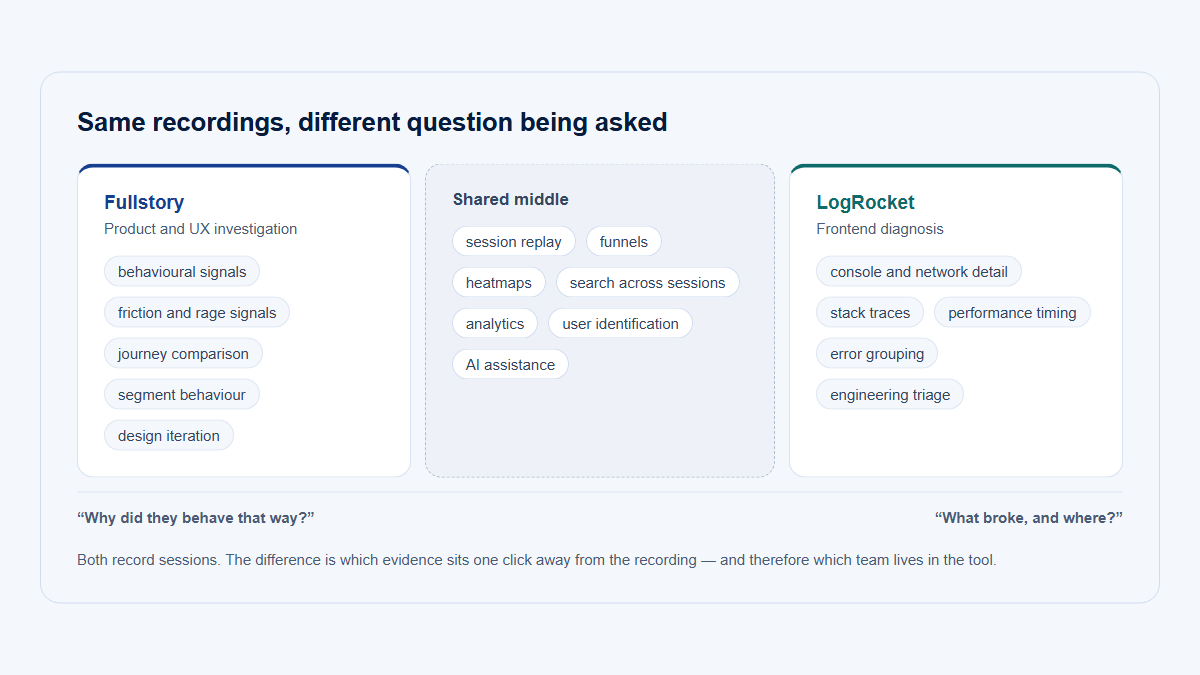
Shared capabilities, two different operating loops
PostHog loop
Instrument, ship, measure
Where the loops overlap
LogRocket loop
Report, diagnose, fix
Starts from something you shipped Starts from something someone reported
Both loops consume the same middle. The difference is what triggers them: a release you are measuring, or a problem someone raised.
Can one directly replace the other?
| Question | Short answer | Main loss or rebuild |
|---|---|---|
| Can PostHog replace LogRocket? | Often, not automatically. It covers analytics, replay, errors, console, network, and performance while consolidating more tools. | Test developer-pane, GraphQL, performance, triage, support, and agent workflows on real incidents. |
| Can LogRocket replace PostHog? | Only for analytics and replay overlap: funnels, paths, retention, heatmaps, surveys, replay, errors, and performance. | Keep systems for flags, experiment delivery, groups, managed warehouse data, general pipelines and logs, workflows, and LLM-app observability. |
| Should a team use both? | Sometimes. PostHog can own release and measurement; LogRocket can own high-value frontend diagnosis. | Justify duplicate SDKs, capture, cost, privacy review, identity, and ownership. |
Consolidation: PostHog may replace more categories; LogRocket may shorten the path from frontend failure to fix. Checklists do not prove parity.
Product analytics, flags, and experiments
Both support product analysis; PostHog connects it to more delivery and data systems. LogRocket links metrics, funnels, paths, retention, and heatmaps to replay. PostHog adds flags, experiments, groups, warehouse queries, and workflows.
| Capability | PostHog | LogRocket | Practical implication |
|---|---|---|---|
| Product analytics | Core | Strong | Both support quantitative analysis; PostHog connects it to a broader product-engineering stack. |
| Account or group analysis | Strong | Limited | PostHog Groups can treat companies as analytical entities; LogRocket primarily relies on user traits, filters, and custom conventions. |
| Replay linkage | Strong | Strong | Both can move from a metric or affected user to selected session evidence. |
| Feature flags | Core | Not native | PostHog can deliver and target a release; LogRocket needs another flag system. |
| Experiments | Core | Not native | PostHog can assign and measure variants; data warehouse metrics are Beta. LogRocket analyzes variant events assigned elsewhere. |
| Surveys | Available | Available on web | Both collect in-product responses and connect feedback to behavioral context; LogRocket documents Surveys as web-only. |
| Feedback | Available | Beta | PostHog connects surveys to its platform; LogRocket’s dedicated Feedback workflow is currently beta. |
| Warehouse | Core | Limited | PostHog imports and queries external data; LogRocket exports data to an external system. |
| Pipelines | Core | Limited | PostHog has destinations, transformations, and batch exports; LogRocket’s comparable path is Streaming Data Export and integrations. |
| Workflows and alerts | Strong | Strong for diagnostics | PostHog supports broader event-triggered automation; LogRocket focuses on metric, issue, support, ticket, and fix workflows. |
| Error tracking | Strong | Core | PostHog integrates errors into its platform; LogRocket makes frontend diagnosis a defining workflow. |
PostHog flags support targeted rollout, kill switches, remote configuration, and experiments using events, funnels, or data warehouse metrics (Beta), with replay links. LogRocket can analyze externally assigned variants, but does not deliver or assign them. See the flag and experiment documentation.
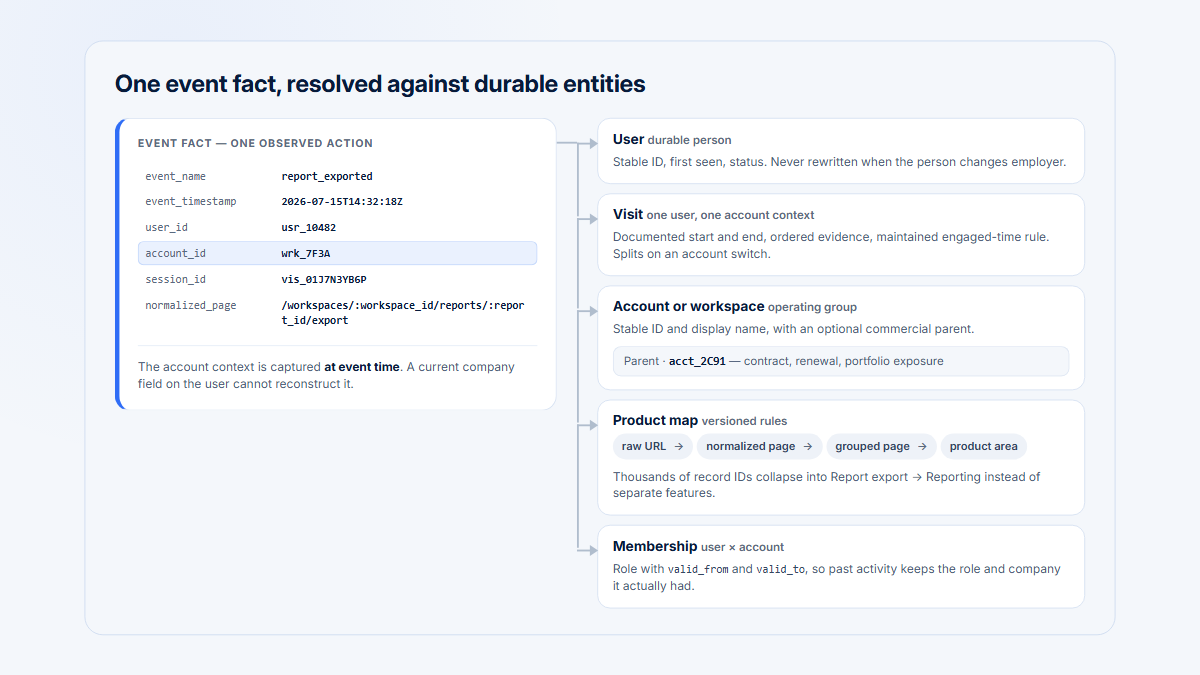
B2B accounts: PostHog company groups support company-level analysis. LogRocket documents company traits and filters, not comparable first-class group semantics. Paid Group Analytics bills all identified events once enabled.
Replay, errors, network, and performance
PostHog adds technical replay to a broad platform; LogRocket centers a purpose-built frontend investigation workflow. Both connect reconstructed sessions to console, requests, errors, people, and performance. Neither proves intent or root cause.
| Diagnostic capability | PostHog | LogRocket | Important qualification |
|---|---|---|---|
| JavaScript errors | Strong | Core | Both capture frontend exceptions and connect them to affected sessions. |
| Stack traces | Strong | Core | Both need correct source-map and production-bundle configuration. |
| Source maps | Available | Available | Upload maps and validate bundle matching in either product. |
| Console logs | Available in replay | Core developer pane | Browser or app console evidence is not necessarily a general log-management replacement. |
| Network requests | Strong on web | Core developer pane | Both show requests around a replay; LogRocket puts more workflow around this evidence. |
| Request or response bodies | Optional on web; masking; 1 MB truncation; mobile telemetry only | Privacy- and role-controlled; mobile varies | Require redaction and access review. |
| GraphQL | Generic capture; no dedicated interface documented | GraphQL-aware search and network-error handling | Verify Issues 2026 Beta parity. |
| Frontend performance | Replay network and performance evidence, plus separate Web Vitals analytics | Dedicated web and mobile frontend-performance monitoring | Evaluate real slow-session, device, and network scenarios. |
| Release tracking | Available in Error Tracking | Available through release and version context | Both need consistent release identifiers. |
| Issue grouping | Automatic grouping and custom fingerprints | Grouping, triage, severity, impact, and Signals-to-Issues | Redesigned Issues is 2026 Beta. |
| Alerts | Available across analytics, errors, logs, and other products | Available for metrics and issues | Plan and destination details require verification. |
| Issue-tracker and agent handoff | Integrations and workflows | Tickets and coding-agent actions | Verify plan, processing, and credentials. |
| Replay-to-error workflow | Strong | Core | LogRocket is more explicitly oriented around frontend reproduction and resolution. |
PostHog web replay records request URLs and performance. Optional capture adds headers and bodies, truncated at 1 MB and subject to masking; mobile records telemetry, not bodies. See network recording.
LogRocket replay marks errors and failed requests. Issues 2026 Beta adds severity, analysis, tickets, and agent handoff; several non-JavaScript Signals require Pro or Enterprise.
Worked example: a Reporting release that regresses
Delivery and detection
Technical diagnosis branches
Close the loop
One release can need both loops: a product-delivery loop to expose and measure it, and a frontend-diagnosis loop to explain it. Neither product covers the backend, so budget for that separately.
Data platform, integrations, and deployment
PostHog extends into data infrastructure; LogRocket stays closer to frontend observability. PostHog queries imported sources, sends realtime or batch data, ingests OpenTelemetry logs, runs workflows, and traces LLM calls.
PostHog’s breadth can consolidate multiple systems, but adds meters, permissions, retention choices, and owners. Review its warehouse, logs, and AI Observability documentation before consolidating.
Privacy, implementation, and ownership
Replay and request capture require deliberate governance. Test what leaves the device under the actual masking, sampling, identity, URL, network, access, retention, and deletion configuration.
| Area | PostHog | LogRocket |
|---|---|---|
| Managed cloud | Yes; the current pricing page lists US and EU regions | Yes |
| Self-hosting | Open-source hobby deployment; single-machine, limited support, and material cloud-feature gaps | Enterprise self-hosting is advertised on customer infrastructure |
| Infrastructure responsibility | Vendor cloud; customer scaling, backups, security, and recovery when self-hosting | Vendor SaaS; customer operations when self-hosting |
| Data storage | Vendor-managed cloud storage or customer-selected storage when self-hosted | Vendor-managed SaaS storage or customer infrastructure for self-hosting |
| Upgrades | Vendor-managed in cloud; customer-managed for open-source self-hosting | Vendor-managed in SaaS; confirm self-hosted upgrade responsibilities |
| Security | Shared capture, access, region, classification, and vendor review | Shared capture, request-body, role, region, and contract review |
| Retention | Free cloud: one year; pay-as-you-go: seven years; product rules vary | Plan-specific; qualifying watched sessions reach 12 months; Issues remain one month after the last instance |
| Deletion | Verify events, people, replay, warehouse, logs, and backups | Verify sessions, user data, Issues, exports, and backups |
| Likely primary owner | Product engineering or data/platform engineering, with product and growth users | Frontend engineering or support engineering, with product, UX, and support users |
| Implementation effort | Medium–high with groups, delivery, data products, logs, and privacy | Low–medium pilot; medium for production identity, privacy, maps, releases, sanitization, integrations, and self-hosting |
PostHog masks page and network data and gates recording by rules; review its privacy controls. LogRocket sanitizes DOM, network, headers, URLs, and Redux; see its privacy controls.
Self-hosting is not parity. PostHog documents a single-machine, unsupported hobby deployment with feature gaps. LogRocket advertises Enterprise deployment on AWS, GCP, Azure, and Kubernetes; verify AI, flows, sizing, upgrades, support, retention, and parity.
Pricing and customer feedback
Pricing units differ. PostHog meters products after recurring allowances; LogRocket meters captured sessions, with seats, retention, AI, and add-ons affecting quotes.
| Pricing or review item | PostHog | LogRocket |
|---|---|---|
| Free allowance | 1M analytics events; 5K web and 2.5K mobile replays; 1M flag requests; 100K exceptions; 1,500 survey responses; 1M warehouse rows; 10K realtime triggers plus 1M batch rows; 100K AI-observability events; 10 GB logs; and 10K workflow messages per channel | Main platform: 14-day no-card trial, without a permanent platform-wide allowance; Surveys and beta Feedback publish separate allowances |
| Paid billing units | Separate usage meters by product; rates reduce at volume | Captured web and mobile sessions; final price also depends on seats, retention, and add-ons |
| Replay | First 5K web recordings free monthly, then from $0.005; first 2.5K mobile recordings free, then from $0.01 | Included in session-based pricing; the current calculator shows a $176/month starting example at 25K sessions |
| Flags and experiments | First 1M flag requests free, then from $0.0001/request; experiments bill with flags; Group Analytics starts at $0.000071 per identified event | No native flag-delivery or experiment-assignment meter because those systems are external |
| Error and performance packaging | First 100K exceptions free, then from $0.00037; replay performance is metered with replay, while logs have their own meter | Analytics, error events, logs, network data, and frontend performance are included; Galileo and some Issue capabilities require Pro or Enterprise |
| Warehouse and pipelines | First 1M managed rows free, then from $0.000015; historical syncs are free; first 10K realtime triggers and 1M batch rows are free | Enterprise Streaming Data Export sends data externally; no equivalent managed analytical warehouse is documented |
| G2 rating and review count | 4.5/5 from 1,054 reviews | 4.6/5 from 2,399 reviews |
| Official pricing | PostHog pricing and allowances | LogRocket pricing calculator and packages |
Recurring free allowances
PostHog
Starts at $0/month
Multiple product meters can accumulate as usage grows.
Public calculator signal
LogRocket
From $176/month
Seats, retention, commitment, AI, and export can change this calculator example.
G2 snapshot
PostHog reviews
G2 snapshot
LogRocket reviews
| Product | Rating | Recurring praise | Recurring criticism |
|---|---|---|---|
| PostHog | 4.5/5 · 1,054 reviews | Connected coverage; replay context; setup; free allowances | Learning curve; dense configuration; instrumentation and cost choices |
| LogRocket | 4.6/5 · 2,399 reviews | Readable replay; technical context; faster reproduction | Volume cost; session search at scale; learning curve; feature requests |
Qualitative themes, not sentiment analysis. G2’s five- and four-star shares are 69% and 27% for PostHog, versus 76% and 22% for LogRocket. Snapshots can change.
Model equal workloads before comparing price
Model every PostHog meter. For LogRocket, model captured-session rules, seats, retention, AI tier, export, support, mobile allocation, commitment, and overages.
With both SDKs, include duplicate capture, identity, privacy, ownership, and client overhead. Confirm currency, taxes, discounts, minimums, support, termination, and data-access terms.
Which should you choose?
Choose by owner and recurring workflow. PostHog starts with release, measurement, accounts, and data; LogRocket starts with replay-backed frontend diagnosis and support escalation.
| Scenario | Best starting fit | Why | Watch-out or additional system |
|---|---|---|---|
| Early-stage engineering startup | PostHog when consolidation and recurring free tiers matter | One implementation can cover analytics, replay, flags, experiments, surveys, errors, and more | LogRocket may be the better first purchase when frontend incidents and customer troubleshooting dominate |
| Product manager needing funnels | PostHog for the broader analytics and experimentation loop | Funnels, retention, segments, account groups, and release context | LogRocket is credible when replay-first interpretation matters more than native experiments |
| Frontend engineer diagnosing failures | LogRocket | Replay, console, network, GraphQL, errors, performance, and Issue workflows are central | Backend APM, traces, or logs may still be necessary |
| Team needing flags and experiments | PostHog | Native rollout, targeting, kill switches, assignment, metrics, and replay | Validate methodology, exposure tracking, beta warehouse metrics, SDK behavior, and scale pricing |
| Support team | LogRocket | Move from a reported problem to the user session and technical evidence | A support desk still owns tickets, communication, and service workflows |
| B2B customer-success team | PostHog Groups or Hymetry, depending on the workflow | PostHog models company groups; Hymetry is organized around Companies, Users, product areas, and Visits | Neither replaces a CRM or complete customer-success platform |
| Organization with a warehouse | PostHog when analysts should query warehouse and product data together | Managed sources, SQL, and pipelines reduce some external stitching | Existing warehouse governance and BI may remain authoritative |
| Team requiring self-hosting | LogRocket Enterprise for a commercial route; PostHog open source only with accepted limitations | The deployment propositions are materially different | Run a feature-parity, data-flow, support, architecture, and total-cost review |
| Mobile team | Pilot both against the exact SDK matrix | LogRocket emphasizes diagnostics; PostHog connects analytics, flags, experiments, and replay | Replay mode, masking, network evidence, crashes, performance, and framework support vary |
Worked scenario: a B2B Reporting release
A SaaS team releases Reporting behind a flag, then completion falls. Sessions show an exception, failed request, or slow response. The team also needs company adoption and warehouse context.
| Task | PostHog | LogRocket | Additional system needed |
|---|---|---|---|
| Rollout | Native flag, targeting, staged release, and kill switch | Observe affected sessions and externally assigned variants | External flag service if PostHog is not used |
| Experiment | Native assignment and analysis; data warehouse metrics are Beta | Analyze custom variant events assigned elsewhere | External experimentation or flag platform |
| Product funnel | Funnel with segments, flags, groups, and replay links | Funnel with replay and Issue context | None for the basic funnel |
| Account adoption | Company-group funnel and retention with Group Analytics | Trait filters and user sessions; no comparable group object documented | Hymetry or warehouse modeling for richer account investigation |
| Replay | Linked to funnel, person, flag, experiment, and error context | Core replay workflow with detailed developer evidence | None for basic session review |
| Error diagnosis | Issues, stack traces, maps, releases, and replay | Errors, grouping, replay, severity, and triage | Backend error or tracing platform for server failures |
| Network diagnosis | Web waterfall and optional request details | Network pane, request and response context, GraphQL, and related Issues | Backend APM or distributed tracing for complete causality |
| Performance | Replay-level performance and network evidence | Dedicated frontend performance monitoring | Backend and infrastructure monitoring for end-to-end latency |
| Warehouse join | Managed warehouse and SQL context | Export to an external warehouse | Existing warehouse, BI, or data platform with LogRocket |
| Customer-success evidence | Group, person, and replay context can be assembled | Sessions and summaries can be shared | CRM, customer-success platform, or Hymetry for Company → User → Visit |
PostHog can own more of the release loop; LogRocket can focus frontend investigation. Use both only when that diagnostic gain outweighs duplicate capture, cost, privacy, and ownership.
Where Hymetry fits
Hymetry adds an account-centric investigation path for multi-user B2B SaaS. PostHog and LogRocket can identify important product or session signals; Hymetry helps follow a selected signal through the commercial customer and the people and Visits behind it.
Hymetry does not replace PostHog flags, experiments, error tracking, warehouse, pipelines, general logs, workflows, or engineering tooling. It also does not replace LogRocket’s detailed network, GraphQL, console, performance, and issue-diagnosis workflow. Read Product Usage by Company for the account model.
- Reliable account and user intelligence requires valid identity.
- Replay does not establish intent or causality.
- Risk, friction, and expansion signals require human investigation; they are not deterministic predictions.
- Hymetry does not claim automatic root-cause detection or specialist observability parity.
- Advanced automatic friction events and readable session narratives remain roadmap- or verification-sensitive.
FAQ, methodology, and sources
Is PostHog better than LogRocket?
Not universally. PostHog better unifies analytics, groups, releases, experiments, replay, and data tooling. LogRocket better centers frontend replay and diagnosis.
Can PostHog replace LogRocket?
Often, if consolidation matters more than specialist depth. First test real errors, requests, GraphQL problems, slow sessions, source maps, support, and triage.
Which is better for product analytics?
Usually PostHog, especially for groups, flags, warehouse data, and pipelines. LogRocket still supports funnels, retention, paths, tables, heatmaps, and replay links.
Which is better for frontend debugging?
Usually LogRocket: replay, console, network, GraphQL, performance, stack traces, issue grouping, alerts, tickets, and coding-agent actions form its central workflow.
Which has stronger feature flags and experiments?
PostHog provides delivery, targeting, rollout, kill switches, assignment, analysis, and replay links; data warehouse metrics are Beta. LogRocket only analyzes externally assigned variants.
Should a team use both?
Yes, if specialist diagnosis justifies duplicate capture, cost, privacy, and ownership. PostHog can own releases and measurement; LogRocket can handle high-value frontend incidents.
Where does Hymetry fit?
Hymetry adds account-centric B2B investigation across product areas, Companies, Users, and Visits; it complements both platforms.
Methodology, author, disclosure, and evidence limits
Researched: August 11, 2026. Author and publisher: Hymetry.
Evidence includes public product, pricing, deployment, privacy, and SDK documentation; G2; and the listed videos. Classifications reflect documented workflow orientation. Pricing uses public allowances and examples, not quotes.
Review themes are qualitative and beta features are labeled. No controlled benchmark, contract review, interview, or vendor briefing was performed. Packages, support, ratings, and counts can change.
Disclosure: Hymetry overlaps with account analytics and session evidence. Neither vendor paid for placement or reviewed the conclusions.
Sources
Official PostHog product and documentation sources
Official LogRocket product and documentation sources
Pricing and customer-review sources
- PostHog pricing
- LogRocket pricing
- LogRocket Surveys packaging
- LogRocket Feedback packaging
- PostHog on G2
- LogRocket on G2
Pricing and G2 snapshots were verified August 11, 2026. G2 displayed 4.5/5 from 1,054 reviews for PostHog and 4.6/5 from 2,399 reviews for LogRocket.
Independent video, vendor video, and related comparisons
- EP 116 — Session Replay Wrap Up with Matt & Moshe, independent Product for Product Podcast context, uploaded October 1, 2024
- Introducing the LogRocket MCP, official vendor demonstration, June 2, 2026
- Product Analytics Tools Compared
- Fullstory vs LogRocket
- OpenReplay vs LogRocket vs Fullstory