Quick comparison
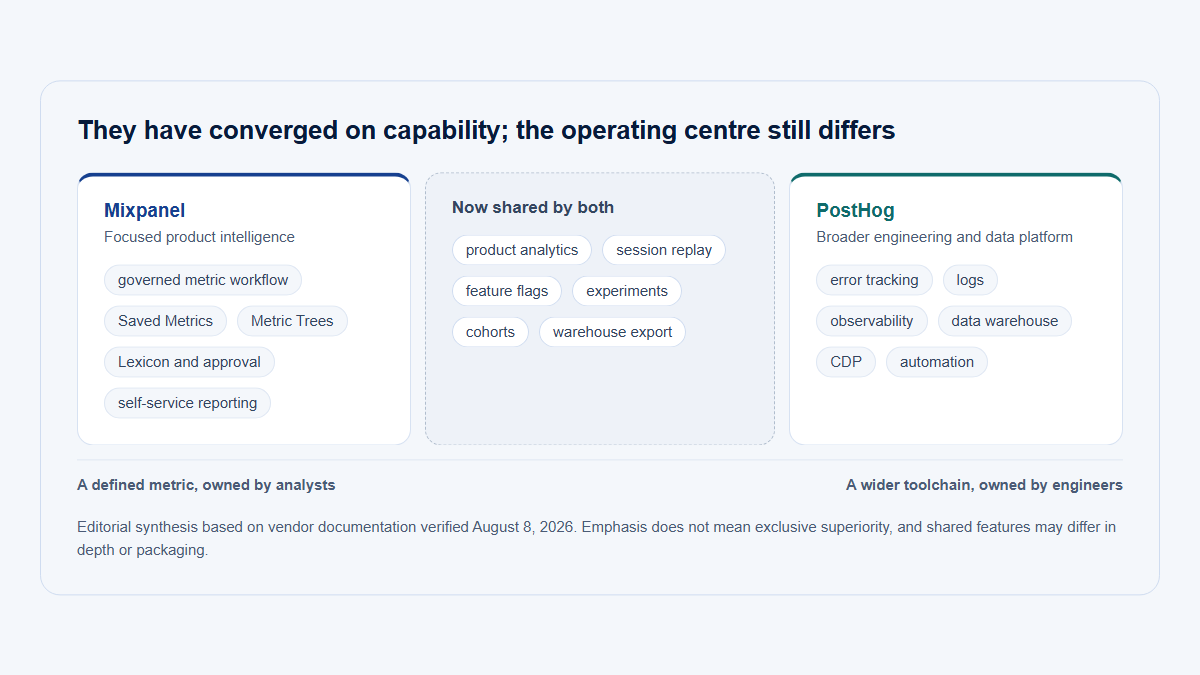
HockeyStack’s action-based model connects website activity, campaigns, sales touches, CRM changes, and product signals to buyers and accounts. PostHog combines event analytics with release, experimentation, replay, observability, and data workflows.
| Question | HockeyStack | PostHog | Decision implication |
|---|---|---|---|
| Which campaigns created pipeline? | Strong | Campaign-to-event analysis; CRM pipeline needs modeling | HockeyStack is closer to a ready-made B2B pipeline answer |
| Which sales touches preceded a deal? | Strong with connected CRM and engagement data | Possible through imported CRM activity or custom events | PostHog can query the data, but you design the commercial model |
| Which trial features are adopted? | Telemetry can contribute to account intelligence | Strong native event, funnel, and cohort analysis | PostHog is the more natural product-analysis system |
| Which companies completed onboarding? | Available through account and funnel definitions | Strong when groups and onboarding events are modeled | Both answer it from different analytical layers |
| Which users returned? | Not the primary native model | Strong retention and lifecycle analysis | PostHog fits recurring authenticated behavior |
| Which sessions show friction? | Replay not documented as a current core product | Replay connects sessions to events and errors | PostHog supplies direct session evidence |
| Which intervention improved activation? | Controlled product experiments not documented as a core product | Flags and experiments support randomized exposure | Experiments can produce stronger intervention evidence |
| Which usage preceded expansion? | Connects telemetry to account, opportunity, and revenue context | Possible with groups plus billing or warehouse data | Association is useful, but it is not automatic causal proof |
Commercial motion, or product and engineering
HockeyStack
GTM and revenue
Overlap
PostHog
Product and engineering
Marketing and RevOps ask first Product and engineering ask first
These are rarely competing purchases. They answer questions on either side of the contract, and the overlap is where you must decide who owns which metric.
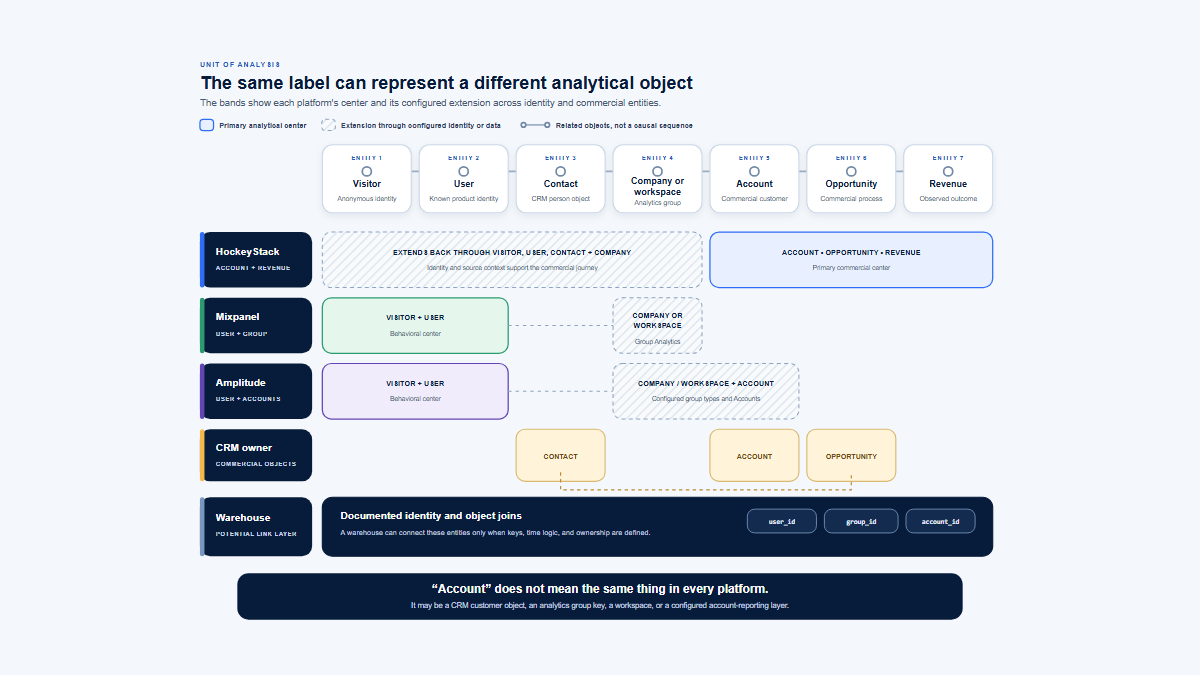
Accounts, users, CRM, and identity
The central modeling difference is not simply “accounts versus users.” Both platforms can represent people and companies. The difference is which relationships are first-class and how much work turns them into a trustworthy analytical model.
HockeyStack’s model
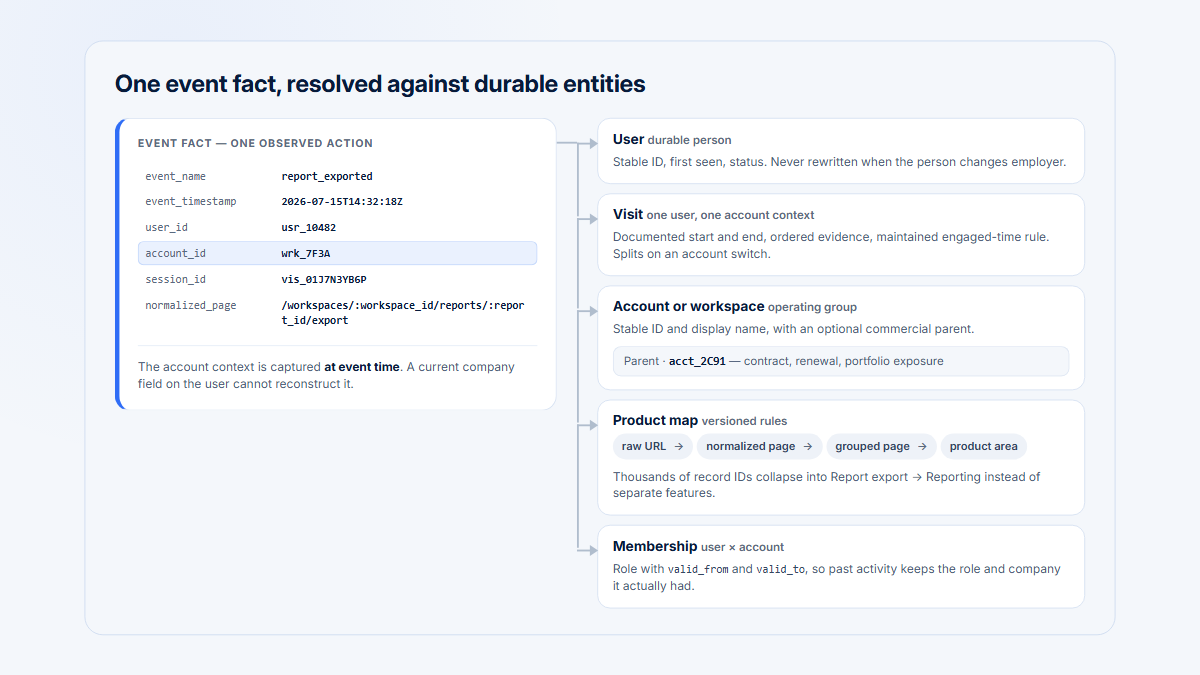
HockeyStack’s identity documentation describes anonymous, personal, and business identities. Atlas normalizes connected information around Person, Company, Action, and Metadata. Company domains, CRM relationships, opportunities, sales activity, campaigns, and commercial results are central to the journey.
That suits a buying process with several stakeholders and a long delay between first website activity and a deal. It still depends on CRM hygiene, opportunity-contact relationships, campaign definitions, identity rules, and attribution settings. A polished visualization cannot repair duplicate accounts, missing roles, or inconsistent lifecycle stages.
PostHog’s model
PostHog begins with anonymous and identified persons, events, and sessions. Organizations, companies, or workspaces are modeled as groups. Its paid Group Analytics add-on supports up to five group types and can drive group funnels, retention, flags, and experiments. Once enabled, its billing applies to all identified events, not only grouped events.
Customer Analytics is currently labeled beta. Its B2B mode requires Group Analytics, and its journey views are also beta. Treat those surfaces as useful evolving workflows, not mature equivalents to every dedicated commercial account-intelligence process.
| Entity or signal | HockeyStack | PostHog |
|---|---|---|
| Anonymous visitor | Journey identity that can connect to a person or business | Anonymous distinct ID that can later be identified and merged |
| Contact | First-class CRM and buying-journey participant | Usually a person; CRM contacts can be imported and joined |
| Product user | Identified person and source of product signals | First-class analytical entity |
| Company or account | First-class commercial entity | Group entity when configured |
| Opportunity | First-class CRM and funnel context | Imported table, custom event, or warehouse entity requiring modeling |
| Campaign and sales activity | Core journey and attribution inputs | UTM, ad, imported CRM, or custom-event data |
| Product event | Supported telemetry input | Native analytical primitive |
| Session evidence | Commercial touchpoint context; current core materials do not establish PostHog-like replay | Native session and replay context |
| Subscription and revenue | Connected commercial reporting context | Billing source, warehouse table, property, or custom event |
| Warehouse context | Data Syncs add-on for documented imports and exports | Sources, models, views, and pipelines in an integrated query layer |
For either product, decide whether “company” means a CRM account, billing customer, product workspace, or parent organization—and how multi-account users are handled. A champion-heavy account can look healthy while most users never adopt. See B2B product analytics and product usage by company.
Attribution, pipeline, and revenue
This is HockeyStack’s clearer category advantage. Its current materials center on marketing and account intelligence, buyer journeys, campaigns, opportunities, pipeline, and revenue. Blueprints are described as finding historical journey patterns, while Odin is positioned as an AI analyst. Those are vendor product descriptions, not proof that a score or pattern is objectively true.
PostHog’s Web Analytics covers traffic, sessions, referrers, UTMs, and event conversions. Marketing Analytics is an opt-in beta combining campaign data with PostHog events, actions, or warehouse-defined goals, including cost and conversion measures.
That is useful for website or product-event conversions, but it is not a ready-made B2B opportunity model. PostHog can import CRM and billing data and build the joins; someone must still own account matching, touchpoint logic, attribution windows, stage history, and reconciliation.
Nine stages from campaign to reconciled revenue
1
Campaign
2
Visitors
3
Matched account
4
Opportunity
5
Trial users
6
Onboarding
7
Flags
8
Paid plan
9
Warehouse
HockeyStack emphasis
PostHog emphasis
Shared IDs join them
Authoritative elsewhere
Each product is strongest across a different span of the same journey. The stages at either end belong to systems that are neither product — and stay authoritative there.
Product analytics, replay, flags, and experiments
PostHog has the clearer category advantage when teams need to understand and operate the product. Its Product Analytics documentation covers trends, funnels, retention, paths, stickiness, lifecycle, correlation, and SQL. Replay connects recordings to users, events, flags, console output, network requests, and errors. Feature flags support controlled rollout, while experiments randomize exposure and evaluate defined metrics.
The product directory also includes surveys, web analytics, error tracking, logs, workflows, warehouse tools, and pipelines. This context differs from seeing a product signal only inside a commercial journey.
Where HockeyStack overlaps
HockeyStack can ingest product telemetry alongside CRM, website, advertising, warehouse, and sales data. That can show whether an account activated before an opportunity advanced, which behaviors appeared before expansion, or which signals should be surfaced to sales and customer success. Current official materials place those signals inside GTM and account intelligence; they do not document equivalent native depth in retention analysis, replay, release control, experimentation, error diagnosis, or logs.
| Capability | HockeyStack | PostHog |
|---|---|---|
| Multi-touch attribution | Core strength | Custom modeling; Marketing Analytics focuses on campaigns and event conversions |
| Account and opportunity journey | Core strength | Product journeys through groups; commercial opportunity layer is modeled |
| Product analytics | Telemetry contributes to commercial analysis | Core strength |
| Retention and cohorts | Not documented at equivalent native depth | Native |
| Session replay | Not documented as core | Native |
| Feature flags and experiments | Not documented as core | Native; experiments use flag requests for billing |
| Errors and logs | Not documented as core | Current products |
| Marketing analytics | Native commercial attribution focus | Official beta for the enhanced campaign surface |
| AI and automation | Odin, Blueprints, account research, scoring, and workflows | AI, workflows, and product automation across current offerings |
Evidence labels: “Native” and “core” summarize current official documentation. “Not documented as core” is a public-evidence limitation, not a claim that no legacy, private, partner, or custom implementation can exist.
Two current PostHog walkthroughs
Data architecture, integrations, and implementation
Both products need durable identity, definitions, privacy controls, and an owner who can reconcile outputs against source systems.
Implementation priorities
For HockeyStack, reconcile person and company identities, domains, CRM account relationships, opportunity-contact roles, lifecycle stages, campaign naming, sales activity, pipeline amounts, revenue definitions, product telemetry, and the selected attribution model. Its pricing page lists GTM/CRM integrations, hands-on support, and custom setup across plans. Data Sync imports and exports require the Data Warehouse add-on.
For PostHog, define anonymous-to-identified transitions, canonical events, group keys, multi-account membership, replay privacy, flag ownership, experiment exposure, error grouping, warehouse models, and volume budgets. The established integrated warehouse query layer should not be conflated with the separately documented managed warehouse endpoint, which is currently beta and waitlist-gated.
| Layer | Primary responsibility | Governance check |
|---|---|---|
| HockeyStack | Campaigns, buyer journeys, CRM activity, opportunities, pipeline, attribution, revenue analysis | Document model, window, and commercial definitions |
| PostHog | Product events, funnels, retention, replay, flags, experiments, errors, logs, workflows | Own event schema, exposure, privacy, and volume |
| CRM | Accounts, contacts, opportunity stage and amount, ownership, sales activity | Resolve duplicates and stage-history rules |
| Billing or finance | Subscription state, invoices, recognized revenue, financial measures | Keep analytical estimates separate from authoritative amounts |
| Warehouse | Cross-system joins, durable transformations, dimensions, reconciled reporting | Version shared definitions |
| Identity contract | Stable user, company, CRM account, and relevant workspace IDs; persistent campaign fields | Define mergers, subsidiaries, agencies, and multi-workspace accounts |
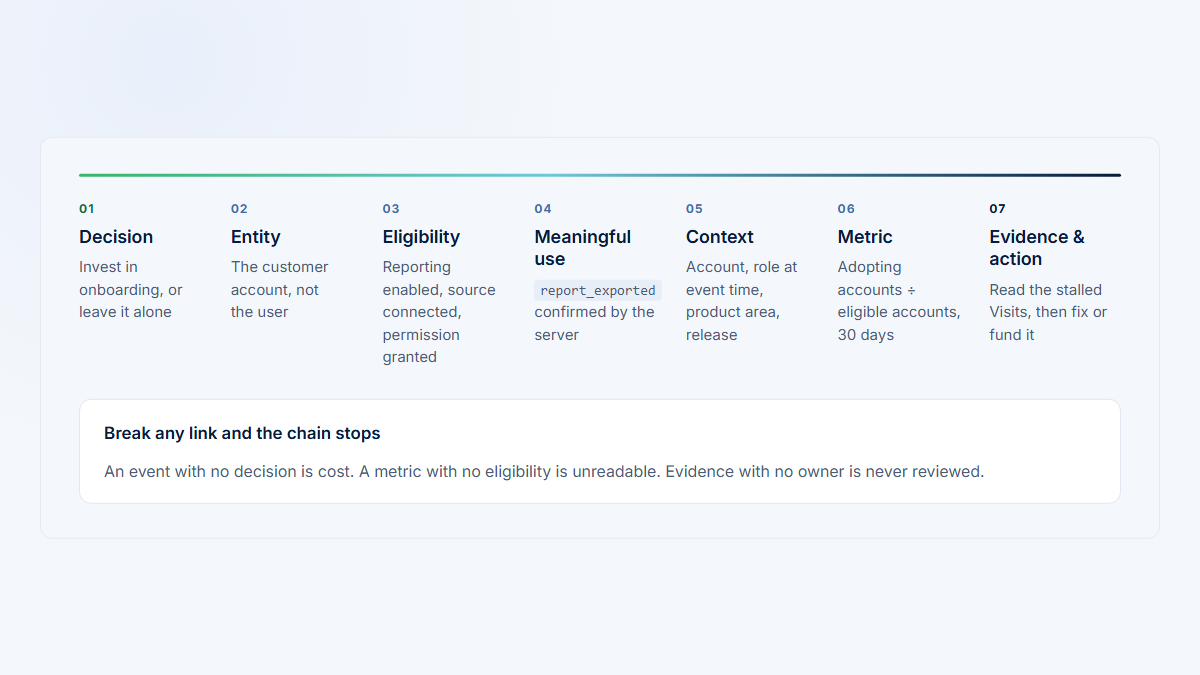
Let the instrumentation owner define product events, the CRM owner define opportunity stages, and finance or billing define revenue. Store shared activation, adoption, expansion, and revenue definitions in one governed location instead of recreating them independently in every platform.
Routed by purpose, connected by a contract
Sources, routed by purpose
Identity and governance contract
Who reads the output
Route each source to the lane that owns its question. The governance layer is what stops the same metric being computed twice with two different meanings.
Pricing and customer feedback
Pricing is uneven. HockeyStack’s public page lists service elements but no fixed software price. Its master services agreement (MSA) puts fees in the order form and describes Monthly Tracked User (MTU) true-ups. PostHog publishes product-specific allowances and marginal rates, so cost can grow across several meters.
HockeyStack pricing
HockeyStack
Sales-assisted
- Commercial unit
- Order-form fees and tracked usage; MSA describes MTU true-ups
- Across plans
- GTM/CRM integrations, hands-on support, custom setups, and ROI reporting are listed
- Agent credits
- Current documentation lists per-action credit costs; confirm the included balance and commercial rate
- Warehouse
- Data Syncs require the Data Warehouse add-on
PostHog pricing
PostHog
Usage based
- Free workspace
- No card, one project, one-year retention, unlimited members
- Selected monthly allowances
- 1M analytics events, 5K web recordings, 1M flag requests, 100K exceptions, 1,500 survey responses, 1M warehouse rows, and 10GB logs
- Experiments and groups
- Experiments use flag billing; Group Analytics is a paid add-on billed across identified events
- Packages
- Boost $250/month, Scale $750/month, Enterprise by contact at verification
Detailed pricing cautions
HockeyStack’s current MSA says MTU true-ups use the preceding three-month average and lists $3,000 per additional 10,000 MTUs annually, prorated; the signed order form controls the commercial agreement. Confirm implementation, add-ons, credits, minimums, and current terms during procurement.
PostHog’s listed marginal meters include replay at $0.005 per recording after the free allowance and feature flags at $0.0001 per request; its pricing calculator distinguishes analytics event types and exposes separate rates for exceptions, rows, triggers, logs, surveys, messages, AI, and retention. Model a normal month, a launch spike, and a 10× growth case rather than comparing only the free tier.
Customer-review summary: these qualitative themes are evaluation prompts, not statistical findings. Equal ratings do not mean equal evidence.
Which one fits your scenario?
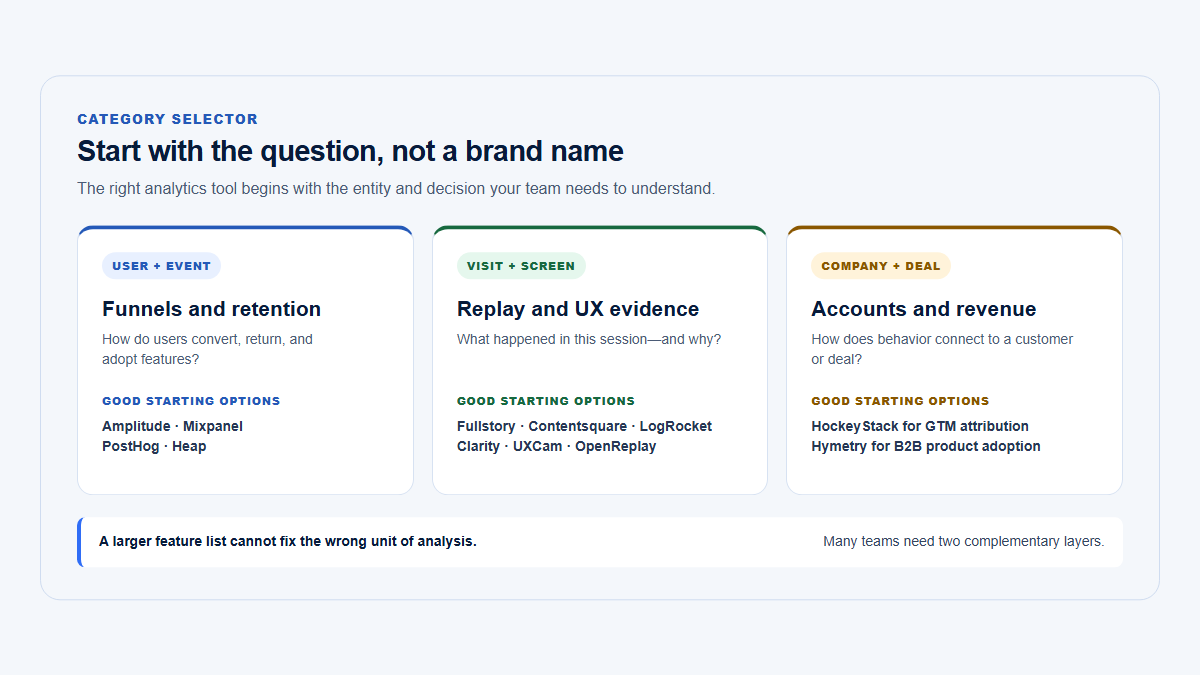
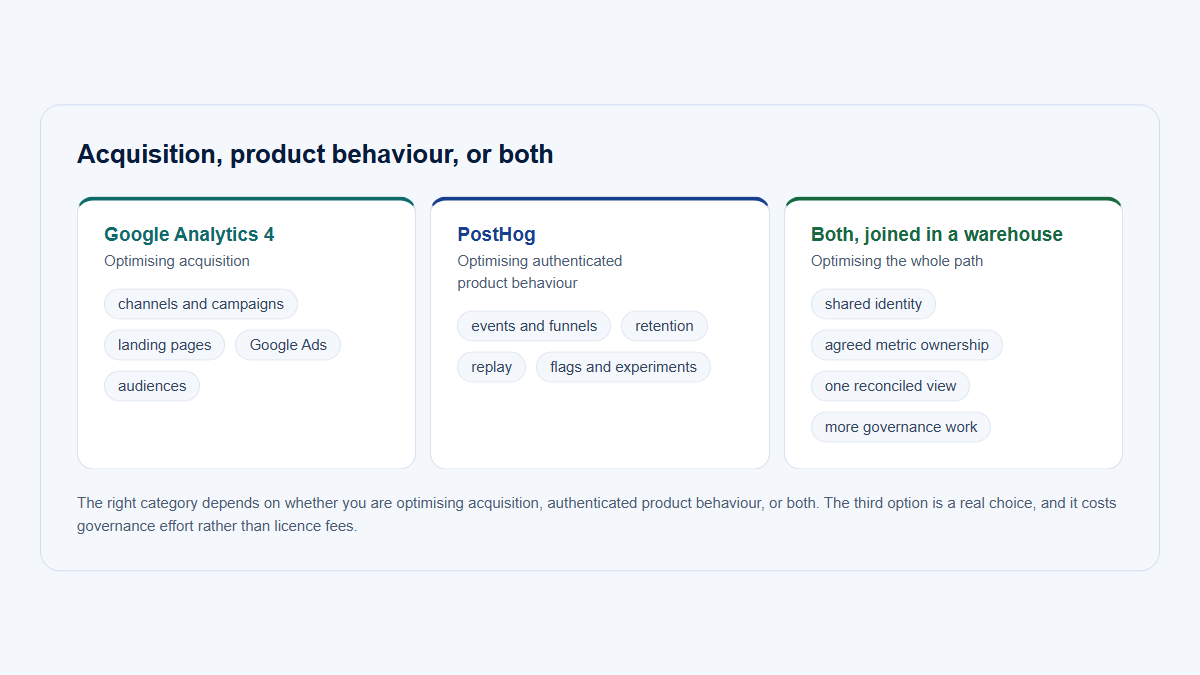
Editorial inference Locate the system where the unresolved question originates. Campaign, buyer, opportunity, pipeline, or revenue questions point toward HockeyStack. Event, workflow, session, flag, experiment, exception, or release questions point toward PostHog. Questions that begin in product usage and end in CRM or revenue often need both plus shared governance.
| Scenario | Starting fit | Why | Main caveat |
|---|---|---|---|
| B2B demand generation | HockeyStack | Commercial attribution, account, opportunity, pipeline, and revenue are the core job | Attribution remains model-dependent |
| Product growth | PostHog | Funnels, retention, replay, flags, experiments, and cohorts support iteration | Model groups and volume early |
| Engineering-led startup | PostHog | Analytics, release, errors, logs, and workflows can share a platform | Breadth creates operational and cost complexity |
| Sales-assisted PLG | Both | Commercial journeys and authenticated behavior both matter | Identity, ownership, and definitions are mandatory |
| RevOps | HockeyStack | CRM, account, pipeline, scoring, attribution, and activation are central | CRM and opportunity data must be clean |
| Customer success | Depends on the question | HockeyStack supplies commercial context; PostHog supplies detailed product evidence | Neither is automatically a full CS workflow system |
| Mature warehouse | Either or both | The warehouse can reconcile the commercial and product layers | It does not replace purpose-built workflows |
| One-product constraint | Choose the larger unresolved layer | Optimize for the primary operating team, not the longest feature list | Fill the missing layer with governed CRM, BI, or specialist tooling |
A sales-assisted PLG example
Imagine a B2B reporting product with paid campaigns, several stakeholders, a multi-user trial, product experimentation, a CRM opportunity, subscriptions, expansion, and a warehouse. HockeyStack owns commercial attribution; ad platforms own spend, CRM owns stage and amount, and billing or finance owns revenue. PostHog owns activation, product behavior, replay, experiments, and error diagnosis. The warehouse reconciles cross-system definitions.
Can HockeyStack replace PostHog?
Only for part of the surface
Usually not when product and engineering teams need native replay, retention, flags, experiments, errors, logs, and release operations. Replacing PostHog then means buying or building that layer elsewhere.
Can PostHog replace HockeyStack?
Only with substantial modeling
Usually not when the company expects turnkey CRM opportunity journeys, multi-touch attribution, pipeline, and revenue reporting. PostHog can hold source data, but the team owns the commercial model and its maintenance.
Final recommendation: choose HockeyStack when the main object is an account or opportunity and the outcome is pipeline or revenue. Choose PostHog when the main object is an event, person, group, or session and the outcome is adoption, release quality, experiment performance, or diagnosis. Use both when neither layer is expendable.
Where Hymetry fits
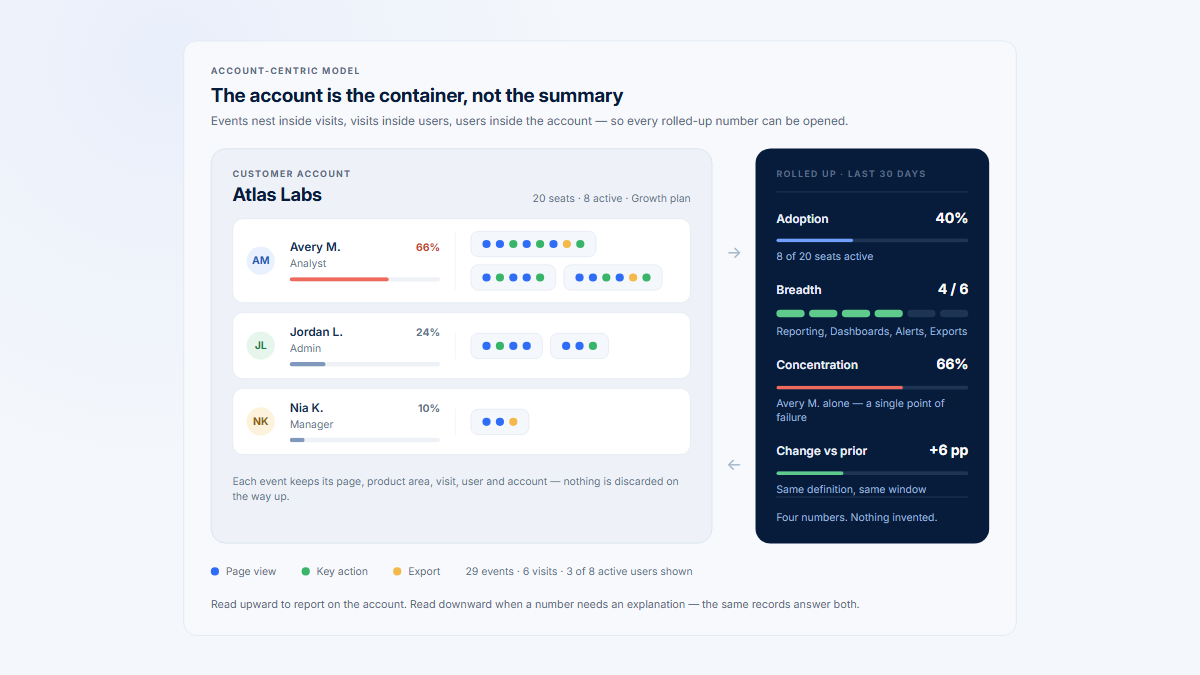
Hymetry is account-centric product intelligence for B2B SaaS. It connects product behavior across Pages, Companies, Users, and Visits so teams can inspect company adoption, user penetration, usage concentration, and session evidence.
Hymetry may complement HockeyStack by supplying focused product evidence for customer companies while HockeyStack remains responsible for campaigns, commercial journeys, CRM opportunities, attribution, pipeline, and revenue. It may also be a narrower alternative to PostHog when account-focused product intelligence is sufficient and the team does not need feature flags, controlled experiments, error tracking, logs, or PostHog’s wider engineering platform.
Explore Pages, Companies, Users, and Visits. For practical account workflows, see product usage and expansion opportunities and product usage before a renewal meeting.
FAQ, methodology, and sources
Is HockeyStack a PostHog alternative?
Only for part of PostHog’s analytical surface. HockeyStack can be the better alternative for B2B account intelligence, campaign attribution, CRM activity, opportunity journeys, pipeline, and revenue. It is not a direct substitute for PostHog’s native replay, flags, experiments, errors, logs, and product-engineering workflows.
Can PostHog replace HockeyStack?
PostHog can reproduce some analysis by importing CRM, campaign, billing, and warehouse data. It is not turnkey when the company expects a dedicated model for contacts, accounts, opportunities, sales touches, attribution, pipeline, and revenue. Building and governing that model is ongoing work.
Which is better for product analytics?
PostHog is generally the stronger fit. It includes native event analysis, funnels, retention, paths, cohorts, replay, flags, experiments, surveys, errors, and connected workflows. HockeyStack can use product telemetry, primarily as evidence inside GTM and account analysis.
Which is better for B2B attribution?
HockeyStack is generally stronger when attribution must connect campaigns and sales activity to accounts, opportunities, pipeline, and revenue. PostHog’s Marketing Analytics can analyze campaigns and event conversions, but the current beta surface is not equivalent to a dedicated CRM opportunity-attribution model.
Which includes replay and experiments?
PostHog includes session replay and feature-flag-based experiments. HockeyStack’s current official package materials reviewed for this article did not document equivalent native products as core capabilities.
Should a PLG company use both?
A sales-assisted PLG company may benefit from both. PostHog can own product events, funnels, replay, flags, experiments, and technical evidence; HockeyStack can own campaigns, buyer journeys, CRM activity, opportunities, attribution, pipeline, and revenue analysis. Shared user and company IDs are essential.
Where does Hymetry fit?
Hymetry fits when a B2B SaaS team needs account-centric product evidence across grouped Pages, Companies, Users, adoption, user penetration, and Visits. It can complement HockeyStack and may be a narrower alternative to PostHog, but it does not replace CRM attribution, pipeline, revenue systems, or PostHog’s engineering platform.
Methodology and evidence limits
- Current official product, documentation, pricing, legal, and self-hosting sources were primary.
- Products were compared by questions and workflows, not raw feature count.
- Beta, waitlist, add-on, and self-hosting limits remain visible.
- Comparable G2 seller pages supplied ratings and review counts; themes are qualitative.
- Vendor AI, scoring, prediction, attribution, and lift language is treated as product description, not causal proof.
- “Not documented” describes the public evidence reviewed, not a technical impossibility.
- No authenticated tenant, performance benchmark, or hands-on product test was used.
Visible disclosure: Hymetry publishes this page and appears as a possible complement or narrower alternative. No vendor paid for placement. Public capabilities, packaging, beta status, prices, ratings, and counts can change after the August 13, 2026 verification.