Key differences
| Criterion | Amplitude | PostHog |
|---|---|---|
| Primary strength | Governed product intelligence | Engineering and product operations breadth |
| Core analytics | Stronger governance Mature self-service analysis | Flexible analysis with HogQL and developer context |
| B2B accounts | Paid Accounts package | Paid Group Analytics add-on with documented limitations |
| Replay | Web plus beta native mobile replay | Web and supported mobile replay linked to developer context |
| Experiments and flags | Feature/Web Experiment and feature management | Experiments commonly use metered flags; external exposure supported |
| Guides and surveys | Both native | Surveys native; no current first-class guide product verified |
| Developer operations | Replay error analytics; no general logs product | Stronger Errors, logs, AI observability, workflows |
| Deployment | Managed platform | Managed cloud plus limited unsupported hobbyist OSS edition |
| Billing | Platform event volume plus packages | Separate product usage meters |
Both cover the core workflows; their centres of gravity differ
Amplitude
Governed product intelligence
Shared across both
PostHog
Engineering and product operations
Analytics team owns the model Engineering owns the instrumentation
Overlap in a capability list does not mean equal depth. Consolidation decisions should distinguish mature, plan-dependent, early-access, legacy and absent.
Decision by scenario
| Scenario | Start with | Why | Important limitation |
|---|---|---|---|
| Product/data-led analytics program | Amplitude | Governed metrics and broad analytical workflows | Requires instrumentation and administration ownership |
| Engineering-led product platform | PostHog | Release controls, replay, errors, data, and automation connect | Module breadth and maturity vary |
| Experiment-heavy team | Evaluate both | Both connect analytics, flags, and experiments | Compare exposure logic and pricing meters |
| B2B account analysis | Evaluate both | Both offer paid group/account models | Capture active account context at event time |
| Developer diagnostics | PostHog | First-class errors, logs, and observability | Not every newer module has equal maturity |
| Native guides and engagement | Amplitude | Mature Guides and Surveys product family | Expanded packaging may apply |
| Supported full self-hosting | Neither | PostHog OSS is officially limited and unsupported | Choose a supported self-hostable category if required |
Analytics, B2B accounts, and session replay
Amplitude usually offers the stronger governed analytical environment. PostHog connects competent analysis more directly to engineering and release evidence.
| Capability | Amplitude | PostHog | Decision |
|---|---|---|---|
| Funnels, retention, cohorts | Mature self-service analysis with governed definitions | Flexible reports integrated with flags, replay, and HogQL | Amplitude for governance; PostHog for developer context |
| Metrics | Metrics Library, official definitions, plans, and schemas | Flexible schema and SQL-like analysis; authority is more team-designed | Amplitude if standardization is central |
| Account model | Accounts package and account reporting | Group Analytics for companies, workspaces, or projects | Paid add-on/package |
| Replay | Linked to events and analysis; native mobile replay is beta | Linked to persons, flags, experiments, exceptions, and developer context | PostHog for diagnostics; pilot mobile parity |
| Privacy | Managed controls and enterprise governance | Replay privacy controls plus cloud/self-host decisions | Review capture defaults and data minimization |
| Warehouse | Connections, imports, exports, and Activation; Warehouse Native is legacy | Managed Warehouse and source connections | Validate the current architecture |
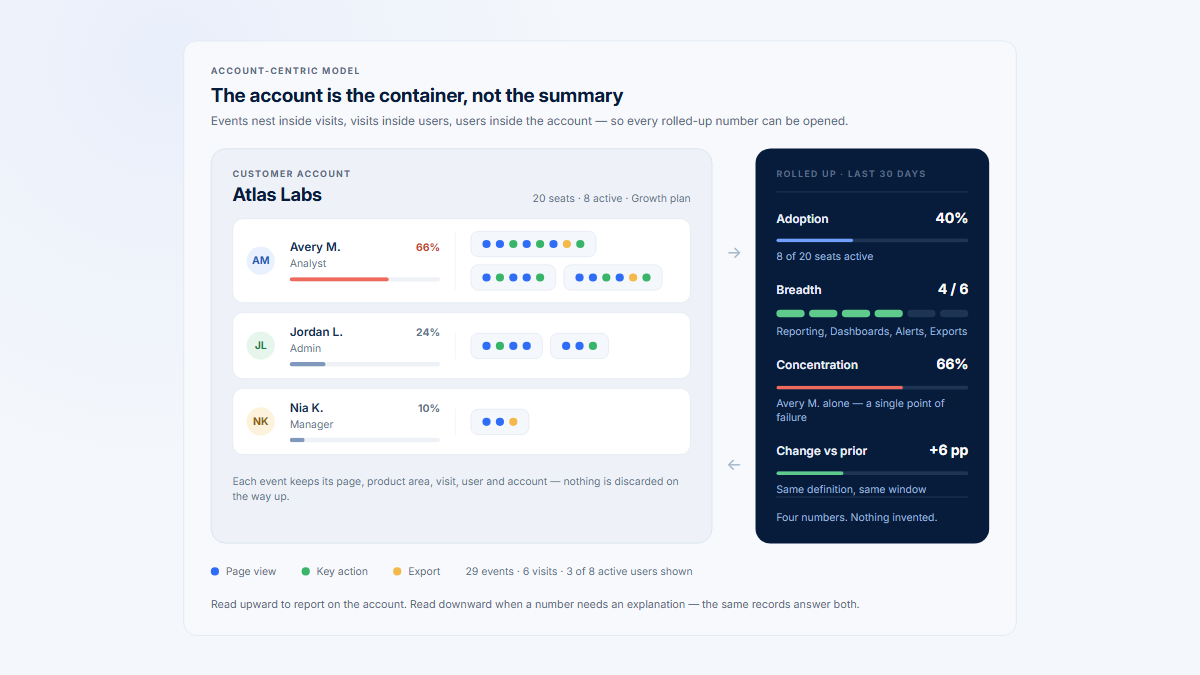
For B2B SaaS, add the active company or workspace key to relevant events. A mutable user profile cannot reliably reconstruct historical company context. Group support also does not calculate adoption breadth, user penetration, or usage concentration automatically. See account vs user adoption.
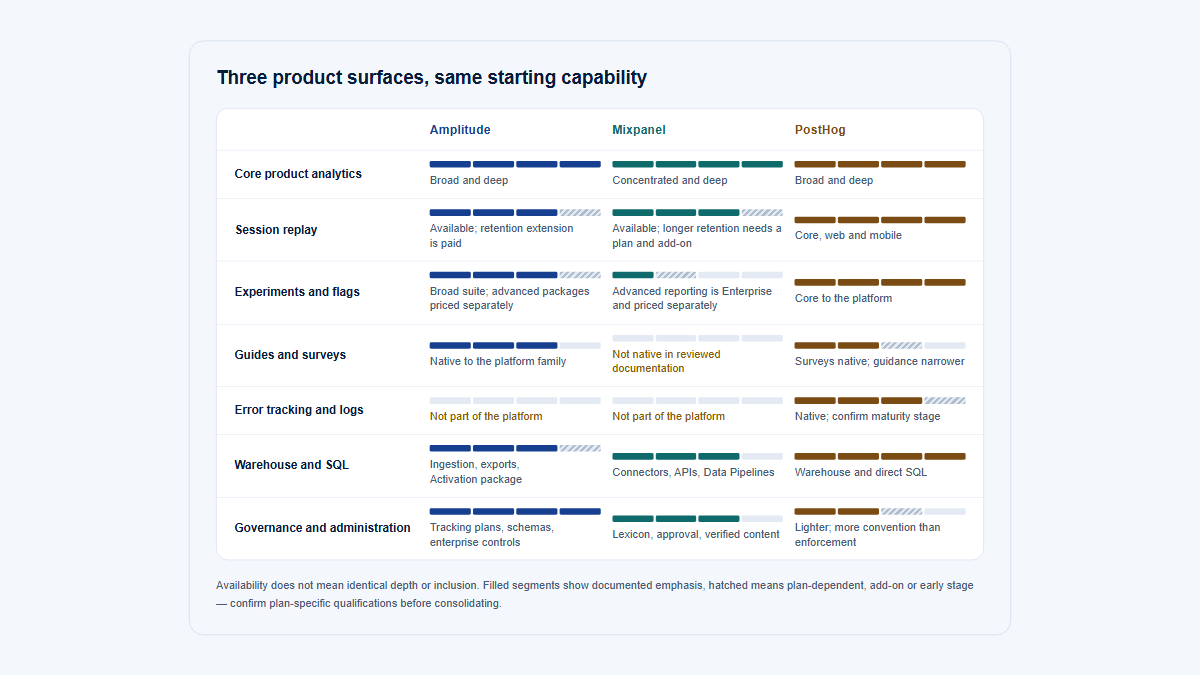
Consolidating means checking maturity, not presence
Amplitude
PostHog
Product analytics
Mature
Mature
Session replay
Mature; retention extension is paid
Mature, web and mobile
Experiments and flags
Broad suite; advanced packages affect cost
Core to the platform
Guides and surveys
Native platform family
Surveys native; in-app guidance narrower
Error tracking and logs
Not part of the reviewed platform
Native; confirm maturity stage per product
Warehouse and SQL
Ingestion, exports, Activation package
Warehouse and direct SQL access
Governance and administration
Tracking plans, schemas, enterprise controls
Lighter; more convention than enforcement
Filled segments show documented emphasis, not a score. Hatched segments are plan-dependent, add-on or early stage. Verify the exact packaging in a pilot.
Engineering, data, and deployment
PostHog has the clearer advantage when the purchase is also about developer operations.
| Capability | Amplitude | PostHog | Buyer implication |
|---|---|---|---|
| Error tracking | Replay Error Analytics, not a general issue product | Issues, traces, source maps, breadcrumbs, ownership, and alerts | PostHog stronger |
| Logs | No first-class general log store documented | OpenTelemetry-oriented search, patterns, and alerts | PostHog may replace a narrow log workflow, not every observability tool |
| AI observability | Early-access Agent Analytics connects traces to outcomes | Prompts, tokens, cost, latency, tools, and traces | Compare maturity and cost |
| Automation | Activation, monitoring, alerts, and analytical agents | Workflows with triggers, conditions, delays, branches, and actions | PostHog for engineering-owned automation |
| Self-hosting | No supported full platform | OSS edition is hobbyist-oriented, limited-parity, single-machine, and unsupported | Do not treat OSS as cloud-equivalent enterprise deployment |
One B2B feature release, two ways to run it
1
Account-targeted rollout
2
Experiment exposure
3
Account adoption
4
Replay and error evidence
5
Survey, warehouse, action
Amplitude route
PostHog route
Neither product supplies
The same release can centre on a governed analytical workflow or an engineering-owned diagnostic one. Pick the one matching who is on call for the metric.
Pricing and customer ratings
Amplitude prices a platform and expanded packages. PostHog exposes separate usage meters. Compare a complete twelve-month workload, not only the free headline.
Amplitude pricing
Amplitude
2M events
- Replay
- 10,000 monthly sessions
- Seats
- Unlimited
- Accounts
- Expanded paid package
- Paid model
- Event volume, plan, and packages
PostHog pricing
PostHog
1M events
- Replay
- 5,000 web + 2,500 mobile recordings
- Billing
- Separate product meters
- Groups
- Paid add-on
- Paid model
- Usage, packages, or enterprise agreement
| Cost driver | Amplitude | PostHog |
|---|---|---|
| Analytics | Platform event volume | Analytics-event meter |
| Flags/experiments | Plan and package dependent | Flag requests and exposure architecture |
| Developer modules | No comparable error/log meters | Exceptions, logs, AI events, workflows, and pipelines |
| Warehouse | Plan/package dependent | Rows and historical sync |
| Self-hosting | Not available | Infrastructure and engineering cost borne by customer |
Detailed pricing notes
At verification, PostHog published separate allowances and rates for flags, exceptions, logs, warehouse rows, pipelines, surveys, AI-observability events, workflows, and Group Analytics. Amplitude’s effective cost depended on event volume, Accounts, experiments, replay, Guides and Surveys, Activation, governance, and enterprise terms. Treat all amounts as a dated snapshot and model expected and stress-case usage.
The matching one-decimal rating does not choose a winner. Product scope, customer mix, implementation maturity, and the relevance of each review matter more.
Which should you choose?
| Choice | Choose it when | Implementation caveat |
|---|---|---|
| Amplitude | Governed product insight and cross-functional product operations are primary | Budget for event design, administration, and package ownership |
| PostHog | Engineering wants to connect analytics, release controls, diagnostics, data, and automation | Set boundaries around modules, meters, and maturity |
| Use both temporarily | You are migrating or testing a separated architecture | Keep one metric and identity owner |
Where Hymetry fits
Hymetry is narrower account-centric product intelligence for B2B SaaS. It does not replace Amplitude’s analytical suite or PostHog’s engineering platform.
| Decision | Consider Hymetry when | Choose Amplitude or PostHog when | Hymetry’s limitations |
|---|---|---|---|
| Primary job | Company-level usage is the default view | Broad analytics, experiments, flags, or developer operations are primary | Less analytical and engineering breadth |
| B2B workflow | Companies, Users, Visits, adoption breadth, and concentration belong together | You can build account analysis from general group primitives | Smaller ecosystem and fewer integrations |
| Evidence | Customer teams inspect Visits behind account signals | You need deeper general replay or diagnostics | No comparable independent review base |
Explore Hymetry’s Pages, Companies, Users, and Visits.
Frequently asked questions
Which has stronger product analytics?
Amplitude generally has stronger governed self-service analysis and enterprise metric workflows. PostHog provides flexible funnels, retention, paths, cohorts, and HogQL while connecting them closely to flags, replay, errors, and engineering context.
Which is better for B2B accounts?
Both require paid packaging and reliable group keys. Amplitude’s Accounts package fits its broader analytics suite; PostHog’s Group Analytics supports companies or workspaces but has documented limitations across some analyses. Validate event-time account context.
Which has stronger session replay?
Amplitude connects replay to its analytics workflow, with native mobile replay still beta at verification. PostHog connects replay to persons, flags, experiments, exceptions, and developer diagnostics. Verify mobile parity, masking, retention, and pricing.
Can PostHog be self-hosted?
An open-source edition exists, but official guidance describes it as hobbyist-oriented, single-machine, limited-parity, and unsupported. Do not treat it as equivalent to PostHog Cloud or as a supported enterprise deployment without accepting the operating burden.
Which has the better free plan?
Amplitude listed 2 million monthly analytics events and 10,000 replays. PostHog listed 1 million analytics events plus separate allowances for replay, flags, errors, logs, warehouse, surveys, and other products. The better offer depends on which meters your workload uses.
Can Amplitude replace PostHog Error Tracking and Logs?
No direct equivalent was verified. Amplitude Replay Error Analytics helps investigate replay errors, while PostHog provides first-class Error Tracking and Logs. A buyer should still compare either with specialist observability tools for production-critical needs.
Sources
Disclosure: Hymetry publishes this comparison and appears only where its narrower B2B account model is relevant. Product capabilities, prices, ratings, deployment guidance, and videos were verified on August 8, 2026 and may change.
Methodology and evidence limits
Official product, implementation, pricing, security, deployment, and package documentation were prioritized. G2 was used as the common rating source; third-party reviews were supplementary context.
No authenticated Amplitude or PostHog tenant was used. No hands-on benchmark or production implementation is claimed. Early-access, beta, legacy, limited-parity, and package-dependent labels were retained.
Full source directory
Amplitude official sources
- Platform, pricing, documentation, and SDK catalog
- Session Replay and replay component self-hosting
- Metrics, account reporting, data planning, and schema configuration
- Anomaly and forecast, Warehouse Native status, and warehouse model
- Guides and Surveys, Guide overview, and Survey overview
- Agent Analytics, security and privacy, and Statsig partnership
- Quickstart series and Replay episode
PostHog official sources
- Platform, pricing, and documentation
- Product analytics, Group Analytics, Session replay, and mobile replay
- Feature flags, Experiments, and external flags and custom exposure
- Surveys, Error Tracking, Logs, and AI Observability
- Data warehouse, Workflows, and activity logs
- Replay privacy and open-source disclaimer
Ratings and context
Additional preserved references
These references supported the original detailed article and remain available for claim verification and further reading.