Quick comparison
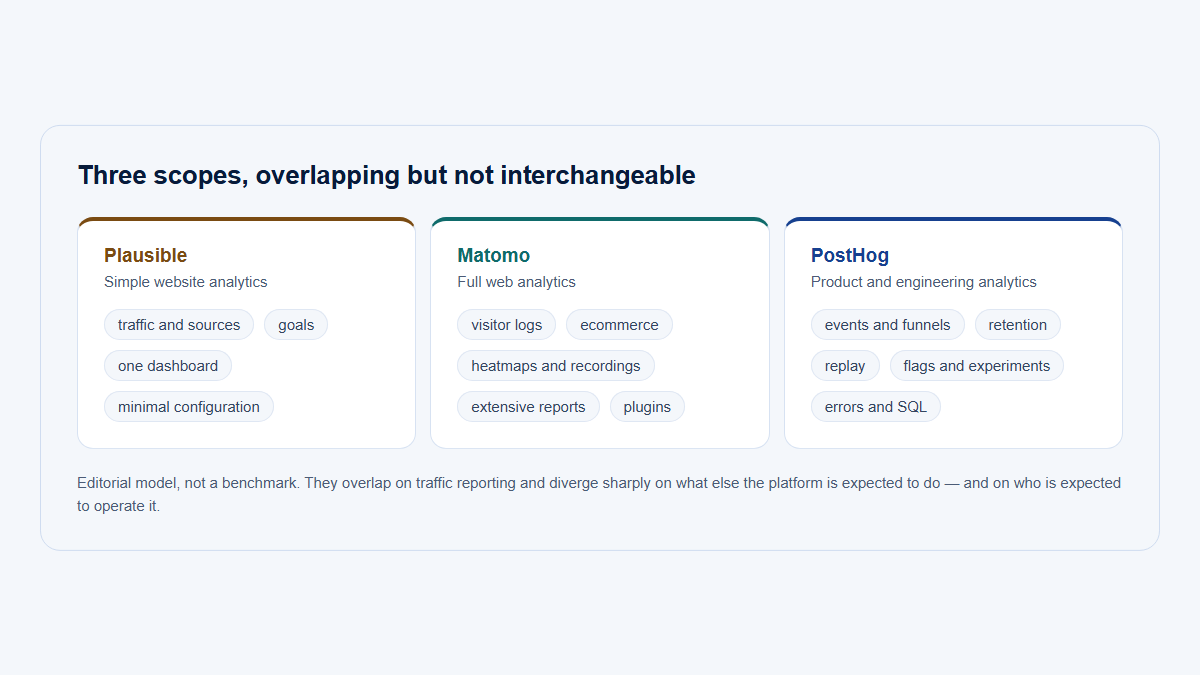
The decision is not “powerful versus incomplete.” It is a wide web-analytics system versus a deliberately constrained one. Matomo adds visitor histories, User IDs, custom reports, and behavioral modules; that breadth needs questions, governance, and ownership to justify it.
Deliberately small, or comprehensive
Plausible
Deliberate aggregate website analytics
Both cover
Matomo
Comprehensive visitor and behavioural analytics
Everything on one screen A report for every question
Plausible's smaller surface is the product, not a gap. The honest test is whether your team would actually open the extra reports Matomo provides.
For broader shortlisting, see the product analytics tools comparison and the three-way comparison of PostHog, Matomo, and Plausible.
Traffic, campaigns, events, and ecommerce
Both products cover the core public-site measurement loop: how people arrived, which pages they viewed, and whether they completed a goal. Matomo extends much further into visitor history, custom reporting, ecommerce detail, and behavioral analysis.
| Capability | Matomo | Plausible | What this means |
|---|---|---|---|
| Visitors | Metrics, visit log, Visitor Profile | Aggregate estimate from a daily identifier | History versus non-persistent trends |
| Page views | Page, entry, exit, transition, content reports | Pages, entries, exits, engagement, filters | Both cover content; Matomo goes deeper |
| Sessions | Visits and action sequences | Aggregate session metrics | Only Matomo exposes granular histories |
| Referrers | Sources, channels, and acquisition reports | Sources, channels, landing pages, filters | Both cover routine acquisition |
| Campaigns | UTMs, conversions, segments, multi-channel option | UTMs, channels, goals, revenue attribution | Lean versus deeper attribution |
| Goals | Core conversion reports | Starter pageview and event goals | Both cover common conversions |
| Custom events | Category, action, name, value | CSS, JavaScript, or API; usage-counted | Different reporting models |
| Funnels | Cloud; paid On-Premise | Business Cloud, 2–8 steps; absent from CE | Packaging matters |
| Ecommerce | Orders, products, carts, revenue, attribution | Business revenue goals and properties | Fuller versus lean reporting |
| User profiles | Visitor Profile; optional User ID | Unsupported by design | Fundamental model difference |
| Custom dimensions | Supported; Cloud allowances | Business non-identifying properties | Plausible prohibits PII/persistent IDs |
| Segments | Flexible report segmentation | Saved segments; Business properties | Matomo slices further |
| Custom reports | Cloud; paid On-Premise | No general builder | Use API or connectors |
| Scheduled reports | Email reports and alerts | Email and Slack from Starter | Both distribute summaries |
| API and export | APIs, files, On-Premise DB, Cloud connector | APIs, CSV, connector, Enterprise events, CE database | Plausible Cloud is aggregate-first below Enterprise |
A compact B2B SaaS website scenario
Consider a SaaS company with campaigns, content, signup, trial, checkout, custom events, several user roles, and an authenticated product.
| Measurement need | Matomo | Plausible | Additional product needed |
|---|---|---|---|
| Traffic | Detailed visit reports | Aggregate dashboard | Usually no |
| Campaign performance | Acquisition and conversion reports | UTM, channel, goal, revenue attribution | Usually no |
| Content | Page and transition reports | Page, source, engagement, conversion | Usually no |
| Signup | Goal or event | Pageview or custom-event goal | Usually no |
| Custom goals | Core goals and events | Goals and custom events | Usually no |
| Ecommerce | Orders, products, carts, revenue | Business revenue goals/properties | Payments remain the financial source |
| Funnels | Cloud or paid On-Premise | Business Cloud | Separate tool if insufficient |
| Person-level behavior | User ID, profile, history | Unsupported | Post-signup product analytics |
| Company adoption | Approximation, not account-native | No person/account history | Account-centric product intelligence |
| Session replay | Cloud or paid On-Premise | Unavailable | Replay tool if needed |
Keep public-site questions here. After signup, account adoption and multi-user behavior become a different problem; define the boundary in a product analytics instrumentation plan.
Data model, users, and analytical depth
The data model is the decisive difference. Matomo can recognize returning visitors and configured User IDs. Plausible intentionally prevents long-term person histories.
Plausible derives a daily identifier from rotating salt, domain, IP, and user agent. It deletes the salt after 24 hours and never stores raw IP or user agent, so it cannot recognize someone on a later day.
| Question | Matomo | Plausible |
|---|---|---|
| Aggregate visitors | Yes, plus visits and profiles | Yes; the central model |
| Persistent identifiers | Default visitor ID; optional User ID | None |
| Cookies | Default first-party; cookieless option | None |
| User ID | Can link sessions/devices | No person ID; properties forbid PII/pseudonymous IDs |
| Person profile | Visitor Profile and history | No profile, cross-day history, or returning segment |
| Custom properties | Dimensions; customer-governed | Business, non-identifying properties |
| IP handling | Default masking; configurable | Transient counting/geolocation; never stored raw |
| URL handling | URLs/queries; exclude sensitive values | Hostname/path; campaigns but not ordinary queries |
| Retention | Cloud raw 24 months, reports indefinitely; configurable On-Premise | Starter/Growth 3 years; Business 5; Enterprise 5+; operator-controlled CE |
| Deletion | Configurable automation and tools | Site/account deletion; operator-controlled CE |
| Data residency | Cloud Frankfurt; operator-chosen On-Premise | Cloud Germany; operator-chosen CE |
| Consent | Depends on configuration and lawful basis | Reduced data; implementation-specific obligations remain |
| Self-hosted responsibility | Operator owns governance/security | Operator owns governance, upgrades, security |
Three depths of question, and where each product stops
Plausible
Matomo
Aggregate visitor analysis
The primary model
Fully supported
Identified-user histories
Outside the intended model
Possible, subject to configuration and consent
Account-level B2B analysis
Needs an explicit company model
Needs an explicit company model
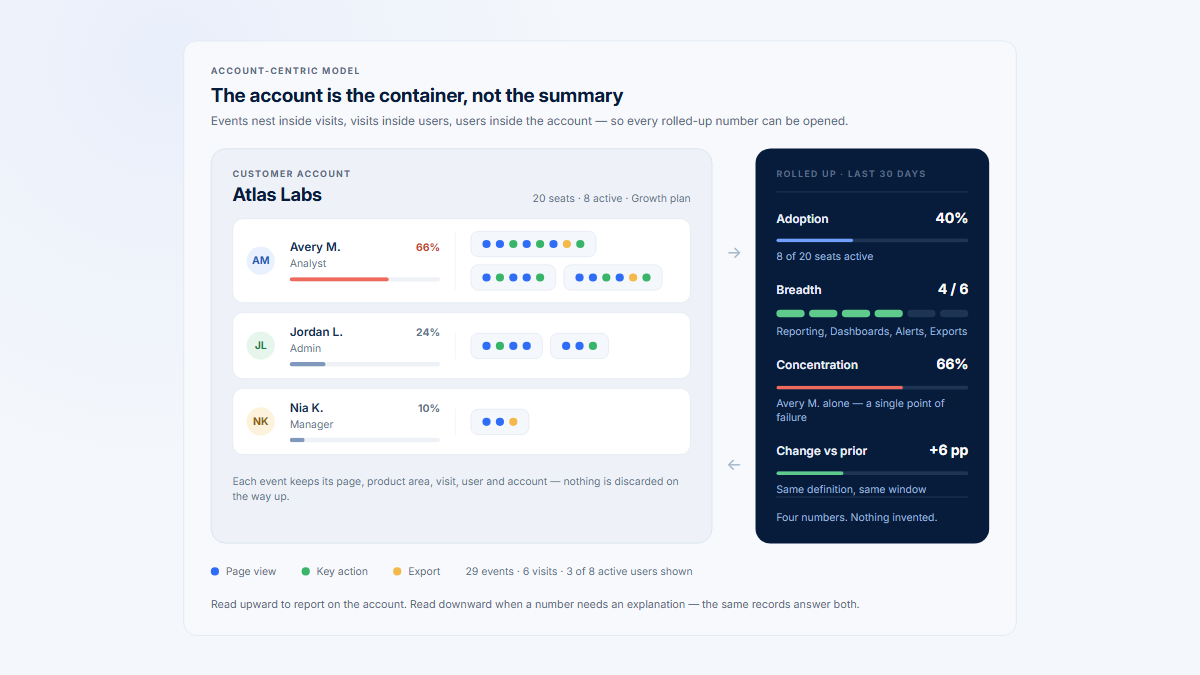
Neither is a B2B account analytics product. That requires a company entity holding several users, attached to the event when it happens — a data-model decision made before the tool choice.
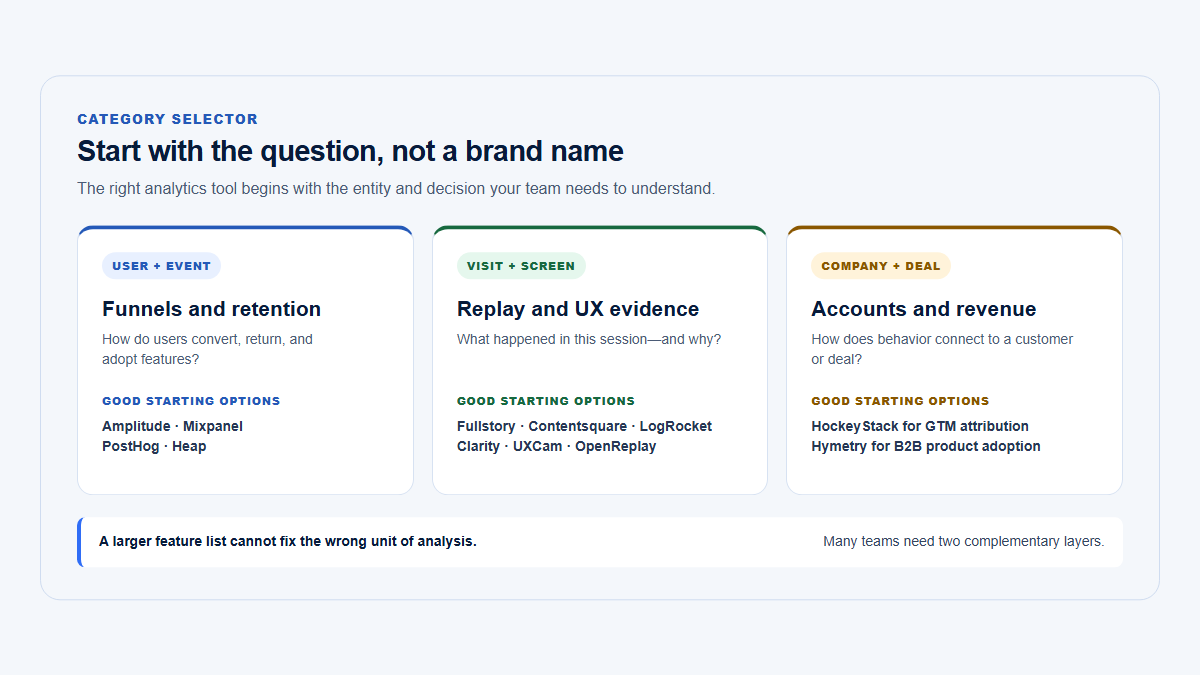
Start with the data model, not labels such as “open source,” “self-hosted,” or “cookieless.” Ask whether recognizing people later, inspecting visits, or associating authenticated identity is necessary.
Hosting, privacy, and operational responsibility
Both offer managed and free self-hosted editions, but packages and workloads differ.
Plausible CE omits marketing funnels, journeys, revenue goals, SSO, and Sites API. Its operator owns installation, capacity, uptime, backups, filtering, upgrades, and security.
| Area | Matomo | Plausible |
|---|---|---|
| Hosted Cloud | Business/Enterprise; infrastructure managed | Starter–Enterprise; infrastructure managed |
| Community self-hosting | Free On-Premise Community Core | Free Plausible Community Edition |
| License | Core GPLv3+; paid plugins use InnoCraft EULA | CE AGPLv3+; tracker MIT |
| Database | MySQL/MariaDB, PHP, supported web server | PostgreSQL and ClickHouse |
| Backups | Cloud managed; operator-owned On-Premise | Cloud managed; operator-owned CE |
| Updates | Cloud automatic; operator maintains On-Premise stack | Cloud continuous; operator applies twice-yearly CE releases |
| Monitoring | Cloud managed; On-Premise stack monitored | Cloud managed; CE pipeline/databases monitored |
| Security | Cloud shared scope; operator hardens On-Premise | Cloud shared scope; operator hardens CE |
| Scaling | Cloud hit tiers; operator-sized On-Premise | Cloud usage tiers; operator-sized CE |
| Support | Cloud email; forum; paid bundles | Plan-based Cloud; community CE |
| Premium modules | Paid plugins/bundles; Cloud allowances | Plan gates; documented CE omissions |
| Operational complexity | Cloud: low infrastructure; On-Premise: medium–high | Cloud: low; CE: moderate |
Both vendors assign the self-hosted stack, backups, security, and availability to the operator. The workload comparison is a moderate-confidence inference from those documented responsibilities.
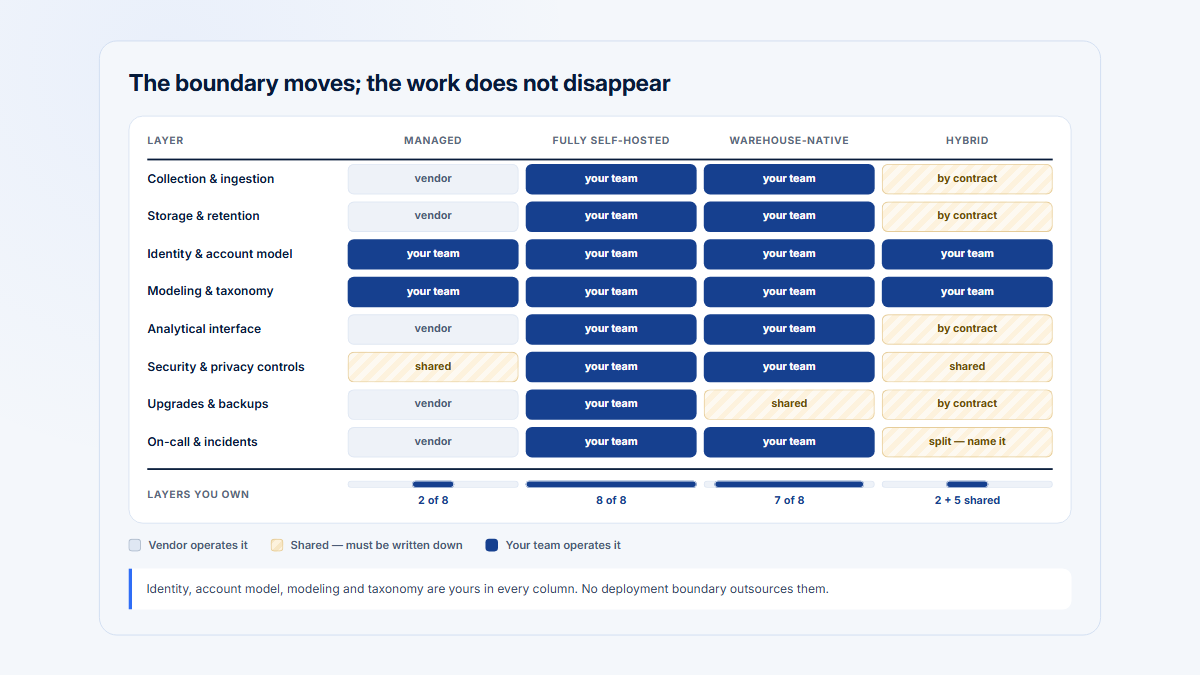
Managed or self-hosted, governance stays yours
Managed Cloud
Self-hosted — either product
What actually changes
Both products offer both models. Choose by whether your team wants to run a database, because the governance work is identical either way.
Control and responsibility arrive together; a free license is only one cost component. See the self-hosted product analytics guide for authenticated products.
Useful video walkthroughs
Pricing and customer feedback
Matomo Cloud bills hits across tracked interactions. Plausible bills combined pageviews and custom events across team sites.
At 10,000 monthly usage, Plausible showed $9 Starter, $14 Growth, and $19 Business. Pageview goals add no usage. The plans allow 1/3/10 sites, 3/3/5 years’ retention, and 1/3/10 members respectively; Business adds properties, API, revenue, funnels, and journeys.
Cloud or self-managed
Matomo
€29/month
- Cloud
- 21-day trial; 30 sites/members; managed infrastructure and backups
- Cloud allowances
- At 50,000 hits: 1,500 heatmap pageviews and 150 session recordings monthly
- Community
- Free; unlimited licensed users/hits; infrastructure/plugins separate
- Team
- €275 monthly/€230 annual equivalent; 4 users, 5M hits
- Business
- €1,450/€1,209; 20 users, 30M hits
- Enterprise
- €3,400/€2,834; 50 users, 100M hits
Cloud or Community Edition
Plausible
$9/month
- Starter
- $9; 1 site; 3 years
- Growth
- $14; 3 sites/members; 3 years
- Business
- $19; 10 sites/members; 5 years; advanced features
- Enterprise
- Custom; SSO, Sites API, proxy, raw-event exports
- Cloud trial
- 30 days, no card; two months free annually
- Community Edition
- Free license; self-managed, community-supported, twice-yearly releases; Cloud omissions
| Item | Matomo | Plausible |
|---|---|---|
| Hosted start | €29/month; 50,000 hits; tax excluded | $9/month; 10,000 pageviews plus events |
| Free self-hosted option | On-Premise Community Core | Community Edition |
| Billing unit | Tracked hits | Team-wide pageviews plus events |
| Traffic limits | Cloud tiers; uncapped Community license | Cloud tiers; infrastructure-bound CE |
| Premium model | Plugins or Team/Business/Enterprise bundles | Hosted plan gates; CE omissions |
| Ecommerce/funnels | Core ecommerce; Cloud/paid funnels | Business Cloud; absent from CE |
| Infrastructure cost | Included in Cloud; separate On-Premise | Included in Cloud; separate in CE |
| Rating and review count | G2: 4.2/5 from 96 reviews | G2: 4.5/5 from 4 reviews |
| Evidence warning | Directional, self-selected | Too few for confident comparison |
| Verification date | August 13, 2026 | August 13, 2026 |
| Official pricing | Matomo pricing and packaging | Plausible hosted plans |
What customer reviews visibly suggest
Four Plausible reviews cannot support a statistical head-to-head. Treat visible examples as anecdotes, not a verdict.
| Product | Visible positive evidence | Visible caution | Evidence confidence |
|---|---|---|---|
| Matomo | Control, depth, Cloud convenience, replay | Self-hosted operations; modules need budget/ownership | Moderate: 96 reviews plus documentation |
| Plausible | Clean, privacy-oriented, lightweight | One reviewer wants reporting depth | Low: four reviews |
Plausible is not reliably “better rated.” Matomo’s sample is directional; Plausible’s is anecdotal.
Which one fits your scenario?
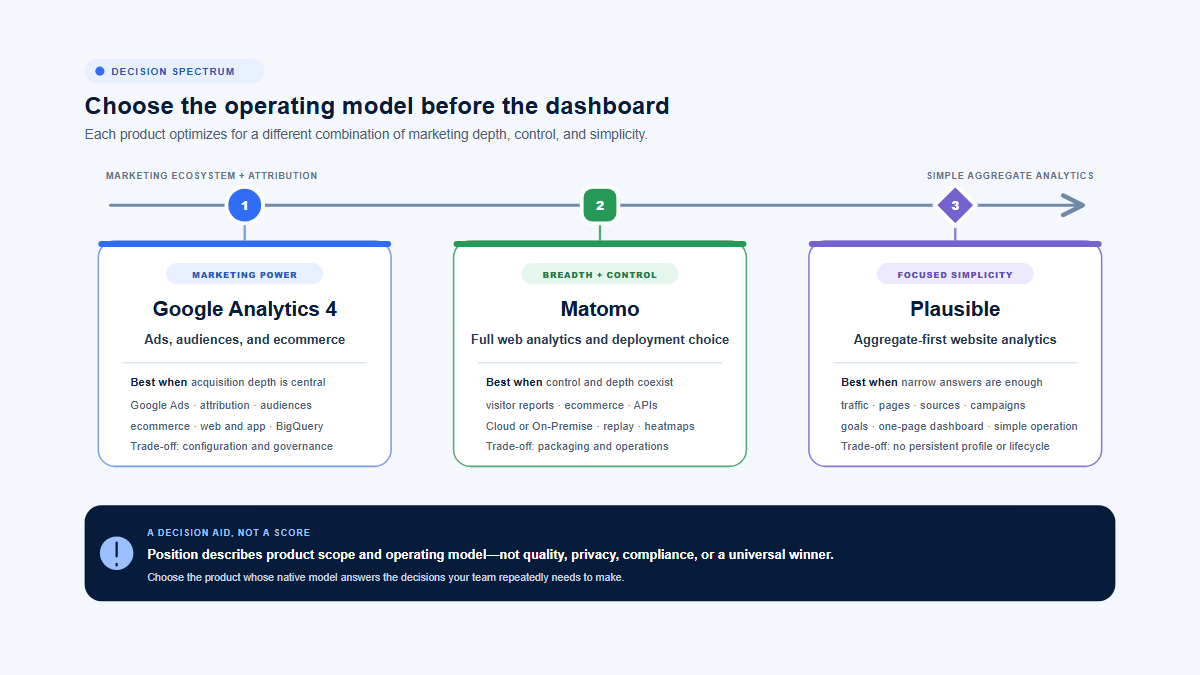
Start with measurement questions, not feature count. Plausible fits shared traffic and conversion answers; Matomo fits visitor history, ecommerce, custom reporting, attribution, or replay.
| Scenario | Better starting point | Why | Important caveat |
|---|---|---|---|
| Personal/portfolio | Plausible | Low-configuration traffic/content | Either can be self-hosted |
| Small company site | Plausible | Core acquisition and conversions | Matomo adds depth |
| Publication | Plausible | Shareable content reporting | Matomo adds custom reports |
| Ecommerce | Matomo | Orders, products, carts, attribution | Plausible covers lean revenue |
| Agency | Depends | Readability versus analytical depth | Check limits, access, operations |
| On-Premise | Depends | Both self-host | Different feature packages |
| Detailed segmentation | Matomo | Visitor/campaign/reporting depth | Needs governance |
| B2B SaaS public site | Plausible lean; Matomo deep | Both cover acquisition/signup | Separate product questions |
| Authenticated SaaS | Additional product | Neither is account-centric | Define identity, structure, adoption, evidence |
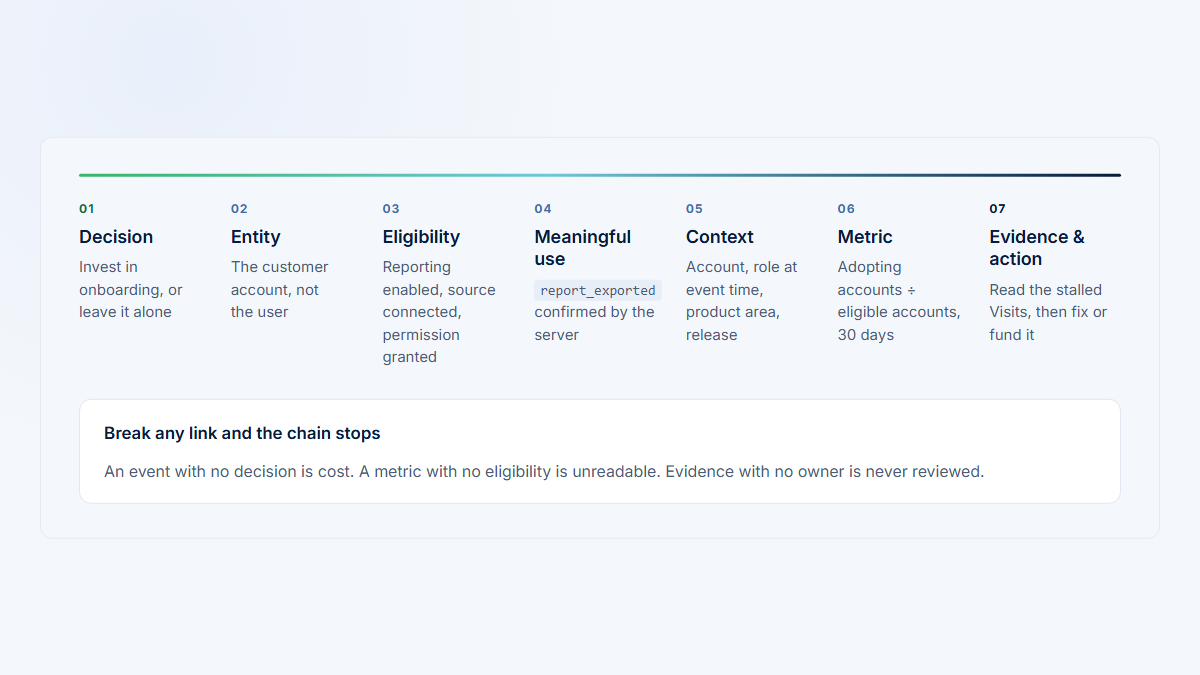
A public-site dashboard cannot show account adoption, champion dependence, or feature penetration by itself. The B2B product analytics guide explains the required model.
Can one replace the other?
Plausible can replace Matomo when scope narrows. Matomo answers most Plausible questions, but does not automatically reproduce its data minimization or small interface.
| Question | Short answer | Main compromise |
|---|---|---|
| Can Plausible replace Matomo? | Yes, for aggregate acquisition/conversion scope | Loses profiles, reports, heatmaps, replay, ecommerce depth |
| Can Matomo replace Plausible? | Functionally, usually | Minimalism requires governance and restraint |
| Use both? | Sometimes, with separate jobs | Duplicate scripts, costs, ownership, and counts |
A dual-tool setup needs separate jobs, such as minimal public reporting and separately governed deep analysis. Running both to compare numbers creates reconciliation, not insight.
For adjacent decisions, compare Google Analytics, Matomo, and Plausible or Google Analytics and Matomo.
Where Hymetry fits
Matomo and Plausible primarily analyze public websites: traffic, pages, acquisition, campaigns, content, goals, conversions, and ecommerce. Matomo can extend into authenticated areas through User IDs and detailed visit analysis, but remains web-analytics-first. Plausible deliberately avoids identified person-level histories.
After signup, a B2B SaaS team may need product areas, grouped pages or features, Companies, Users, account adoption, user penetration, usage concentration, and Visits. Hymetry connects usage across Pages, companies, users, and visits so a team can move from an account or feature signal to the users and session evidence behind it.
Hymetry does not replace public-site traffic, campaign, content, or ecommerce analytics. Read product usage by company for the underlying B2B measurement problem.
FAQ, methodology, and sources
Is Plausible better than Matomo?
Plausible is better when the desired result is intentionally simple aggregate website analytics without persistent user profiles. Matomo is better when the team needs detailed campaigns, visitor analysis, custom reports, ecommerce, funnels, heatmaps, replay, or broader configuration. Neither is universally better.
Can Plausible replace Matomo?
Yes, when the team no longer needs Matomo’s person-level history, custom reports, fuller ecommerce analysis, replay, heatmaps, or advanced modules. Treat the change as a deliberate reduction in measurement scope, not a like-for-like migration.
Which is easier to use?
Plausible Cloud generally has the smaller learning and configuration surface because its principal reports share a consistent aggregate dashboard. Matomo Cloud removes infrastructure work but retains more reports and configuration. Self-hosting either product adds operational responsibility.
Which can be self-hosted?
Both. Matomo offers free On-Premise Community Core under GPLv3-or-later. Plausible offers free Community Edition under AGPLv3-or-later. Their self-hosted feature packages, release models, databases, and maintenance responsibilities differ.
Which is better for ecommerce?
Matomo is usually better for detailed ecommerce analysis across orders, products, SKUs, carts, revenue, acquisition, and conversions. Plausible Business fits lean purchase, revenue, product-property, funnel, and campaign attribution rather than a broad ecommerce suite.
Which collects less person-level data?
Plausible, by design. It does not store persistent visitor identifiers, user profiles, or cross-day person histories. Matomo can be configured for data minimization and cookieless tracking, but its default visitor model and optional User ID support more persistent analysis.
Where does Hymetry fit?
Hymetry becomes relevant after signup when a B2B SaaS team needs product areas, grouped pages or features, Companies, Users, account adoption, user penetration, usage concentration, and Visits. It does not replace public-site traffic, campaign, content, or ecommerce analytics.
Methodology
Desk research was verified across official documentation, live pricing, editions, licenses, data models, privacy controls, G2 snapshots, and videos. No authenticated hands-on testing was performed.
- Prefer official product, privacy, pricing, license, and deployment sources.
- Separate Cloud from self-hosted editions and Core from paid modules.
- Compare data models without privacy scores; weight ratings by volume.
- Treat videos as supplementary and vendor comparisons as non-neutral.
Sources
Official Matomo product documentation
- Matomo pricing and plan comparison
- Matomo reports overview
- Acquisition and marketing channels
- Goals and conversions
- Event tracking
- Ecommerce reports
- Visitor reports
- User ID reports
- Session recordings
- Heatmaps
- Reporting API reference
- Raw-data access and export options
- Matomo hit definition
- Matomo Cloud trial
Official Matomo privacy, deployment, and licensing material
- Default Matomo cookies
- Cookieless tracking configuration
- Cookieless accuracy effects
- Privacy settings and deletion
- Matomo On-Premise guide
- On-Premise maintenance responsibilities
- Matomo system requirements
- Matomo licenses
- Core, tracker, and plugin licensing
- Matomo open-source analytics overview
- Matomo Core license