Quick comparison
The shortest useful distinction is governance, control, or simplicity. Piwik PRO manages governance, Matomo exposes deployment control, and Plausible deliberately collects less. Plausible’s narrower scope is a valid design choice, not an unfinished version of the others.
| Replacement question | Concise answer |
|---|---|
| Can Plausible replace Matomo? | Yes for traffic, campaigns, goals, events, and lightweight conversions. Usually not for durable profiles, broad custom reports, detailed ecommerce, native replay, or Matomo’s extension model. |
| Can Matomo replace Piwik PRO? | Often for analytics. Not automatically for Piwik PRO’s packaged CMP workflow, Data Activation, private-Cloud procurement, or managed enterprise governance. |
| Can Piwik PRO replace Matomo? | Often for managed Cloud analytics. Not when source-level control or a customer-operated On-Premise deployment is mandatory. |
| Can Plausible replace Piwik PRO? | Only for the narrower website-analytics job. It does not replace native tag management, current CMP packaging, visitor-level analysis, or Data Activation. |
| Should an organization use more than one? | Sometimes during migration or when public-site and authenticated-product analytics have distinct jobs. Avoid indefinite duplicate collection without purpose and privacy review. |
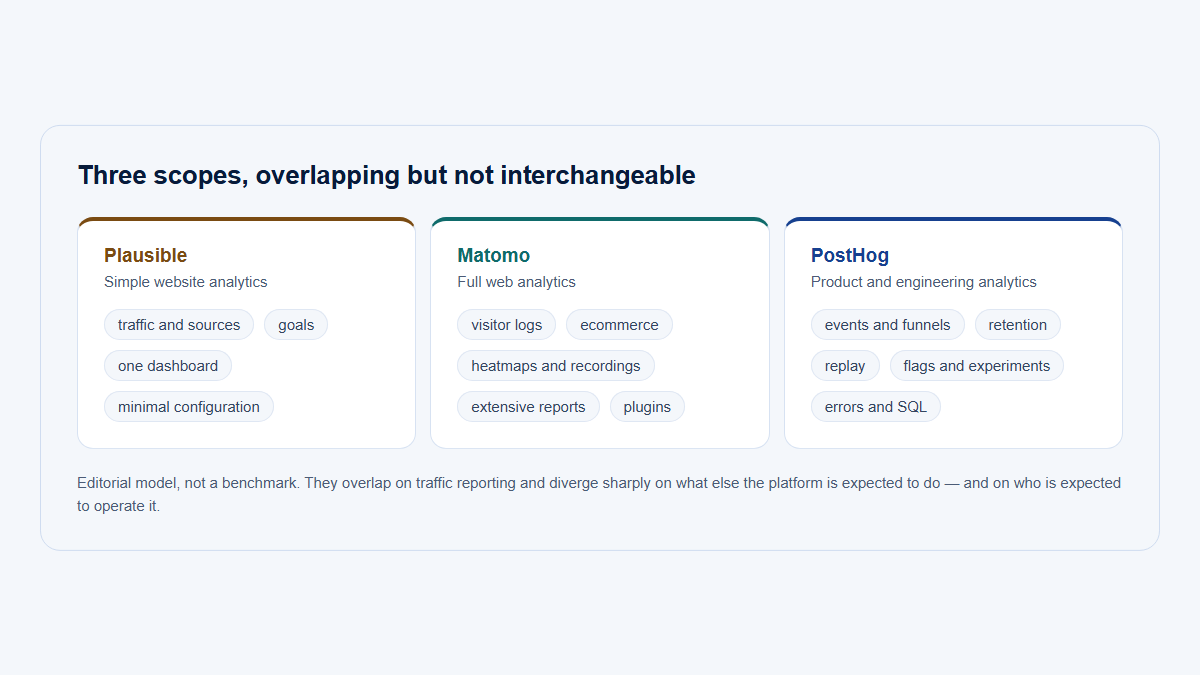
Three operating priorities, not a universal rank
Piwik PRO
Managed privacy and governance
Matomo
Full analytics with deployment control
Plausible
Aggregate simplicity
Choose by operating priority: who runs the infrastructure, who answers the privacy questions, and how much analytical depth you will actually use. None of these is a ranking.
For adjacent decisions, compare Google Analytics, Matomo, and Plausible or review the broader product analytics tools landscape.
Traffic, campaigns, ecommerce, and events
All three answer basic traffic and conversion questions; Piwik PRO and Matomo continue farther into detailed analysis. Plausible keeps the workspace compact and offers selected advanced capabilities through hosted plans, filters, its Stats API, or Data Studio.
| Capability | Piwik PRO | Matomo | Plausible |
|---|---|---|---|
| Visitors and sessions | Detailed sessions, Session Log, optional User ID | Detailed visits, Visitor Log/Profile, optional User ID | Aggregate visitor and session metrics without durable identity |
| Campaigns | UTM reports, conversion paths, attribution options | Campaign reporting; advanced attribution varies by package | UTM, referrer, source, term, content, and conversion breakdowns |
| Goals and events | Native Goals and custom events | Native Goals, events, and ecommerce | Native Pageview and custom-event goals |
| Funnels and journeys | Native | Plan-dependent Cloud or paid On-Premise | Business Funnels and journeys |
| Ecommerce | Detailed ecommerce events and reports | Core ecommerce tracking plus premium analysis options | Business revenue events, properties, funnels, and attribution |
| Custom dimensions | Native, with limits by plan | Native | Custom properties on Business |
| Custom reports | Native, with plan limits | Cloud included; paid On-Premise capability | No equivalent builder listed Business API and Data Studio |
| Mobile and server data | Website plus Android, iOS, React Native, and Flutter SDKs | Tracking APIs and mobile SDK options | Events API accepts server or app events; web analytics remains the center |
| Heatmaps and replay | Site Inspector maps; replay through Smartlook integration | Native Heatmap & Session Recording by package | Not native |
| Data access | Reporting APIs; exports and integrations vary by plan | Reporting/Tracking APIs; direct database in On-Premise | Business Stats API, Enterprise scheduled raw exports, or CE databases |
Campaign and commerce depth
Piwik PRO and Matomo suit teams that expect visitor paths, custom reports, detailed ecommerce, and wider segmentation. Plausible is strongest when the useful question is which source, campaign, page, device, or event contributed to a goal or revenue event.
Behavioral evidence
Matomo supplies native replay and heatmaps through Cloud or eligible On-Premise packaging. Piwik PRO supplies heatmaps, clickmaps, and scrollmaps through Site Inspector but uses an external Smartlook integration for replay. Plausible deliberately omits both.
Data model and analytical depth
The most consequential difference is the observable unit, not the number of widgets. Plausible operates naturally at aggregate visitor and event level. Piwik PRO and Matomo can retain visitor histories and associate activity with an explicit User ID. None has a customer-company entity as its primary native model.
Each rung answers a question the one below it cannot
What it can answer
Supported by
Aggregate visitors
How much traffic, from where, to which pages — with daily or session continuity
Plausible, Matomo, Piwik PRO
Persistent or identified visitors
What one visitor did across sessions, and what a known user did over time
Matomo and Piwik PRO, subject to configuration and consent
Customer companies with several users
Whether an account adopted the product, and which people inside it did the work
Not the primary native model of any of these three
All three are web analytics products. B2B account questions need an explicit company entity with several users attached at event time — a different data model, not a deeper report.
| Question | Piwik PRO | Matomo | Plausible |
|---|---|---|---|
| Persistent visitor context | Available | Available | No durable cross-day profile in the standard model |
| Configured User ID | Available | Available | Not the product model |
| Customer company entity | Not the primary native model | Not the primary native model | Not supported as a durable account model |
| Reporting API | Available | Available | Stats API on Business |
| Raw event export | Plan-dependent exports or warehouse integrations | Direct database control On-Premise | Scheduled exports on Enterprise |
| Direct database control | No | Yes, On-Premise | Yes, Community Edition |
Plausible’s aggregate identity
Plausible’s hosted model uses no cookies, local storage, or persistent cross-day browser ID. A daily identifier is derived using a rotating salt and request information; the salt is discarded after 24 hours. The same person can be counted separately across days or devices.
- Useful for traffic, campaign, content, goal, and event totals
- Not designed for multi-week person histories or stable behavioral cohorts
Piwik PRO and Matomo visitor context
Both can connect visits with configured User IDs and retain richer histories. Piwik PRO also supplies Data Activation profiles and audiences. Matomo On-Premise exposes its stored analytics database directly. Those choices require deliberate identifier, access, retention, deletion, masking, and export policies.
- Useful for detailed paths and repeat behavior
- Not automatically an account-centric B2B product model
An aggregate API, raw event export, and direct database access are different promises. Before purchase, ask which layer is available, at what latency, under which schema and plan, and whether historical backfill or deletion propagates to downstream systems.
Consent, tags, and privacy configuration
“Privacy-focused” describes three different architectures here. Piwik PRO coordinates a managed governance workflow. Matomo exposes privacy controls, a tag manager, and external CMP integrations. Plausible minimizes its own tracker’s identity footprint but does not govern the rest of a site’s tags.
| Workflow area | Piwik PRO | Matomo | Plausible |
|---|---|---|---|
| Consent manager | Packaged Cookie Information CMP in current plans | External No Matomo-hosted CMP listed in the current offering | Not listed |
| Tag manager | Native | Native | Not native |
| Consent enforcement | Consent categories can control tag firing | External CMP can coordinate tracker and Tag Manager | No broader tag-enforcement layer |
| Cookies | Configurable cookie or cookieless operation | Configurable cookie or cookieless operation | No analytics cookies by default |
| Durable browser identity | Available when configured | Available when configured | Not used in the standard model |
| IP handling | Configurable collection and anonymization controls | Configurable anonymization controls | Raw IP not stored in the standard model |
| Replay capture | External integration must be configured separately | Masking and capture controls apply when replay is present | Not applicable; no native replay |
| Governance center | Analytics, Tag Manager, Data Activation, and CMP package | Analytics and Tag Manager plus selected CMP and plugins | Focused analytics service, not a governance suite |
Use the current Piwik PRO package
Piwik PRO’s legacy Consent Manager remains in documentation but is no longer offered to new accounts. Current Business and Enterprise pricing packages Cookie Information CMP. Its tag connects consent categories with Piwik PRO consent types and tag-blocking rules.
Configuration is not compliance
Cookieless collection, private Cloud, self-hosting, and data minimization are technical choices, not universal legal conclusions. Purpose, jurisdiction, contracts, other scripts, consent rules, retention, access, and organizational practice still matter. Assess the complete implementation.
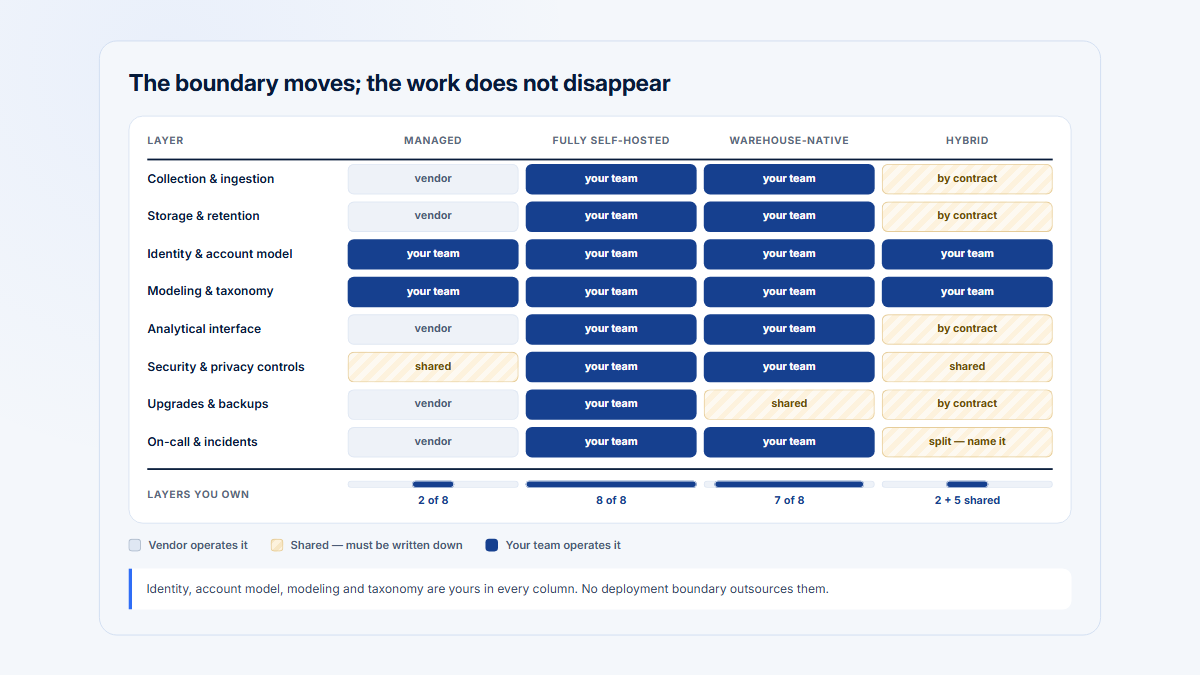
Hosting, data control, and operational responsibility
Matomo spans the widest control spectrum; Piwik PRO and Plausible offer simpler managed paths. Piwik PRO is Cloud-only today. Matomo offers managed Cloud or genuine On-Premise. Plausible offers managed Cloud or a free Community Edition with a narrower feature and release model.
| Responsibility | Piwik PRO | Matomo | Plausible |
|---|---|---|---|
| Deployment choice | Public or private Cloud | Managed Cloud or On-Premise | Managed Cloud or Community Edition |
| Infrastructure owner | Vendor | Vendor in Cloud; organization On-Premise | Vendor in Cloud; organization in CE |
| Application updates | Vendor | Vendor in Cloud; organization On-Premise | Vendor in Cloud; operator follows CE long-term releases |
| Database and backups | Vendor-operated service | Included in Cloud; MySQL/MariaDB and backups On-Premise | Included in Cloud; PostgreSQL, ClickHouse, and backups in CE |
| Scaling and monitoring | Vendor-managed within plan | Vendor in Cloud; organization On-Premise | Vendor in Cloud; organization in CE |
| License and source | Proprietary managed product | GPLv3 Core; premium plugins use separate licenses | AGPLv3 Community Edition; hosted premium scope differs |
| Operational load | Low to medium | Low in Cloud; high On-Premise | Low in Cloud; high in CE |
Who operates what, per deployment
Piwik PRO
Public or private Cloud
Matomo
Cloud, or On-Premise
Plausible
Cloud, or Community Edition
Self-hosting moves the data under your control and the operational burden onto your team. Configuration and legal basis stay yours in every deployment, including managed Cloud.
Managed does not mean no work
Cloud removes server operation, not implementation, taxonomy, access, consent, retention, export, incident, and contract review. Private Cloud can change procurement and isolation, but it is still vendor-operated rather than customer-installed.
Self-hosting is an operating commitment
Matomo On-Premise and Plausible CE shift security, jobs, database health, backups, upgrades, compatibility, monitoring, uptime, and capacity to the operator. Budget that labor alongside any software license.
Read the practical self-hosted product analytics guide before choosing control for its own sake. Matomo’s Core and many community plugins are open source, but premium plugins are not all free or GPL-licensed.
Plausible CE specifically excludes the hosted service’s marketing funnels, user journeys, ecommerce revenue goals, SSO, and Sites API, among other managed features. Its twice-yearly long-term releases also differ from the hosted release stream.
Pricing and customer feedback
The lowest subscription price is not the lowest total cost. Managed plans vary by traffic, actions, domains, retention, users, exports, and support. Self-hosted editions add infrastructure, backups, monitoring, security, database maintenance, upgrades, and incident response.
Managed suite
Piwik PRO
From €36/month
Enterprise starts at €366/month when billed annually. Higher limits and dedicated support vary by tier; private Cloud is an option in the highest Secure Intelligence tier. Current plans package all four modules.
Cloud or On-Premise
Matomo
Cloud from €22/month
The structured offer also lists US$26/month, so currency is location-dependent. Community is free; premium plugins and Team, Business, Enterprise, or VIP On-Premise bundles add cost.
Traffic-priced hosted
Plausible
From $9/month
At that tier, Growth is $14 and Business is $19 monthly. Usage counts pageviews plus custom events. Community Edition is free; Enterprise pricing is custom.
| Pricing factor | Piwik PRO | Matomo | Plausible |
|---|---|---|---|
| Free entry | 30-day trial; no free production tier | Free Community On-Premise | Free Community Edition |
| Hosted start | Business €36/month | €22/month for 50,000 hits in displayed EUR locale | Starter $9/month at 10,000 monthly pageviews, annual billing |
| Billing unit | Monthly actions and domain allowance | Monthly hits in Cloud | Pageviews plus custom events |
| Entry allowance | 2M actions across 20 domains | Selected hit tier; Business includes 30 websites and 30 team members | Starter one site; higher plans add sites and members |
| Retention signal | Business 25 months | Cloud 24 months raw; reports retained indefinitely | Starter 3 years; Business 5 years; Enterprise 5+ years |
| Premium scope | Analytics, Tag Manager, Data Activation, and Cookie Information CMP packaged | Cloud hosted features; Community excludes premium plugins | Business adds properties, API, Data Studio, revenue, funnels, and journeys |
| Enterprise | From €366/month annually | Cloud custom; paid On-Premise bundles | Custom with SSO, Sites API, managed proxy, and scheduled raw exports |
| Self-hosted paid path | Not applicable | Annual-effective bundles advertised from €230, €1,209, and €2,834/month | No paid CE license; operator funds infrastructure and work |
| Infrastructure | Included in managed price | Included in Cloud; separate On-Premise | Included in Cloud; separate in CE |
Price boundary: figures exclude taxes and, unless stated, implementation, consulting, infrastructure, premium plugins, migration, and legal review. Recheck the live currency, billing period, plan, allowance, and contract before buying.
Piwik PRO actions are not visits: they can include pageviews, events, goals, Tag Manager or CMP loads, uploads, and API calls. Model the allowance for your implementation.
Piwik PRO
Matomo
Plausible
| Product | Common praise | Common criticism | Buying implication |
|---|---|---|---|
| Piwik PRO | Privacy orientation, integrated stack, familiar workflow, support | Some reviewers want more integrations, flexibility, modern UI, or lower cost | Validate advanced reporting, integrations, and total contract cost |
| Matomo | Control, source availability, self-hosting, customization, breadth | Setup and maintenance demands; mixed interface and scale feedback | Confirm that depth and control justify implementation and operations |
| Plausible | Clean, fast, easy, intentionally focused | Less flexible advanced analysis | The four-review sample is too small for a dependable market conclusion |
Do not turn these ratings into a winner. Review populations are self-selecting, samples differ sharply, counts change, and the products target different operating models. G2 explicitly says Plausible has too few reviews for buying insight.
Which one fits your scenario?
Start with the job and the operating model, then test the exact plan. These recommendations are conditional starting points, not an ordered league table.
| Scenario | Likely fit | Reason and caveat |
|---|---|---|
| Personal or small website | Plausible hosted; Matomo Community when self-hosting is intentional | Plausible minimizes setup. Community removes a license fee, not server work. |
| Content publisher | Plausible for concise reporting; Matomo for deeper analysis | Choose one dashboard for editors or a wider workbench for analysts. |
| Ecommerce | Matomo or Piwik PRO; Plausible Business for lighter revenue attribution | Validate item detail, journeys, funnels, properties, and attribution needs. |
| Enterprise marketing | Piwik PRO | Integrated analytics, tags, CMP workflow, activation, support, and private Cloud reduce stack fragmentation. |
| Public sector or regulated environment | Piwik PRO for managed private Cloud; Matomo when On-Premise is mandatory | Neither creates automatic compliance. Validate residency, access, retention, procurement, and security. |
| Mandatory On-Premise | Matomo | Piwik PRO has no current self-hosting. Plausible CE is self-hosted but narrower. |
| Consent plus tag management | Piwik PRO; Matomo when an external CMP is acceptable | Plausible does not govern other site tags. |
| Agency | Plausible for simple multi-site dashboards; Matomo for depth; Piwik PRO for high-governance clients | Compare sites, users, white-label needs, support, and APIs. |
| B2B SaaS public website | Any of the three | Choose managed governance, depth/control, or aggregate simplicity. |
| Authenticated SaaS application | Piwik PRO or Matomo for identified behavior; another layer for customer-company adoption | Plausible remains aggregate; none centers several users inside one B2B customer company. |
Compact international B2B SaaS scenario
Fictional example: Northbridge Cloud runs regional public websites, campaigns, content, subscription checkout, consent and tags, warehouse exports, and an authenticated product used by several people at each customer company.
| Requirement | Piwik PRO | Matomo | Plausible | Additional product? |
|---|---|---|---|---|
| Public traffic | Strong | Strong | Strong and concise | No |
| Campaigns | Detailed reports and paths | Detailed reporting | Clear UTM and source reporting | Possibly for advanced cross-channel attribution |
| Ecommerce | Comprehensive | Comprehensive | Business revenue events and funnels | Possibly for detailed commerce BI |
| Consent | Cookie Information CMP package | External CMP required | No CMP for other scripts | Yes unless every relevant tag is already covered |
| Tag management | Native | Native | Not native | Yes for Plausible when several tags need governance |
| Raw data | APIs and plan-dependent exports | API or On-Premise database | Business API, Enterprise exports, or CE databases | Warehouse or ELT may still be required |
| Hosting control | Public or private Cloud | Cloud or full On-Premise | Cloud or Community Edition | No |
| Operations | Low to medium | Low Cloud; high On-Premise | Low Cloud; high CE | Depends on deployment |
| Authenticated users | Detailed User ID model | Detailed User ID model | Daily aggregate identity | Product analytics may be required |
| Company adoption | Not the primary native model | Not the primary native model | No durable account model | Yes for account-centric B2B analysis |
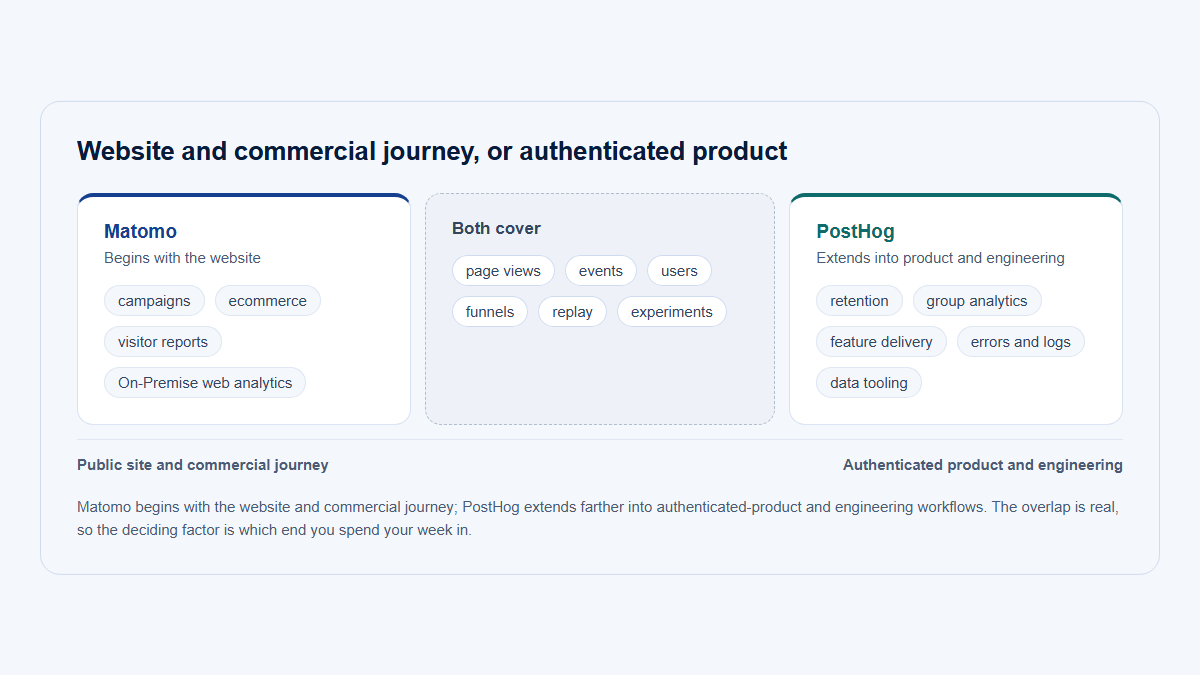
Any product could serve Northbridge’s public sites. Authenticated users, customer companies, retention, experiments, debugging, and revenue remain separate decisions. Also compare PostHog vs Matomo vs Plausible.
When another analytics category is required
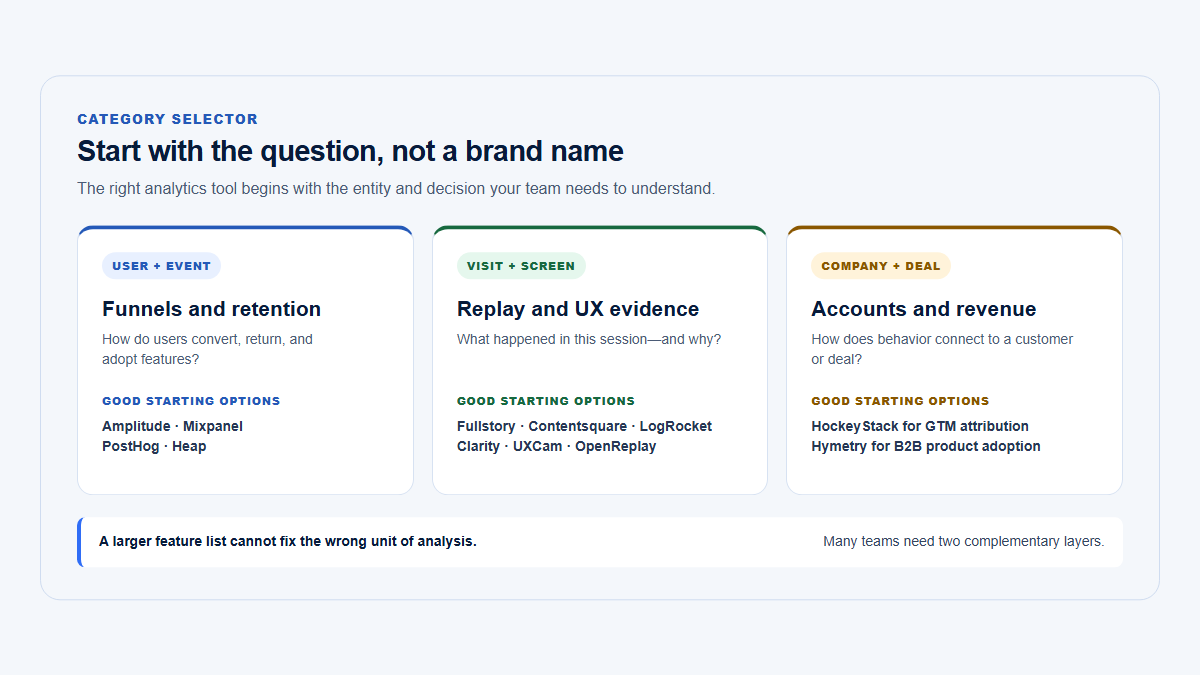
Web analytics does not cover every product, experiment, debugging, replay, attribution, or B2B account question. Give each system a clear job and avoid duplicate collection without purpose.
- Authenticated-product retention: behavioral cohorts, lifecycle analysis, and repeat use tied to a stable product identity.
- Feature flags and experiments: rollouts, variants, exposure data, and statistical experiment workflows.
- Frontend debugging: errors, performance traces, network failures, and technical evidence connected to sessions.
- B2B revenue attribution: anonymous acquisition joined with leads, opportunities, contracts, subscriptions, and recognized revenue.
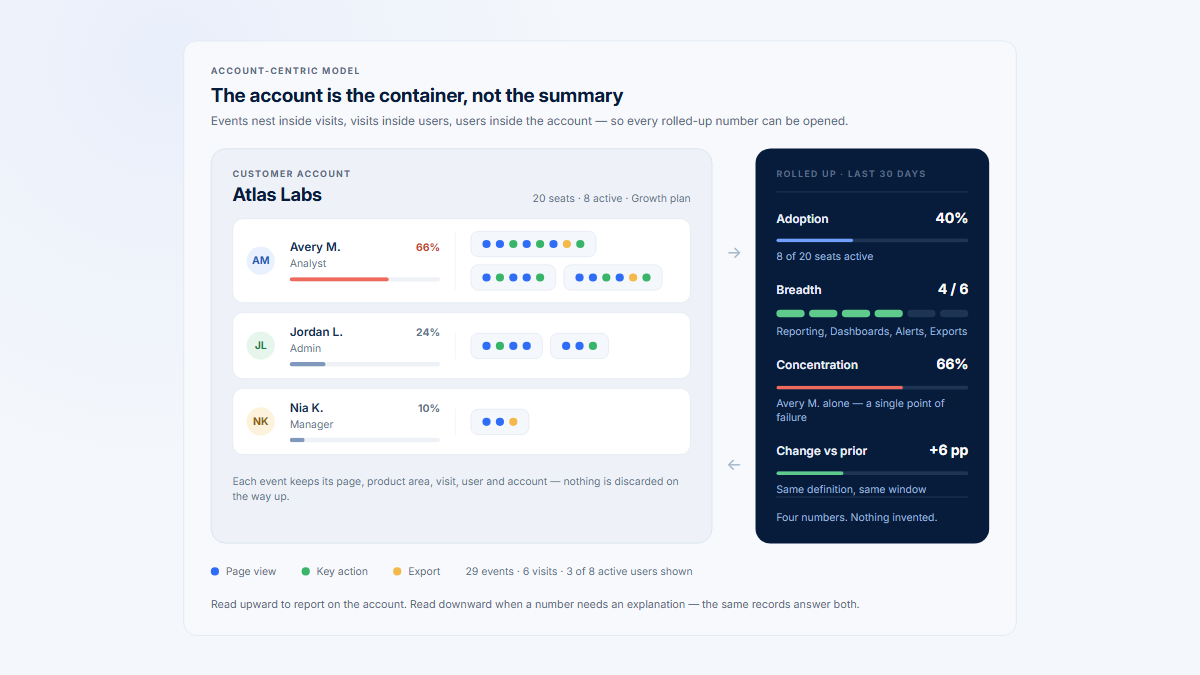
- Company-level adoption: several users grouped into a customer company, with breadth, penetration, and concentration.
- Session replay: a separate product when the selected analytics product or plan does not supply it natively.
Use the product analytics instrumentation plan, B2B product analytics guide, company usage guide, and session replay privacy checklist to define those boundaries.
Where Hymetry fits
Piwik PRO, Matomo, or Plausible for the public website + Hymetry for authenticated B2B account usage.
Web analytics explains which sources, campaigns, landing pages, and public-site events contributed to signup. Inside an authenticated B2B application, the focus shifts to adoption across several people in one customer organization.
- Which product areas has each customer company adopted?
- Which grouped pages or features are used across the account?
- How many people inside the company use an adopted workflow?
- Is usage broad or concentrated in one champion?
- Which users are gaining or losing momentum?
- Which visits contain the session evidence behind a change?
Hymetry is account-centric product intelligence for B2B SaaS. It connects product usage across Pages, Companies, Users, and Visits so teams can examine product areas, grouped pages or features, account adoption, user penetration, usage concentration, and session evidence.
Hymetry does not replace campaign analytics, consent management, tag management, ecommerce reporting, or public-site traffic analysis. Its role is the authenticated company-centric layer after a user enters the B2B product. See the product usage by company guide for the measurement model.
FAQ, methodology, and sources
Is Piwik PRO the same as Matomo?
No. They share historical roots in the earlier Piwik project but now have separate companies, codebases, packaging, roadmaps, licenses, and deployment models. Piwik PRO is a proprietary managed Cloud suite. Matomo Core is open source and can run On-Premise. Piwik PRO is not “hosted Matomo.”
Is Matomo better than Plausible?
Matomo is more capable for visitor profiles, detailed ecommerce, custom reports, native replay, extensions, APIs, and On-Premise control. Plausible is often better when the desired outcome is understandable aggregate website analytics without durable visitor profiles. The priority determines “better.”
Which is easiest to use?
Plausible is generally easiest to understand because its dashboard and data model are intentionally constrained. Piwik PRO provides a familiar full-analytics workflow across coordinated modules. Matomo exposes the widest control surface and can require more implementation and administration, especially On-Premise.
Which can be self-hosted?
Matomo has a free On-Premise Community edition. Plausible Community Edition can be self-hosted under AGPLv3, but excludes hosted funnels, journeys, ecommerce revenue goals, SSO, and Sites API. Piwik PRO currently documents public and private Cloud only, not On-Premise or self-hosted deployment.
Which has consent management?
Piwik PRO has the strongest packaged option: current plans include Cookie Information CMP with Piwik PRO Tag Manager integration. Matomo supplies consent APIs, privacy controls, Tag Manager, and external CMP integrations; no Matomo-hosted CMP is listed. Plausible has no listed CMP and does not govern other site tags.
Which is best for ecommerce?
Piwik PRO and Matomo are stronger defaults for detailed ecommerce analytics. Plausible Business can track revenue events, campaign attribution, custom product properties, funnels, and journeys. It can suit concise revenue-by-source analysis without becoming a comprehensive commerce workbench.
Where does Hymetry fit?
Hymetry fits after public-site acquisition in an authenticated B2B SaaS product. It organizes usage around product areas, grouped pages or features, customer Companies, Users, account adoption, user penetration, usage concentration, and Visits. It does not replace public-site, campaign, consent, tag, or ecommerce analytics.
Sources
Methodology and publisher disclosure
- Official sources first. Capabilities, packaging, deployment, retention, APIs, privacy controls, and pricing were checked against current vendor documentation.
- Current-date verification. Research was verified August 12, 2026. Readers should confirm current contract details.
- Review data is directional. G2 ratings are shown with counts and are not normalized for use case, age, or sample volume.
- No fresh hands-on test. The same production property was not instrumented in all three products.
- Editorial fit, not scoring. The triangle groups operating models; it is not a benchmark, compliance score, or universal ranking.
- Legal caution. Configuration, purpose, jurisdiction, contracts, other scripts, and organizational practice determine obligations.
- Cost boundaries. Prices may exclude taxes, infrastructure, plugins, implementation, migration, support, and professional services.
Hymetry publishes this comparison and is mentioned only in the authenticated-product section. No compared vendor paid for placement. Hymetry may benefit if readers later evaluate it, but the main comparison stands without Hymetry. No customer results, testimonials, legal conclusions, or hands-on findings were invented.
Official Piwik PRO documentation
- Piwik PRO plans, modules, limits, and pricing
- Piwik PRO Business plan
- Legacy Consent Manager availability notice
- Cookie Information tag integration
- Tag blocking with Cookie Information consent
- Piwik PRO statement on On-Premise and self-hosting
- Public and private Cloud deployment
- Piwik PRO User ID
- Piwik PRO mobile SDK support
- Piwik PRO data collection and privacy controls
Official Matomo documentation
- Matomo Cloud and On-Premise pricing
- Matomo features
- External CMP integration with Matomo Tag Manager
- Heatmap and Session Recording availability
- Heatmap and replay privacy configuration
- Matomo Session Recordings
- Matomo On-Premise requirements
- Matomo database schema
- Matomo Core, tracker, and plugin licenses
Official Plausible documentation
- Plausible hosted product and pricing
- Plausible documentation
- Plausible metric definitions
- Plausible funnel analysis
- Plausible user journeys
- Plausible ecommerce revenue tracking
- Plausible custom properties
- Plausible APIs and data access
- Plausible data policy and daily visitor identifier
- Hosted Plausible and Community Edition differences
- Plausible subscription plans
- Plausible Community Edition source and license
Ratings and supplemental media
- Piwik PRO reviews on G2
- Matomo reviews on G2
- Plausible Analytics reviews on G2
- MeasureU category comparison video
- MeasureU companion article and sponsorship disclosure
- Official Piwik PRO Tag Manager tutorial
Videos are supplementary explanations, not neutral proof of feature, privacy, or legal claims. Availability, metadata, runtime, disclosures, and embeddability were checked August 12, 2026.